

California caps qualifying plug-in solar systems at 1,200 watts of AC output per dwelling, and that limit shapes which balcony kit makes sense. Plug-in balcony solar uses one or more small panels and a grid-tied microinverter to feed power into a household circuit. It can work well in an apartment, but legality, landlord approval, electrical rules and certification vary by location. For details on the California rules, see this pv magazine USA report on California’s balcony solar law.
Quick answer
For most apartments with a sunny balcony, the 800W micro inverter is the practical starting point. It pairs with two panels and stays under the 1,200W California cap. Confirm certification and building rules before buying.
- Best for most balconies: 800W Micro Inverter
- Best for larger arrays: 1200W Micro Inverter
- Best for backup power: Jackery HomePower 3600 Plus
- Best for portability: ZOUPW 100W Panel
Our Winner: 800W Micro Inverter, 2 MPPT Grid Tie Solar Inverter
Based on the listing, this model combines 800W output, 96% rated efficiency, two MPPT inputs, an IP67 enclosure, WiFi app monitoring and a 16.4ft AC cable. Its rating suits a two-panel balcony and sits below the 1,200W cap. It also has the higher buyer rating of the two inverters (3.8 vs 3.6 stars). Note that the listing does not state a safety certification, so verify that before you buy.
How We Compared These Models
This comparison is based on listing specifications and Amazon buyer ratings, not hands-on testing. The criteria that matter most are inverter capacity relative to legal limits, weather protection and monitoring, whether the product actually feeds a home circuit, and stated certification or warranty. Several listings here are not grid-tied balcony kits, so each is labeled by what it really does.
| Product | Key Specs | Our Choice | Action |
|---|---|---|---|
| 800W Micro Inverter (B0H7986FWZ) | 800W, 2 MPPT, 96% efficiency, IP67, WiFi app, 16.4ft AC cable | Best Overall | |
| 1200W Micro Inverter (B0H794HVVW) | 1200W, 2 MPPT, 96% efficiency, IP67, WiFi app, 16.4ft AC cable | Best for Larger Arrays | |
| Jackery HomePower 3600 Plus with 2x200W Panels (B0FMXCPWBN) | 3584Wh battery, 3600W AC output, two 200W panels | Best for Backup Power | |
| ZOUPW 100W Portable Solar Panel (B0CR42CFJ9) | 100W, 23.5% efficiency, IP67, 9.48 lbs, foldable | Best for Portability | |
| Skoiuc 25FT Plug-In LED String Lights (B0GGQDX7JY) | 25ft, app and remote, dimmable, timer, waterproof | Best Budget (Lighting) |
Detailed Feature Comparison
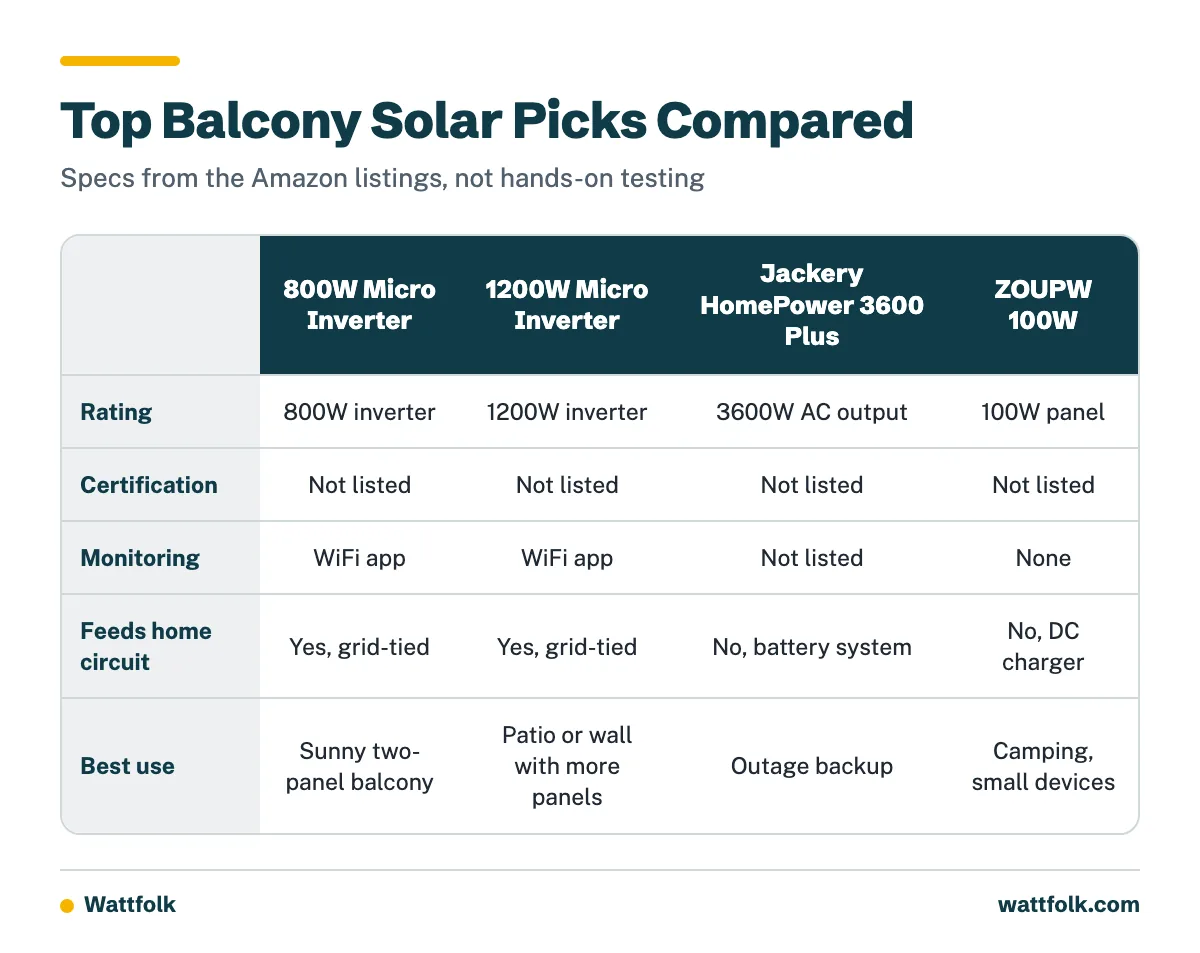
Fields marked "Not listed" are absent from the Amazon listing data. Generation figures use the illustrative assumptions from the sizing example below, not measured results.
| Product | Panel Output | Inverter Rating | Mounting Included | Certification | Battery Support | Monitoring | Warranty | Est. Annual Generation | Best Use |
|---|---|---|---|---|---|---|---|---|---|
| 800W Micro Inverter | Not listed (panels separate) | 800W | Not listed | Not listed | Not listed | WiFi app | Not listed | About 840 kWh with 2x400W panels | Sunny two-panel balcony |
| 1200W Micro Inverter | Not listed (panels separate) | 1200W | Not listed | Not listed | Not listed | WiFi app | Not listed | About 1,260 kWh with 1,200W of panels | Patio or wall with room for more panels |
| Jackery HomePower 3600 Plus | 2x200W | 3600W AC output (battery system) | Not listed | Not listed | Built-in 3584Wh | Not listed | Not listed | Up to about 420 kWh before charging losses | Outage backup |
| ZOUPW 100W | 100W | None (DC charger) | Two kickstands | Not listed | Charges portable power stations | None | 12 months | About 110 kWh (DC) | Camping, small devices |
| Skoiuc String Lights | Not solar | Not applicable | Hang on rails, walls, fences | Not listed | Not applicable | App for lighting only | Not listed | Not applicable | Balcony ambience |
What Is Plug-In Balcony Solar?
Plug-in balcony solar is a small solar system that connects to a household outlet circuit instead of a roof-mounted installation. The panels send DC power to a microinverter, which converts it to AC and matches the grid. The power then runs your fridge, router and other loads first.
How Do Plug-In Balcony Solar Panels Work?
Panels produce DC power in sunlight, and the microinverter converts it to grid-synchronized AC. Anything your home is using at that moment is supplied by solar, which reduces what you draw from the grid. Inverters listed here advertise 96% conversion efficiency and 16-60V DC input.
Two MPPT inputs let two panels track their own power point, which helps if they get different light.
Can I Put Solar Panels on My Balcony?
Often yes, but permission comes from three places: the law where you live, your landlord or building, and your balcony’s structure. Some guidance prohibits attaching panels to wooden balconies, fences, gates or timber-clad structures. Panels must also stay clear of exit paths.
Is Plug-In Solar Legal Where I Live?
It depends on your country and state. In the US, states with specific balcony-solar laws commonly cap qualifying systems at 1,200 watts, require recognized safety certification and require shutoff during an outage. California, for example, also requires systems to be designed to offset the user’s own consumption. Connecticut residents have faced confusion, as covered in CT Mirror’s report on plug-in solar legality, so check local rules.
UK rules are separate from US state law. They involve planning and electrical requirements, which Which? explains in its plug-in solar guide. Do not assume a US-sold kit meets UK requirements, or the reverse.
Do I Need Landlord, HOA, Utility or Building Approval?
Assume yes until confirmed in writing. Renters should check the lease, and condo owners should check HOA or building rules. Some utilities require registration or notification. Approval delays are one of the most common complaints in owner feedback.
Is Balcony Solar Safe to Plug Into a Normal Outlet?
It can be, but only with a certified complete system. UL 3700 is a plug-in-solar safety standard that covers contact with energized parts, overload protection, reverse current and a specifically configured plug-and-receptacle system. The two inverter listings here do not state a certification, so confirm one before buying.
- Anti-islanding: the system must shut off during an outage to prevent grid backfeed.
- GFCI protection: outdoor receptacles generally require it under the National Electrical Code.
- Dedicated or lightly loaded outlet: current flowing both ways can overload a circuit shared with a heater or window air conditioner.
- No extension cords or power strips: they add heat and failure points.
- Energized plug pins: only use a plug-and-receptacle system designed to prevent exposed live pins.
How Much Electricity Can a Balcony Solar Kit Generate?
Output is lower than the nameplate wattage suggests, because shade, orientation and inverter losses all reduce it. The example below uses assumptions, not measurements: 4 peak sun hours per day, a 25% discount for shade and imperfect orientation, and the 96% efficiency stated in the inverter listings.
| System | Ideal Annual Output | After 25% Shade/Orientation | After 96% Inverter Efficiency |
|---|---|---|---|
| 400W | 584 kWh | 438 kWh | About 420 kWh |
| 800W | 1,168 kWh | 876 kWh | About 840 kWh |
The math is wattage x 4 hours x 365 days, then each discount applied in turn. At an illustrative $0.20 per kWh, 840 kWh is roughly $168 per year, and 420 kWh is roughly $84. Use your own sun hours and rate, and compare the result with the total cost of panels, mounts and the inverter. Savings shrink if most of your use happens at night with no battery.
Choosing Wattage, Inverter Capacity, Cable Length and Monitoring
Match panel wattage to the inverter and to your daytime load. A 1,200W inverter only helps if your balcony has space and sun for that much panel area. Check that the 16.4ft AC cable reaches a suitable outlet, and look for app monitoring so you can spot underperformance from shade.
How Should I Mount Panels Securely and Protect Them From Wind?
Use rated hardware anchored to structure that can hold the load, and never rely on loose hooks or zip ties alone. A loose panel can injure people below. Wind security is a recurring concern in owner reports for hanging and railing-mounted panels. Wall, easel-back and ground-level patio mounting can reduce wind exposure compared with hanging on a railing.
Can Balcony Solar Work With a Battery?
It can, but a plug-in inverter does not store power by itself. Without a battery, surplus daytime output is not saved for the evening. Battery pairing needs a compatible, approved configuration, so check the manufacturer’s guidance before connecting anything.
Can Plug-In Solar Work With a Tesla Powerwall?
Do not assume it can. A Powerwall is a rechargeable home battery designed to work with Tesla solar systems, as Tesla explains in its Powerwall guide. A plug-in kit may charge a compatible battery only through an approved AC-coupled or installer-supported design, not by connecting directly to the Powerwall.
Cost, Payback and When Rooftop Solar Is Better
Plug-in kits are portable, need little maintenance and avoid roof work. The 800W inverter listing is priced at $149.99, but panels and mounting are extra. Rooftop solar is the better choice if you own your roof, have high daytime and evening usage, or want a system sized for your whole home.
In-Depth Reviews

1. 800W Micro Inverter, 2 MPPT Grid Tie Solar Inverter – Best Overall
Our Verdict: The 800W rating fits a two-panel balcony and stays under the 1,200W cap used in California. It has the higher rating of the two inverters at 3.8 stars.
Based on the listing, it offers 96% efficiency, 16-60V DC input, a 22V start voltage and an IP67 enclosure with an operating range of -40℃ to 65℃. WiFi app monitoring shows generation and system status. The 16.4ft AC cable adds placement flexibility. The listing describes it as compatible with most solar panels, so panels are chosen separately. It does not state a certification, so verify that independently.
Why We Like It
- 800W output suits two panels and most apartment loads
- Dual MPPT tracking helps when panels get different light
- App monitoring makes shade problems visible
Pros & Cons
Pros
- IP67 waterproof and dustproof rating
- 96% rated efficiency
- Included 16.4ft AC cable
Cons
- No certification stated in the listing
- Panels and mounting not described as included
- 3.8-star rating shows mixed buyer feedback

2. 1200W Micro Inverter, 2 MPPT Grid Tie Solar Inverter – Best for Larger Arrays
Our Verdict: This is the choice if you have room for more panels, such as on a patio or wall, and your local rules allow up to 1,200W.
It shares the 800W model’s feature set: 96% efficiency, dual MPPT, IP67, WiFi app and a 16.4ft AC cable. The extra capacity only pays off with enough panel area and unshaded sun. On a shaded balcony it will often run well below its rating. The price on the listing is shown in GBP (129.37), so check the current USD price before ordering. Its 3.6-star rating is slightly lower than the 800W model.
Why We Like It
- 1200W headroom for larger panel arrays
- Same app monitoring and waterproof design as the 800W model
Pros & Cons
Pros
- Highest output of the inverters reviewed
- IP67 rating and wide temperature range
Cons
- May exceed limits or approvals in some buildings
- No certification stated in the listing
- Lower 3.6-star rating

3. Jackery HomePower 3600 Plus & 2x200W Solar Panels – Best for Backup Power
Our Verdict: This is a portable power station, not a grid-tied plug-in kit. Choose it if outage backup matters more than offsetting your daytime bill.
The listing cites 3584Wh capacity and 3600W AC output (7200W in parallel), with 120V and 240V in parallel. It is expandable to 21kWh per unit. It uses ceramic membrane battery cells, with 6,000 cycles and a 10-year lifespan claimed. Recharging takes about 2 hours via hybrid AC+DC, or about 4 hours via solar. Home backup pairs it with a manual transfer switch (MTS). The panels ship separately and may arrive in separate packages. The listing price displays in GBP and is garbled, so check the current price.
Why We Like It
- Large battery capacity for outage backup
- Four charging options, including solar
- 4.5-star buyer rating
Pros & Cons
Pros
- Stores solar power for night and outages
- Wheeled, luggage-style design
Cons
- Does not feed your outlet circuit like a microinverter kit
- Premium price
- Only 400W of panels included

4. ZOUPW 100W Portable Solar Panel – Best for Portability
Our Verdict: A good option for renters who cannot install anything permanent. It charges a portable power station or small devices, but it cannot feed your home circuit.
The listing cites 23.5% efficiency, IP67 protection, ETFE lamination, a weight of 9.48 lbs and a folded size of 24.13 x 21.06 x 1.77 in. It includes a 10ft 5-in-1 cable with several connectors for popular power stations. Built-in ports include one USB-C (PD 15V/3A) and two USB-A. Check your power station’s input limit, since charging speed depends on it. It carries a 12-month warranty and has the best buyer rating here at 4.6 stars.
Why We Like It
- Folds down and carries with a magnetic handle
- Direct USB charging without a power station
- Kickstands for angling toward the sun
Pros & Cons
Pros
- Lightweight and portable
- No wall installation or approval concerns
Cons
- 100W is small for offsetting a household bill
- Not grid-tied

5. Skoiuc Outdoor String Lights 25FT – Best Budget (Lighting)
Our Verdict: These are plug-in LED string lights, not solar. They suit a balcony where you want reliable evening light without depending on sun.
- Brand: Skoiuc
- Power Source: Corded Electric
- Light Source: LED
- Color: Warm White
- Usage: Outdoor
- Special Feature: Waterproof
The listing describes app and remote control, dimming, a timer and a waterproof design. They hang on railings, walls, fences or small pergolas. At $12.99 and 4.4 stars, they are the cheapest product here. They do not generate power, and they should use a GFCI-protected outlet, never your solar inverter’s circuit loaded beyond its limit.
Why We Like It
- Dimmable with timer scheduling
- 25ft length suits small balconies
Pros & Cons
Pros
- Very low price
- Works in limited sunlight
Cons
- Needs an outlet
- Does nothing to reduce your electricity bill
Pre-Purchase Legality and Safety Checklist
- Lease approval or written landlord permission
- HOA, condo or building rules on balcony attachments
- Local electrical law and utility registration requirements
- Recognized safety certification for the complete system
- GFCI protection on the outdoor outlet
- Outlet loading: no heater or window air conditioner on the same circuit
- Outage shutdown (anti-islanding) confirmed
- Wind security and clear exit paths
Decision Tree: Which Option Fits You?
- Renter: start with approval. If denied, choose the ZOUPW 100W for portable use.
- Shaded balcony: expect low output. Consider the ZOUPW or skip solar.
- Sunny south-facing balcony: choose the 800W inverter, or the 1200W if your space and local rules support it.
- Want backup power: choose the Jackery HomePower 3600 Plus.
- Considering a Powerwall: talk to an installer first. Do not connect a plug-in kit directly.
How to Hang Solar Lights on a Patio
Solar string lights are low-voltage lighting and a separate matter from a plug-in solar-PV installation. Use removable hooks, adhesive clips or cable ties on railings, never your PV wiring. Keep the small solar panel facing sun, and route the lights so they do not shade your main panels.
Apartment Balcony Sun Shade Ideas
Place shade on the side of the balcony away from your panels, and keep it from covering the panel face. Avoid large solid sails, which can create unsafe wind loads. Use rated ties or hooks, and keep exit paths clear.
What Do Owners Say?
Owners like
- Simple installation compared with rooftop solar
- Useful for renters or apartment residents who cannot install roof panels
- Low operating and maintenance demands
- App-based production monitoring on better-equipped systems
- Can reduce daytime grid consumption when the balcony receives direct sun
Common complaints
- Actual output falls sharply with shade, poor orientation, or balcony obstructions
- Mounting hardware and cable lengths may not suit every balcony
- Wind security is a recurring concern for hanging or railing-mounted panels
- Savings can be modest when electricity use is mainly at night and no battery is included
- Legal, landlord, utility, and building-rule uncertainty can delay installation
Summarised from owner reviews and long-term user reports; individual experiences vary.
Frequently Asked Questions
How do plug in balcony solar panels work?
Panels create DC power, a microinverter converts it to AC, and the power feeds household loads through a dedicated connection. Certified systems shut off during outages.
Is plug in solar legal?
It depends on location. Some US states have specific laws with caps such as 1,200W, while UK rules involve planning and electrical requirements. Check local rules and approvals first.
Can I put solar panels on my balcony?
Often, if local law, your landlord or building, and the balcony structure allow it. Wooden balconies and timber-clad structures may be restricted.
How to hang solar lights on patio?
Use removable hooks or clips on railings and keep the lights’ small panel in sun. Keep them separate from any solar-PV wiring.
What are apartment balcony sun shade ideas?
Shade the side away from panels, avoid large solid sails, and secure everything with rated hardware so wind loads stay safe.
Conclusion
For most apartments with a sunny balcony, the 800W Micro Inverter is the best starting point, since it fits a two-panel setup and stays under common caps. Choose the 1200W model only with space and approval for a larger array. The Jackery suits backup power, the ZOUPW suits portable use, and the Skoiuc lights are only for ambience. Verify certification, approvals and wind-secure mounting before you buy.
Sources
Affiliate Disclosure: As an Amazon Associate, we may earn commissions from qualifying purchases from Amazon.com. This comes at no extra cost to you and helps support our research.