
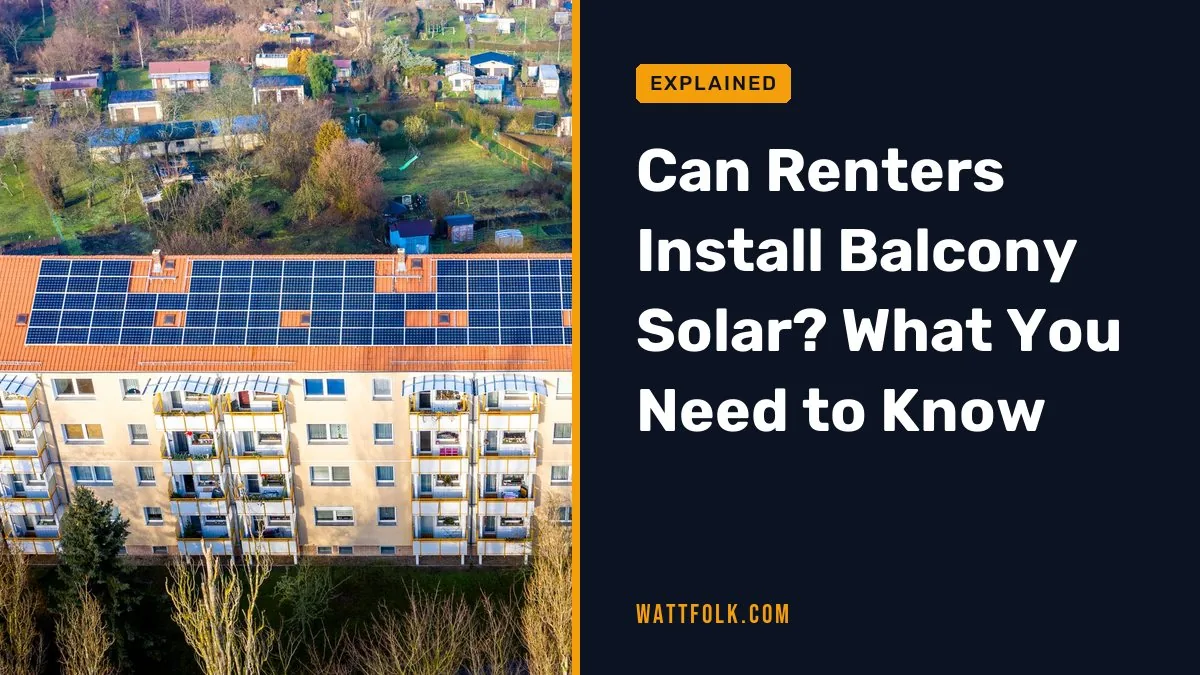
Renters in apartments and condos can often install balcony solar, but not automatically. You need written approval from your landlord or building manager, a certified system, and a mount that suits your railing. Permission from the utility to connect to the grid is a separate thing and does not let you attach anything to the building.
Quick answer
Often yes, if you get written landlord or building approval first and use certified equipment with a removable, non-drilling mount. State rules vary and are changing quickly, so check yours before buying.
- Best for strict buildings: off-grid panel plus battery, fewer electrical questions
- Best for bill savings: certified grid-tied plug-in kit, where local rules allow
- Landlord permission and utility permission are two different approvals. You need both for a grid-tied system.
- Plug-in solar rules vary by state and are changing quickly. Never assume your state allows it.
- A typical 400 to 800 watt kit costs roughly $500 to $1,500, and many renters will see payback in several years, not months.
- Use a certified microinverter, plug straight into a wall outlet, and never use an extension cord.
- Get weight, mounting, cable route, insurance, and removal terms in writing.
- Do I need my landlord’s written permission?
- Can an HOA or building ban balcony solar?
- Is plug-in balcony solar legal where I live?
- Off-grid vs. grid-connected plug-in solar
- Can I attach panels to a railing without drilling?
- Electrical, inverter, and fire-safety requirements
- How much electricity can a renter system produce?
- Cost and payback
- Renter approval checklist
- What must I do when I move out?
- What do owners say?
- Frequently Asked Questions
Do I need my landlord’s written permission to install balcony solar?
Yes, get it in writing. Your lease almost certainly limits changes to the building, and a panel hanging off a railing counts as a change, even if you never drill a hole.
Many guides blur two separate approvals. The utility or local authority decides whether you may connect to the grid. Your landlord decides whether you may attach equipment to the property. One does not grant the other. Landlord approval also does not prove your system meets electrical rules.
A verbal “sure, go ahead” will not protect you if a new manager asks you to remove it. A short signed addendum will. The landlord permission checklist for plug-in solar is a useful starting point for what to ask for.
Can an HOA, condo board, or apartment building ban balcony solar?
Yes, in many cases they can. Condo boards and HOAs often control anything visible from outside or attached to common elements, and balcony railings are usually common elements even when you own the unit.
Read your lease, bylaws, and house rules for words like “alterations,” “exterior,” “railings,” and “fire safety.” Buyers frequently report being told to remove panels after purchase, so ask before you pay. If the board refuses, a freestanding panel that sits on the balcony floor, or an indoor-use portable setup, may be a quieter option. Even that may need approval if the panel is visible.
Is a plug-in balcony solar system legal where I live?
It depends on your state, and the rules are changing quickly. Some places have passed or are considering laws for plug-in solar. Others have no clear rule, which can leave the question to the utility.
Do not assume your state allows it because a retailer sells it. Check with your state energy office and your utility, and ask whether they require notice, a specific inverter listing, or an interconnection agreement. For one state’s approach, see this guide to California SB 868 plug-in solar for renters and homeowners, and confirm current details with official sources.
Some systems are described as allowed up to 1,200 watts in certain jurisdictions, while the common small-kit range is 400 to 800 watts, according to Solar.com’s balcony solar guide. Your local limit may be lower, or the practice may not be addressed at all.
What is the difference between off-grid balcony solar and grid-connected plug-in solar?
Off-grid systems charge a battery or power station and never touch your home wiring. Grid-connected plug-in systems use a microinverter that feeds power into a wall outlet, so your home uses that power first.
| Option | Permission needed | Complexity | Portability | Likely use |
|---|---|---|---|---|
| Off-grid panel + battery | Landlord or building (if attached or visible) | Low | High | Charging devices, lights, small appliances |
| Grid-tied plug-in | Landlord plus utility or state rules | Medium | Medium | Cutting daily bills |
| Permanently wired | Landlord, utility, permit, licensed electrician | High | Low | Homeowners, long-term installs |
If your building or state is unclear or strict, start with off-grid. If approval and local rules are clear, choose a certified grid-tied kit. If you want hard-wiring or a new circuit, hire a licensed electrician.

Can I attach panels to a balcony railing without drilling?
Often yes. Clamp-style and bracket mounts that grip a railing or parapet need no holes and come off cleanly, which is why non-penetrating, removable mounts are generally preferred for rentals. But a mount that fits is not the same as a railing that can carry the load.
How do I know whether my balcony and railing can support the panels and mounting hardware?
Measure and weigh before you buy. Find the panel weight on the datasheet and add the mount. Then check:
- Railing material: Solid metal or masonry parapets are usually better than thin tube or glass railings. Buyers report some panels and hardware are too heavy for glass or lightweight rails.
- Railing size: Match the clamp to the rail’s width and shape.
- Wind exposure: A panel works like a sail. Higher floors and corner units see more wind.
- Secondary tie-off: Add a strap or cable to a solid anchor point so a failed clamp cannot drop a panel.
If the manufacturer or landlord cannot confirm the rail rating, ask a structural professional. Improvised mounts raise real concerns about wind, falling equipment, and balcony damage.
What electrical, inverter, grounding, and fire-safety requirements apply?
Use a certified inverter, protect the circuit, and keep the cabling tidy and out of exit paths. Uncertified inverters and irregular wiring are named as major hazards in the sources behind this article, including Solar.com’s guide.
- Certified microinverter: Look for a recognized safety listing that your local rules accept. The inverter must shut off when the grid goes down. Never bypass that shut-off.
- Plug directly into a wall outlet. Never use an extension cord or power strip.
- Grounding and circuit protection: Confirm the outlet is grounded and on a working breaker. Test GFCI outlets as the manufacturer directs.
- Cable routing: Keep cables off walking paths, away from sharp edges, and protected from water. Do not run cables through windows or doors in a way that stops them closing.
- Fire code: Do not block exits, sprinklers, or balcony egress. Ask building management about any rule on balcony objects.
A licensed electrician is needed if the outlet is ungrounded, the wiring looks old or damaged, you want a new outlet, or you want anything hard-wired. Do not guess.
How much electricity can a renter-sized balcony system produce?
Most renter systems make about 1 to 3.5 kWh per day, depending on size, sun, shade, and direction. The formula is simple: watts × peak sun hours × (1 − losses) ÷ 1,000 = kWh per day.
Here is a worked example. The assumptions are 4 peak sun hours and 25% system losses, which cover shading, a less-than-ideal tilt and orientation, wiring, and inverter loss. Change these to match your balcony.
| Array size | Daily output | Monthly (30 days) |
|---|---|---|
| 400 W | 400 × 4 × 0.75 = 1.2 kWh | 36 kWh |
| 600 W | 600 × 4 × 0.75 = 1.8 kWh | 54 kWh |
| 800 W | 800 × 4 × 0.75 = 2.4 kWh | 72 kWh |
A north-facing or heavily shaded balcony can do far worse. Buyers frequently report that real production falls well below advertised numbers in cloudy, shaded, or poorly oriented spots. Also check the inverter’s output limit, since it caps what the panels can deliver.
How much does a 400- to 800-watt balcony solar system cost, and how long might payback take?
Reported equipment costs run about $500 to $1,500. A representative breakdown is $300 to $600 for panels, $200 to $500 for a microinverter, $50 to $200 for mounting, and $50 to $150 for cables or monitoring. Optional modular battery storage can add roughly $800 to $1,500. One published estimate puts savings at about $15 to $50 per month, depending on location and utility rates.
The scenarios below show how widely payback can swing. They assume you use all the power as it is made and get no credit for exports, and they exclude batteries.
| Scenario | Assumptions | Monthly savings | System cost | Payback |
|---|---|---|---|---|
| Low | 400 W, 3.5 sun hrs, 30% losses, $0.15/kWh | about $4.40 | $500 | about 9.4 years |
| Mid | 600 W, 4 sun hrs, 25% losses, $0.20/kWh | about $10.80 | $900 | about 6.9 years |
| High | 800 W, 5 sun hrs, 15% losses, $0.30/kWh | about $30.60 | $1,500 | about 4.1 years |
The published $15 to $50 range sits toward the upper end of these results, so it needs strong sun and high rates. Your own utility bill shows your price per kWh. Redo the math with it.

What should I put in a renter approval package?
Give your landlord a one-page request that answers their worries before they ask. Few guides offer this, and it often decides the outcome. Include:
- Product certification: Inverter and panel listings, plus datasheets.
- Weights: Panel weight and total mount weight.
- Railing details: Material, dimensions, and the mount’s rated fit.
- Wind plan: Panel position and secondary tie-off.
- Cable route: Where cables run and which outlet you use.
- Circuit details: Outlet type, grounding, and breaker, checked by an electrician if unsure.
- Insurance: Your renter’s policy details, and a note that you accept liability for damage.
- Removal and restoration: You will remove everything at move-out and repair any marks.
The landlord permission checklist lists similar items. Keep a signed copy.
What must I do when I move out?
Remove the system, restore the balcony, and take it with you. A removable kit is the main advantage of balcony solar for renters.
- Unplug the inverter and disconnect the panels.
- Remove the mounts, straps, and cable clips.
- Clean any marks and fix any damage.
- Photograph the balcony and have your landlord sign off, as agreed in your addendum.
Many utilities and rules tie an interconnection to an address. If you notified a utility, tell them you are moving the system.
What do owners say?
Owners like
- Removable systems avoid permanent roof work and suit renters.
- Plug-and-play designs are simpler to set up than conventional rooftop solar.
- Compact systems can charge small devices or pair with a battery for limited off-grid use.
Common complaints
- Actual production can be much lower than advertised in cloudy, shaded, or poorly oriented spots.
- Some users report inverter delivery, compatibility, or reliability problems.
- Panels and mounts may be too heavy for some glass or lightweight railings.
- Landlord, HOA, or building rules can force removal after purchase.
- Improvised or unsuitable mounting raises concerns about wind, falling equipment, and balcony damage.
Summarised from owner reviews and long-term user reports; individual experiences vary.
Frequently Asked Questions
Can renters install balcony solar panels?
Often yes, with written approval from the landlord or building manager, certified equipment, and a removable mount. Rules differ by state and building, so confirm both before you buy.
Do I need my landlord’s written permission to install balcony solar?
Yes. Utility approval for grid connection does not give you the right to attach equipment to the building, and landlord approval does not prove electrical compliance.
Is a plug-in balcony solar system legal where I live?
It depends on your state, and the rules are changing quickly. Check with your state energy office and utility. Do not assume it is allowed because a kit is for sale.
Can I use an extension cord to connect my panels?
No. Plug a certified microinverter directly into a wall outlet. Extension cords and power strips add fire risk, and you should never bypass the inverter’s grid shut-off.
When do I need a licensed electrician?
Call one if your outlet is ungrounded, the wiring is old or damaged, you want a new outlet or circuit, or you plan any hard-wired connection.
Sources