

Affiliate disclosure: As an Amazon Associate, we earn from qualifying purchases. This comes at no extra cost to you.
The real Black Friday choice is between the power station with the biggest discount and the one sized for your loads, and the sized one wins. A big markdown means little if the unit can’t run the fridge overnight during the first outage. Size it to what you’ll actually run, buy only at or below its 90-day low, and use a transfer switch for anything wired into the house. Power stations often drop 30 to 50 percent off list on Black Friday, so the right model at a fair price is realistic.
This page covers solar generators (a battery power station plus solar panels), larger home backup units, and two energy monitors that show what your appliances really draw. It is built for US homeowners, renters and campers.
Last checked: November 2026
Quick answer
Most households should pick a 2 kWh LiFePO4 station: it runs a fridge, router and lights overnight. Buy at or below the 90-day low, and ignore the percent-off badge.
- Best overall: EcoFlow DELTA 2 Max, 2,048Wh and expandable.
- Best solar kit: EcoFlow DELTA 3 with 220W panel, everything in one order.
- Best circuit backup: Jackery HomePower 3600 Plus, 240V in parallel.
- Measure first: Kasa energy-monitoring smart plug, renter friendly.
Our Winner: EcoFlow DELTA 2 Max Portable Power Station
The DELTA 2 Max is the best fit for most outage plans. It has 2,048Wh of LiFePO4 capacity (LiFePO4, or LFP, is a long-life, heat-stable lithium chemistry) and 2,400W of continuous output. It accepts up to 1,000W of solar input, and you can expand it to 6kWh with extra batteries. The worked example below shows why 2kWh is the useful threshold: it carries a fridge, Wi-Fi router and lights through a night with capacity left over, which a 1kWh unit cannot. Power stations in this class are among the most heavily discounted items of the season, so a good price is realistic.
Black Friday 2026 Dates at a Glance
Black Friday 2026 falls on November 27 and Cyber Monday on November 30, according to Amazon’s Black Friday FAQ. Amazon has not announced its 2026 start date.
| Event | Date | What to expect |
|---|---|---|
| Early Black Friday deals | Not yet announced; usually the week before Thanksgiving | Last year, Amazon’s Black Friday Week ran November 20 to December 1. Start tracking prices now. |
| Thanksgiving | November 26 | Many brand deals are already live by this point. |
| Black Friday | November 27 | Peak discounts on many power stations and bundles. |
| Cyber Monday | November 30 | Some deals repeat or improve. Popular sizes can sell out. |
| December holiday sales | Through December | Some deals continue or return after Cyber Monday. |
How to Tell a Real Deal From a Fake One
A deal is real when today’s price is at or below the lowest price of the past 90 days. The size of the percent-off badge does not tell you that. Use these checks before you click Buy.
How can I tell if a power station deal is real?
- Pull the 90-day price history. Free tools such as Keepa and camelcamelcamel chart an Amazon product’s price over time. A sale price that matches a price from three weeks ago is not a Black Friday deal.
- Compare against the all-time low, not the list price. Power stations often sell well below list for most of the year. The all-time low is the number to beat.
- Ignore the percent-off badge. The badge measures the discount from a reference price, not from what people actually paid last month.
- Watch for prices raised before the sale. If the price history shows a jump in October or early November, the Black Friday discount may only undo that increase.
- Understand Amazon’s List Price label. For non-seasonal items, Amazon only shows a List Price when the item sold at or above that price in the past 90 days. That rule helps, but a list price can still be far above what the item usually sells for.
- Buy from the brand or Amazon. Check that the seller is the manufacturer’s store or Amazon itself. Warranty support is simpler that way.
- Confirm it is the current model. Older generations and renamed bundles often carry the biggest badges. Match the exact model name, capacity in watt-hours, and what is in the box.
What Size Power Station Do You Need?
Size by two numbers: watts for what can run at once, and watt-hours for how long it can run. Watts (W) measure power at a moment. Watt-hours (Wh) measure stored energy. One watt-hour is one watt running for one hour.
A station’s continuous output (the watts it can supply nonstop) must exceed the combined running watts of everything plugged in. It also needs surge capacity (a brief burst of extra power) for motors such as fridge compressors and pumps, which pull several times their running watts for a second or two at startup. Capacity in watt-hours decides runtime.
Use this formula:
Runtime (hours) = capacity in Wh x 0.85 / load in watts
The 0.85 is an assumption that covers inverter losses. The inverter converts battery power to household AC, and it wastes some energy as heat. Real efficiency varies by model and load, so treat the result as an estimate.
Typical Backup Loads
These are typical ranges for common US appliances. Your own appliances may differ, which is why the next section recommends measuring them.
| Appliance | Typical running watts | Notes |
|---|---|---|
| Refrigerator (full size) | 100 to 250W while the compressor runs | Cycles on and off. Startup surge is several times higher. |
| Wi-Fi router and modem | 10 to 20W | Runs around the clock. |
| CPAP machine | 30 to 60W | A heated humidifier adds a lot. Check your machine’s power supply label. |
| LED light bulb | 8 to 12W each | Cheap to run for hours. |
| Laptop | 50 to 100W while charging | Use USB-C where you can, which skips inverter losses. |
| Sump pump (1/3 to 1/2 hp) | About 800 to 1,000W | Large startup surge. Runs in bursts during storms. |
| Window air conditioner | 500 to 1,200W | Drains a 2kWh unit in a few hours. |
Worked Example: A 2 kWh Unit Overnight
Assume a 2,048Wh station, such as the DELTA 2 Max, running these loads through a 12-hour night:
- Fridge: 150W while running. Assume the compressor runs about 40 percent of the time, which gives an average of 60W. Over 12 hours: 60 x 12 = 720Wh.
- Router: 15W x 12 hours = 180Wh.
- Lights: four 10W LED bulbs for 5 evening hours = 40 x 5 = 200Wh.
- Total needed: 720 + 180 + 200 = 1,100Wh.
- Usable capacity: 2,048 x 0.85 = about 1,741Wh.
The night uses 1,100Wh, which leaves roughly 640Wh for the morning. With the lights off, the fridge and router together average 75W, so runtime is 1,741 / 75 = about 23 hours.
Run the same loads on a 1,024Wh unit such as the DELTA 3. Usable capacity is 1,024 x 0.85 = about 870Wh, which falls short of the 1,100Wh needed. The fridge and router alone would last 870 / 75 = about 11.6 hours. That is the decision rule: if keeping the fridge going overnight is the goal, buy 2kWh or more, or plan to add solar or an extra battery.
How long does solar recharging take?
Expect a single 200W panel to replace roughly 675Wh on a typical day, not the full 200W every hour the sun is up. Use this formula:
Daily solar energy (Wh) = panel watts x peak sun hours x 0.75
Peak sun hours are the equivalent number of hours of full-strength midday sun your location gets. Across the US this runs from roughly 3 hours in cloudy northern winters to 6 or more in the sunny Southwest. The 0.75 is an assumption for real-world losses from heat, panel angle, dust, wiring and charge conversion.
Worked example: 200W panel x 4.5 peak sun hours x 0.75 = 675Wh per day. That refills a 1,056Wh Anker SOLIX C1000 from empty in about 1.6 days (1,056 / 675). A 2,048Wh station would take about 3 days. Manufacturer figures, such as EcoFlow’s rating of 5.8 hours for the DELTA 3 with one 220W panel, assume strong, steady sun. Use them as a best case.
Wall recharge cost: refilling a 2,048Wh battery from empty draws about 2,048 / 0.85 = 2.41kWh from the wall, allowing for charging losses. At the US average residential price near 17 cents per kWh reported by the U.S. Energy Information Administration’s Electric Power Monthly, that is about 41 cents. At state averages from roughly 12 to 40 cents, it ranges from about 29 cents to 96 cents.
Measure Before You Buy: Why an Energy Monitor Belongs on This List
An energy monitor shows what your fridge, freezer or sump pump actually draws, so you can buy the right size of backup instead of guessing from a chart. An older fridge in a hot garage can use far more than the typical range above. A newer one may use less, which could mean a smaller, cheaper station is enough.
There are two types:
- Plug-in monitors, such as an energy-monitoring smart plug, sit between the outlet and the appliance. They are renter friendly and take seconds to set up. Leave a plug on your fridge for a full week to capture a realistic daily kWh figure.
- Whole-home monitors, such as the Emporia Vue 3, clamp sensors around the wires inside your electrical panel. They see hardwired and 240V loads that a plug can’t. Installation means working inside a live panel, so hire a licensed electrician unless you are qualified to do it yourself.
Plug-in monitors report running watts and energy use over time. They may not catch the brief startup surge, so leave headroom on the station’s surge rating.
How We Compared These Models
We weighed four things that decide whether a power station deal is good value: usable capacity in watt-hours, continuous and surge output, recharge speed from the wall and from solar, and battery chemistry and cycle life. For the two monitors, we weighed installation type and what they can measure. These picks are based on manufacturer specifications and verified past-sale data.
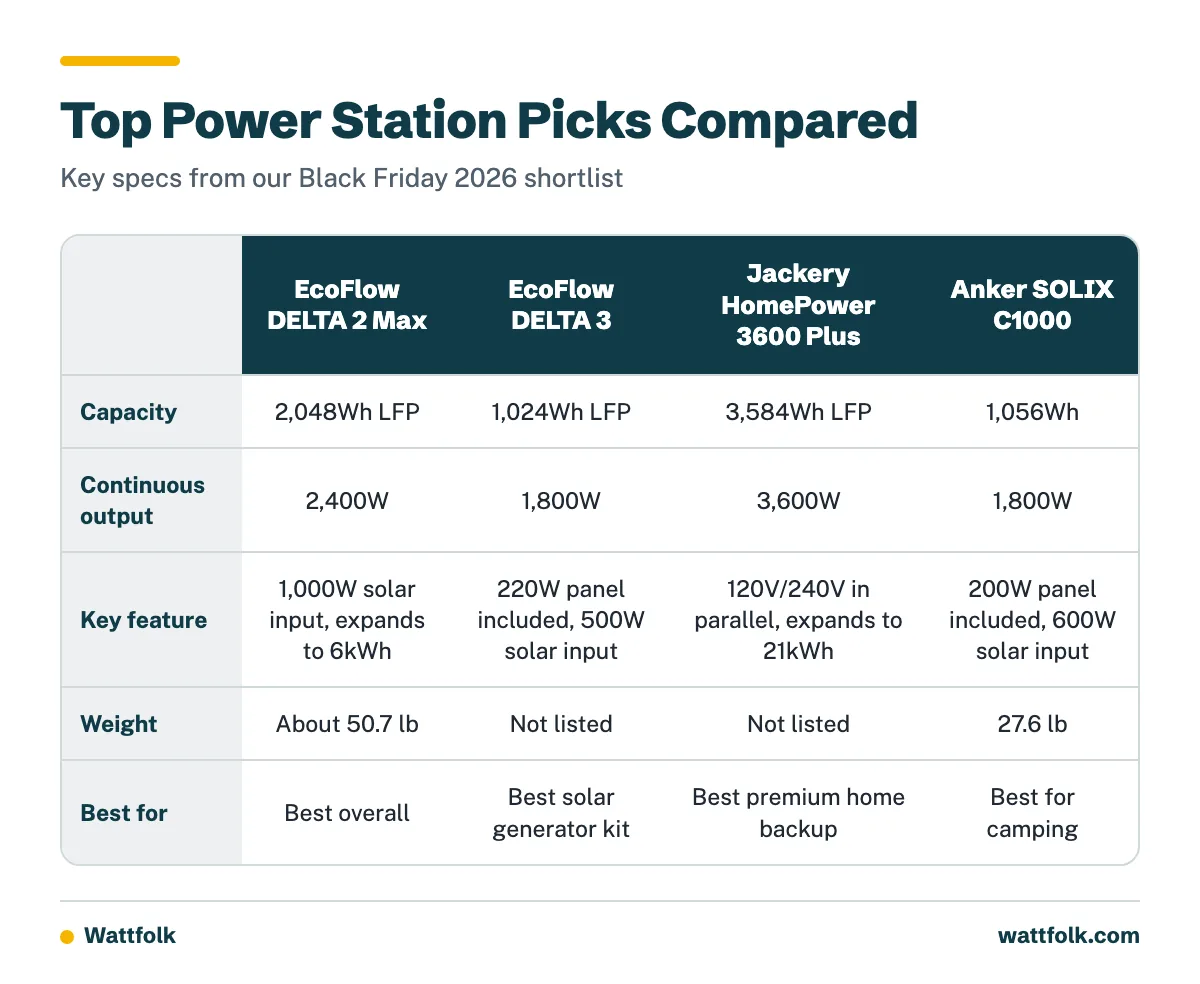
| Product | Key Specs | Our Choice | Action |
|---|---|---|---|
| EcoFlow DELTA 2 Max | 2,048Wh LFP, 2,400W (3,400W X-Boost), 1,000W solar input, expands to 6kWh | Best Overall | |
| EcoFlow DELTA 3 with 220W Bifacial Panel | 1,024Wh LFP, 1,800W, 500W solar input, panel included | Best Solar Generator Kit | |
| Jackery HomePower 3600 Plus | 3,584Wh LFP, 3,600W, 120V/240V in parallel, expands to 21kWh | Best Premium Home Backup | |
| Jackery Explorer 2000 v2 | 2,042Wh LFP, 2,200W, 39.5 lb, 20ms UPS switching | Best for Quiet UPS Backup | |
| Anker SOLIX C1000 with 200W Bifacial Panel | 1,056Wh, 1,800W (2,400W SurgePad), 600W solar input, 27.6 lb | Best for Camping | |
| Emporia Vue 3 Home Energy Monitor | Panel-mounted, UL listed, accuracy within 2 percent, up to 16 branch sensors | Best Whole-Home Monitor | |
| Kasa Matter Smart Plug with Energy Monitoring | 15A/1,800W max, 120V, Matter compatible | Best Renter-Friendly Monitor |
In-Depth Reviews

1. EcoFlow DELTA 2 Max – Best Overall
Our Verdict: Buy this if you want one station that keeps a fridge, router and lights running overnight and can grow later. Skip it if you need 240V for a well pump or dryer, or if you will carry it often. Based on the listed 23 kg, it weighs about 50.7 lb.
- Brand: EF ECOFLOW
- Capacity: 2,048 watt-hours
- Output Wattage: 3,400 watts (X-Boost); 2,400W continuous per the feature list
- Voltage: 120 volts
- Weight: 23 kg (about 50.7 lb)
- Included Components: AC charging cable, DELTA 2 Max power station
The 2,400W continuous rating covers a fridge, a microwave and electronics at the same time. The 3,400W figure comes from X-Boost, which lowers the voltage so heating appliances such as kettles run at reduced power. It does not help motor loads like pumps start. The 1,000W solar input is the highest among the portable units here. Five 200W panels in 4.5 peak sun hours could return about 1,000 x 4.5 x 0.75 = 3,375Wh in a day, more than a full refill. No panel is included, so budget for one separately.
Why It Made the List
- 2kWh is the capacity that passed the overnight fridge example with room to spare.
- Expands from 2kWh to 6kWh with up to two extra batteries.
- LFP battery rated by EcoFlow for 3,000 cycles to 80 percent capacity.
- 15 outlets, and charging as quiet as 30 dB according to EcoFlow.
Pros & Cons
Pros
- Large usable capacity for the size class
- 1,000W solar input for fast off-grid refills
- 80 percent charge in 43 minutes using solar and AC together, per EcoFlow
- App control and automations
Cons
- About 50 lb, which is heavy to carry upstairs
- No solar panel in the box
- 120V only, so no 240V appliances
- Lower rated cycle life than the DELTA 3 and HomePower 3600 Plus
Black Friday buying tip: There is no verified record of this model’s past Black Friday price, but Backup Power Hub’s price tracker shows it has sold at well under half its list price at its lowest. Use that tracked low, or at least its 90-day low, as your target, and treat a modest percent-off badge as no deal at all. Don’t buy it at any price if you need 240V circuits or a station you can carry one-handed.

2. EcoFlow DELTA 3 with 220W Bifacial Panel – Best Solar Generator Kit
Our Verdict: This is the pick if you want a true solar generator in one order: station, panel and the cable that connects them. It suits apartments, RV trips and short outages. Skip it if your main goal is a full night of fridge backup with lights, because the sizing example shows 1kWh falls short.
- Brand: EF ECOFLOW
- Output Wattage: 1,800 watts
- Dimensions: 15.7 x 8 x 11.2 inches (L x W x H)
- Included Components: DELTA 3, 220W bifacial solar panel, AC charging cable, manuals and warranty card
- Recommended Uses: Camping, residential
- Color: Black and gray
The Amazon listing shows capacity as 1024 KW, which is an error. The product title and feature list state 1,024Wh. That runs a 75W fridge-and-router load for about 11.6 hours by the formula above, or a 45W CPAP for about 1,024 x 0.85 / 45 = 19 hours, which covers two nights. The panel is bifacial, meaning it also collects light reflected onto its back. EcoFlow rates it at 25 percent conversion efficiency. By the solar formula, it returns about 742Wh on a 4.5 peak-sun-hour day (220 x 4.5 x 0.75).
Why It Made the List
- Only bundle here with a station of at least 1,800W plus a panel in the box.
- LFP cells rated by EcoFlow to keep 80 percent capacity after 4,000 cycles.
- Full AC charge in 56 minutes, or 80 percent in 30 minutes, per EcoFlow.
- Expands to 5kWh with DELTA 3, DELTA Pro 3 or DELTA 2 Max batteries.
Pros & Cons
Pros
- Complete solar setup, with an MC4 to XT60i cable included
- Highest rated cycle life of the EcoFlow units here
- IP65 battery pack resists splashes and dust
- 13 outputs
Cons
- About 1kWh, so it can’t carry a fridge through a long night
- 500W solar input caps how many panels help
- Station and panel ship separately
Black Friday buying tip: There is no verified record of past Black Friday pricing for this bundle, so judge it by its own 90-day price history. Also compare the bundle against the station alone plus a separate panel, because bundle discounts are sometimes smaller than they look. Don’t buy it at any price if you need overnight fridge backup without sun the next day. The DELTA 2 Max is the better fit for that.

3. Jackery HomePower 3600 Plus – Best Premium Home Backup
Our Verdict: Choose this if you own your home and want to back up actual circuits, including 240V loads such as a well pump or dryer, through a properly installed transfer switch. Skip it if you rent, only need to keep a fridge cold, or can’t budget for an electrician.
The Amazon listing provides no structured specifications for this unit. The figures below come from Jackery’s feature text.
It has 3,584Wh of LFP capacity and 3,600W of output, or 7,200W with two units in parallel. Running in parallel also supplies 120V and 240V. Capacity expands to 21kWh per unit, or 43kWh across multiple units. Usable energy is about 3,584 x 0.85 = 3,046Wh. That runs the overnight fridge, router and lights load from the example (1,100Wh) for roughly 2.7 nights. It could also run a 900W sump pump for about 3.4 hours of actual pumping time. Jackery rates it for 6,000 cycles and operation down to -4°F. Wheels and a telescopic handle help, since a 3.6kWh battery is not light.
Why It Made the List
- The only unit here that reaches 240V (with two units in parallel) for whole-home style backup.
- Designed to pair with Jackery’s manual transfer switch (MTS) for circuit-level backup.
- Four charging methods: hybrid AC and DC in 2 hours, AC in 2.5 hours, solar in 4 hours, or a gas generator in 2.5 hours, per Jackery.
- Highest rated cycle count in this guide.
Pros & Cons
Pros
- Large capacity with a path to 21kWh or more
- Battery cells rated for heat up to 302°F and use in -4°F cold
- Rolling, luggage-style design
Cons
- Circuit backup needs a transfer switch and, in practice, a licensed electrician, despite the plug-and-play marketing
- 240V requires buying two units
- Weight is not listed, so check before buying if you plan to move it often
Black Friday buying tip: On last year’s Black Friday, this model sold at about half its list price, according to Bob Vila’s Black Friday generator deal coverage. At this price level, wait for something close to half off list or a new 90-day low unless storm season forces your hand. Don’t buy it at any price if you rent or can’t install a transfer switch, because most of its value comes from circuit-level backup.
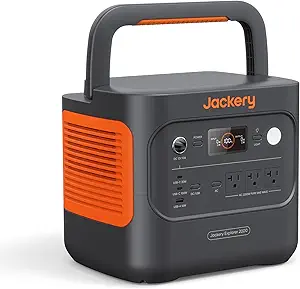
4. Jackery Explorer 2000 v2 – Best for Quiet UPS Backup
Our Verdict: This suits a bedroom or home office where noise matters and you want devices to stay on automatically when the grid drops. Think CPAP, modem and work laptop. Skip it if you need lots of AC outlets or want a solar panel in the box.
- Brand: Jackery
- Output Wattage: 2,200 watts
- Voltage: 120V AC
- Weight: 39.5 pounds
- Included Components: AC charging cable, Explorer 2000 v2
- Recommended Uses: Camping, commercial, residential
At 2,042Wh, it matches the DELTA 2 Max on capacity while weighing about 11 lb less. UPS stands for uninterruptible power supply: devices stay plugged into the station while it is plugged into the wall, and it takes over when power fails. Jackery lists 20ms switching and UL1778 test certification for UPS systems. Test your own CPAP or computer through a pretend outage before you rely on it. Jackery also rates Silent Charging Mode at under 30dB.
Why It Made the List
- 2kWh capacity at 39.5 lb, which Jackery says is 41 percent lighter than typical 2kWh LFP units
- 0 to 80 percent in 66 minutes on AC, per Jackery
- LFP battery with a 10-year rated life
- USB-C PD 100W port for laptops without inverter losses
Pros & Cons
Pros
- Light for its capacity
- UPS-style automatic switchover
- Quiet charging mode for bedrooms
Cons
- Only 3 AC outlets
- No panel included, and Jackery’s solar time assumes 400W of panels
- No stated expansion battery option in this listing
Black Friday buying tip: There is no verified record of this model’s past Black Friday price, but Backup Power Hub’s price tracker shows it has sold at well under half its list price at its lowest. A Black Friday price well short of that may be beaten later, so be patient unless you need it before winter storms. Don’t buy it at any price if you need to power more than three AC devices at once or want a solar-ready kit out of the box.

5. Anker SOLIX C1000 with 200W Bifacial Panel – Best for Camping
Our Verdict: Campers and van travelers get the most from this kit. It is the lightest station with a panel in this guide, and it has the fastest rated solar refill. Skip it if your priority is overnight home backup for a fridge. Its 1,056Wh falls in the same short range as the DELTA 3.
- Brand: Anker
- Output Wattage: 1,800 watts
- Weight: 27.6 pounds
- Included Components: Anker SOLIX C1000 power station, 200W bifacial solar panel
- Recommended Uses: Camping
- Color: Dark gray
Anker rates solar input at up to 600W, with a full refill in 1.8 hours at that rate. The included panel is 200W, so in practice expect about 675Wh per sunny day using the formula above. You would need three such panels to approach Anker’s figure. SurgePad, Anker’s term for its high-surge mode, delivers 2,400W. At camp, the station runs a 50W 12V fridge for about 1,056 x 0.85 / 50 = 18 hours, assuming the fridge draws that much continuously. Anker says the PS200 panel weighs 11 lb with its stand and carries an IP68 rating against rain, mud and dust.
Why It Made the List
- 100 percent AC recharge in 58 minutes using UltraFast mode in the Anker app, per Anker
- 11 ports
- Panel included, with an aluminum frame and a scratch-resistant surface
Pros & Cons
Pros
- Lightest station in this guide
- 600W solar input leaves room for more panels
- Rugged, waterproof panel
Cons
- About 1kWh limits home backup runtime
- Fastest AC charging requires the app
- Station and panel arrive in separate packages
Black Friday buying tip: There is no verified record of past Black Friday pricing for the C1000 or this exact panel bundle. Judge the bundle by its 90-day history and by pricing the station and panel separately. Don’t buy it at any price as your only fridge backup for multi-day outages.

6. Emporia Vue 3 Home Energy Monitor – Best Whole-Home Monitor
Our Verdict: Homeowners planning circuit-level backup, especially with a unit like the HomePower 3600 Plus, should install this first. It shows what each circuit really uses, which tells you which circuits belong on a transfer switch. Renters and anyone without panel access should skip it.
- Manufacturer: Emporia Corp.
- Type: Whole home monitor
- Certification: CE, UL
- Dimensions: 10 x 5 x 5 inches
- Weight: 1.92 pounds
- Included Components: Energy monitor, current transformers, wire harness, Wi-Fi antenna assembly, wire nuts, splicing wires
The Vue 3 mounts inside your electrical panel and uses clamp-on sensors called current transformers, which measure current without cutting wires. Emporia states accuracy within 2 percent. It supports single-phase and split-phase homes, which covers most US houses. You can add up to sixteen 50A branch sensors, sold separately, to track your AC, furnace, water heater and range individually. A week of data on a well pump circuit tells you whether a 3.6kWh station covers it or whether you need expansion batteries.
Why It Made the List
- Sees hardwired and 240V loads that plug-in monitors can’t
- Also monitors solar and net metering, which helps if you add rooftop solar later
- UL listed for safety
Pros & Cons
Pros
- Whole-home picture in one app
- Expandable to 16 branch circuits
- Time-of-use automation settings in the app
Cons
- Panel installation; hire a licensed electrician unless you are qualified
- Requires 2.4 GHz Wi-Fi and an internet connection
- Branch sensors cost extra
- 1-year warranty
Black Friday buying tip: There is no verified record of past Black Friday pricing for this monitor, so buy at or below its 90-day low. Check whether a bundle with branch sensors beats buying them separately. Don’t buy it at any price if you rent or your home lacks 2.4 GHz Wi-Fi.

7. Kasa Matter Smart Plug with Energy Monitoring – Best Renter-Friendly Monitor
Our Verdict: This is the cheapest way to replace guesswork with real numbers before you spend on a power station. Plug your fridge into it for a week and you will know its true daily watt-hours. Skip it if the loads you care about are hardwired or 240V.
- Brand: Kasa Smart
- Current Rating: 15 A
- Operating Voltage: 120 volts
- Dimensions: 2.62 x 1.57 x 1.5 inches
- Connector Type: Plug in
- Material: Copper
The plug handles up to 15A or 1,800W, so it can measure a fridge, chest freezer, CPAP, router or plug-in sump pump. Here is how to use the reading. If the app shows your fridge used 1.4kWh in a day, it averaged about 1,400 / 24 = 58W. Plug that into the runtime formula to size your station. The compact design leaves the second outlet free. Matter support means it works with Apple Home, Alexa, Google Home and SmartThings, and it keeps working on your local network if the internet drops.
Why It Made the List
- Renter friendly, with no tools or panel access needed
- Tracks energy use over time, not just live watts
- UL certified flame-retardant design, with a 2-year limited warranty
Pros & Cons
Pros
- Fast setup in the Kasa or Tapo app
- Wide smart home compatibility
- Small enough to leave both outlets usable
Cons
- Can’t measure hardwired or 240V appliances
- Not for loads above 1,800W
- May not capture brief startup surges
- Check the listing for how many plugs are included
Black Friday buying tip: There is no verified record of past Black Friday pricing for this plug. Compare today’s price against its 90-day low, and compare the per-plug cost if multipacks are offered. Don’t buy it at any price if your key backup loads are a well pump, electric range or other hardwired equipment. The Emporia Vue 3 is the tool for those.
Home Backup Safety
A power station is safe by default when you plug devices directly into its outlets. Risk starts when you try to feed your home’s wiring.
Can a power station back up my house safely?
Yes, but only through a transfer switch or the manufacturer’s approved home-backup kit, installed by a licensed electrician. A transfer switch is a device mounted at your panel that disconnects selected circuits from the grid before connecting them to backup power.
- Never backfeed through an outlet. A cord with plugs on both ends, run from a station to a wall outlet, can energize the utility lines outside your home. That can injure line workers, damage equipment and start fires.
- Never run extension cords to house wiring. Run extension cords only from the station to individual appliances.
- Hire a licensed electrician for any transfer switch, inlet box or panel work. Many areas require a permit. Jackery’s manual transfer switch for the HomePower 3600 Plus still needs proper installation at your panel.
- Renters: stick to plugging appliances directly into the station. Panel changes need landlord permission and an electrician.
- Indoors vs gas: battery stations produce no exhaust, so they can be used indoors. Follow the maker’s ventilation and placement guidance. Gas generators must never run indoors or in a garage, because of carbon monoxide.
After Cyber Monday
Missing Black Friday rarely means missing the best price. Price trackers such as Backup Power Hub’s price tracker show some power stations reaching their lowest prices outside the Black Friday week, so a missed sale is not the end of good deals.
- December holiday sales and January clearance: keep a Keepa or camelcamelcamel price alert set at your target price.
- Prime Day in July: a second major window, and it lands before peak hurricane season.
- Prime Big Deal Days in October: useful for winter storm preparation.
- If you need it now: a storm forecast outweighs a few percent of savings. Buy the right size today, keep the box, and check the return window on your order page. Amazon usually extends returns on holiday purchases, but confirm the exact date on your order.
Frequently Asked Questions
When does Amazon Black Friday 2026 start?
Black Friday itself is November 27, 2026, and Cyber Monday is November 30, per Amazon’s FAQ. Amazon has not announced when early deals begin. Last year, its Black Friday Week ran from November 20 to December 1, so expect deals to start around the week before Thanksgiving.
Is a solar generator worth buying on Black Friday?
Usually, yes. Power stations see some of the largest discounts of the year, often 30 to 50 percent off list. A verified example: the Jackery HomePower 3600 Plus sold at about half its list price on last year’s Black Friday. The deal only pays off if the size fits your loads and the price is at or below the 90-day low.
What size power station do I need to run a fridge?
For overnight fridge backup, choose about 2,000Wh. A full-size fridge averaging 60W, plus a 15W router, uses about 900Wh over 12 hours. A 2,048Wh unit has about 1,741Wh usable at an assumed 85 percent efficiency. A 1kWh unit runs out after roughly 11 to 12 hours. Measure your own fridge with an energy-monitoring plug to confirm.
Can a power station power my house during an outage?
It can power selected circuits, but only through a transfer switch or the maker’s approved home-backup kit installed by a licensed electrician. Never backfeed through a wall outlet. Without that setup, plug appliances directly into the station. Running 240V loads or a large share of a house requires a high-capacity system such as the HomePower 3600 Plus with two units in parallel.
Do portable power stations qualify for a solar tax credit?
Generally, no. Portable power stations are not usually treated as qualifying home solar equipment, and federal residential clean energy credit rules have changed recently. Before counting on any credit, check current IRS guidance or ask a tax professional, especially if you are pairing storage with a permanent rooftop system.
Conclusion
For most US households, the EcoFlow DELTA 2 Max is the Black Friday buy. It has 2kWh of capacity that clears an overnight fridge, router and lights load, plus room to expand. Choose the EcoFlow DELTA 3 kit if you want a complete solar generator in one order and mostly run smaller loads. Choose the Anker SOLIX C1000 kit for camping. Homeowners backing up real circuits should look at the Jackery HomePower 3600 Plus, budget for a transfer switch and an electrician, and install an Emporia Vue 3 first. Everyone else can start with a Kasa energy-monitoring plug on the fridge.
Measure first, set a price alert at the 90-day low, and check today’s price against that number before you buy, not the badge.
Sources