

EV charging cost equals the kilowatt-hours (kWh) you put into the battery multiplied by your price per kWh, plus about 10% for energy lost while charging and any station fees. At the US average of about 17 cents per kWh, a 60 kWh charge at home costs roughly $11. The same charge at a DC fast charger often costs about three times as much. This guide shows you the formula, the real numbers for home and public charging, and a worksheet you can use with your own electric bill.
Quick answer
A full 60 kWh home charge costs about $8 to $27, depending on your state’s electricity price. Most of that range sits near $11. Charge at home whenever you can, and save DC fast charging for road trips.
- Best for daily driving: Level 2 home charging, which has the lowest cost per mile.
- Best for road trips: DC fast charging, which is quick but costs the most.
- Best for renters without a plug: Public AC (Level 2) charging at work or near home.
- Formula: kWh added ÷ 0.9 × price per kWh. Dividing by 0.9 covers about 10% charging loss.
- At 17 cents per kWh, a 60 kWh charge costs about $11.33 at home. The same energy costs about $34 at a fast charger priced at 51 cents.
- Use your car’s usable battery size, not the advertised (nominal) size.
- An EV that only fast charges can cost more to run than a gas car. Home charging is where the savings come from.
- The charger’s price and the installation price are two separate costs. Wiring and panel work often cost more than the charger itself.
- How much does EV charging cost for a full charge?
- How much does EV charging cost at home?
- What is the difference between home, public AC, and DC fast-charging costs?
- Does electric car charging cost more than gas?
- What do EV chargers cost to buy and install?
- How is an EV charging cost calculator used?
- What about EV charging costs in Malaysia and India?
- Frequently Asked Questions
How much does EV charging cost for a full charge?
A full charge costs your battery’s usable kWh, divided by 0.9, times your price per kWh. For a 60 kWh battery at 17 cents, that comes to about $11.33. The formula is simple. Most mistakes come from the inputs, so here is what each one means.
Part 1: Usable battery size, not nominal
Carmakers list two battery numbers. Nominal capacity is the total energy the pack can hold. Usable capacity is what the car actually lets you use. The car keeps a small buffer to protect the battery, so the usable number is a few kWh lower. Check your spec sheet and use the usable figure. Many cost articles skip this step, so their full-charge prices come out too high.
Part 2: Charging losses
Not all the power from the wall ends up in the battery. Some turns into heat in the charger, the cables and the battery’s cooling system. A common planning figure is about 10% loss. To cover it, divide the kWh you add by 0.9.
Part 3: Price per kWh, plus fees
At home, your price is on your electric bill. Public stations can add session fees, parking fees or idle fees. An idle fee is a charge for staying plugged in after the car is full.
Worked example
Formula: Cost = (kWh added ÷ 0.9) × price per kWh
60 kWh usable battery, charged from empty to full, at 17 cents per kWh:
60 ÷ 0.9 = 66.7 kWh from the wall
66.7 × $0.17 = $11.33
40 kWh usable battery, same price:
40 ÷ 0.9 = 44.4 kWh from the wall
44.4 × $0.17 = $7.56
A more realistic top-up: most drivers charge from about 20% to 80%. On the 60 kWh battery, that adds 36 kWh.
36 ÷ 0.9 = 40 kWh × $0.17 = $6.80
For context, 60 kWh at 12 to 19 cents works out to about $7 to $11 before losses. Once losses are added, the result lines up with the commonly quoted range of about $9 to $14 for a typical full home charge.
How much does EV charging cost at home?
Home charging usually costs between about $5 and $27 for a full charge. Where you fall in that range depends mostly on your state’s electricity price. According to the U.S. Energy Information Administration, average residential prices run from roughly 12 cents per kWh in the cheapest states to about 40 cents in the most expensive. The national average is near 17 cents. One recent report put the typical US residential rate at about 18.2 cents.
| Electricity price | 40 kWh battery (full) | 60 kWh battery (full) |
|---|---|---|
| 12¢/kWh (low-cost state) | $5.33 | $8.00 |
| 17¢/kWh (national average) | $7.56 | $11.33 |
| 40¢/kWh (high-cost state) | $17.78 | $26.67 |
All figures include a 10% charging loss (kWh ÷ 0.9 × price).
Time-of-use rates can cut the bill
Many US utilities offer time-of-use (TOU) plans. On these plans, power costs less at night and more in the late afternoon and evening. Most EVs and Level 2 chargers let you schedule charging, so the car can wait until the cheap hours start. Look up your utility’s off-peak price and use that number in the formula, not your average price.

For more examples by vehicle, see Kelley Blue Book’s breakdown of what it costs to charge an electric car.
What is the difference between home, public AC, and DC fast-charging costs?
Home charging is cheapest and DC fast charging is the most expensive. Public AC charging usually falls somewhere in between, and it is sometimes free. Industry benchmarks put DC fast charging at roughly three times the home rate. If you pay 17 cents at home, expect about 51 cents per kWh at a fast charger.
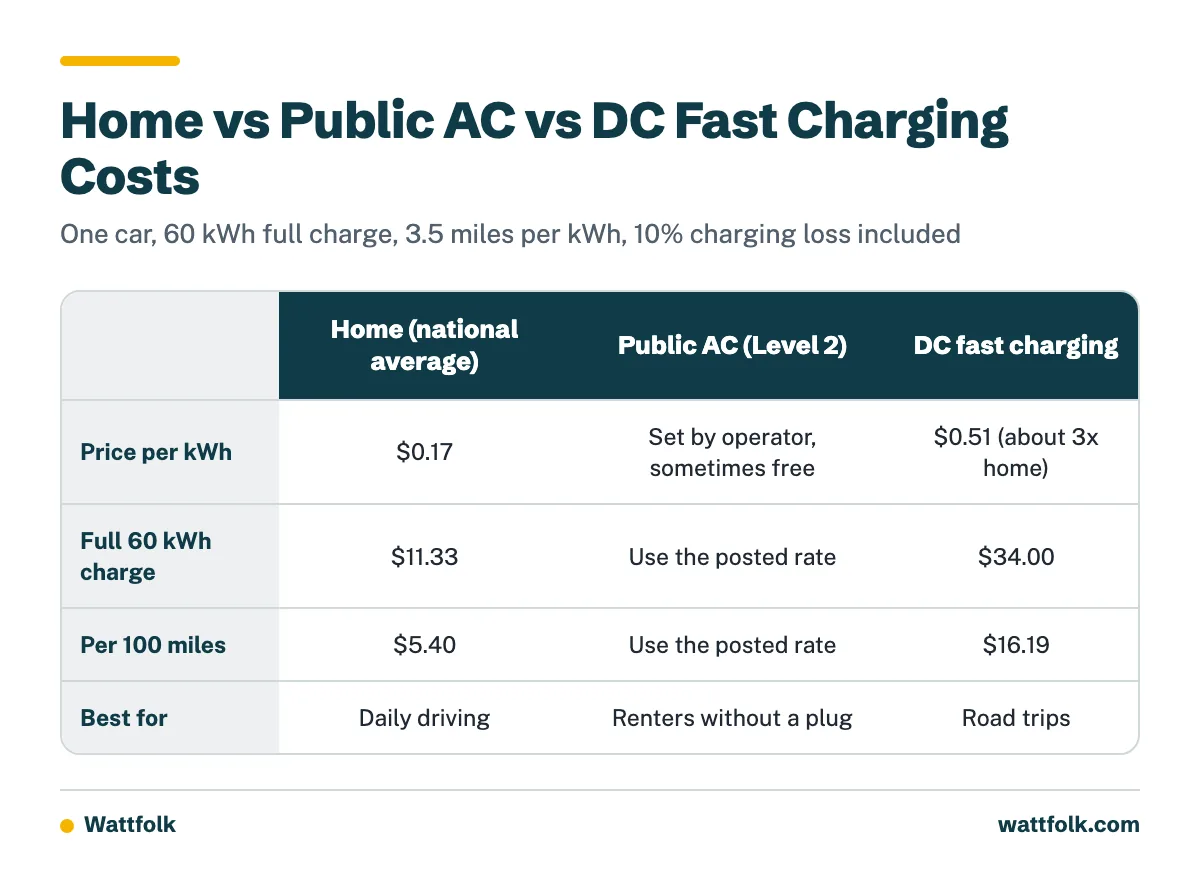
AC charging (Level 1 and Level 2) sends power to the car’s built-in charger. It is slower, and it is what you use at home. DC fast charging skips the car’s charger and feeds the battery directly. It can add hundreds of miles in under an hour, and you pay extra for that speed.
The table compares one car across all options. The assumptions are a 60 kWh full charge, an efficiency of 3.5 miles per kWh (about 5.67 km per kWh, a figure used in published running-cost examples), and a 10% charging loss. That works out to 31.7 kWh from the wall per 100 miles.
| Where you charge | Price per kWh | Full 60 kWh charge | Per 100 miles |
|---|---|---|---|
| Home, low-cost state | $0.12 | $8.00 | $3.81 |
| Home, national average | $0.17 | $11.33 | $5.40 |
| Home, high-cost state | $0.40 | $26.67 | $12.70 |
| Public AC (Level 2) | Set by the operator, sometimes free | Use the posted rate | Use the posted rate |
| Public DC fast (about 3× home) | $0.51 | $34.00 | $16.19 |
Many DC stations bill by the kWh delivered to the car, so your real DC cost may be slightly lower than shown. Session and idle fees are not included.
How public stations bill you
Public prices are not one national rate. They vary by operator, location, charger speed, time of day, membership plan, idle fees and parking or session charges. Some stations bill by the kWh. Others bill by the minute or by the hour.
To turn a per-hour price into a per-kWh price, divide the hourly rate by the kW your car actually accepts. A car limited to 7 kW on a station charging by the hour gets only 7 kWh for each hour of fees, even if the station can deliver more. Before you plug in, check the price screen or the network’s app.
Some networks sell monthly memberships that lower the per-kWh rate. These only pay off if you fast charge often. Do the maths before you sign up.
Does electric car charging cost more than gas?
Charging at home almost always costs less than gas. Relying only on DC fast charging can cost more. Many comparisons pair a cheap home charge against expensive gas, or an expensive fast charge against cheap gas. A fair test uses the same miles and your real charging mix.
Worked example
Example inputs (replace them with your own): 12,000 miles a year, EV efficiency 3.5 mi/kWh, 10% charging loss, home power 17¢/kWh, DC fast 51¢/kWh, gas car 30 mpg, gas $3.50 per gallon.
Gas car: 12,000 ÷ 30 = 400 gallons × $3.50 = $1,400 a year
EV energy needed: 12,000 ÷ 3.5 = 3,429 kWh ÷ 0.9 = 3,810 kWh from the wall
- All home charging: 3,810 × $0.17 = $648 a year
- 80% home, 20% DC: 3,810 × (0.8 × $0.17 + 0.2 × $0.51) = 3,810 × $0.238 = $907 a year
- All DC fast charging: 3,810 × $0.51 = $1,943 a year, which is more than the gas car
The lesson is clear. Your access to home or workplace charging decides whether an EV saves you money on fuel. If you rent and can only fast charge, run this worksheet with your real local prices before you buy.
Gas prices already include fuel taxes, so you do not need to add them. For the EV, add any public session or parking fees you would actually pay.
What do EV chargers cost to buy and install?
You have two costs here: the charger (the hardware) and the installation (the electrical work). Quotes often blur the two, but the installation can easily cost more than the box on the wall. Get each item priced separately.
Level 1: often no new hardware
Most EVs come with a cord that plugs into a standard 120-volt outlet. This is called Level 1 charging. It is slow, but for short daily commutes it may be all you need. Use a dedicated outlet in good condition. Never use an extension cord or adapter chain. They can overheat under a long, steady load.
Level 2: what changes the install price
Level 2 runs on 240 volts, like a clothes dryer. These factors move the installation price the most:
- Distance from your electrical panel to the parking spot. Longer wire runs cost more in copper and labor.
- Panel capacity. If your panel has no room for a new 240-volt circuit, you may need a panel upgrade or a load management device.
- Wall and trenching work, such as running conduit outdoors or through finished walls.
- Permits and inspection, which most US towns require for a new circuit.
- Hardwired vs. plug-in chargers. Hardwired units skip the outlet but need an electrician for any change later.
Ongoing costs
Some smart chargers sell optional app subscriptions. Public networks may offer paid memberships. Neither is required to charge. Pay only when the savings beat the fee.
How is an EV charging cost calculator used?
An EV charging cost calculator takes the kWh you add, adjusts for losses and multiplies by your price. You can build one in a spreadsheet in five minutes.
- Usable battery (kWh): from your car’s spec sheet.
- Start and end charge (%): for example, 20% and 80%.
- kWh added = usable battery × (end % − start %).
- Wall energy = kWh added ÷ 0.9.
- Cost = wall energy × price per kWh + any session fee.
- Cost per 100 miles = (100 ÷ miles per kWh ÷ 0.9) × price per kWh.
For miles per kWh, use your car’s trip display over a few weeks. It reflects your real driving, weather and speed. Cold weather and highway driving usually lower efficiency and raise your cost per mile.

Which charging plan should you use?
- If you own your home and park off-street → install Level 2 and schedule charging for off-peak hours. This is the lowest cost per mile.
- If you drive under about 40 miles a day and have a good 120-volt outlet → try Level 1 before paying for an install.
- If you rent with no outlet → ask your landlord about a charger, and look for free or low-cost Level 2 at work or nearby.
- If you would rely mostly on DC fast charging → run the gas worksheet first. Your savings may be small or negative.
What about EV charging costs in Malaysia and India?
The same formula works in any country: kWh added ÷ 0.9 × the local price per kWh. What changes is where the price comes from.
In both countries, home charging uses the residential electricity tariff. Public AC and DC prices are set by each charging operator, and they vary by location and network. DC fast charging costs much more than home power in both markets, just as it does in the US. Use your own electricity bill and the posted station price in the calculator above.
For local detail, see this guide to home charging in Malaysia and this explainer on EV chargers in India, from wall boxes to CCS2 fast chargers.
Frequently Asked Questions
How much does EV charging cost?
Multiply the kWh you add by your price per kWh, then divide by 0.9 to cover charging losses. At the US average of about 17 cents, a full 60 kWh charge costs about $11.33 at home. At a DC fast charger priced around 51 cents, the same energy costs about $34.
How much does EV charging cost at home?
A full 60 kWh home charge costs about $8 in a 12-cent state, $11.33 at the 17-cent national average, and $26.67 in a 40-cent state. Off-peak time-of-use rates can bring it lower.
How much does EV charging cost in Malaysia?
Use the same formula with your residential tariff for home charging, or with the operator’s posted rate for public charging. Public DC fast charging costs well above home power, and prices vary by network and location.
What is EV charging cost in India?
Home charging is billed at your domestic electricity tariff. Public AC and DC prices are set by each operator, and taxes or session fees may be added. Fast charging costs several times more per kWh than home power, so plug the posted price into the formula.
What do EV chargers cost?
Price the charger and the installation separately. Level 1 often needs no new hardware. Level 2 install costs depend on the distance from your panel, panel capacity, wall or trench work, and permits. A licensed electrician should quote the job.
Does EV charging cost money?
In most cases, it does. You pay for electricity at home, and most public stations charge per kWh, per minute or per session. Some workplaces, hotels and stores offer free Level 2 charging. Check the station app before you plug in.
Does electric car charging cost more than gas?
Charging at home usually costs less than gas. In the worked example, it cost $648 a year against $1,400 for gas. Using only DC fast charging cost $1,943, which is more than gas. Run the worksheet with your own prices.
Sources