
Correct sizing is the decision that counts, because nearly all electric heaters turn their power into heat equally well. Most plug-in models use 1,500 watts on high for about 5,118 BTU per hour, while a 1,000-watt model produces about 3,412. Beyond that, a good thermostat, a tight room, and heating only the space you use matter most. Below, you’ll see how to size a heater, work out what it costs, and tell when something else makes more sense.
Quick answer
A standard 1,500-watt heater makes about 5,118 BTU per hour. That suits roughly 150 square feet with decent insulation. Buy one with a thermostat, because electric heater types are equally efficient.
- Best for fast room warmth: ceramic fan heater.
- Best for quiet rooms: oil-filled radiator, with no fan noise.
- Best for warming one person: infrared heater.
- Best for all-winter heating: heat pump.
- Multiply watts by 3.412 to get BTU per hour.
- A higher BTU claim on a 1,500-watt electric heater means nothing. The physics caps it at about 5,118 BTU per hour.
- Ceramic, infrared, and oil-filled heaters differ in how they deliver heat, not in how much heat they make per watt.
- Hourly cost at full power is kilowatts times your electricity rate. A 1,500-watt heater costs 25.5 cents an hour at 17 cents per kWh.
- A space heater saves money only when it lets you turn down heat in the rest of your home.
- Plug heaters straight into a wall outlet. Never use an extension cord.
- How many BTUs does a typical space heater produce?
- How do I convert space heater watts to BTUs?
- How many BTUs does a space heater need for my room size?
- How much does a space heater cost to run?
- Is a ceramic, infrared, or oil-filled space heater more energy efficient?
- What is the most cost-efficient way to use a space heater?
- Can a space heater save money compared with central heating?
- What are the space heater pros and cons in 2026?
- How do you use a space heater safely?
- What safer or more efficient alternatives should I consider in 2026?
- What do owners say?
- Frequently Asked Questions
How many BTUs does a typical space heater produce?
A typical plug-in space heater produces about 5,118 BTU per hour on high. Most portable home heaters draw 1,500 watts on their top setting and 750 to 1,000 watts on lower settings.
BTU stands for British thermal unit. One BTU is the heat needed to warm one pound of water by 1°F. It measures an amount of heat.
BTU per hour measures how fast heat comes out. Many product pages mix these up, and the difference matters. Run a 1,500-watt heater for two hours at full power and it delivers 10,236 BTU in total (5,118 × 2). Its output rate is still 5,118 BTU per hour.

How many BTUs is a 1,500-watt space heater?
A 1,500-watt space heater makes about 5,118 BTU per hour while its element is on. At 120 volts, it also draws about 12.5 amps, which is why it needs careful circuit planning.
How many BTUs does a 1,000-watt or 750-watt heater produce?
A 1,000-watt heater produces about 3,412 BTU per hour, and a 750-watt heater produces about 2,559 BTU per hour. Many 1,500-watt models offer one of these as a low setting, so one heater can often cover both jobs.
How do I convert space heater watts to BTUs?
Multiply the watts by 3.412 to get BTU per hour. To go the other way, divide BTU per hour by 3.412.
The table below also shows the hourly cost at full power. The three rates reflect U.S. Energy Information Administration state averages, which run from roughly 12 to 40 cents per kWh, with a national average near 17 cents. A kWh, or kilowatt-hour, is 1,000 watts used for one hour.
| Heater watts | BTU per hour | Cost per hour at 12¢/kWh | Cost per hour at 17¢/kWh | Cost per hour at 40¢/kWh |
|---|---|---|---|---|
| 200 W | 682 | 2.4¢ | 3.4¢ | 8¢ |
| 500 W | 1,706 | 6¢ | 8.5¢ | 20¢ |
| 750 W | 2,559 | 9¢ | 12.8¢ | 30¢ |
| 1,000 W | 3,412 | 12¢ | 17¢ | 40¢ |
| 1,500 W | 5,118 | 18¢ | 25.5¢ | 60¢ |
Small heaters cost less per hour because they make less heat. They suit a desk or a very small room, as this look at low-wattage heater cost and heat output shows.
Which is better for heating: watts or BTUs?
Neither is better, because they describe the same heat in different units. For a plug-in heater, shop by watts. Watts appear on the label, set your running cost, and tell you how much of a circuit the heater will use.
BTU ratings are more useful for gas heaters, which have no wattage to compare.
How many BTUs does a space heater need for my room size?
Start with 10 watts per square foot, or about 34 BTU per hour per square foot. That common rule matches a 1,500-watt heater to about 150 square feet, but insulation and climate can move the real number a lot.
| Room size | Watts at 10 W per sq ft | BTU per hour |
|---|---|---|
| 50 sq ft | 500 W | 1,706 |
| 75 sq ft | 750 W | 2,559 |
| 100 sq ft | 1,000 W | 3,412 |
| 150 sq ft | 1,500 W | 5,118 |
| 200 sq ft | 2,000 W | 6,824 (more than one standard plug-in heater) |
What should a sizing checklist include?
Square footage alone misses most of what makes a room hard to heat. Check each of these:
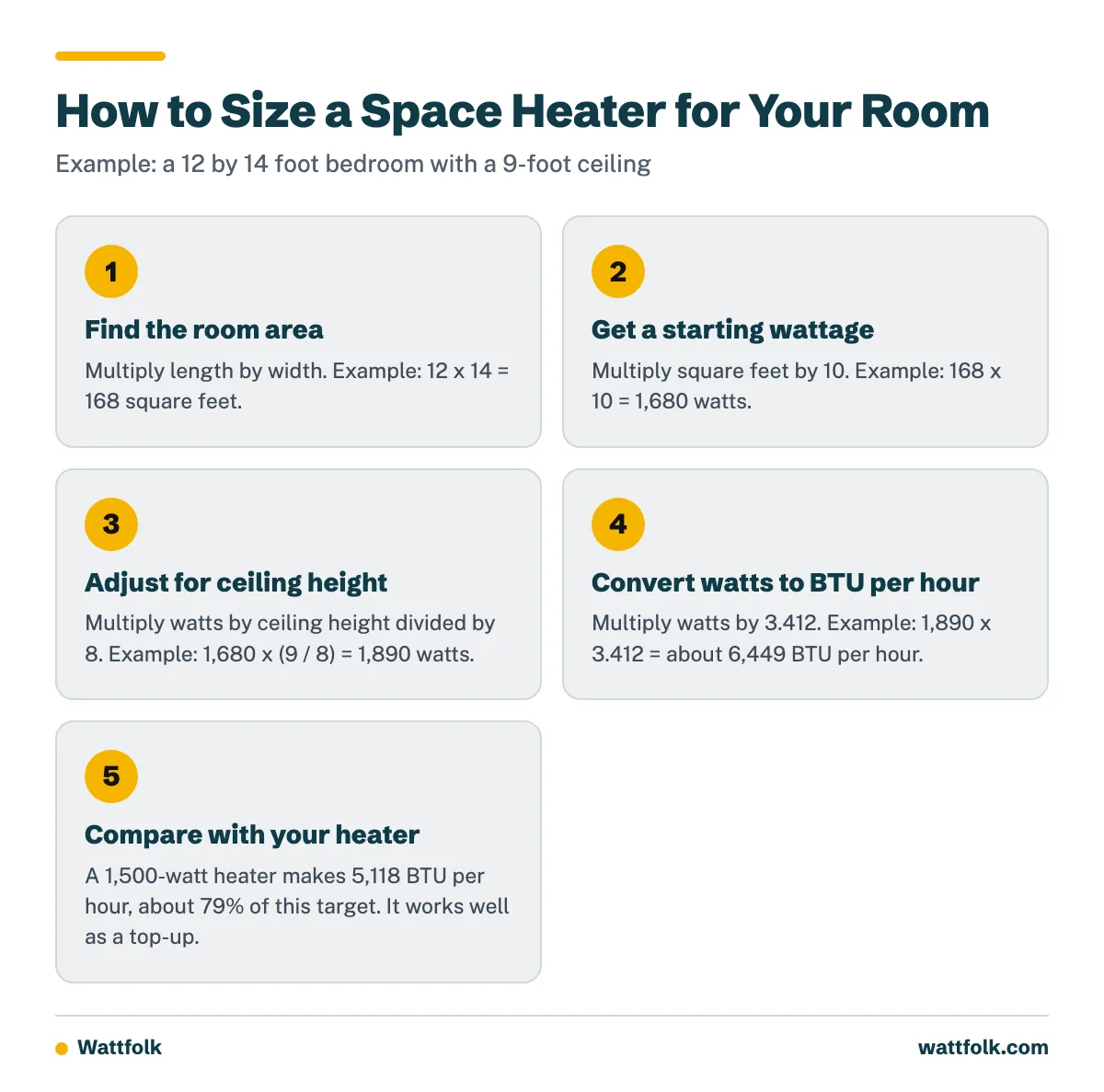
- Room area: Multiply length by width, then multiply by 10 to get a starting wattage.
- Ceiling height: Treat 8 feet as the baseline. For taller rooms, multiply your wattage by the height divided by 8. A 10-foot ceiling adds 25% more air.
- Insulation: Thin walls, an uninsulated floor, or an attic above mean a 1,500-watt heater will cover less than 150 square feet.
- Drafts: Hold your hand near window edges and door bottoms on a cold day. Seal any leaks before you buy a heater.
- Climate: Heat escapes faster as the gap between indoor and outdoor temperature grows. A 70°F room loses about twice as much heat on a 30°F day (40-degree gap) as on a 50°F day (20-degree gap).
- Role of the heater: With central heat still on, the heater only adds a few degrees and can be smaller. If it is the main heat source, size it for the full load and read the alternatives section below.
Worked example
A bedroom measures 12 by 14 feet, with a 9-foot ceiling.
- Area: 12 × 14 = 168 square feet
- Starting wattage: 168 × 10 = 1,680 watts
- Ceiling adjustment: 1,680 × (9 ÷ 8) = 1,890 watts
- Heat target: 1,890 × 3.412 = about 6,449 BTU per hour
One 1,500-watt heater supplies 5,118 BTU per hour, about 79% of that target. It works well as a top-up with the central heat on low. As the only heat source on a very cold day, it may fall short.
Bigger plug-in heaters are not the fix. Most portable models stop at 1,500 watts, and a second heater on the same 15-amp circuit will overload it. If a room truly needs more, hire a licensed electrician to assess a dedicated circuit, or look at a heat pump.
How much does a space heater cost to run?
Multiply kilowatts by hours by your electricity rate. A 1,500-watt heater costs your local rate times 1.5 for every hour at full power.
Use the rate printed on your bill, including delivery charges. For more detail on the formula, see this space heater electricity cost and wattage guide.
Worked example
A 1,500-watt heater warms a home office for 8 hours a day, 20 days a month. The rate is 17 cents per kWh.
- Output: 1,500 × 3.412 = about 5,118 BTU per hour
- Hourly cost: 1.5 kW × $0.17 = $0.255
- Daily energy at full power: 1.5 × 8 = 12 kWh
- Daily cost: 12 × $0.17 = $2.04
- Monthly cost: $2.04 × 20 = $40.80
That same use costs $28.80 at 12 cents and $96 at 40 cents. If a thermostat keeps the element on for half the time (an assumed figure), the cost at 17 cents falls to $20.40. Your real on-time depends on the room and the weather.
Is a ceramic, infrared, or oil-filled space heater more energy efficient?
None of them is more efficient. Electric resistance heaters convert essentially all the electricity they use into heat at the point of use, whether the element is ceramic, oil-filled, or infrared. This breakdown of the most energy-efficient space heater reaches the same conclusion.
What changes is where the heat goes and how fast you feel it. A ceramic heater is one kind of fan-forced heater, meaning a fan blows air across a hot element. Infrared heaters warm people and objects in their path. Oil-filled radiators heat oil sealed inside metal fins, then release that warmth slowly.
| Option | Speed | Noise | Portability | Efficiency | Best use |
|---|---|---|---|---|---|
| Ceramic fan heater | Fast | Fan noise | Easy to move | Nearly all power becomes heat | Short sessions in small rooms |
| Infrared heater | Fast for people in its path | Usually low | Easy to move | Nearly all power becomes heat | Warming one seat or person |
| Oil-filled radiator | Slow | Silent or close to it | Heavy | Nearly all power becomes heat | Quiet rooms and long sessions |
| Heat pump | Steady | Low indoors, with an outdoor unit on most models | Installed | Moves heat, so it delivers more heat than the electricity it uses | Sustained heating of rooms or homes |
| Central heating | Slow, whole home | Low to moderate | Fixed | Varies by system; check the AFUE or heat pump rating | Heating most of the home |
AFUE, or Annual Fuel Utilization Efficiency, is the share of a furnace’s fuel that becomes useful heat over a year.
If you need heat for under an hour, choose a ceramic fan heater.
If noise bothers you and you will stay in the room for hours, choose an oil-filled radiator.
If you sit in one spot in a drafty room, choose an infrared heater aimed at your seat.
If you need heat most days all winter, price a heat pump first.
What is the most cost-efficient way to use a space heater?
Heat one small, closed room and turn down the heat everywhere else. A heater that warms a room you are using while the rest of the house stays cooler is where the savings come from.
- Buy a model with a thermostat that shuts the element off at your set temperature.
- Close the door so the heat stays put.
- Seal gaps around windows and doors before running the heater.
- Lower your central thermostat, or the heater just adds to your bill.
- Use the lowest setting that keeps you comfortable. It will not make heat more cheaply, but it can stop you from overheating the room.
- Switch off when you leave.

Can a space heater save money compared with central heating?
A space heater can save money, but only if it lets you heat far less of your home. Per unit of heat, electric resistance is often the most expensive option.
The table compares the cost of 100,000 BTU of delivered heat, which equals 29.3 kWh of electric resistance heat (100,000 ÷ 3,412). The gas price and heat pump rating are example assumptions, so swap in your own numbers.
| Heat source | Assumptions | Calculation | Cost per 100,000 BTU |
|---|---|---|---|
| Electric space heater | 17¢/kWh | 29.3 kWh × $0.17 | $4.98 |
| Gas furnace | $1.50 per therm, 90% AFUE | $1.50 ÷ 0.90 | $1.67 |
| Heat pump | 17¢/kWh, COP of 3 | (29.3 ÷ 3) kWh × $0.17 | $1.66 |
COP, or coefficient of performance, is the units of heat delivered per unit of electricity used. It falls in very cold weather, so check the rating for your climate.
Here is the decision rule. Under these assumptions, electric heat costs about three times as much as gas or heat pump heat. Each BTU from your space heater must therefore avoid about 3 BTU of central heating. Warming one bedroom while the furnace stays low for the whole house can clear that bar. Warming a leaky room while the furnace runs as usual will not.
Homes with electric baseboards or an electric furnace have an easier choice. Those systems cost the same per BTU as a space heater, so heating less space saves money directly.
What are the space heater pros and cons in 2026?
Space heaters are good at heating one room for a limited time and poor at heating a home all winter.
| Pros | Cons |
|---|---|
| Plug in with no installation, which suits renters | Costly per BTU compared with a heat pump |
| Let you heat one room rather than the entire home | Limited to about 5,118 BTU per hour on a standard plug |
| Heat at the point of use, with no duct losses | Use most of a 15-amp circuit |
| Move from room to room | Fire risk if used carelessly |
How do you use a space heater safely?
Plug the heater directly into a wall outlet, keep it clear of anything that can burn, and turn it off when you leave the room or go to sleep. The U.S. Consumer Product Safety Commission and the National Fire Protection Association both advise keeping heaters at least 3 feet from flammable items.
- Never use an extension cord or power strip. A 12.5-amp load can overheat them.
- Respect the circuit. A 15-amp circuit has only 2.5 amps left with this heater running, or about 300 watts at 120 volts. Keep microwaves, hair dryers, and other large loads off it.
- Look for safety features. Choose a model with tip-over and overheat shutoff, plus a listing mark from a testing lab such as UL or ETL.
- Place it on a hard, level floor. Avoid rugs and tabletops.
- Warm the bedroom before bed. Then switch the heater off before you fall asleep.
- Check the plug during use. If the plug or outlet feels hot, stop using it. Have a licensed electrician inspect the outlet and wiring.
What safer or more efficient alternatives should I consider in 2026?
A heat pump is the strongest alternative for regular heating, because it moves heat rather than making it. Purchase price alone is a poor way to compare these options, so look at what each one costs across a whole winter.
- Ductless mini-split heat pump: The best fit for a room or addition you heat every day. It needs professional installation, and renters need landlord approval.
- Central heat pump: Worth pricing when your furnace or AC is due for replacement. It serves the whole home.
- Existing central heating: With gas at the example price above, it can beat a space heater on cost when you need to heat most of the home.
- Electric radiant panels or floors: Comfortable and quiet, but they have the same per-BTU electricity cost as a space heater.
- Gas radiant or vented wall heaters: Useful where gas is cheap. Hire a licensed installer, and fit carbon monoxide alarms.
- Electric blanket or heated throw: Warms you rather than the room, usually at far lower wattage. Check the label and follow the maker’s directions.
- Air sealing and insulation: These reduce the heat every other option has to supply.
What do owners say?
Owners like
- Ceramic fan heaters bring a room up to temperature quickly.
- Oil-filled radiators earn repeated praise for running silently.
- Oil-filled models keep giving gentle, steady warmth after the thermostat cycles off.
- Infrared heaters make people and nearby objects feel warm quickly.
- Portable heaters let people heat one room instead of the entire home.
Common complaints
- Fan noise comes up often, especially in bedrooms.
- Many users notice a burning-dust or chemical smell during first use.
- Some owners report plugs or cords getting unusually hot.
- Oil-filled radiators are often called heavy and slow to warm a cold room.
- Total heating costs may not fall with long run times or in poorly insulated spaces.
Summarised from owner reviews and long-term user reports; individual experiences vary.
Frequently Asked Questions
How many BTU is a space heater?
Most plug-in electric space heaters make about 5,118 BTU per hour on a 1,500-watt high setting. On lower settings of 750 to 1,000 watts, they make about 2,559 to 3,412 BTU per hour.
How many BTU heater do I need?
Multiply your room’s square footage by 34 for a starting figure in BTU per hour. A 100-square-foot room needs about 3,412 BTU per hour. Add more for tall ceilings, drafts, poor insulation, or very cold weather.
Space heater watts vs BTU: what is the difference?
Watts measure the electric power a heater uses, and BTU per hour measures the heat it gives off. For electric heaters, one watt equals about 3.412 BTU per hour, so the two numbers always move together.
What is the most energy efficient space heater?
No plug-in electric resistance heater beats the others on efficiency. Choose by how you will use it, then pick a model with an accurate thermostat so it does not run longer than needed.
What are the top rated space heater alternatives?
For regular heating, start with a ductless or central heat pump. Then compare your existing central system at your local fuel and electricity prices. For one person who sits still, a heated throw can cover the need at a much lower wattage.
Sources