Plug-in solar is a small solar system, panels plus a grid-tied microinverter, that turns sunlight into household AC power and connects at an outlet. Not every panel works this way, and whether you may connect one depends on your state, your utility, and your equipment.
Quick answer
Plug-in solar is a small panel kit with a certified microinverter that feeds power into your home’s wiring. It can trim your daytime bill, but it is not a casual DIY job. Check local rules and call your utility first.
- Best for renters and balconies: a small kit, if your utility allows it
- Best for backup power: a battery-based portable system, not grid-tied
- Best for big bills: professional rooftop solar
- Plug-in solar uses panels plus a grid-tied microinverter. A raw panel must never go into an outlet.
- Kits usually hold one to three panels and are commonly rated below about 2,000 watts.
- Basic systems are reported at roughly $500 to $2,000. Mounting, permits, and batteries can add more.
- Real output is lower than the label because of shade, angle, heat, and system losses.
- Most grid-tied kits shut off during a blackout. That is a safety feature, not a defect.
- US rules depend on state, local code, and utility policy. Confirm with your utility before you buy.
- What is plug-in solar?
- How do plug-in solar panels work?
- Can I plug solar panels directly into an outlet?
- How is plug-in solar safe?
- Is plug-in solar legal where I live?
- Does plug-in solar work during a power outage?
- How much does plug-in solar cost?
- How much electricity and money can it produce?
- Plug-in vs. portable vs. rooftop solar
- Are plug-in solar panels any good?
- Pre-purchase checklist
- What do owners say?
- Frequently Asked Questions
What is plug-in solar?
Plug-in solar is a small solar-electric system that sends power into your home’s wiring through a grid-tied microinverter. You skip the big rooftop job. The system covers part of your daytime use, and the grid covers the rest.
The names get mixed up, so here is how they differ:
- Plug-in solar: panels, a grid-tied microinverter, and a cable to a household-voltage connection.
- Plug-and-play solar: a marketing term. It often means plug-in solar, but some products sold this way are battery kits.
- Balcony solar: plug-in solar mounted on a railing, wall, or balcony floor.
- Portable solar generator: panels charging a battery power station. You plug appliances into the station. It does not feed your wall wiring.
- Rooftop solar: a larger system, professionally installed, usually with permits and a utility sign-off.
According to Wattbuild’s overview of plug-and-play panels, kits commonly include one to three panels, a microinverter, mounting hardware, and a cable. Small systems are commonly rated below about 2,000 watts, though allowed limits differ by place and product.
How do plug-in solar panels work?
Panels make direct current (DC). Your outlets use alternating current (AC). The microinverter sits between them and changes DC into AC that matches your home’s power.
A grid-tied microinverter locks onto the grid’s voltage, frequency, and phase. Then it pushes power into your home circuit. Your appliances use that solar power first. If they need more, the grid fills the gap.
Here is the flow:
Sun → Panel (DC power) → Microinverter (DC to AC, synced to grid) → Home circuit and loads (fridge, router, lights, laptop)
Grid import → tops up your home when solar is short, such as at night or under clouds.
Optional battery ← stores extra solar power for later use, and needs a system designed for it.
The main parts are:
- Panels: they collect sunlight. Output depends on size, angle, and shade.
- Microinverter: the safety and conversion brain.
- Cables and connectors: they must be rated for outdoor use.
- Mounting: a railing bracket, ground stand, or wall mount. Wind loads are real.
- Monitoring: an app that shows watts and daily energy.
- Battery (optional): adds cost and complexity.
One more point. Extra solar power can flow back toward the grid when your home uses less than the panels make. Some utilities restrict or prohibit that. Ask yours.

Can I plug solar panels directly into an outlet?
No. A bare solar panel puts out DC power and has no grid protection. Plugging it into an outlet is unsafe and can damage equipment or start a fire.
A certified grid-tie microinverter is what makes a plug-in kit different. It converts the power, syncs with the grid, and shuts down if the grid fails. Never use extension cords to connect a kit. Never bypass the inverter’s shut-off. If your outlet or circuit looks old, damaged, or overloaded, hire a licensed electrician.
How is plug-in solar safe?
Plug-in solar is safe when it uses certified equipment, a suitable circuit, and secure installation. The key feature is anti-islanding protection, which makes the microinverter stop when the grid goes down.
Why it matters: if your system kept pushing power into dead wires, a lineworker fixing the outage could meet live power where none should exist. The inverter senses the grid failing and cuts off fast. That is what “grid-tied” safety means.
Safety also covers the rest of the setup:
- A certified inverter with automatic grid shut-off
- A dedicated or suitable circuit that can handle the added load
- Weatherproof connectors and cable routing
- Mounting that holds in wind, rain, and snow
- A wiring check if the outlet or panel is old
Manufacturer guides, such as Anker’s explanation of plug-in panels at home, describe the same basics. Still, the guide cannot see your wiring. A licensed electrician can.
Is plug-in solar legal where I live?
It depends. In the US, legality turns on your state, local code, utility policy, and whether your equipment is compliant. There is no single national answer, and rules are changing quickly.
Do these steps before you buy:
- Call or check the website of your electric utility. Ask if it allows small grid-tied systems and whether you must notify, register, or get approval.
- Check with your city or county building office about permits or inspections.
- Renters: read your lease and ask your landlord in writing. Many buildings restrict balcony items.
- HOA members: check the rules on visible equipment.
Why can plug-in solar be illegal or restricted?
Most restrictions come down to safety and grid control. Many electrical codes were written before small plug-in kits existed. They assume a solar system is wired in by a licensed installer, with a permit.
Common reasons for limits:
- Backfeed risk: power flowing the wrong way can be unsafe if protections fail.
- Circuit overload: solar plus household loads on one circuit can overload old wiring.
- Uncertified products: cheap inverters may lack proper shut-off.
- Utility planning: utilities want to know what connects to their network.
Rules vary by state and utility, and some jurisdictions require notification, approval, inspection, or registration. So confirm with your utility before you order.
If your utility and city say yes → buy a certified kit and follow their steps.
If they say maybe → get the answer in writing first.
If they say no → consider a battery-based portable system, or ask about a permitted small installation.
Does plug-in solar work during a power outage?
Usually not. Most grid-tied plug-in systems shut down during an outage, because the microinverter needs the grid to sync with and must stop to protect line workers.
A grid-tied kit cannot act as backup power by itself. To keep power flowing in a blackout, you need a system designed for islanding, with a battery and the right switching gear. That is a different product, often installed by a licensed electrician. A portable power station is the simpler option for a few devices. You plug phones, a router, or a small fridge directly into the station.
How much does plug-in solar cost?
Reported consumer pricing for basic plug-and-play systems is about $500 to $2,000. Systems with batteries can cost roughly twice as much, according to EcoFlow’s plug-and-play solar guide. Your actual cost varies a lot.
Many ads show only the kit price. Add the extras:
| Cost item | Why it matters |
|---|---|
| Panels and microinverter | The core kit |
| Mounting hardware | Railing, wall, or ground mounts may be sold separately |
| Electrical inspection | An electrician may need to check the outlet or circuit |
| Permits or fees | Depends on your city, county, and utility |
| Monitoring | Some apps or gateways cost extra |
| Battery | Can roughly double the price |
| Delivery | Panels are large and heavy |

How much electricity and money can a plug-in solar system produce?
A small kit often makes enough to cover some always-on loads, such as a fridge and router, and it saves a modest amount per year. Panel watts alone do not tell you that. You need peak sun hours, losses, and your electricity price.
Here is a worked estimate. Assumptions: two 400-watt panels (800 W total), 4 peak sun hours per day (a reasonable middle value for many US locations), 20% system losses (a factor of 0.80), and electricity at 17 cents per kWh (near the national average from the U.S. Energy Information Administration).
- Daily energy: 800 W × 4 hours × 0.80 = 2,560 Wh, or 2.56 kWh
- Yearly energy: 2.56 kWh × 365 = about 934 kWh
- Yearly value: 934 kWh × $0.17 = about $159
Now see how price and sun change the answer. The kit price below is an example of $800, not a quote.
| Scenario | Peak sun hours | Price per kWh | Yearly kWh | Yearly value | Simple payback on $800 |
|---|---|---|---|---|---|
| Low rate, good sun | 4 | $0.12 | 934 | about $112 | about 7 years |
| National average | 4 | $0.17 | 934 | about $159 | about 5 years |
| High rate, good sun | 4 | $0.40 | 934 | about $374 | about 2 years |
| National average, weaker sun | 3 | $0.17 | 701 | about $119 | about 7 years |
These numbers assume you use all the solar power in your home. If extra power flows to the grid and your utility pays nothing for it, the saving shrinks. Shade, a poor angle, heat, cable losses, and winter sun can all pull output lower. Redo the math with your own panel watts, local sun hours, and the rate on your bill.
Plug-in vs. portable vs. rooftop solar
Many pages blur these together. They are three different tools.
| Feature | Plug-in grid-tied solar | Portable solar generator | Professional rooftop solar |
|---|---|---|---|
| How it connects | Microinverter to home wiring | Panels charge a battery; devices plug into the station | Wired into the main panel by an installer |
| Typical size | Commonly under about 2,000 W | Small to mid-size, battery-limited | Sized for the whole home |
| Reported cost | About $500 to $2,000 for basic kits | Varies widely by battery size | Much higher; varies by home |
| Works in an outage | Usually no | Yes, from the battery | Usually no, unless built with battery backup |
| Permits and utility steps | Vary by state, city, and utility | Usually none for standalone use | Usually required |
| Best for | Cutting daytime use on a small scale | Camping, backup, no grid link | Large bills and long-term owners |
Are plug-in solar panels any good?
They are good for the right user. They suit people with sun exposure, steady daytime power use, and a utility that allows them. They disappoint people who expect to erase a large bill or run the house in a blackout.
Advantages:
- Lower upfront cost than rooftop solar
- Simple setup compared with a full installation
- Works on balconies, patios, sheds, and gardens
- Modular, so renters and small homes can scale
Disadvantages:
- Output well below the label rating
- Legal and utility steps differ by location
- Little value if no one is home or using power by day
- No outage power without a separate backup design
If you rent with a sunny balcony and your utility allows it → a small kit may fit.
If your balcony is shaded most of the day → skip it; the output will be poor.
If your home uses 900 kWh or more each month and you own the roof → get quotes for professional solar.
If your outlet or panel is old, or you are unsure about the circuit → hire a licensed electrician first.
Pre-purchase checklist
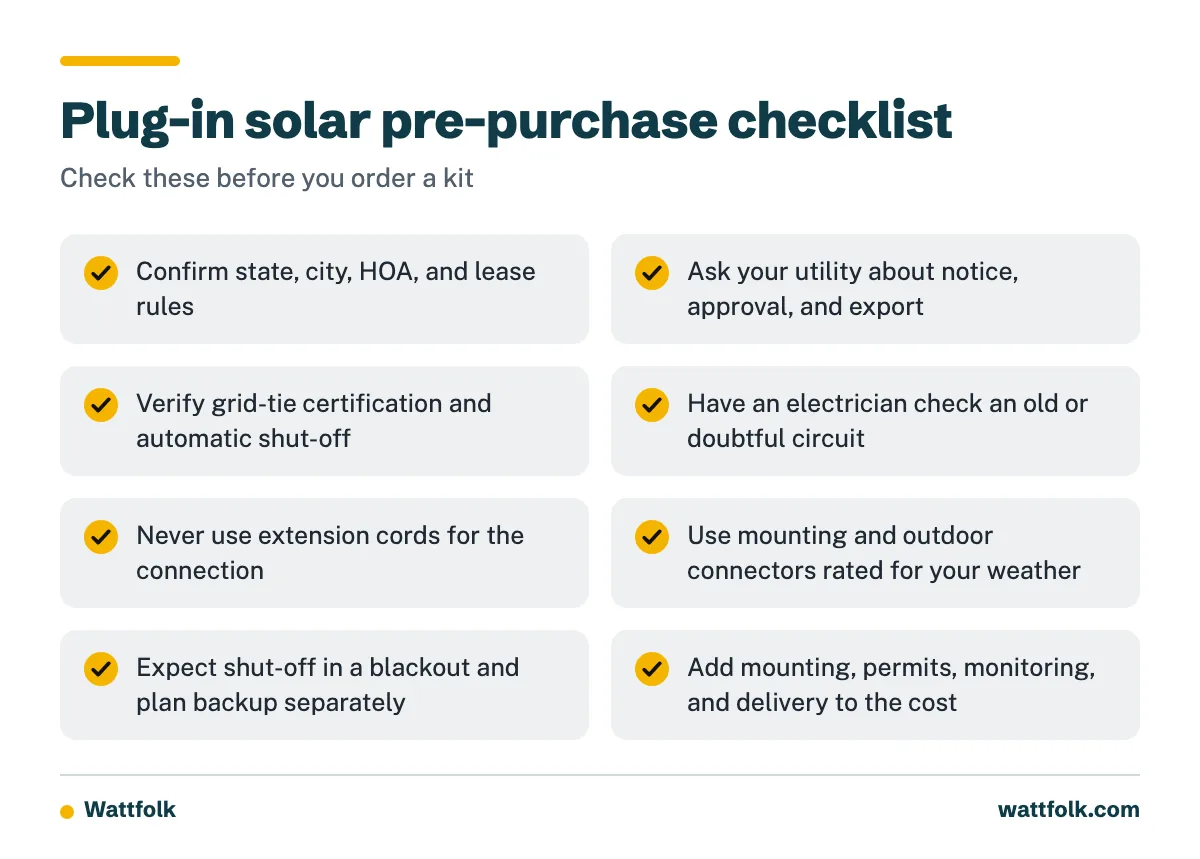
- Local rules: confirm state, city, and HOA or lease rules.
- Utility notice: ask if you must notify, register, or get approval, and whether export is allowed.
- Inverter certification: verify a grid-tie safety certification and automatic grid shut-off.
- Outlet and circuit: have a licensed electrician check condition and capacity if there is any doubt.
- No extension cords: the connection should be direct and rated for the job.
- Mounting: choose hardware rated for your wind and snow conditions, and fix it securely.
- Weatherproofing: use outdoor-rated connectors and route cables so water cannot run into them.
- Sun check: note shade at different hours and seasons.
- Outage behavior: expect shut-off in a blackout. Plan separate backup if you need it.
- Total cost: add mounting, inspection, permits, monitoring, and delivery to the kit price.
What do owners say?
Owners like
- Simple setup compared with a full rooftop solar installation
- Useful for balconies, gardens, sheds, patios, and other places without a large roof
- Lower upfront cost than conventional rooftop solar
- Portable or modular designs that can suit renters and small households
- Ability to reduce daytime grid electricity use without installing a large system
Common complaints
- Actual output is often much lower than the advertised panel rating because of shading, orientation, weather, and seasonal sunlight
- Uncertainty over permits, utility approval, registration, and local legality
- Limited value without enough daytime electricity use or good sun exposure
- Systems generally stop working during grid outages unless a separate backup system is installed
- Concerns about cable routing, weatherproofing, mounting security, and the condition or capacity of the outlet and circuit
Summarised from owner reviews and long-term user reports; individual experiences vary.
Frequently Asked Questions
What is plugin solar panels?
The phrase usually means a small kit: one to three solar panels, a grid-tied microinverter, mounting hardware, and a cable. The panels alone do not plug into anything. The microinverter makes the connection safe and usable.
How do plug solar panels work?
Panels turn sunlight into DC power. The microinverter changes it into AC power that matches the grid. Your home uses that power first, and the grid supplies whatever the panels cannot.
Can I plug solar panels into an outlet?
Not raw panels. Only a kit with a certified grid-tie microinverter is designed for a household-voltage connection, and even then your state, utility, and circuit condition decide whether it is allowed. Never use extension cords or bypass the inverter’s shut-off.
How much is plugin solar?
Reported pricing for basic plug-and-play systems is about $500 to $2,000. Battery versions can cost roughly twice as much. Mounting, inspection, permits, monitoring, and delivery can add to the total.
How is plug in solar safe?
It is safe when the microinverter is certified, the circuit can handle the load, and the mounting and cables are weatherproof and secure. Anti-islanding protection shuts the system off when the grid fails so line workers are not exposed to live power.
Is plug in solar legal?
It depends on your state, local code, utility policy, and equipment. Some places require notification, approval, inspection, or registration. Confirm with your utility and building office before you buy.
Why is plug in solar illegal?
Where it is restricted, the reasons are usually safety and grid management. Codes may assume a licensed installer, backfeed protection can be a concern, and old circuits can overload. Utilities also want to know what connects to their network. Rules differ by location and keep changing.
Sources