A single 250W plug-in solar panel makes roughly 0.8 kWh on an average day, worth about 14 cents at the US average electricity price. Buy plug-in solar only from the manufacturer or an established solar retailer that sells a complete kit with a certified microinverter, clear instructions and real support. Then confirm your utility, landlord and outlet circuit allow it before you plug anything in.
Quick answer
Buy from a manufacturer’s own store or a known solar retailer, not an unknown marketplace seller. Choose a complete kit with a listed grid-tied microinverter. Check your utility’s rules, and never use an extension cord.
- Best for renters: a small kit you can unplug and take with you
- Best for homeowners: a kit on a dedicated, electrician-checked outlet
- A panel cannot plug straight into a wall outlet. It needs a grid-tied microinverter that shuts off when the grid goes down.
- Buy complete kits from manufacturers or established retailers. Look for safety listings, a datasheet and written instructions.
- Plug-in solar rules differ by state and change fast. Confirm with your utility before you buy.
- A 250W panel saves about $50 a year at 17 cents per kWh. Treat savings claims that are much higher with caution.
- Never use an extension cord, and never bypass the inverter’s shut-off. Call a licensed electrician if you are unsure about the circuit.
- Can I plug a solar panel into an outlet?
- Where can I buy plug-in solar panels?
- How do I buy plug-in solar panels safely?
- Do I need permission before I plug in?
- Outlet and wiring safety
- How many amps does a 250 watt solar panel produce?
- What can a 90 watt solar panel run?
- Are plug-in solar panels any good?
- Plug-in vs rooftop, balcony and battery systems
- Signs of an unsafe product
- Frequently Asked Questions
Can I plug a solar panel into an outlet?
No, not the panel alone. A panel makes direct current (DC). Your home outlet carries alternating current (AC) at about 120V. A grid-tied microinverter sits between the two and converts the power.
That inverter also does a safety job. If the grid goes down, it must stop sending power within seconds. This protects utility workers who may be repairing the line. Never bypass or defeat this shut-off. A kit that skips it is not a plug-in kit. It is a hazard.
Where can I buy plug-in solar panels?
You have three sensible options. Each has trade-offs.
- The manufacturer’s own website. You get the full datasheet, manuals and direct support. Prices may be higher than at marketplaces.
- Established solar retailers. These sellers handle returns, answer technical questions and know which products fit which setups.
- Large online marketplaces and home improvement stores. Prices can be good. Quality varies a lot, so check the seller, the product listing and the paperwork before you pay.
Skip anonymous sellers with no datasheet, no manual and no contact address. If a listing only says “plug and play” and shows no inverter details, move on.

How do I buy plug-in solar panels safely?
Check the product first, then the seller, then your home. Based on the specifications buyers should expect, use this list before you pay.
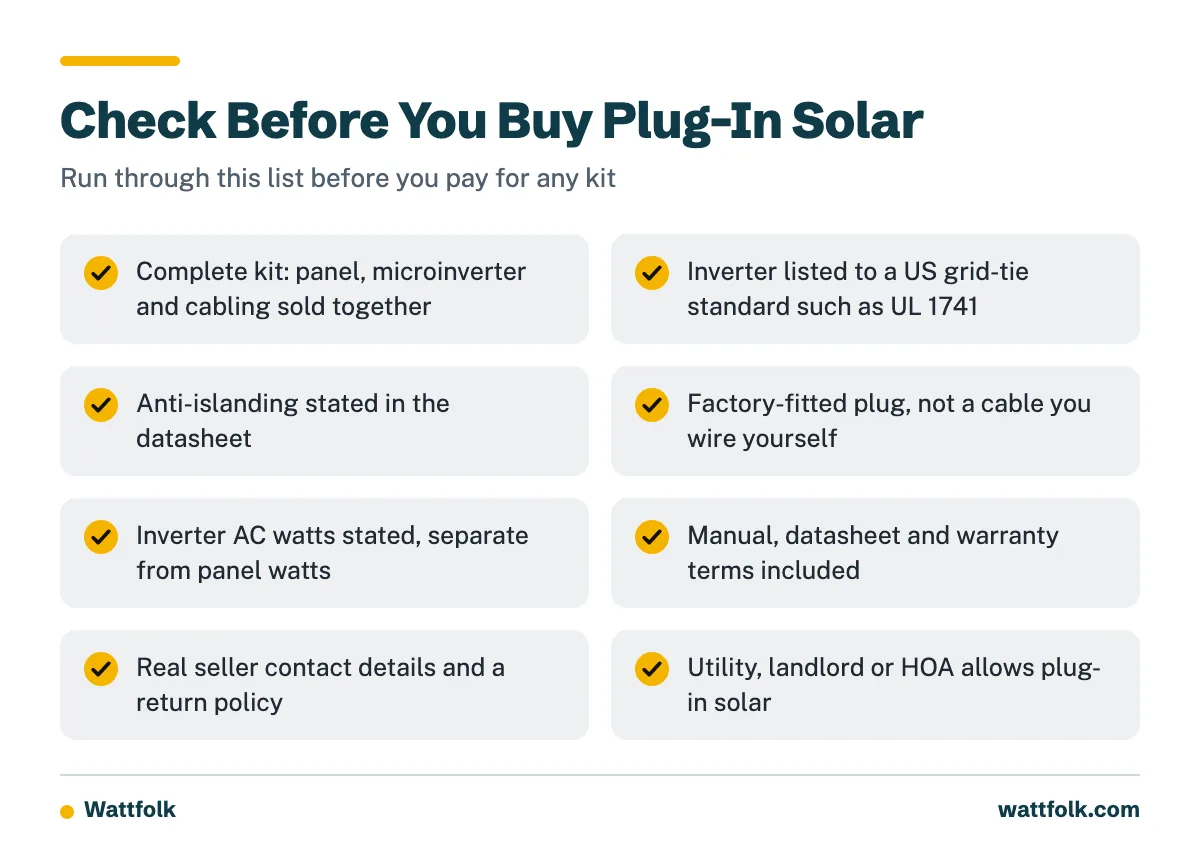
| Check | What to look for | Why it matters |
|---|---|---|
| Complete kit | Panel, microinverter and cabling sold together | Mismatched parts can be unsafe or not work at all |
| Safety listing | The inverter is listed to a US grid-tie standard such as UL 1741, shown in the manual or datasheet | Shows it was tested for shut-off behavior |
| Anti-islanding | Stated in the datasheet | Stops power flowing into a dead grid |
| Plug | Factory-fitted, not a loose cable you wire yourself | Home wiring work needs a licensed electrician |
| Output rating | Inverter AC watts clearly stated, separate from panel watts | Panel size and inverter size are different numbers |
| Documents | Manual, datasheet, warranty terms | You need these for your utility and landlord |
| Seller support | Real contact details and a return policy | Helps if the kit arrives faulty |
The Energy Saving Trust publishes a checklist of checks to make before you buy. It is written for UK homes, so its product rules do not apply here. Its general approach still works: check the product, the property and the permissions before you order.
Do I need permission before I plug in?
Often, yes. Plug-in solar rules vary by state and change quickly. Some utilities require you to tell them or sign an interconnection form. Others may not allow plug-in systems at all. I cannot tell you your state’s rule here, so confirm with your utility before buying.
If you rent: get written permission from your landlord first. Ask if you can use a balcony, patio or outlet for this.
If you live in an HOA or condo: read the rules on exterior equipment and balcony changes.
If you own a house: call your utility and ask about its small-system or interconnection rules.
If the utility says no or the rules are unclear: wait. Do not plug in and hope.
Outlet and wiring safety
Plug a kit directly into a wall outlet on a healthy circuit. Do not use an extension cord, a power strip or a cord reel. UK guidance from Electrical Safety First bans extension leads, cable reels and adaptors for plug-in solar. The same logic applies here. Those cords can overheat, and they were not designed for power flowing backward.
Also think about the circuit itself. Check these points:
- Is the outlet in good shape, with no loose plugs, scorch marks or warm spots?
- Does the circuit have other heavy loads, like a space heater or window AC?
- Do your breakers and ground-fault protection (GFCI) work with the inverter? Follow the manufacturer’s notes.
- Is the home older, with aluminum wiring or a mix of old and new work?
If any answer worries you, hire a licensed electrician. They can inspect the circuit or add a dedicated outlet. That is money well spent.
How many amps does a 250 watt solar panel produce?
About 8.3 amps on the DC side, if the panel runs near 30 volts. The math is simple: amps = watts ÷ volts, so 250 ÷ 30 ≈ 8.3A. Your panel’s datasheet lists the exact operating current. Use that number, not mine.
The AC side is different. A microinverter changes voltage and current. On a 120V outlet, 250W of output is about 2.1A (250 ÷ 120). Here is how the numbers change with size:
| Panel size | Typical inverter output | Likely daily output* | AC amps at 120V (inverter at full output) | Suitable loads | Typical use |
|---|---|---|---|---|---|
| 90W | Small unit, roughly 90W or less | about 0.29 kWh | about 0.75A | Router, phone and laptop charging, LED lights | Small test setup, shed, apartment baseload |
| 250W | About 250W | about 0.8 kWh | about 2.1A | Fridge average draw, TV, router, chargers | Single-panel balcony kit |
| 400W | About 350-400W | about 1.3 kWh | about 3.3A | All of the above plus a desktop and fans | Larger renter or small-home kit |
| 800W | About 800W | about 2.6 kWh | about 6.7A | Household daytime baseload and some appliances | Homeowner setup, ideally electrician-checked |
*Assumptions: 4 peak sun hours a day (many US locations fall between roughly 3 and 6), 20% system losses, panel watts × 4 × 0.8. Change the peak sun hours to match your area.
What can a 90 watt solar panel run?
A 90W panel can offset small, steady loads during daylight. It cannot reliably run big appliances. Its 90W rating applies only under lab test conditions. Real output drops with clouds, angle, heat, shade and inverter losses.
Here is a worked example. These are illustrative numbers, not measurements:
- Router: 10W
- Refrigerator, average draw over time: 50W
- Phone and laptop charging: 30W
- Total: 90W
On a clear midday with 20% losses, the panel delivers about 72W (90 × 0.8). It would cover most of that load, but only for a few hours around noon. Over a day, it makes about 0.29 kWh (90W × 4 hours × 0.8). Your loads use more than that over 24 hours, and sunlight is not constant.
A microwave (often 1,000W or more), a hair dryer or a space heater is far beyond this panel. The grid will supply that power, and the panel will only trim a small part.
Are plug-in solar panels any good?
They are good for a specific job: trimming your daytime electric bill at a low cost, with no roof work. They are not a replacement for a full rooftop system. Savings are modest, and they depend on your sunlight and your electric rate.
Here is the math for a 250W panel, using 292 kWh a year (0.8 kWh × 365):
| Electricity price | Yearly value of 292 kWh |
|---|---|
| 12 cents per kWh (low-cost states) | about $35 |
| 17 cents per kWh (US average, per the U.S. Energy Information Administration) | about $50 |
| 40 cents per kWh (high-cost states) | about $117 |
Real savings can be lower. Shade, a poor angle or a home that is empty all day can cut the value. Panel output only counts when something in the house is using power at that moment. If your kit sends extra power to the grid and your utility does not credit it, that portion earns nothing. Ask your utility how it treats it. If a seller promises big savings with no assumptions, be suspicious.

Plug-in vs rooftop, balcony and battery systems
| System | Best for | Main limit |
|---|---|---|
| Plug-in solar | Renters and small budgets | Low output, rules vary by state |
| Balcony solar | Apartments with sun-facing railings | Needs permission and a safe mounting point |
| Rooftop solar | Owners with sunny roofs and high bills | High upfront cost, installer and permits |
| Off-grid battery system | Cabins, backup power | More parts, more cost, more design work |
Balcony solar is usually just a plug-in kit placed on a balcony. The buying rules above all apply.
Signs of an unsafe product
- No mention of grid shut-off or anti-islanding
- No safety listing in the manual or datasheet
- Loose bare wires instead of a factory-fitted plug
- Claims you can power a whole house or run a heater
- No manual, no company address and no warranty terms
- Instructions that tell you to use an extension cord or a multi-plug adaptor
If you see any of these, do not buy. If you already bought and spot them, do not use the kit.
Frequently Asked Questions
How to buy plug in solar panels?
Pick a complete kit from the manufacturer or an established solar retailer. Check the safety listing, the inverter rating and the paperwork. Then confirm your utility, landlord or HOA allows it before you order.
Can I plug a solar panel into an outlet?
Not a bare panel. You need a grid-tied microinverter that converts DC to AC and shuts off when the grid is down. Plug the kit straight into a wall outlet, never through an extension cord.
How many amps does a 250 watt solar panel produce?
About 8.3A on the DC side at 30V (250 ÷ 30). Check your panel’s datasheet for its exact operating current. After the inverter, the AC current at 120V is about 2.1A at full output.
Buy plug in solar panels: what should I avoid?
Avoid sellers with no datasheet, no manual and no safety listing. Avoid kits that need you to wire your own plug or bypass the inverter’s shut-off.
What can a 90 watt solar panel run?
Small loads like a router, LED lights and phone or laptop chargers, during daylight. It makes only about 0.29 kWh a day under our stated assumptions, so it cannot run large appliances.
Where can I buy plug in solar panels?
Buy from manufacturer websites or established solar retailers. Marketplaces and home improvement stores can work if you check the seller, listing and paperwork closely.
Where can I buy plug in solar panels UK, and can you buy plug in solar panels in the UK?
This guide is for US shoppers. UK rules are different, with their own product limits, plug requirements and network registration. UK buyers should read UK guidance from sources such as Electrical Safety First and buy from UK-compliant sellers.
Are plug in solar panels any good?
They work well for small, steady daytime loads and low upfront cost. A 250W panel saves about $50 a year at the 17-cent US average, so expect modest savings, not a zero bill.