Plugging a solar microinverter into an existing outlet is simpler than adding a dedicated circuit, but it is not always allowed or safe. A dedicated circuit is often the safer choice, and sometimes the required one. The answer depends on the inverter’s output, the outlet, what else shares the circuit, and your local rules.
Quick answer
Not always. If the manual allows a standard plug and the outlet is grounded, in good shape and protected from weather, an existing outlet may work. Check what else shares the circuit first. Larger or outdoor systems usually need a dedicated circuit.
- Best for small kits: a grounded, lightly loaded outlet, if the manual allows it
- Best for larger systems: a dedicated circuit installed by an electrician
- The product manual and local code decide the connection method, not a general rule.
- A circuit can sit under its breaker rating and still be overloaded once solar is added.
- The outlet must be properly grounded. Never use an ungrounded outlet.
- Never use extension cords, adapters or power strips with plug-in solar.
- Use a licensed electrician for any new circuit, breaker, disconnect or outdoor receptacle.
- Can I plug a solar microinverter into a normal wall outlet?
- How does plug-in solar connect to household wiring?
- When does plug-in solar require a dedicated circuit?
- Can the outlet share a circuit with other loads?
- Worked load example
- Shared, dedicated or hardwired: which fits?
- Does plug-in solar need its own breaker or disconnect?
- What outlet, grounding and weather protection are required?
- Can I use an extension cord or power strip?
- Are plug-in solar systems legal?
- Pre-installation checklist
- Who should install or inspect the connection?
- Frequently Asked Questions
Can I plug a solar microinverter into a normal wall outlet?
Sometimes. Certain plug-in microinverters are designed to connect to a standard household outlet using a specified AC cable, according to manufacturer documentation. Others are not. Some manufacturers require a branch-circuit breaker with separate neutral and protective-earth connections instead of a standard plug.
So the product itself sets the first limit. Product manuals also warn that direct plug-in compatibility and required installation steps depend on local regulations and the specific microinverter. Read the manual before you buy, not after. The EcoFlow STREAM Ultra user manual shows the kind of connection and safety instructions a manufacturer publishes.
How does plug-in solar connect to household wiring?
Power flows from the panels, through a microinverter that turns DC into 120 V AC, then into your home’s wiring. From there it feeds nearby loads first, and any extra goes back toward the grid.

When does plug-in solar require a dedicated circuit?
A dedicated circuit is required when the manual says so, when local code says so, or when the existing wiring cannot safely carry the added current. Some systems specify a dedicated circuit or a weatherproof exterior receptacle for compliance and safe operation.
A dedicated circuit is also the prudent choice in these cases:
- The inverter’s output is high for a single outlet.
- The outlet is outdoors or in a damp place.
- The circuit already runs a heater, microwave, space heater or other heavy load.
- You cannot confirm the outlet’s grounding or the wire size behind it.
- The manual calls for a branch-circuit breaker and not a plug.
Can the outlet share a circuit with appliances or other loads?
It can, but it is the riskiest setup. Many pages skip this point. A solar inverter pushes current into the circuit, and the breaker only measures what comes from the panel side. It does not see what the inverter adds.
That means an overloaded wire may never trip its breaker. The next section shows how.
How much power can plug-in solar feed into a household circuit?
The amount is limited by the inverter’s rated AC output and the circuit’s wire and breaker size. Here is a worked example. Assumptions: 120 V, an 800 W AC microinverter, a 15 A breaker, and 14 AWG wire (the common pairing, rated for 15 A).
- Inverter current: 800 W ÷ 120 V ≈ 6.7 A.
- Breaker limit: 15 A × 120 V = 1,800 W. For continuous loads, the usual 80% rule gives about 1,440 W.
Now say the inverter outlet sits mid-circuit. Downstream outlets run a 1,500 W space heater and a 900 W appliance. That is 2,400 W, or 20 A.
- Grid supplies up to 15 A. The breaker sees 15 A and stays closed.
- The inverter supplies 6.7 A.
- The wire between the inverter and those loads carries about 20 A, on wire rated for 15 A.
The circuit looks fine on paper because it never exceeds the breaker rating. Yet the wire is overloaded and there is no trip to warn you. This is why a lightly loaded or dedicated circuit matters. A lower-output system, say 400 W (3.3 A), has far less margin to worry about, but the same logic applies.
What is the difference between a plug-in connection and a hardwired branch circuit?
A plug-in connection uses a cord and a receptacle. A hardwired branch circuit connects the inverter to its own breaker in the panel with fixed wiring. The table compares the three common setups.
| Setup | Suitability | Protection | Typical use |
|---|---|---|---|
| Existing shared circuit | Low-output kits only, with light existing loads | Breaker sees grid current only; wire overload can go unnoticed | Small balcony kit where the manual allows a standard plug |
| Dedicated receptacle circuit | Good for most plug-in kits | Own breaker, no other loads on the wire | Plug-in inverter with a grounded or weatherproof outlet on its own circuit |
| Hardwired branch circuit | Required by some manufacturers and many larger systems | Branch-circuit breaker, AC disconnect, fixed neutral and earth | Higher-output or permanent installs |
If the manual requires a breaker connection → do hardwire it with an electrician.
If the manual allows a plug and the outlet is grounded with light loads → do verify the checklist below, then plug in.
If the outlet is shared with heavy appliances or you are unsure → do add a dedicated circuit.
Does plug-in solar need its own circuit breaker or disconnect?
It depends on the connection type. Microinverter systems rely on an AC branch-circuit breaker or AC disconnect for shutdown and isolation, according to manufacturer documentation such as Enphase’s IQ microinverter installation documentation. Hardwired systems need one. Plug-in systems use the plug as the point of disconnect, but the circuit’s own breaker still protects the wire.
Never bypass a microinverter’s built-in grid shut-off. It stops power flowing into the wiring when the grid goes down, which protects utility workers.
What type of outlet, grounding and weather protection are required?
You need a properly grounded outlet. Manufacturer safety instructions warn against using an ungrounded outlet with a plug-in solar inverter. Check polarity too. A simple outlet tester shows wiring faults, though an electrician can confirm what is behind the wall.
Outdoors, use a weatherproof receptacle with an in-use cover, and think about a GFCI-protected outlet. Ask your electrician which protection your local code requires. Also check that the AC cable’s rating matches the inverter’s output and the cable’s use outdoors.

Can I use an extension cord or power strip with plug-in solar?
No. Extension cords, adapters and power strips are not designed to carry continuous generated power back into a circuit. They add heat, loose connections and a second weak point. Plug the approved AC cable straight into a proper outlet. If the cable is too short, move the outlet or have an electrician install a new one closer.
Are plug-in solar systems legal under local electrical codes?
It depends on where you live. Manufacturer instructions commonly require electrical installation to follow local electrical codes, and plug-in solar rules vary by state and change quickly. Some utilities want notice or an interconnection agreement, even for small systems. Call your utility and your local building department before you connect anything.
Look for a recognized US safety certification on the inverter, such as a UL listing. A foreign-market unit that lacks one may not be accepted. The Hoymiles MI600 manual is one example of how manuals tell owners to follow local rules for the install. Be aware that it is written for another market.
Pre-installation checklist
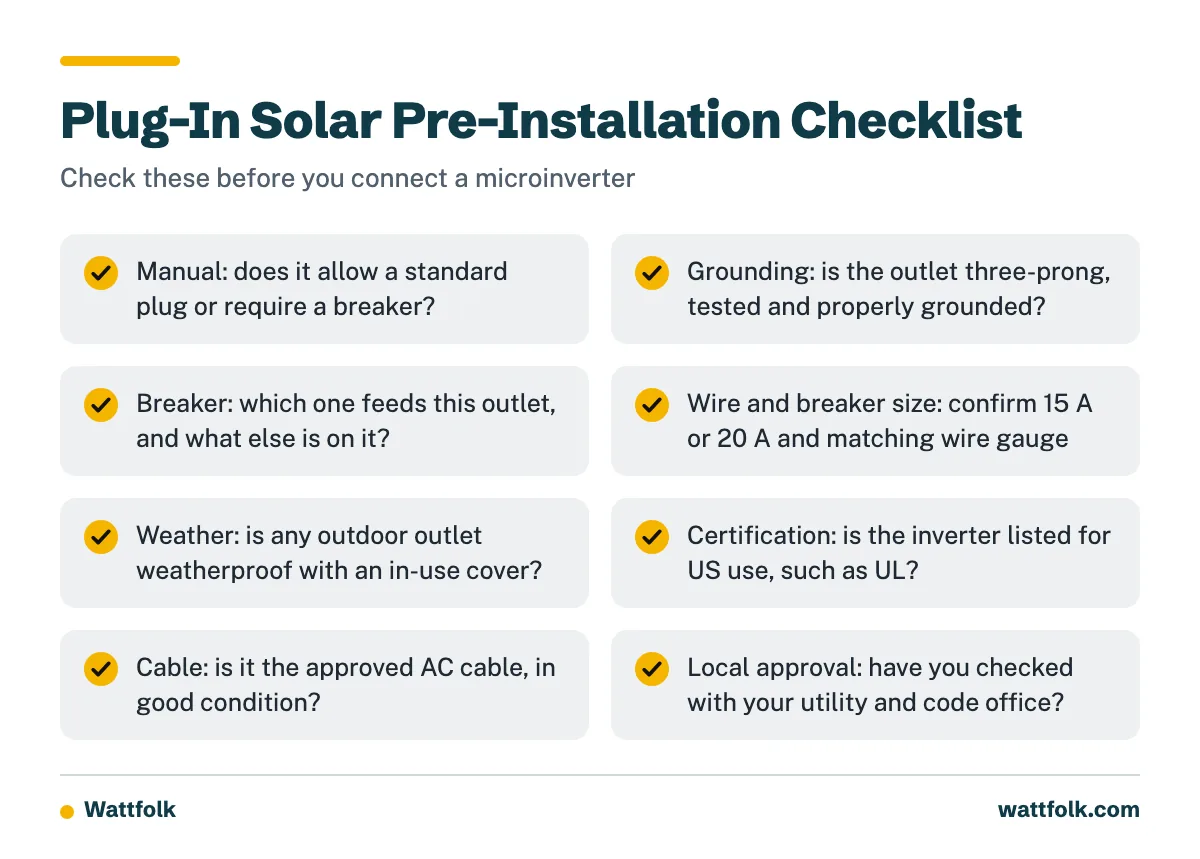
- Manual: Does it allow a standard plug, or require a breaker?
- Outlet grounding: Is it a three-prong, tested and properly grounded?
- Breaker identification: Which breaker feeds this outlet, and what else is on it?
- Wire and breaker size: Confirm 15 A or 20 A and the matching wire gauge.
- Weather protection: Is any outdoor outlet weatherproof with an in-use cover?
- Inverter certification: Is it listed for US use?
- Cable rating: Is the AC cable the approved one, in good condition?
- Local approval: Have you checked with your utility and local code office?
Who should install or inspect a plug-in solar connection?
A licensed electrician should handle anything beyond plugging in a listed kit on a verified outlet. That includes a new dedicated circuit, a breaker or AC disconnect, an outdoor receptacle, or any outlet you cannot confirm is grounded. Renters should ask the landlord first, since the wiring is not theirs to change. The electrician’s job is to make sure the final connection matches the manual and local code.
Frequently Asked Questions
Does plug-in solar need a dedicated circuit?
Not always. A small kit may use a suitable, grounded existing outlet if the manual and local rules allow it. Higher-output systems, outdoor installs and shared circuits often call for a dedicated circuit.
Can I plug a solar microinverter into a normal wall outlet?
Only if that specific model is designed for it. Some connect through a standard outlet with a specified AC cable. Others need a branch-circuit breaker and fixed wiring.
Can the outlet share a circuit with appliances?
It can, but it is not ideal. The breaker does not see inverter current, so loads beyond the inverter can overload the wire without a trip. A dedicated circuit removes that risk.
Can I use an extension cord or power strip with plug-in solar?
No. Use the approved AC cable plugged directly into a proper outlet. Have an electrician add an outlet if the cable cannot reach.
Are plug-in solar systems legal under local electrical codes?
That varies by state and locality, and rules change fast. Confirm with your utility and building department before connecting.
Who should install or inspect a plug-in solar connection?
A licensed electrician, for any new circuit, breaker, disconnect or outdoor receptacle, or if you cannot verify the outlet’s grounding.
Sources