The United States has no single federal rule that makes plug-in solar legal or illegal. Whether you can plug a panel into a wall outlet depends on your state law, your utility’s interconnection rules, local electrical code, your equipment, and your lease or HOA.
Quick answer
Plug-in solar is not simply legal or illegal nationwide. Some states have passed laws that expressly address it. In many places, the utility still decides whether you must notify it or apply. Check your utility before you connect anything.
- Best for renters: a portable off-grid battery system, plus landlord approval
- Best for homeowners in a plug-in state: a certified grid-connected kit, after utility confirmation
- Best for unclear rules: a licensed electrician and a permanent system
- No federal law governs plug-in solar. State statutes, utilities, and local codes do.
- A state with no ban is not the same as a state that gives permission.
- Some state laws use a limit near 1,200 watts, but limits and effective dates vary.
- A UL-listed product helps, but it does not override utility, lease, or HOA rules.
- A law that is signed but not yet in effect is not current permission.
- California, Texas, and Florida all require checking your specific utility.
- What plug-in solar is and how backfeeding works
- Who decides if plug-in solar is legal?
- Is plug-in solar legal in California?
- Is plug-in solar legal in Texas?
- Is plug-in solar legal in Florida?
- What states allow plug-in solar?
- Why is plug-in solar not legal in some places?
- Do I need utility permission?
- Does a UL-listed microinverter make it legal?
- Can a renter use plug-in solar?
- Which system type fits your situation?
- What should I check before connecting?
- What do owners say?
- Frequently Asked Questions
What plug-in solar is and how backfeeding works
Plug-in solar, also called balcony solar, is a small panel set with a microinverter. The inverter turns the panel’s DC power into 120-volt AC power. You connect it to a standard outlet, and the power flows into your home’s wiring.
Your appliances use that power first. The fridge, router, and lights pull less from the grid while the sun shines. That flow into house wiring is called backfeeding. It is the reason the law cares.
A system that sends power through household wiring can be treated as grid-connected generation. This is true even when it uses an ordinary wall outlet. The plug does not change the category.
Who decides if plug-in solar is legal?
Several layers decide, and each can say no. Here they are in order.
- Federal: No single plug-in solar rule exists.
- State: Some states have statutes that expressly address plug-in solar. Others are silent.
- Utility: Utilities set interconnection rules. They may require notice or an application, even for small systems. Rules can differ between utilities in the same state.
- Local code: Cities and counties enforce electrical code and permits.
- Property: Your lease, HOA, or building owner can ban it on their own terms.
Many web pages treat “no state ban” as “allowed.” That is a mistake. Silence in state law can still leave utility rules in force. Treat each layer as a separate gate.

Is plug-in solar legal in California?
Do not assume it is. California utility interconnection is commonly tied to CPUC Electric Rule 21, which covers generation that connects to the grid. Whether a plug-in kit fits under that rule, or under a newer plug-in-specific law, must be verified before you buy.
Pending bills are not permission. A bill that is signed but not yet effective is not permission either. Look up the current statute text and your utility’s page. Your utility might be Pacific Gas and Electric, Southern California Edison, San Diego Gas and Electric, or a municipal utility. Each may handle small systems differently.
Is plug-in solar legal in Texas?
Texas has no single statewide plug-in solar permission that automatically applies to every utility. The provider’s own rules must be checked.
This matters because the state has both regulated and deregulated areas. In deregulated areas, one company delivers power to your home. A different retail company sells you the electricity. The interconnection rules usually come from the delivery utility, so start there. Your retail plan may also affect whether you get credit for exported power. Many plug-in systems are sized to offset your own use and send little to the grid.
Call the delivery utility named on your bill. Ask about notification, application, and any approved equipment list.
Is plug-in solar legal in Florida?
Florida also has no single statewide plug-in permission that covers every utility. Approval depends on your provider, its net-metering terms, and local requirements.
Florida’s strong sun makes plug-in solar tempting. But sunshine does not change the paperwork. Investor-owned utilities, municipal utilities, and co-ops can each have different processes. Local building departments may also have a say. Confirm with your utility before connecting, and ask your city or county whether a permit applies.
What states allow plug-in solar?
The honest answer is that it depends on the date and on what you mean by “allow.” Some states have enacted laws that expressly address plug-in solar and commonly use a system limit around 1,200 watts. The exact limit and effective date vary by state.
Which states have plug-in solar laws in force? That list changes often. State lists online also tend to mix four different things: enacted laws, laws signed but not yet effective, proposed bills, and informal utility policies. Only the first group is clear current permission. For an up-to-date view, compare trackers such as Plug and Sun’s state law tool and this state-by-state legality page. Then confirm with the statute text and your utility.
| Location | Statewide statute? | Typical wattage limit | Utility notice? |
|---|---|---|---|
| California | Verify current law and effective date | Verify | Check your utility; Rule 21 commonly applies |
| Texas | No single statewide permission | Set by each utility | Check your delivery utility |
| Florida | No single statewide permission | Set by each utility | Check your utility |
| States with express plug-in laws | Yes, if in effect | Often around 1,200 W; varies | Varies by law and utility |
Treat the table as a starting map, not a green light.
Why is plug-in solar not legal in some places?
Often it is not banned. It is just not approved. Utilities and code writers raise several concerns.
- Worker safety. Lineworkers expect dead lines during an outage. A system that keeps feeding power could harm them. This risk is called islanding.
- Exposed plug pins. A cord that carries live power at the plug end is a shock risk if it is unplugged.
- Circuit overload. Generation plus household loads on one branch circuit can exceed the wiring rating.
- Tracking. Utilities want to know what generation is on their grid.
- Old rules. Many interconnection rules were written for rooftop systems with permits and inspections.
This is why some systems face rejection even though they look harmless.
Do I need utility permission before plugging in a solar panel?
If the system backfeeds through house wiring, assume yes until your utility says otherwise. Utilities may require notification or an interconnection application for systems that backfeed the grid, including small ones. Requirements can differ between utilities in the same state.
Some state laws reduce or remove the application step for qualifying systems. Others still expect a notice. Do not guess. Contact the utility, ask what applies at your address, and keep the answer on file.
Does a UL-listed microinverter make plug-in solar legal?
No. Certification is one gate, not all of them. UL 3700 is a standard that can be required by an applicable law or program. A listing shows the product met safety testing. It does not override utility, building, lease, or HOA rules.
This is a common surprise. Owners report buying a certified product, then learning it was not automatically authorized for grid connection where they live.
Here are the three equipment types people mix up.
| Type | Connects to house wiring? | Usual approval path |
|---|---|---|
| Certified plug-in system | Yes, through an outlet | State law, utility notice or application, local rules |
| Portable off-grid battery system | No | Mostly property rules; fewer utility issues |
| Uncertified inverter tied to house wiring | Yes | Likely unapproved; avoid |
Look for anti-islanding. This means the microinverter shuts off when grid power drops. Never bypass or defeat that grid shut-off. It protects utility workers and your home.
Worked example: why 1,200 watts may not qualify
Say a rule caps systems at 1,200 watts. You buy four 400-watt panels and a microinverter rated at 1,200 watts AC output.
- Panels: 4 × 400 W = 1,600 W DC.
- Inverter: 1,200 W AC.
If the rule counts inverter output, you may fit under the cap. If it counts panel nameplate watts, you are at 1,600 W and may not qualify. The wording of the law decides it. Equipment certification, circuit limits, and your utility’s own threshold can still change the answer.
Output is lower than the label anyway. Assume 1,200 W of panels, 4 peak sun hours a day, and 20% system losses (a 0.80 factor).
- 1,200 W × 4 hours × 0.80 = 3,840 Wh, or 3.84 kWh a day.
- 3.84 kWh × 365 = about 1,402 kWh a year.
- At the national average near 17 cents per kWh: about $238 a year.
- At 12 cents: about $168. At 40 cents: about $561.
These figures assume you use all of the power at home. Shade and balcony direction can cut them. Redo the math with your own sun hours and rate.

Can a renter or apartment resident use plug-in solar?
Sometimes. Electrical legality and property permission are separate questions. The utility may allow it while your landlord says no.
- Lease: Read it for rules on balcony attachments, wiring changes, and modifications.
- Landlord or building owner: Get approval in writing.
- HOA: Many HOAs control what hangs on a balcony or wall.
- Insurance: Ask your insurer whether an unapproved system could affect a claim.
- Building code: Balcony railings and fire rules may limit mounting.
Renters often have the simplest path with a portable off-grid battery system. It does not backfeed the home’s wiring, so utility rules usually matter less. Landlord and HOA rules can still apply.
Which system type fits your situation?
If you rent and want the least friction: choose a portable off-grid battery system. Get landlord OK for any mounting. Utility approval is usually not the main hurdle.
If you own or have permission and your state and utility allow it: choose a certified grid-connected plug-in system. Confirm the utility path, wattage limit, UL certification, and outlet condition.
If your utility says no, or you want more power: choose a permanent rooftop system. Expect permits, a licensed installer, and a formal interconnection application.
What should I check before connecting a plug-in solar system?
Work through this list in order. Stop if any answer is no.
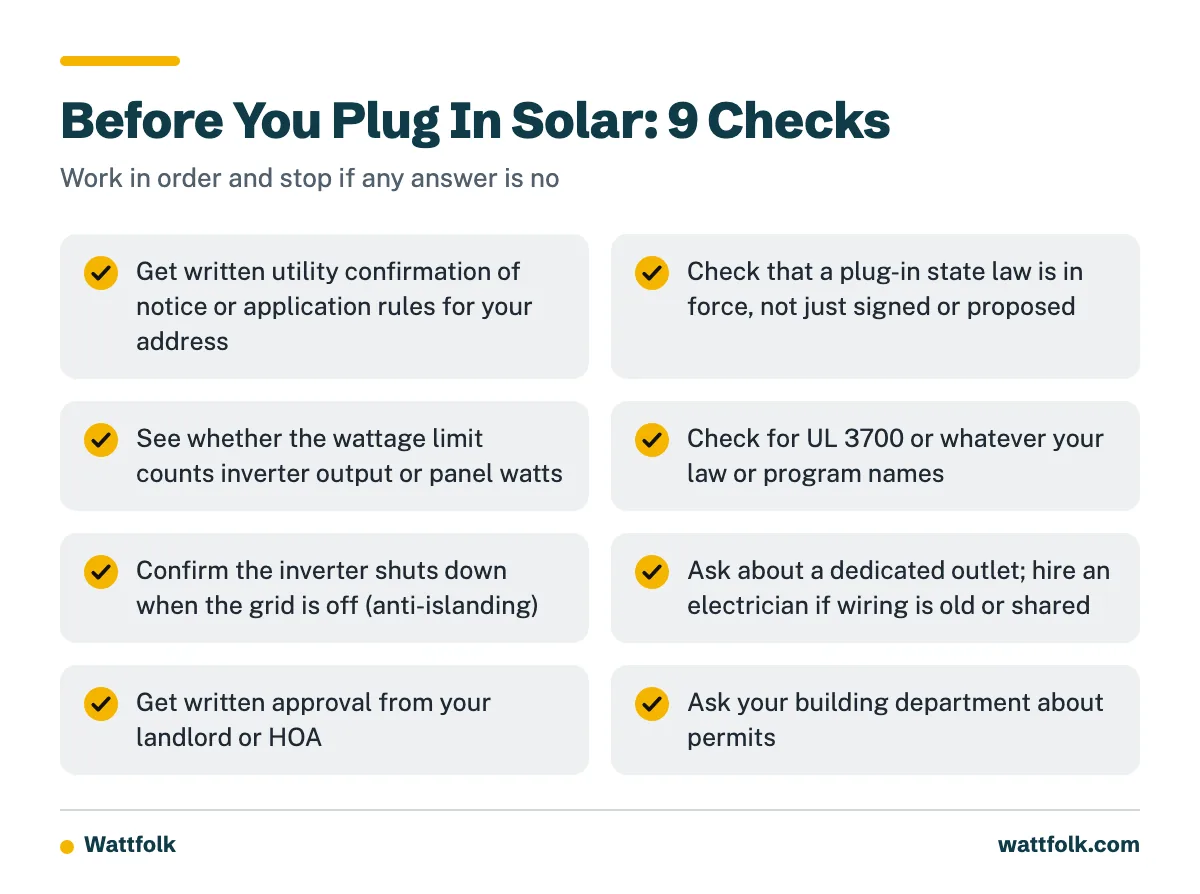
- Utility confirmation. Get written confirmation of notice or application rules for your address.
- State law. Check whether a plug-in statute is in force, not just signed or proposed.
- Wattage limit. See whether the law counts inverter output or panel watts.
- Certification. Check for UL 3700 or whatever your law or program names.
- Anti-islanding. Confirm the inverter shuts down when the grid is off.
- Outlet and circuit. Ask about a dedicated outlet. Hire a licensed electrician if the wiring is old or shared.
- Landlord or HOA. Get written approval.
- Local inspection. Ask your building department about permits.
- Insurance. Tell your insurer if required.
For more state-level background, see this plug-in solar legislation tracker. Use it as a lead, then verify at the source.
What do owners say?
Owners like
- Easy installation without roof access or a full rooftop-solar project
- Useful for renters and apartment residents when landlord and utility rules permit it
- Small-scale daytime energy production from a balcony, yard, or sunny wall
- Lower upfront complexity than a conventional rooftop installation
Common complaints
- Rules and approval requirements are unclear and vary by utility
- Energy production is often lower than expected because of shade, balcony orientation, and limited panel size
- Apartment, landlord, and HOA restrictions can block installation even where utility rules allow it
- Some systems need extra safety equipment, a dedicated outlet, or an electrician
- A certified product is not automatically authorized for grid connection in your location
Summarised from owner reviews and long-term user reports; individual experiences vary.
Frequently Asked Questions
Is plugin solar legal in California?
It depends on the current statute and your utility. California utility interconnection is commonly tied to CPUC Electric Rule 21. Verify any plug-in-specific law and its effective date, then confirm with your utility before connecting.
Is plugin solar legal in Texas?
Texas has no single statewide permission that covers every utility. Check the rules of your delivery utility, especially in deregulated areas where the retailer and the delivery company differ.
Is plugin solar legal in Florida?
Florida has no one statewide plug-in permission either. Your utility’s approval process, net-metering terms, and local requirements decide. Ask your provider and your local building department.
What states is plug in solar legal?
Some states have enacted laws that expressly address plug-in solar, often with a limit around 1,200 watts. The list and the effective dates change often. Confirm in the statute text and with your utility.
Which states is plug in solar legal?
Look for states where a plug-in law is in force, not merely signed or proposed. Even then, utility, building, and lease rules can still apply. A guide like this balcony solar overview can help you start, but verify the details yourself.
Why is plug in solar not legal?
In many places it is not banned, only unapproved or unclear. Concerns include lineworker safety, islanding, exposed plug pins, circuit overload, and rules written for permitted rooftop systems. Requirements vary, so check your utility.
Sources