
Plug-in solar and a Tesla Powerwall do not simply connect. A plug-in kit pushes power into a wall outlet through a microinverter, and a Powerwall cannot be charged from a standard outlet. The right way to add solar to a Powerwall is a permitted, hardwired installation.
Quick answer
No, you cannot plug panels into an outlet to charge a Powerwall. Solar reaches a Powerwall through a hardwired system tied to your electrical panel and Powerwall Gateway. Plug-in kits can still lower your bill, but they run separately from the battery.
- Best for charging a Powerwall: hardwired solar by a licensed installer
- Best for renters or small budgets: a plug-in kit or portable power station
- Plug-in solar and hardwired solar-plus-storage are two different categories.
- Powerwall 2 is AC-coupled. Powerwall 3 has a built-in solar inverter.
- Grid-tied microinverters shut off during outages, so a plug-in kit will not power your home.
- An 800 W kit adds only about 3 kWh a day. A Powerwall holds 13.5 kWh.
- Rules change fast. Confirm your state’s rules with your utility.
- What Is Plug-In Solar?
- Can I Plug Solar Panels Into a Wall Outlet and Charge a Tesla Powerwall?
- How Does a Powerwall Actually Receive Solar Power?
- Is Plug-In Solar Legal in My State?
- What Happens to Plug-In Solar During an Outage?
- Can I Add Third-Party Solar Panels or Inverters to a Powerwall?
- What Do I Need Installed to Add Solar to a Powerwall?
- How Much Does It Cost Compared With a Plug-In Kit?
- Are There Safety Risks?
- Low-Cost Alternatives With Battery Storage
- Decision Checklist
- Frequently Asked Questions
What Is Plug-In Solar and How Does It Differ From a Standard Rooftop System?
Plug-in solar is a small kit, usually one to four panels, with a microinverter that turns panel power into household AC. You plug it into a wall outlet, and the power feeds your home’s circuits. Kits are typically 400 to 800 W.
A standard rooftop system is different. It is wired into your main panel by a licensed electrician, permitted by your city, and approved by your utility. It often runs 6,000 W or more. Many web pages blur these two categories. They are not the same product, and they do not follow the same rules.
Can I Plug Solar Panels Into a Wall Outlet and Charge a Tesla Powerwall?
No. A Powerwall does not charge from a standard outlet. It connects to your home through the Gateway and main panel, and solar must be wired into that system.
A plug-in kit is built to feed a nearby circuit, not to talk to a battery. The microinverter has no link to the Powerwall. Your home may use the kit’s power first, which cuts what you pull from the grid. But the kit does not fill the battery on purpose.
Worked example: 800 W kit vs a 13.5 kWh Powerwall
Here are the assumptions so you can redo the math: 800 W of panels, 4 peak sun hours, 80% system efficiency after losses, and 17 cents per kWh (near the U.S. national average from the Energy Information Administration).
- Daily output: 0.8 kW × 4 hours × 0.80 = about 2.6 kWh
- With little loss and good sun, output may reach 3 to 3.2 kWh
- Daily value: 2.6 kWh × $0.17 = about $0.44
- Powerwall capacity: 13.5 kWh, so the kit would need about 5 sunny days to fill an empty battery, even if every watt went to it
Your home also uses power during the day. In practice, the kit would offset that use first. It would not meaningfully fill a Powerwall.

How Does a Powerwall Actually Receive Solar Power?
It depends on the model. According to Tesla’s specifications, Powerwall 2 is AC-coupled. Powerwall 3 has an integrated solar inverter.
| Feature | Powerwall 2 | Powerwall 3 |
|---|---|---|
| Usable capacity | 13.5 kWh | 13.5 kWh |
| Continuous power | 5 kW | 11.5 kW |
| Solar connection | AC-coupled, needs a separate solar inverter or Tesla Solar | Built-in solar inverter, up to 20 kW of solar input, multiple MPPT inputs |
AC-coupled means solar is converted to AC first, then the battery converts it again to store it. A built-in inverter with MPPT inputs takes DC power straight from the panels. That is a cleaner path. Either way, an installer wires it in. Neither path uses a wall outlet.
Is Plug-In Solar Legal in My State?
It depends on your state, and the rules are changing. Utah passed HB 340 in 2025. It allows portable plug-in solar up to 1,200 W without an interconnection agreement, taking effect in 2026. Other states are looking at similar bills.
For context, Germany permits Balkonkraftwerk systems with up to 800 VA inverter output and simplified registration. That is not a U.S. rule, and it does not apply here.
In most states, plug-in kits still sit in a gray area. Some utilities expect an interconnection agreement for any grid-tied inverter. Call your utility before you buy, and ask about local permits too.
What Happens to Plug-In Solar During an Outage?
It shuts off. Grid-tied inverters must stop when the grid goes down, under anti-islanding rules such as UL 1741 and IEEE 1547. This protects line workers from power flowing back into a dead line.
A Powerwall can form a microgrid when the grid fails. But a plug-in microinverter is not set up to work with it. Do not count on a plug-in kit to run your home or help charge the battery during a blackout. Never try to bypass the microinverter’s grid shut-off. It is a safety feature, not a flaw.
Can I Add Third-Party Solar Panels or Inverters to a Powerwall?
Often yes, if the inverter is compatible and an installer wires it in. With Powerwall 2, a separate solar inverter or a Tesla Solar system supplies the solar. With Powerwall 3, panels connect to its built-in inverter, or an existing system can be coupled with it.
Compatibility depends on your Gateway version, your inverter model, and local code. Ask the installer to confirm before you buy equipment.

What Do I Need Installed to Add Solar to a Powerwall?
You need a licensed electrician or solar installer, a permit, and a utility interconnection approval. You also need a compatible Gateway, and often a Backup Switch or equivalent hardware, depending on the setup.
Questions to ask your electrician
- Which Gateway version do I have, and is it compatible with the new solar?
- Does my main panel have room and capacity for the added solar?
- Do I need a new or updated interconnection agreement?
- Does the system need rapid shutdown, and who supplies it?
- Who handles the permit and inspection?
- Will the system keep running in an outage?
How Much Does Adding Solar to an Existing Powerwall Cost Versus a Plug-In Kit?
A plug-in kit costs far less up front, but it does far less. Hardwired solar costs more and is the only route that charges your Powerwall. Exact prices vary by region and installer, so get at least two quotes.
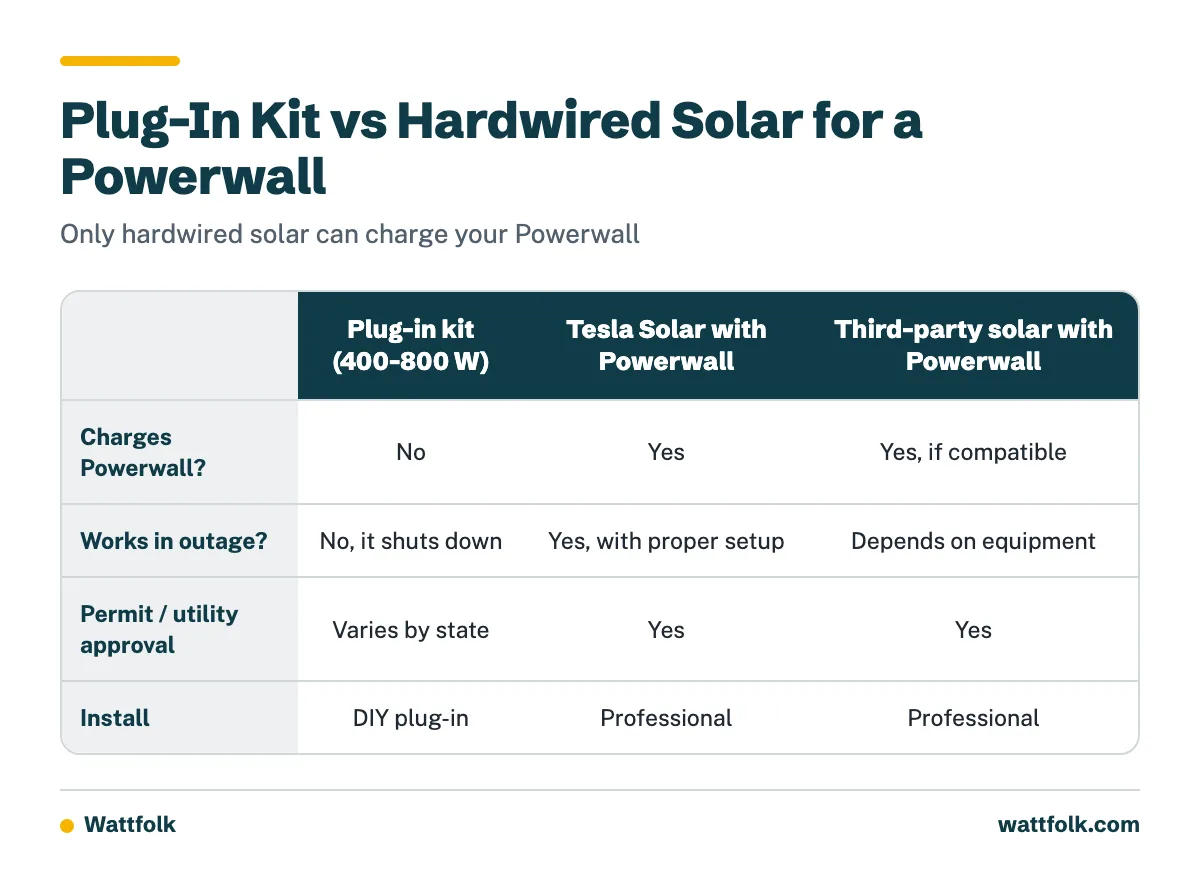
| Option | Charges Powerwall? | Works in outage? | Permit / utility approval | Install |
|---|---|---|---|---|
| Plug-in kit (400-800 W) | No | No, it shuts down | Varies by state; check your utility | DIY plug-in |
| Tesla Solar with Powerwall | Yes | Yes, with proper setup | Yes | Professional |
| Third-party solar with Powerwall | Yes, if compatible | Depends on equipment | Yes | Professional |
The federal 30% residential clean energy credit for solar and storage has been subject to legislative changes, with provisions ending after 2025. Check the current status with a tax professional before you count on it.
Are There Safety Risks of Backfeeding Through Outlets or Overloading Circuits?
Yes, if the setup is wrong. Outlet backfeed puts power onto a circuit that was designed to take power out. A certified plug-in kit has a microinverter that limits output and shuts off if the grid drops. A homemade setup does not.
- Never use an extension cord to connect solar to your home.
- Never bypass the microinverter’s grid shut-off.
- Do not add a plug-in kit to a circuit that is already near its limit.
- Use a licensed electrician for anything touching the panel, Gateway, or Powerwall.
What Are the Alternatives for a Low-Cost, Partial Solar Setup With Battery Storage?
The best low-cost option is a portable power station with its own solar input. You connect panels directly to the station, and it stores the power in its own battery. It does not touch your home’s wiring.
Small hybrid systems are another choice, but they usually need an installer. Renters can use a power station for lights, a laptop, and a router. It will not run a whole home like a Powerwall.
Decision Checklist: Can I Use My Panels or Kit With My Powerwall?
- If you want solar to charge your Powerwall: hire an installer for a hardwired system.
- If you already have panels and an inverter: ask an installer whether they are compatible with your Powerwall model and Gateway.
- If you own a Powerwall 3: ask about connecting panels to its built-in inverter.
- If you own a Powerwall 2: you need a separate solar inverter or Tesla Solar.
- If you rent or have a small budget: consider a plug-in kit (where allowed) or a portable power station.
- If you want backup power during outages: do not rely on a plug-in kit.
Frequently Asked Questions
Can I plug solar panels into a wall outlet and charge a Tesla Powerwall?
No. A Powerwall does not charge from a standard outlet. Solar must be wired into your panel and Gateway by a licensed installer.
Is plug-in solar legal in my state?
It depends. Utah’s HB 340 allows portable plug-in solar up to 1,200 W without an interconnection agreement, starting in 2026. Other states vary. Confirm with your utility before you buy.
Can I add third-party solar panels or inverters to a Powerwall?
Often yes, if the equipment is compatible with your Powerwall model and Gateway. An installer should confirm this first.
What happens to plug-in solar during a grid outage?
It shuts down. Anti-islanding rules (UL 1741 and IEEE 1547) require grid-tied inverters to stop when the grid fails.
How much does adding solar to an existing Powerwall cost versus a plug-in kit?
A plug-in kit costs much less but cannot charge the battery. Hardwired solar costs more, and prices vary by installer and region. Get multiple quotes.
What are the alternatives if I want low-cost solar with battery storage?
A portable power station with solar input is the simplest choice. It stores power on its own and does not connect to your home wiring.