Every plug-in solar panel makes DC power, and a certified microinverter converts it to AC that matches your home’s wiring, then shuts off the moment the grid goes dark. Safety also depends on listed equipment, a sound circuit, weather protection, secure mounting, and your utility’s rules.
Quick answer
Plug-in solar is safe when a certified microinverter converts the panel’s DC to grid-matched AC and stops output during an outage. Plug directly into a sound, inspected outlet. Never use extension cords. Confirm local rules with your utility first.
- Best for renters: check your lease and utility rules before buying
- Best for homeowners: have an electrician inspect the circuit
- The panel makes DC. The microinverter makes AC. Only the AC side connects to your outlet.
- Anti-islanding protection stops the system from feeding power into a dead grid, which protects utility workers.
- Never use extension cords, adapters, or power strips with plug-in solar.
- Panels stay live in daylight even when the system is switched off indoors.
- US rules vary by state and change fast. Confirm with your utility before you plug in.
- How does a plug-in solar panel generate electricity?
- How does the microinverter make plug-in solar safe?
- What happens to plug-in solar during a power cut?
- Can plug-in solar backfeed the grid and endanger utility workers?
- Can I plug a solar panel into any household outlet?
- Do I need an electrician to install plug-in solar?
- Can I use an extension cord, adapter, or power strip?
- How do I protect the system from rain?
- Safe mounting and fire risk
- What certifications and markings should the equipment have?
- A worked energy example
- Why batteries add risk
- What if something gets hot or damaged?
- Pre-installation safety checklist
- Frequently Asked Questions
How does a plug-in solar panel generate electricity?
A solar panel turns sunlight into direct current (DC) electricity. Light knocks electrons loose in the silicon cells, and they flow in one direction through the panel’s wiring.
Your home does not run on DC. It runs on alternating current (AC), which reverses direction 60 times per second in the US. That gap is why a plug-in system needs more than a panel and a cord.
Here is the path the power takes:
| Step | What happens | Type of power |
|---|---|---|
| 1. Sunlight | Light hits the panel cells | None yet |
| 2. Solar panel | Cells produce electricity | DC |
| 3. Short DC cables | Carry power to the microinverter | DC (live in daylight) |
| 4. Microinverter | Converts and syncs with the grid | AC |
| 5. Household outlet | Power enters the home circuit | AC |
| 6. Household loads | Fridge, router, lights use it first | AC |
| 7. The grid | Receives only any surplus | AC |
The key point: the DC side and the AC side are very different. Only the AC side ever touches your outlet.
How does the microinverter make plug-in solar safe?
The microinverter converts the panel’s DC into AC that matches your home’s voltage, frequency, and timing. It also watches the grid constantly and switches off if the grid fails or drifts out of range.
Three jobs matter for safety:
- Waveform matching. It copies the grid’s 60 Hz wave so the two sources do not fight.
- Output limits. It caps how much current it pushes into the circuit.
- Grid shut-off. It stops output when the grid is lost. This is called anti-islanding.
What happens to plug-in solar during a power cut?
A properly built system shuts off within moments of a grid outage, even in full sun. It will not run your home as a backup. Without a battery and special equipment, a plug-in system is not a backup power source.
The microinverter senses the loss of grid voltage and stops sending power. When the grid returns and stays stable, it waits and then restarts. Plug-in solar equipment must include this protection, according to the UK specification and Electrical Safety First guidance. In the US, listed grid-tied inverters follow the same principle under standards such as UL 1741.
Can plug-in solar backfeed the grid and endanger utility workers?
Yes, if the equipment lacks anti-islanding protection. That is why you should only buy certified equipment.
Picture a storm that knocks out a power line. Crews treat that line as dead and begin repairs. If a home system kept pushing power into the wiring, it could energize the line through the neighborhood transformer. This is called islanding. Anti-islanding protection prevents it by cutting output the instant the grid fails.
Small plug-in systems also change how your local network behaves. London Fire Brigade advises telling the local network operator within 28 days of installation in the UK. In the US, the equivalent step is contacting your utility. Many utilities require notice or an interconnection agreement. Confirm yours before you plug in. For background on how US codes are starting to address these systems, see this IAEI article on balcony PV and the code.

Can I plug a solar panel into any household outlet?
No. The outlet must be in good condition, on a suitable circuit, and not overloaded. Not every outlet meets that test.
Check these points:
- Condition. No scorch marks, loose plug fit, cracks, or warm cover plates.
- Grounding. The outlet should be properly grounded. Older homes may have ungrounded two-prong outlets.
- Circuit load. Most US outlet circuits are 15 A or 20 A at 120 V. A 400 W microinverter pushes roughly 3.3 A at 120 V (400 W divided by 120 V). Other loads on the same circuit still count.
- Protection. Check for a working breaker. Outdoor, bathroom, and garage outlets normally need GFCI protection. Ask an electrician how GFCI or AFCI devices interact with your inverter.
- Circuit type. Dedicated circuits for fixed appliances, such as an oven or dryer, are poor choices.
For scale, the UK interim product specification limits plug-in systems to 800 VA and 3.5 A at the mains. That is a UK limit on 230 V. It is not a US rule. US limits depend on your state, utility, and local code.
Do I need an electrician to install plug-in solar?
The plug-in part needs no wiring work. But a licensed electrician should check the circuit first, especially in an older home. Electrical Safety First advises a competent electrician check suitability before you buy or use plug-in solar panels.
Call an electrician if you see any of these:
- Two-prong or ungrounded outlets
- Aluminum wiring or an old fuse panel
- Outlets that feel warm, buzz, or spark
- No GFCI protection on an outdoor outlet
- You plan to add a new outdoor outlet
Renters should also get landlord approval in writing. A landlord can reasonably refuse changes to the building’s structure or wiring.
Can I use an extension cord, adapter, or power strip?
No. Plug the microinverter directly into a wall outlet. Electrical Safety First and London Fire Brigade both advise against extension leads, adapters, and overloaded sockets for plug-in solar.
Cords and strips can overheat. A cheap cord may not be rated for continuous current. A power strip adds contacts that can loosen and arc. If your panel cannot reach a suitable outlet, the answer is to have an electrician install one in the right place, not to add a cord.
| Safer practice | Unsafe shortcut |
|---|---|
| Certified, listed equipment from a known seller | Unknown imports with no listing mark |
| Weatherproof outdoor outlet with a proper cover | Cord fed through a window to an indoor outlet |
| Direct connection to a wall outlet | Extension cord, adapter, or power strip |
| Electrician-checked circuit | Assuming any outlet will do |
| Secure mounting with rated hardware | Panel leaned on a railing or tied with string |
| Utility notified | Silent installation |
How do I protect the panels, cables, inverter, and socket from rain?
Use outdoor-rated parts only, and keep every connection sealed and off the ground. Water and electricity are a bad mix, and loose plugs are a common weak point.
The UK specification requires outdoor plug-in components and connections to have at least IP55 ingress protection. London Fire Brigade recommends at least IP65 for outdoor sockets. IP ratings measure dust and water resistance. Higher numbers mean better protection. Read the London Fire Brigade safety advice for residents for their reasoning. US equipment uses NEMA or UL enclosure types instead. Look for outdoor-rated labels.
- Mount the microinverter off the ground, out of pooling water.
- Do not leave connectors lying on a wet balcony floor.
- Use a weather-resistant outlet cover that stays closed with the plug in.
- Keep cables from rubbing on sharp edges.
How should plug-in solar be mounted safely?
Treat the panel, mount, cables, and inverter as one system. A well-built electrical part still fails if the panel falls or the wiring cooks against a combustible surface.
- Wind load. Use hardware rated for the panel’s weight and local wind. A loose panel can become a falling object.
- Railing and wall strength. Check that the balcony railing or wall can hold the load.
- Clearances. Leave airflow behind the panel. Keep the inverter and cables away from wood, curtains, and stored items.
- Fire exits. Do not block escape routes or windows.
- Shared buildings. Check with building management. London Fire Brigade has separate advice for property owners and building managers that explains why.
What certifications and markings should plug-in solar equipment have?
Look for recognized safety listings on every component. In the US, that usually means a UL or similar nationally recognized lab mark.
- Microinverter: listed to UL 1741 (grid-connected inverter safety, including anti-islanding).
- Panel: certified to UL 61730 or UL 1703 safety standards.
- Plug and cord: listed and rated for outdoor use if outside.
- Enclosure rating: clear outdoor weather rating.
UK products use plugs built to BS 1363-1 for UK sockets. That does not apply to US outlets. If a seller cannot show listing documents, skip the product. Also confirm that your state and utility allow the product. Plug-in solar rules change quickly in the US, and a listed product is not always permitted for plug-in use everywhere.
A worked energy example: what does a 400 W panel really deliver?
A 400 W panel almost never delivers 400 W for long. That number is its rating under lab test conditions. Real output is lower because of sun angle, heat, shade, and system losses.
Assumptions (so you can redo the math): 400 W panel, 4.5 peak sun hours per day (a common US average, varies by location), 20% system losses, and electricity at 17 cents per kWh (near the national average from the U.S. Energy Information Administration).
- Daily energy: 400 W × 4.5 hours × 0.80 = 1,440 Wh, or 1.44 kWh.
- Yearly energy: 1.44 kWh × 365 = about 526 kWh.
- Value if you use all of it: 526 kWh × $0.17 = about $89 per year.
Now look at a single midday moment. Say the panel and inverter put out 300 W. Your fridge, router, and standby devices use 150 W. Those loads take the solar power first. Only the 150 W left over flows out to the grid, and many utilities do not pay for it. If your home uses more than the panel makes, the grid fills the gap and the savings are smaller than the panel’s rating suggests. Higher-priced states, near 40 cents per kWh, save more per kWh. Lower-priced states, near 12 cents, save less.

Why do batteries add extra risk?
Batteries store a lot of energy in a small space, and a fault can cause a fire. Lithium cells can overheat if they are damaged, overcharged, or poorly ventilated.
A battery also changes the electrical design. The system may need its own protection, wiring, and a transfer device. That is work for a licensed electrician and a listed system. Do not add a DIY battery to a plug-in kit.
What should I do if the cable, plug, inverter, or panel becomes hot or damaged?
Unplug it only if you can do so safely, then stop using it. If you see smoke, flames, or melting, leave and call 911.
- Warm plug or outlet: unplug the microinverter if the plug is not too hot to touch safely, or turn off the breaker. Have an electrician inspect the outlet.
- Cracked panel or damaged cable: keep away. Treat it as live. London Fire Brigade warns panels keep producing electricity in daylight even when the system is switched off indoors.
- Water ingress: turn off the breaker, do not touch wet connectors, and call a pro.
- Burning smell, buzzing, or scorch marks: stop use and get it checked before restarting.
Do routine checks every few months. Look for loose plugs, frayed cables, discoloration, rust on hardware, and loose mounts.
Pre-installation safety checklist
Print this list and tick each item before you plug in.
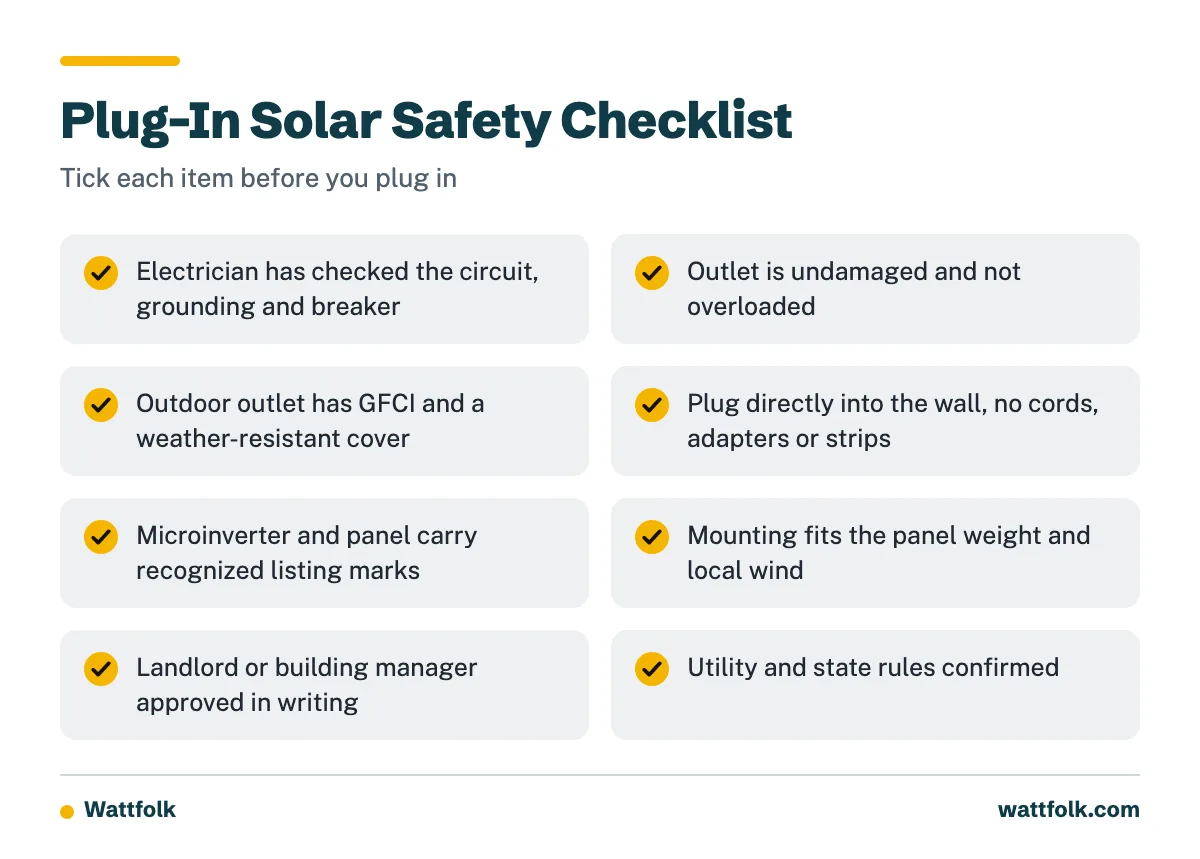
- ☐ An electrician has checked the circuit, grounding, and breaker.
- ☐ The outlet is undamaged and not overloaded.
- ☐ Outdoor outlet has GFCI protection and a weather-resistant cover.
- ☐ The panel connects directly to a wall outlet, with no extension cord, adapter, or power strip.
- ☐ Microinverter and panel carry recognized listing marks.
- ☐ Equipment has an outdoor weather rating.
- ☐ Mounting hardware fits the panel weight and local wind.
- ☐ Panel, inverter, and cables are clear of combustibles and exits.
- ☐ Landlord or building manager approved in writing.
- ☐ Utility and state rules confirmed, with any notice or agreement done.
- ☐ Output stops when the grid is off (confirmed in the product’s documentation).
- ☐ Emergency plan: breaker location known, 911 for smoke or fire.
Frequently Asked Questions
How does plug-in solar work safely when electricity is fed into a household socket?
A certified microinverter turns the panel’s DC into AC that matches the grid. It limits current and stops output when the grid fails. Safety also relies on a sound circuit, weather protection, secure mounting, and local rules.
Can I plug a solar panel into any household outlet?
No. The outlet and circuit must be in good condition, grounded, and not overloaded. Have an electrician check the circuit, especially in older homes.
Can I use an extension cord, adapter, or power strip?
No. Plug the microinverter directly into a suitable wall outlet. Cords and strips can overheat and loosen under continuous load.
What happens to plug-in solar during a power cut?
The microinverter shuts off within moments, even in bright sun. This protects utility workers. A plug-in system without a battery will not power your home in an outage.
Do I need an electrician to install plug-in solar?
The plug-in step needs no wiring, but a licensed electrician should check the circuit first. You need one for any new outlet, GFCI work, or battery.
Is plug-in solar legal everywhere in the US?
No. Rules vary by state and utility and change quickly. Contact your utility before buying, and get landlord approval if you rent.
Sources