
For most portable or window air conditioners, the practical plug-in solar solution is a portable power station with a pure-sine-wave inverter, at least 2,000W of continuous output, adequate surge capacity, and roughly 2,000Wh or more of battery storage, recharged by solar panels. None of the five Amazon listings below is a power station, so this guide ranks them by how useful they are to an AC-focused solar setup. The AIRGO soft starter is the most relevant pick, and the rest are small fans or grid-tie hardware that cannot run an air conditioner by themselves.
This guide is for renters, apartment residents, and homeowners who want backup cooling or lower grid use without a rooftop installation. Product details come from the Amazon listing titles, features, and specifications. Several listings include very little technical data, and that is noted where it matters.
Quick answer
Plug-in solar panels alone cannot reliably run an air conditioner. Pair a 2,000W+ pure-sine power station (about 2,000Wh or more) with solar panels. Of the listings here, the AIRGO soft starter is the only one that directly helps an AC run from solar, stored energy, or a generator.
- Best for central AC or heat pumps: AIRGO Soft Starter, lowers startup surge
- Best for balcony solar: 1200W Micro Inverter, grid-tied only
- Best for cheap ventilation: 25W Solar Fan, no AC replacement
Our Winner: Soft Starter for Air Conditioners & Heat Pumps (AIRGO, 16-32A)
Compressor startup surge is the main reason undersized solar systems fail to run an AC. This soft starter is built to ramp the compressor up gently, which lowers inrush current on generators, solar, and stored-energy systems. It is the only listed product that addresses the actual electrical problem. It is a 240V accessory, so it suits central AC and heat pumps, not typical 120V window units.
How We Compared These Models
We compared the listings on four criteria: direct relevance to running an AC compressor, power rating or electrical function, safety and compatibility details, and buyer ratings. Rankings rely on specifications, listing text, and displayed Amazon ratings, not hands-on use. Prices for some items are shown in GBP in the source data, so confirm the current USD price on Amazon.
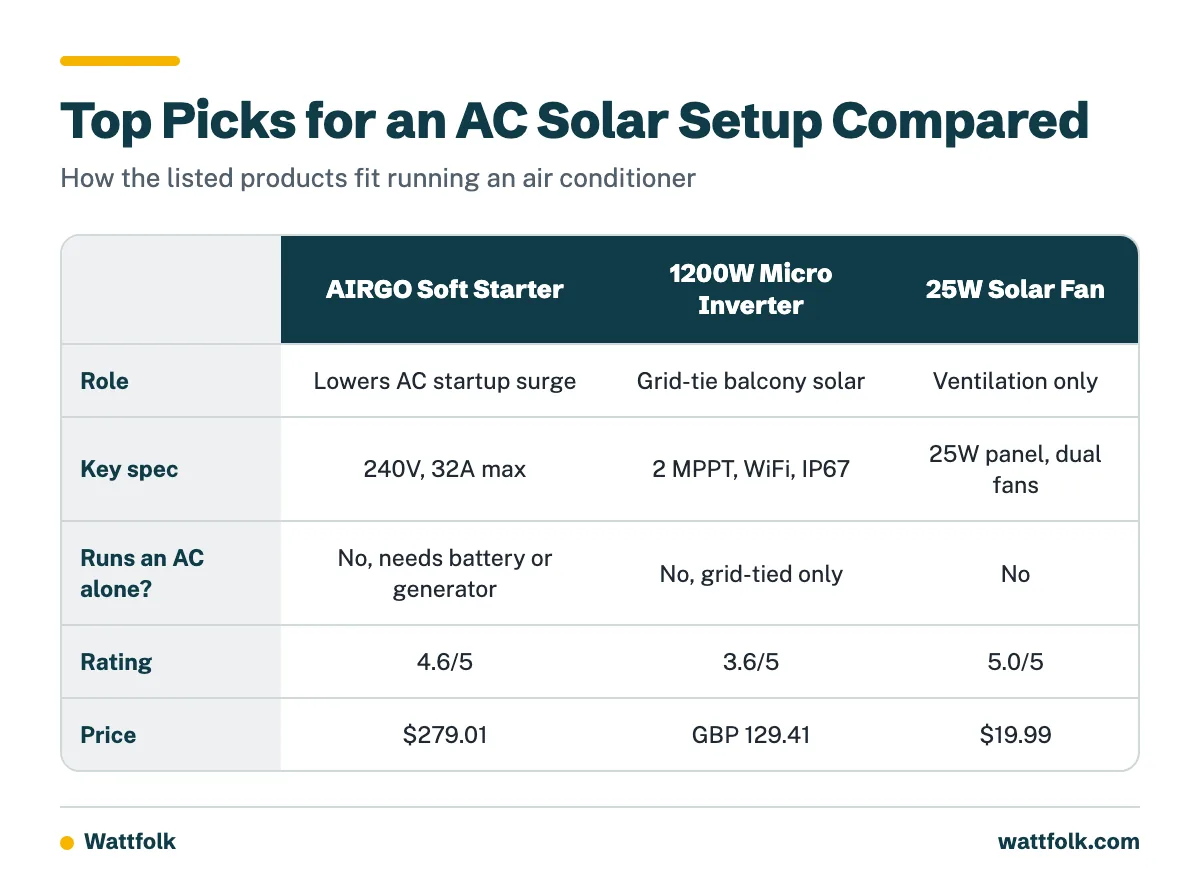
| Product | Key Specs | Our Choice | Action |
|---|---|---|---|
| AIRGO Soft Starter for AC & Heat Pumps | 240V, 32A max, reverse motor protection, 4.6/5, $279.01 | Editor’s Choice | |
| 1200W Micro Inverter, 2 MPPT, WiFi | Grid-tie, IP67, 16.4 ft AC cable, 3.6/5, GBP 129.41 | Best for Balcony Solar | |
| 25W Solar Fan, 2-Pack | 25W panel, dual fans, tempered glass, 5.0/5, $19.99 | Best Budget | |
| Solar Exhaust Fans, 15W Panel | 2 brushless DC fans, 36dB, 16.4 ft cable, 3.9/5, GBP 24.68 | Best for Portability | |
| Solar Cooler Car Window Fan | No specs listed, 2.1/5, GBP 34.48 | Proceed With Caution |
Can plug-in solar panels run an air conditioner directly?
Generally no. An AC compressor needs hundreds to thousands of watts of steady power plus a startup surge, while a few balcony panels deliver a variable output that drops with clouds and shade.
Plug-in balcony systems use a grid-tie micro inverter. It feeds solar power into household wiring and follows the grid, so it can offset what your AC draws but is not a dedicated supply. If the grid goes down, a standard grid-tie inverter shuts off for safety. That is why this guide treats a battery power station as the real answer for AC backup.
Plug-in solar versus a solar generator: which use case are you solving?
These are three different jobs, and the equipment differs for each.
- Emergency cooling from a battery station: The power station runs the AC from stored energy. Solar is optional and only recharges it.
- Solar-assisted daytime operation: Panels feed a power station while the AC runs. Output must be large enough to cover a meaningful share of the load.
- Grid-connected balcony generation: A micro inverter pushes power into the home circuit. It reduces grid consumption, including AC use, but does not power anything in an outage.
How many watts does a portable or window air conditioner actually use?
Most small units draw roughly 450W to 1,200W while the compressor runs, and central systems draw several times more. The nameplate on the unit is the authoritative number. The table below uses the 0.8 to 0.9 usable-energy range for a 2,000Wh station, and the wattages are planning estimates, not measurements.
| AC Type | Typical Running Watts | Recommended Inverter | Minimum Battery | Runtime from 2,000Wh |
|---|---|---|---|---|
| 5,000 BTU window | About 450W | 1,200W+ continuous, 2,000W surge | 1,000Wh | 3.6 to 4.0 hours |
| Small portable | About 600W | 1,500W continuous, 3,000W surge | 1,500Wh | 2.7 to 3.0 hours |
| 8,000 BTU window | About 700W | Above 1,500W continuous | 2,000Wh | 2.3 to 2.6 hours |
| 10,000 BTU portable | About 1,000W | 2,000W+ continuous | 2,000Wh | 1.6 to 1.8 hours |
| 12,000 BTU portable | About 1,200W | 2,400W+ continuous or higher surge | 3,000Wh | 1.3 to 1.5 hours |
| Central AC | 3,000W to 5,000W+ | 240V whole-home system | Several kWh | About 0.5 hour or less |
What size solar generator do I need for a 5,000-, 8,000-, or 12,000-BTU AC?
A 5,000-BTU unit can run on a station around 1,000Wh to 2,000Wh. An 8,000-BTU unit generally needs a station rated above 1,500W, and larger 10,000 to 16,000-BTU units may need roughly 2,000W to 3,500W or more. These figures follow common manufacturer sizing guidance, such as this solar generator sizing guide for air conditioners.
One verified data point: a 2,048Wh battery at about 85% usable energy can run a 600W portable AC for roughly 2.9 hours, and a 450W 5,000-BTU window unit for about 3.9 hours.
What inverter continuous and surge ratings are required for an AC compressor?
Plan for continuous output at or above the AC’s running watts and surge capacity of about twice that figure. One manufacturer sizing guide recommends at least 2,400W of surge for a 1,200W air conditioner.
Many roundups quote battery capacity without checking whether the inverter can handle compressor startup. Look for the locked-rotor or startup requirement on the AC nameplate, and choose a pure-sine-wave inverter. A soft starter, like the AIRGO unit reviewed below, can lower the surge a larger 240V compressor demands.
How much battery capacity is needed to run an AC for 2, 4, or 8 hours?
Use this formula: runtime equals battery watt-hours multiplied by 0.8 to 0.9, divided by average AC watts. A 2,000Wh station and a 500W AC yields roughly 3.2 to 3.6 hours after losses.
Reversed, the battery you need is the AC watts multiplied by hours, divided by about 0.85. For a 500W average load:
- 2 hours: about 1,200Wh
- 4 hours: about 2,350Wh
- 8 hours: about 4,700Wh
Without losses, a 2,000Wh station powering an 800W AC lasts about 2.5 hours, and planning should reduce that by roughly 10% to 20%. A 1,264Wh station is estimated to run a 500W AC for about 2 hours and a 1,000W AC for about 1 hour. Hot weather, a dirty filter, and continuous compressor operation all shorten these numbers.
Is a 1,000Wh, 2,000Wh, or 3,000Wh power station the better choice?
For most window and portable ACs, 2,000Wh is the practical starting point. A 1,000Wh station suits only a small 5,000-BTU unit for a short stretch. A 3,000Wh station suits 10,000 BTU and larger units, or anyone who wants a full evening of cooling.
Bigger batteries also weigh more, which matters for apartments and for moving the unit during an outage.
How many solar panels are needed to recharge the battery while the AC is operating?
To run an AC from solar in real time, panel output must roughly match the AC’s average draw, which usually means 400W to 1,000W of panels. As a planning estimate, 400W of panels in 4 to 5 peak sun hours produces about 1,600Wh to 2,000Wh before losses, and shade or cloud cover cuts that further.
Check the power station’s maximum solar input rating. A station that accepts only 200W to 400W of solar will recharge slowly no matter how many panels you own.
Can a solar generator run a central air-conditioning system?
Not a typical portable one. Central AC runs on 240V with much higher running and starting loads than a window unit. Running it needs a large home battery system or generator, a transfer switch installed by a licensed electrician, and often a soft starter to reduce inrush current.
Are plug-in balcony solar systems legal and safe for apartments?
It depends on your jurisdiction, your utility, and your lease. Rules vary by country and state, so get landlord permission and check local electrical requirements before installing anything.
Plug-in solar installations may require equipment meeting applicable product-safety standards, and balcony-approved products must follow their stated installation limits. In the US, look for inverters listed to UL 1741. The London Fire Brigade plug-in solar safety advice specifies at least IP65 for an outdoor socket and advises notifying the local network operator within 28 days in applicable UK installations.
What safety features and certifications should buyers check before connecting an AC?
- Pure-sine-wave output, to protect compressor motors and electronics.
- Continuous and surge ratings that exceed the AC’s running and startup needs.
- Overload, short-circuit, over-temperature, and low-voltage protection.
- Recognized safety listings such as UL or ETL on the power station and inverter.
- A grounded outlet and a heavy-gauge extension cord rated for the load.
- A weather-protected socket if any connection is outdoors.
For more on how solar generators pair with portable ACs, see this solar generator and portable AC guide.
Sizing checklist and worked outage example
Record these before you buy:
- AC nameplate running watts and amps.
- Locked-rotor or startup requirement.
- Desired runtime in hours.
- Solar input rating of the power station.
- Outlet voltage, 120V or 240V.
Example: An 8,000-BTU window AC averages 700W while running, but the compressor cycles, so assume a 60% duty cycle, or about 420W average. For an 8-hour night, 420W times 8 hours is 3,360Wh, divided by 0.85 gives about 3,950Wh of battery. A 2,000Wh station would cover roughly four hours of that night. Solar panels could extend the evening use, but only if the daytime recharge is realistic.
What about noise, portability, battery chemistry, and warranty?
Large stations are heavy, and their fans can be audible under AC load. LiFePO4 chemistry generally offers a longer cycle life than older lithium types, but confirm the warranty length and service support before buying. These details matter more than a headline capacity figure.
In-Depth Reviews

1. Soft Starter for Air Conditioners & Heat Pumps – Editor’s Choice
Our Verdict: The most relevant product in this group, because it tackles startup surge, the main failure point for AC on solar or generator power.
- Brand: AIRGO
- Operating Voltage: 240 volts
- Current Rating: 32 A
- Dimensions: 5.5 x 3 x 2.17 inches
- Connector Type: Clamp
- Material: Plastic
Based on the listing, this soft starter ramps up the compressor to lower inrush current and reduce electrical stress. It is marketed for generators, solar, stored energy, and weak grid conditions, and it works with heat pumps in both cooling and heating modes. It also advertises reverse motor protection when switching between generator and utility power.
The 240V, 16 to 32A rating means it targets central AC and larger heat pumps, not a 120V window unit. It does not store or generate energy, so you still need a suitable battery or generator. Installation involves wiring, so a licensed electrician is the safer route.
Why We Like It
- Lowers startup surge, which helps smaller inverters and generators.
- Supports heat pumps year-round without adjustment, per the listing.
- Strong 4.6/5 rating.
- Reverse motor protection when switching power sources.
Pros & Cons
Pros
- Addresses compressor inrush directly
- Compatible with generator and stored-energy setups
- Compact size
Cons
- $279.01 is a notable cost
- Not for 120V window ACs
- Does not supply power on its own

2. 1200W Micro Inverter, 2 MPPT Grid Tie – Best for Balcony Solar
Our Verdict: A reasonable fit for grid-connected balcony generation that offsets household use, including AC, but not a stand-alone AC power source.
The listing describes a grid-tie inverter with two MPPT inputs, WiFi app control, an IP67 waterproof rating, and a 16.4 ft AC cable. The source data provides no further features or specifications, so confirm what is included, whether panels are part of the kit, and what grid voltage it supports. The GBP price suggests a UK-market listing, so US buyers should verify compatibility with 120V/240V service and UL 1741 listing.
A grid-tie inverter generally depends on grid power to operate. It will not keep an AC running in an outage, and it does not charge a battery. Its value is reducing the electricity you buy while the AC runs in daylight.
Why We Like It
- Two MPPT inputs for flexible panel layouts.
- IP67 rating for outdoor mounting.
- WiFi monitoring through an app.
Pros & Cons
Pros
- Plug-and-play design for balcony systems
- Weather-resistant housing
- App monitoring
Cons
- 3.6/5 rating
- Limited specification detail in the listing
- No backup power during outages
- Local rules may restrict use

3. Solar Fan for Greenhouse, 25W, 2-Pack – Best Budget
Our Verdict: A low-cost way to ventilate a coop, shed, or greenhouse with solar power. It is not a substitute for air conditioning.
The listing describes a 25W monocrystalline panel measuring 15.35 by 13.0 inches, a dual-fan design, and a tempered glass surface for weather resistance. It is marketed to keep working at dusk, dawn, and on cloudy days. The 5.0/5 rating is perfect, but the data does not show how many reviews support it, so treat it cautiously.
Why We Like It
- 25W panel is larger than the 10W and 15W alternatives, per the listing.
- Tempered glass panel for weather resistance.
- $19.99 price.
Pros & Cons
Pros
- Very affordable
- No battery or wiring to an outlet
- Separate or combined installation
Cons
- Moves air, does not cool it
- Cannot power an AC
- No technical specs in the data beyond panel size

4. Solar Exhaust Fans with 15W Panel – Best for Portability
Our Verdict: The most flexible small solar fan kit here, thanks to a long cable and a USB adapter, but it only ventilates.
The listing cites a 15W panel, two brushless DC fans with 4 x 120.5 CFM airflow, 3200 RPM, and 36dB noise. It includes a 16.4 ft extension cable, a separate on/off switch, and a USB adapter cable. The listing states that it cannot store electricity and that clouds or shadows greatly reduce performance. Its 3.9/5 rating is middling.
Why We Like It
- 16.4 ft cable lets the panel sit away from the fans.
- Quiet at 36dB, per the listing.
- Pre-drilled panel holes for easy mounting.
Pros & Cons
Pros
- Flexible placement
- Low noise
- Manual switch
Cons
- No energy storage
- Weak output in shade
- Does not cool air

5. Solar Cooler Car Window Solar Powered Car Air Conditioning – Proceed With Caution
Our Verdict: The weakest option here. The listing offers no features or specifications, and its 2.1/5 rating signals dissatisfied buyers.
Despite the title, a small solar-powered window device should not be mistaken for a true air conditioner, which requires a compressor and far more power than a small panel provides. With no wattage, airflow, or panel data in the listing, there is no way to verify what it does.
Why We Like It
- Low price at GBP 34.48.
- Simple concept for venting a parked car.
Pros & Cons
Pros
- Inexpensive
- No wiring required
Cons
- 2.1/5 rating
- No specifications provided
- Cannot cool like an AC
What do owners say?
Owners like
- Portable power stations are convenient for short outages because they provide ordinary AC outlets without fuel or exhaust.
- Large-capacity models can run small window or portable AC units for several hours.
- Solar input can extend daytime cooling and reduce dependence on grid charging.
- Pure-sine-wave output suits sensitive electronics and compressor-based appliances.
Common complaints
- Air conditioners drain portable power-station batteries quickly, especially at 800W to 1,500W loads.
- Advertised runtime is often longer than real use once inverter losses, hot weather, and continuous compressor operation are included.
- Large units are heavy and difficult to move, reducing their usefulness in apartments or during outages.
- Solar recharging can be slow in shade, clouds, or limited balcony space.
- Fan noise, AC startup failures, and insufficient surge capacity are recurring frustrations with undersized systems.
Summarised from owner reviews and long-term user reports; individual experiences vary.
Frequently Asked Questions
Can a solar fan replace an air conditioner?
No. Solar fans move air and can vent hot spaces such as sheds or greenhouses, but they do not remove heat the way a compressor does.
Do I need a soft starter with a power station?
Not for most small window units if the station has enough surge capacity. A soft starter is more relevant for 240V central AC or heat pumps, or when a generator or small inverter struggles with startup.
Will a micro inverter keep my AC running in a blackout?
Typically no. Standard grid-tie micro inverters shut down when the grid fails. Backup requires a battery system or power station.
Can I plug an AC straight into a solar panel?
No. Panels produce variable DC power, and an AC compressor needs stable AC power with surge capacity. Use a power station or a properly designed hybrid system.
How do I confirm local rules for balcony solar?
Ask your landlord and your utility, and check local electrical codes. Rules differ widely, and some jurisdictions require notification or approved equipment.
Conclusion
The best plug-in solar setup for an air conditioner is a 2,000W+ pure-sine power station with about 2,000Wh or more of storage, plus enough panels to recharge it. Among the five products listed here, the AIRGO soft starter is the strongest, since it reduces compressor surge for 240V AC and heat pump systems. The 1200W micro inverter suits grid-connected balcony generation, while the solar fans are inexpensive ventilation tools. The car window cooler is hard to recommend. Size your system from the AC nameplate watts, startup demand, and desired runtime before you buy.
Sources
Affiliate Disclosure: As an Amazon Associate, we may earn commissions from qualifying purchases from Amazon.com. This comes at no extra cost to you and helps support our research.