

Paying extra for a “high-efficiency” ceramic or infrared heater is the most common mistake buyers make, because every plug-in electric resistance heater turns essentially all of its electricity into heat. Shop for control instead: your bill depends on wattage, thermostat accuracy, runtime, room size, and whether you turn down the heat in the rest of your home. Below, you will find the math, a side-by-side look at each heater type, and the cases where a space heater really does lower your costs.
Quick answer
Electric space heaters are about 100% efficient where you use them, and no resistance type makes more heat per watt. Choose the lowest wattage that warms your room, with an accurate thermostat.
- Best for fast warmth: ceramic or fan-forced, which heat quickly.
- Best for quiet rooms: oil-filled, with steady, fan-free heat.
- Best for one seated person: infrared, which warms what it faces.
- Best for whole-home savings: a heat pump, not a space heater.
- Ceramic, infrared, oil-filled, micathermic, and fan-forced heaters have about the same efficiency at the same wattage.
- A 1,500-watt heater uses 1.5 kWh per hour at full power. That costs about 26 cents at the US average price of 17 cents per kWh.
- A good thermostat cuts use by switching the heater off once the room is warm.
- A space heater only saves money when you heat the rest of your home less.
- Heat pumps can beat every resistance heater because they move heat instead of making it.
- Plug heaters straight into a wall outlet, and never use an extension cord.
- How efficient are electric space heaters?
- Which space heater types are the most energy efficient?
- Do electric space heaters use a lot of electricity?
- How much does a 1,500-watt space heater cost to run?
- How can a thermostat, timer, or eco mode reduce a heater’s electricity use?
- Is zone heating with a portable heater actually cheaper?
- Are electric space heaters more efficient than central heating?
- Do they make high-efficiency electric space heaters?
- What size heater does your room need?
- What safety and circuit-loading issues affect efficient space-heater use?
- What to look for when you buy
- What do owners say?
- Frequently Asked Questions
How efficient are electric space heaters?
Electric space heaters are about 100% efficient at the point of use. That means almost all the electricity entering the heater becomes heat in your room.
These are called resistance heaters. Electric current flows through a material that resists it, and that resistance creates heat. There is no flame, chimney, or duct for heat to escape through. Even the small amount of power used by a fan ends up as heat in the room.
But efficient does not mean cheap. The 100% figure ignores energy lost at the power plant and on power lines. It also says nothing about whether you are heating a room you actually use. A perfect heater running in an empty room still wastes your money.
This is why no resistance heater type beats the others on efficiency. The savings come from using less heat, not from a better heating element.
Which space heater types are the most energy efficient?
None of the common resistance types is more energy efficient than the others at the same wattage. They differ in how the heat reaches you, how much noise they make, and how well they hold a steady temperature.
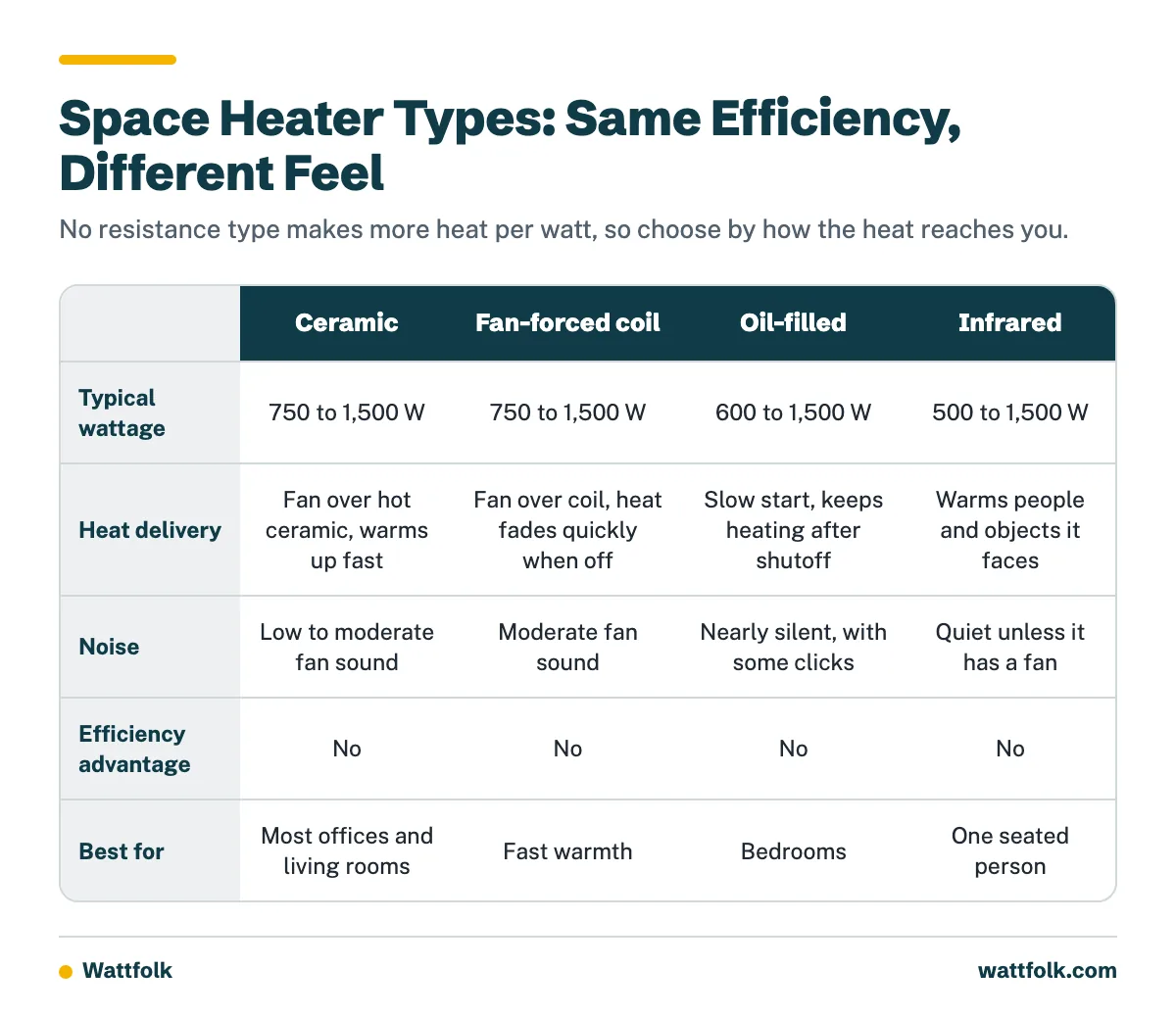
The wattages below are general market ranges, so check the label on any model you are considering.
| Heater type | Typical wattage | How it delivers heat | Noise | Thermostat behavior | Point-of-use efficiency advantage? |
|---|---|---|---|---|---|
| Ceramic | 750 to 1,500 W | Fan blows air over a hot ceramic element; warms up fast | Low to moderate fan sound | Often digital on mid-priced models; quality varies | No |
| Fan-forced coil | 750 to 1,500 W | Fan blows air over a metal coil; fast but heat fades quickly when off | Moderate fan sound | Basic models often use a rough dial | No |
| Oil-filled radiator | 600 to 1,500 W | Heats oil sealed inside fins; slow start, keeps giving heat after the element shuts off | Nearly silent, with some clicks | Slow, gentle temperature swings | No |
| Infrared (quartz) | 500 to 1,500 W | Radiant heat warms people and objects it faces | Quiet unless it has a fan | Varies; some are only on or off | No |
| Micathermic | 750 to 1,500 W | Mix of radiant heat and rising warm air | Nearly silent | Varies by model | No |

Is a ceramic heater more efficient than an oil-filled or infrared heater?
No. At 1,500 watts, each one makes the same amount of heat. What changes is how that heat feels.
Comfort can still affect your bill. Infrared heat warms you directly, so you may feel fine with a lower setting while sitting in one spot. That is a usage benefit, not extra efficiency. Oil-filled heaters release stored heat after the element turns off, but they had to use electricity to store that heat first.
Here is what we would pick. Ceramic suits most offices and living rooms because it heats quickly. Skip it if fan noise bothers you. Oil-filled suits bedrooms, but skip it if you need heat within minutes, since it warms slowly. Infrared suits one person in a chair or garage workspace. Skip it for warming a whole room, since it mostly heats what it can “see.”
Do electric space heaters use a lot of electricity?
Yes, at full power they are one of the largest plug-in loads in most homes. A 1,500-watt heater uses 1.5 kilowatt-hours (kWh) for each hour it runs flat out. One kWh is 1,000 watts used for one hour, and it is the unit on your electric bill.
Heat output follows wattage. Using the standard conversion of 1 watt to 3.412 BTU per hour, a 1,500-watt heater makes about 5,118 BTU per hour while it is on. A BTU, or British thermal unit, is a measure of heat. A resistance heater cannot make more BTUs per watt than that, whatever the box says.
Rated wattage is also only the top limit. Once the thermostat reaches its target, the element shuts off, so real use is often lower than the label.
How much does a 1,500-watt space heater cost to run?
A 1,500-watt heater costs about 26 cents an hour at full power, using a price of 17 cents per kWh. The U.S. Energy Information Administration reports state averages from roughly 12 to 40 cents, with a national average near 17 cents, so your cost may differ.
Cost = watts ÷ 1,000 × hours used × electricity price
Worked example
Assumptions: 1,500 watts, full power the whole time, 17 cents per kWh.
- 4 hours per day: 1,500 ÷ 1,000 × 4 × $0.17 = $1.02 per day, or $30.60 over 30 days.
- 8 hours per day: 1,500 ÷ 1,000 × 8 × $0.17 = $2.04 per day, or $61.20 over 30 days.
Here is the same heater at low, average, and high US prices, before any thermostat cycling:
| Price per kWh | Per hour | 4 hours/day | 8 hours/day | 30 days at 4 hours | 30 days at 8 hours |
|---|---|---|---|---|---|
| 12 cents | $0.18 | $0.72 | $1.44 | $21.60 | $43.20 |
| 17 cents | $0.26 | $1.02 | $2.04 | $30.60 | $61.20 |
| 40 cents | $0.60 | $2.40 | $4.80 | $72.00 | $144.00 |
Those numbers are the ceiling. To get closer to real use, add the duty cycle, which is the share of time the element is actually on. If the thermostat keeps the heater on half the time, multiply by 0.5. Eight hours at 17 cents then falls from $2.04 to $1.02. The 50% is only an example. A cold, drafty room could keep the heater on almost all the time.
For your own price, divide the total supply and delivery charges on your bill by the kWh you used. You can compare your result with this space heater electricity cost and wattage guide.
How can a thermostat, timer, or eco mode reduce a heater’s electricity use?
These controls reduce use by limiting how much heat the heater makes. None of them changes how efficiently it turns electricity into heat.
Thermostat. This is the control that matters most. Heat loss rises and falls roughly in line with the gap between indoor and outdoor temperatures. Say it is 32°F outside and you want 68°F, a gap of 36 degrees. A sloppy thermostat that lets the room reach 71°F creates a 39-degree gap. That is 3 ÷ 36, or about 8% more heat than you wanted to pay for.
Timer. A timer stops the heater from running after you have left the room or gone to bed. Pick a heater with one built in, so nothing has to sit between the plug and the wall.
Low-power setting. A 750-watt setting uses half the power per hour. In a small room it can hold the temperature while running longer. It saves money only if the room gets less total heat. In a small room, it also avoids the big overshoot a 1,500-watt setting can cause.
Eco mode. The meaning varies by brand. It usually holds a preset temperature or adjusts the power as the room warms up. Read the manual to see what yours actually does.
Is zone heating with a portable heater actually cheaper?
Zone heating is cheaper only when the rest of your home is really kept cooler. Zone heating means warming the room you are in and letting the other rooms cool down. Add a heater without touching the main thermostat, and you may just raise your bill.
Worked example
Assumptions: an all-electric-resistance home that averages 5,000 watts to stay at 68°F when it is 32°F outside, 8 hours of heating, 17 cents per kWh, and one 750-watt heater in a small occupied room. The 5,000 watts is an example figure, so swap in your own.
Turning the house down to 60°F shrinks the temperature gap from 36 to 28 degrees. The main system’s load falls to about 5,000 × 28 ÷ 36 = 3,890 watts.
| Scenario | Average watts | kWh in 8 hours | Cost |
|---|---|---|---|
| Whole home kept at 68°F | 5,000 | 40.0 | $6.80 |
| Home at 60°F, heater running flat out | 4,640 | 37.1 | $6.31 |
| Home at 60°F, heater on half the time | 4,265 | 34.1 | $5.80 |
| Home left at 68°F, heater added on top | Up to 5,750 | Up to 46.0 | Up to $7.82 |
The savings are $0.49 to $1.00 per 8-hour period. Forget to turn the house down, and the heater could add up to $1.02.
The savings grow as the setback gets bigger and the heated room gets smaller. They shrink if your main system is cheaper to run per unit of heat. Do not turn the house down so far that you risk frozen pipes in very cold weather.
Are electric space heaters more efficient than central heating?
A space heater is not more efficient than a heat pump, and comparing it with gas depends on your local prices. It can only win by heating less of your home.
Heat pumps. Efficiency here is measured by coefficient of performance, or COP, which is units of heat delivered per unit of electricity used. Electric resistance has a COP of about 1.0. Heat pumps can go well above that in suitable conditions because they move heat from outdoors instead of making it. At an assumed COP of 3 and 17 cents per kWh, a kWh of heat costs about 5.7 cents, compared with 17 cents from a space heater. Heat pump COP drops as outdoor temperatures fall, so check your unit’s cold-weather ratings.
Gas furnaces. One therm of gas holds 100,000 BTU, which equals about 29.3 kWh. Buying that much heat from a resistance heater at 17 cents costs 29.3 × $0.17, or about $4.98. A furnace with a 90% AFUE, the rating for how much fuel energy becomes heat, matches that cost only if gas reaches about $4.48 per therm ($4.98 × 0.90). Check your gas bill. If your price is lower, the furnace makes cheaper heat, and a space heater only pays off for short, single-room use.
Electric baseboard or furnace. These are also resistance systems, so a space heater has the same efficiency. This is where zone heating works best.
Do they make high-efficiency electric space heaters?
Not in the sense of a resistance heater that makes more heat per watt. Any model that claims this is really describing better controls, a nicer feel, or a lower wattage.
The true high-efficiency electric option is a heat pump. A ductless mini-split can heat one zone at a COP above 1, but it costs far more than a space heater and usually needs professional installation. If you will heat the same room for many winters and you own the home, get a quote.
Why is there no ENERGY STAR space heater?
The ENERGY STAR program has no portable space heater category. It exists to reward products that use less energy than similar ones, and resistance heaters all convert power to heat at about the same rate. This explanation of why ENERGY STAR does not cover space heaters goes into more detail. Treat any “energy saving” sticker on a portable heater as marketing until you see what control feature backs it up.
What size heater does your room need?
A common industry rule of thumb is about 10 watts per square foot for a room with normal insulation. It gives you a starting point:
- 75 square feet: about 750 watts
- 100 square feet: about 1,000 watts
- 150 square feet: about 1,500 watts
High ceilings, single-pane windows, and outside walls all push that number up. Drafts matter too. Warm air leaves, cold air replaces it, and the heater keeps running.
Cheap fixes come first. Close the door to the room. Add weatherstripping around leaky doors and windows. Pull heavy curtains closed at night. If a 1,500-watt heater never cycles off, the room is losing heat too fast, or it is too big for one heater. Do not add a second heater on the same circuit.
What safety and circuit-loading issues affect efficient space-heater use?
The main risks are overloaded circuits, cords, and heaters placed too close to things that can burn. A heater that trips the breaker or gets moved to a poor spot also heats your room badly, so safe setup and good performance go together.
Portable heaters can draw about 1,500 watts on a typical 120-volt circuit. Amps equal watts divided by volts, so that is 1,500 ÷ 120, or 12.5 amps. A 15-amp circuit tops out at 1,800 watts. Electricians often plan long-running loads at 80% of the breaker rating, about 1,440 watts here. So a 1,500-watt heater already uses the circuit’s practical capacity.
- Plug the heater directly into a wall outlet. Never use an extension cord or power strip.
- Keep other big loads, such as microwaves and hair dryers, off that circuit.
- Keep anything that can burn at least 3 feet away, as the National Fire Protection Association advises.
- Place it on a hard, level floor, and not in walkways.
- Choose a model with tip-over and overheat shutoff, listed by a recognized testing lab such as UL or ETL.

Call a licensed electrician if a plug or outlet feels hot, an outlet looks discolored, the breaker keeps tripping, or you want a new dedicated circuit. Stop using that outlet until it has been checked.
What to look for when you buy
Buy in this order of priority. Ignore any heat-per-watt claim.
- Accurate thermostat control. A digital readout with a set temperature helps you avoid paying for overshoot.
- Usable low-power setting. Around 750 watts suits small rooms and lightens the load on the circuit.
- Built-in timer. It stops the heater from running after you stop needing it.
- Tip-over and overheat protection. Treat these as a must, along with a safety listing from a testing lab.
- Direct wall connection. Check that the cord reaches an outlet from a safe spot, with no extension cord.
- Right size for the room. Start at about 10 watts per square foot.
If you want heat in minutes: buy ceramic with a digital thermostat.
If you need quiet for sleep or work: buy oil-filled and start it early.
If you sit in one spot in a cold space: buy infrared and aim it at yourself.
If you cannot turn down the main heat: a space heater probably won’t cut your bill, so fix drafts first.
If you own your home and heat with electric resistance: price a heat pump before buying several heaters.
What do owners say?
Owners like
- Quick warm-up from ceramic and fan-forced heaters
- Steady heat and quiet running from oil-filled radiators
- Accurate digital thermostats that cycle the heater rather than leaving it on nonstop
- Timers and eco modes that make overnight or scheduled use simpler
- Small size and good heating for one person or one room
Common complaints
- Fan noise, especially in bedrooms and quiet work areas
- Thermostats that are not accurate on cheaper models
- Burning or dusty smells the first few times the heater is used
- Hot plugs, tripped breakers, or weak performance on a shared circuit
- Oscillation motors or other controls that fail early
Summarised from owner reviews and long-term user reports; individual experiences vary.
Frequently Asked Questions
How efficient are portable electric heaters?
Portable electric resistance heaters are about 100% efficient at the point of use. Nearly all the electricity they draw becomes heat in the room. They still cost more per unit of heat than a heat pump working in suitable conditions.
What are the most efficient electric space heaters?
Among resistance heaters, no type wins on efficiency. The cheapest one to run is usually the lowest-wattage model that can warm your room, paired with an accurate thermostat and a timer. A heat pump is the more efficient electric choice overall.
Do space heaters use a lot of electricity?
A 1,500-watt heater uses up to 12 kWh in 8 hours, which costs $2.04 at 17 cents per kWh. Actual use is often lower when the thermostat cycles the heater off. A 750-watt setting cuts the hourly maximum in half.
Are electric space heaters efficient for heating a whole house?
They convert power to heat efficiently, but heating a whole house this way is usually expensive. Each room needs its own heater, and each 1,500-watt heater needs its own circuit capacity. Use them for one or two occupied rooms, and rely on your main system for the rest.
Sources