The average US home uses roughly 850 to 900 kWh a month, according to the U.S. Energy Information Administration (EIA), and every one of those kilowatt-hours lands on your bill. To read the bill, find the kWh used, multiply it by your per-kWh rate, then add fixed charges, taxes and fees. This guide shows each step with real math in US dollars.
Quick answer
Your usage is the current meter reading minus the previous one, shown in kWh. Multiply that by your rate, add the fixed monthly charge and taxes, and you get the total. First check whether the reading is marked actual or estimated.
- Every bill has five parts: account info, usage, rates, fixed charges and the total.
- Usage in kWh equals the new meter reading minus the old one.
- A kW is power. A kWh is energy over time. You pay for kWh.
- Estimated reads can be wrong. Send your own reading to fix them.
- Lighting is a small slice of most bills. Heating, cooling and water heating are the big ones.
- What are the five parts of an electric bill?
- What is a kW versus a kWh?
- How do I read my electric meter and check it matches the bill?
- What is the difference between actual and estimated readings?
- How is the total calculated?
- What do delivery, generation and fixed charges mean?
- What are peak, off-peak and time-of-use rates?
- How do I read an Origin or Red Energy bill?
- Do lights run up the electric bill?
- How do I check for errors and compare with last year?
- Bill-reading checklist
- Frequently Asked Questions
What are the five parts of an electric bill?
Almost every bill has the same five parts, even when the layout changes.
- Account info: your name, service address, account number and billing dates.
- Usage: the kWh you used, with the start and end meter readings.
- Rates: the price per kWh. Some bills split this into several lines.
- Fixed charges: a monthly or daily fee you pay even if you use no power.
- Total: usage charges, plus fixed charges, plus taxes and fees, minus any credits.
Start with the usage box. If the kWh number looks wrong, every dollar figure after it will be wrong too.
What is a kW versus a kWh and why does the difference matter?
A kilowatt (kW) measures how fast a device uses power. A kilowatt-hour (kWh) measures how much energy it used over time. One kWh is a 1,000-watt appliance running for one hour, and it is the standard billing unit for electricity.
Think of a car. Speed is kW. Distance driven is kWh. Your bill charges for distance, not speed.
Here is a quick example. A 1,500-watt space heater is 1.5 kW. Run it for 2 hours and it uses 3 kWh. At 17 cents per kWh, that is about 51 cents. The same heater running 8 hours costs about $2.04.
This matters because a high-wattage device used briefly can cost less than a small device left on all day.
How do I read my electric meter and check it matches the bill?
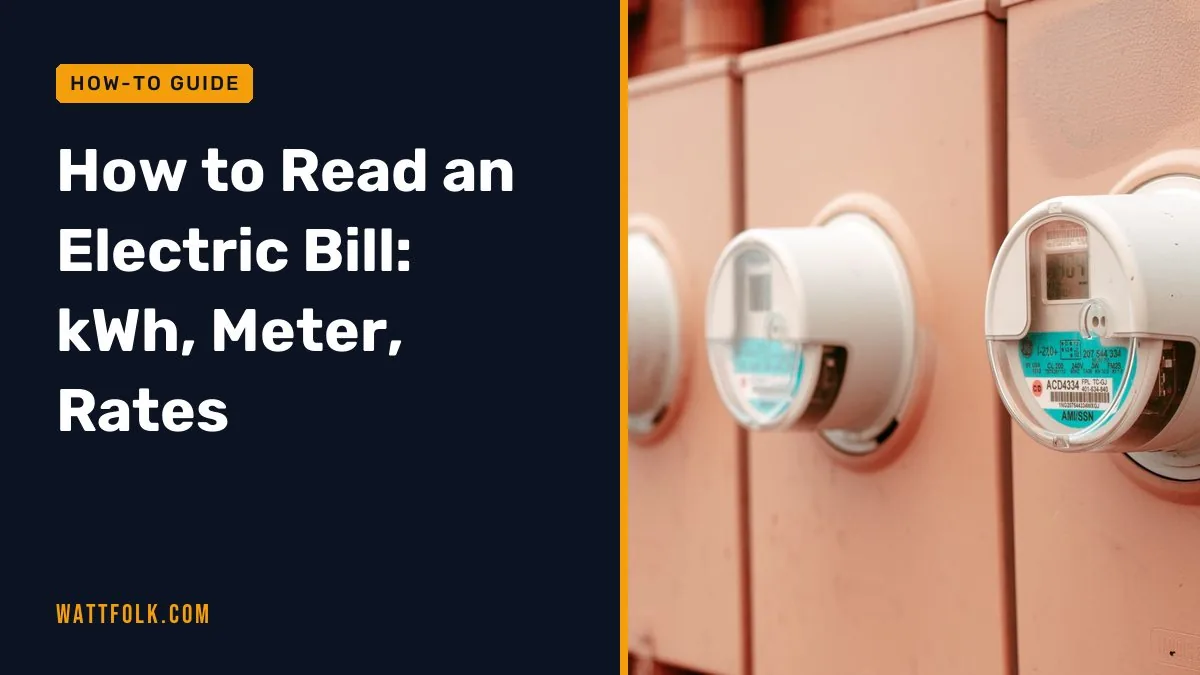
Read the number on your meter, then compare it to the “current reading” on the bill. If the meter shows a higher number than the bill, you have used more power since the bill was cut. The gap between the two bill readings is your usage.
Digital and smart meters
A digital meter shows a row of digits on a screen. Look for the label showing kWh used (some meters also show kWh sent back to the grid). Write down every digit. Smart meters send readings to your utility automatically, but you can still read the display to double-check.
Dial meters
Dial meters have four or five small clock faces. Read them left to right. Each dial turns in the opposite direction from its neighbor, so check the printed arrows. If a pointer sits between two numbers, write down the lower one. If it sits right on a number, look at the dial to its right. If that dial has not passed zero, use the lower number on the first dial.

Calculate usage yourself
Subtract the old reading from the new one. For example, 45,930 minus 45,210 equals 720 kWh. If that matches the bill, the usage line is correct.
What is the difference between actual and estimated readings?
An actual reading comes from a real meter read, by a person or a smart meter. An estimated reading is a guess based on your past use. Bills often mark them with an “A” and an “E”, or the words Actual and Estimated.
Estimates cause trouble. Guess too low and you get a large catch-up charge later. Guess too high and you overpay.
How do I dispute an estimate?
- Read your meter today and take a photo showing the digits and the date.
- Submit the reading through your utility’s website, app or phone line. Many offer a self-read form.
- Ask for a corrected bill based on the actual reading.
- If the estimate stays wrong, ask the utility about its dispute process. Your state’s public utility commission can also help.
How is the total calculated? A worked example
Here is one bill, step by step. These numbers are assumptions for teaching, not a real utility’s prices: a 17 cent per kWh rate, a fixed charge of 40 cents per day, a 30-day cycle and a 5% tax.
| Step | Math | Result |
|---|---|---|
| 1. Usage | 45,930 − 45,210 | 720 kWh |
| 2. Usage charge | 720 kWh × $0.17 | $122.40 |
| 3. Fixed charge | $0.40 × 30 days | $12.00 |
| 4. Subtotal | $122.40 + $12.00 | $134.40 |
| 5. Tax | $134.40 × 5% | $6.72 |
| 6. Total | $134.40 + $6.72 | $141.12 |
Try this on your own bill. If your total is off by more than a few cents, look for a line you missed, such as a surcharge or a credit.
What do delivery, generation and fixed charges mean?
Your bill often splits the price of power into two jobs: making the energy and carrying it to your home. Knowing which line is which helps you see what you can change.
- Generation or supply: the cost of the energy itself. In some states you can pick a different supplier for this line.
- Delivery or distribution: the cost of poles, wires and repairs. Your local utility sets this.
- Customer or service charge: a fixed fee for billing, the meter and service. It stays the same no matter how much you use.
- Taxes, riders and surcharges: state or local taxes, plus smaller add-ons for programs like efficiency or fuel cost changes.
Some utilities show these as separate rates per kWh. Add them together to get your full rate. For example, 7 cents of delivery plus 10 cents of generation equals 17 cents per kWh.
What are peak, off-peak and time-of-use rates?
Time-of-use (TOU) rates charge different prices at different hours. Peak hours cost the most, usually late afternoon and early evening. Off-peak hours, like overnight, cost the least. Some plans add a shoulder period in between.
On the bill, TOU shows up as separate usage lines, each with its own kWh and rate. Add the lines together to confirm your total kWh matches your meter.
Two other pricing types can appear:
- Tiered rates: the first block of kWh costs less, and the next block costs more.
- Demand charges: a fee based on your highest kW spike in a short window. These are common for businesses and appear on some home plans.
Rate plans vary by utility, so confirm your plan’s hours and prices on your utility’s website.
How do I read an Origin or Red Energy bill?
Origin and Red Energy are Australian retailers, and their bills use the same building blocks as a US bill with different names. You will usually see a daily supply charge, a usage charge per kWh, and 10% GST. The usage box shows the meter readings and kWh, just like the example above.
Some of their bills also show a solar feed-in credit for power sent back to the grid, or a concession for eligible customers. Credits are subtracted before the total.
| Concept | US | UK | Australia |
|---|---|---|---|
| Fixed daily fee | Customer or service charge | Standing charge | Supply charge |
| Energy used | kWh | Units (kWh) | kWh |
| Price of energy | Rate per kWh | Unit rate | Usage charge |
| Sales tax | State or local tax | VAT | GST |
| Solar export | Net metering credit | Export payment | Feed-in credit |
To check an Origin or Red Energy bill, use the same steps: confirm the readings, multiply usage by the rate, add the supply charge, then add GST. If you have US solar, net metering and export credit rules vary by state and utility, so confirm yours with your utility.
Do lights run up the electric bill?
Lights add to the bill, but not by much, especially with LEDs. The EIA and U.S. Department of Energy estimate lighting at roughly 5 to 10% of typical household use. On 850 kWh a month, that is about 43 to 85 kWh, or roughly $7 to $14 at 17 cents per kWh.
The table below uses assumed wattages, a 30-day month and 17 cents per kWh. Redo it with your own numbers.
| Device | Watts | Hours per day | kWh per month | Cost per month |
|---|---|---|---|---|
| LED bulb | 10 | 5 | 1.5 | $0.26 |
| Incandescent bulb | 60 | 5 | 9 | $1.53 |
| Laptop | 50 | 8 | 12 | $2.04 |
| TV | 100 | 4 | 12 | $2.04 |
| Microwave | 1,000 | 0.5 | 15 | $2.55 |
| Window air conditioner | 1,000 | 8 | 240 | $40.80 |
| Space heater | 1,500 | 4 | 180 | $30.60 |
| Electric dryer | 5,000 | 1 | 150 | $25.50 |
Swap ten 60-watt bulbs for ten 10-watt LEDs at 5 hours a day, and monthly use drops from 90 kWh to 15 kWh. That saves about $12.75 a month. Switching bulbs helps, but heating, cooling and water heating usually matter more.
The formula is simple: watts ÷ 1,000 × hours per day × 30 × your rate.
How do I check for errors and compare with last year?
Compare your kWh to the same month last year, not just last month. Weather changes use a lot, so a July bill should be judged against another July. Most bills include a usage graph, and online accounts let you download past data.

Look for these common problems:
- An estimated reading that does not match your meter.
- A billing period much longer than 30 days.
- A rate that changed without a notice.
- A missing credit, such as a solar export credit or a payment you made.
- A new fee you do not recognize.
- If the reading is estimated: send a real reading and ask for a corrected bill.
- If kWh match your meter but are higher than last year: check heating, cooling, new appliances or guests.
- If kWh are normal but the total is high: look for a rate change, a new rider or a missing credit.
- If usage seems high with nothing new running: ask your utility about a meter check, and have a licensed electrician inspect your wiring if you suspect a fault.
Bill-reading checklist
Use this five-minute routine each month.
- ☐ Is the billing period about 30 days?
- ☐ Are both readings marked actual, not estimated?
- ☐ Does the new reading match your meter today (allowing for days since the bill)?
- ☐ Does the new reading minus the old one equal the kWh billed?
- ☐ Does kWh times rate match the usage charge?
- ☐ Are the fixed charge, taxes and fees what you expect?
- ☐ Are any credits applied?
- ☐ Is usage close to the same month last year?
Frequently Asked Questions
How do you read an electric bill?
Start with the usage box and check the kWh used and whether the readings are actual. Then multiply kWh by the rate, add the fixed charge and taxes, and compare the result with the total due.
How do I read kWh on my electric bill?
Find the usage section, usually labeled “kWh used” or “energy usage.” It equals the current meter reading minus the previous reading. If you are on a time-of-use plan, add the peak and off-peak lines together.
How do I read my electric bill meter?
Write down every digit on a digital meter. On a dial meter, read the dials left to right and use the lower number when a pointer sits between two digits. Compare the result with the bill’s current reading.
How do I read an energy bill?
Look at five things: account info, usage, rates, fixed charges and the total. Confirm usage first, then check each charge. If your home has both electricity and gas, each fuel usually has its own section.
How do I read a Red Energy or Origin electricity bill?
Both are Australian retailers. Look for the meter readings and kWh, the daily supply charge, the usage charge per kWh, any solar feed-in credit or concession, and 10% GST. The math works the same as the worked example above.
Do lights run up the electric bill?
Only a little. At 17 cents per kWh, a 10-watt LED on for 5 hours a day costs about 26 cents a month. A 60-watt incandescent costs about $1.53. Lighting is roughly 5 to 10% of typical household use, per EIA and DOE estimates.
How do I check my electric bill reading?
Read your meter, then compare it with the current reading on the bill. Subtract the previous reading from the current one to confirm the kWh. If the bill is estimated or the numbers do not match, send your utility a dated photo of the meter.