
Apartment dwellers with a private balcony who want plug-in solar should know that none of the five Amazon listings below is a grid-tied balcony power system. A true plug-in system pairs panels with a certified microinverter and a household plug, while these products are off-grid panels, solar lights, and one mains night light. Based on the listing data, the DOKIO 150W foldable panel kit is the closest fit for generating usable power from a balcony without touching your wiring.
Quick answer
For real grid-connected savings, buy a certified microinverter kit after confirming local rules and building approval. Among these five listings, the DOKIO 150W kit is the only one that produces meaningful power, and it works with a compatible battery or power station, not your outlet.
- Best for portable power: DOKIO 150W kit
- Best for balcony lighting: HULPPRE Solar Shed Light
- Best budget: HMCITY 4 Pack
Our Winner: DOKIO 150W Portable Foldable Solar Panel Kit with Charge Controller
It is the only listing here that can collect a meaningful amount of energy. It folds to 19.3 x 20.9 x 1.1 inches, weighs 7.3 lb, and includes a standalone PWM controller, a 9.8 ft cable, and four DC adapters. It suits renters who want to charge a battery on a balcony without any grid connection. Check that your power station accepts its input first.
How We Compared These Models
Because the product pool is mixed, we compared each listing on four criteria: power generation capacity, balcony-friendly size and mounting, weather protection (IP rating), and whether it needs any electrical connection to your home. The comparison relies on listed features and Amazon ratings, not personal use.
| Product | Key Specs | Our Choice | Action |
|---|---|---|---|
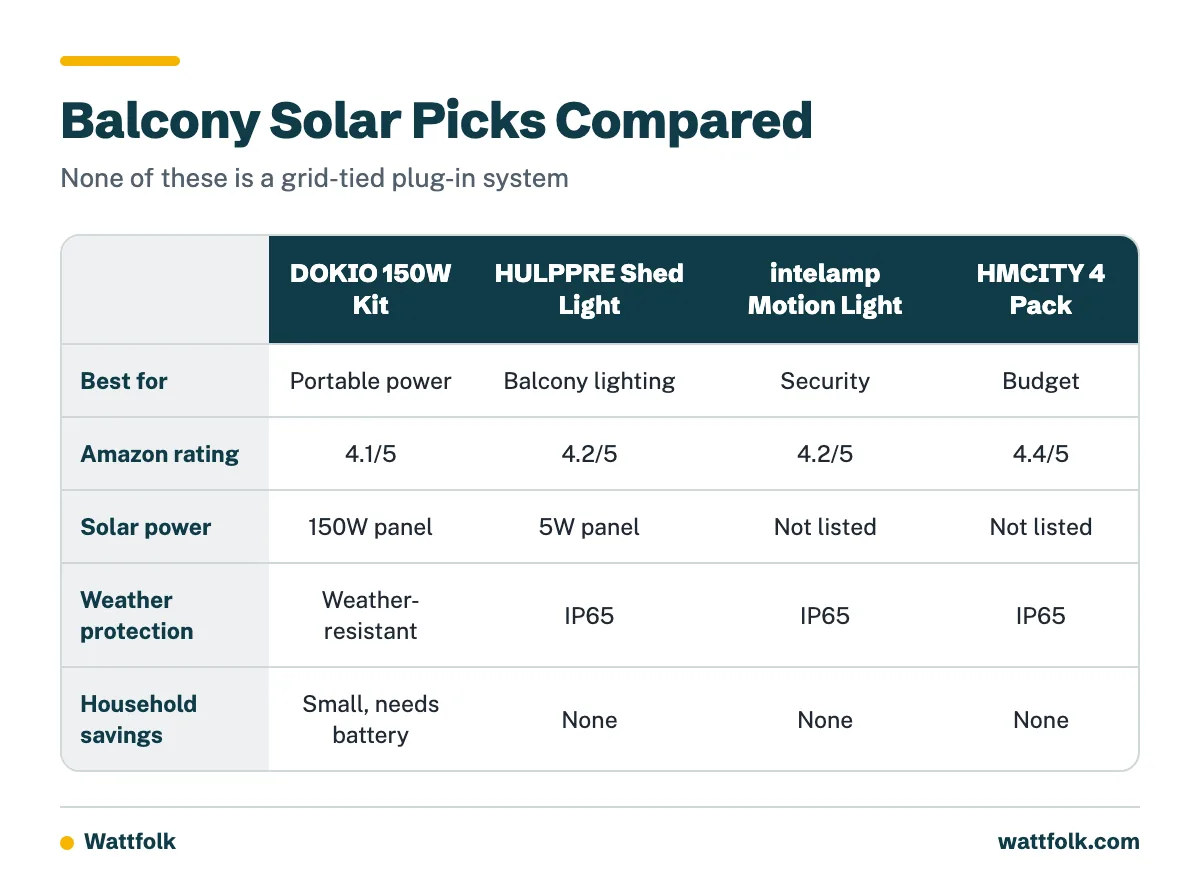
| DOKIO 150W Foldable Solar Panel Kit | 150W panel, PWM controller for 12V batteries, 7.3 lb, 4.1/5 stars | Best Overall | |
| HULPPRE Solar Shed Light | 5W panel, 136 LEDs, 1000 lumens, IP65, remote, 4.2/5 stars | Best for Balcony Lighting | |
| intelamp Solar Motion Sensor Light | 1200 lumens, 180° radar, 26 ft range, IP65, 4.2/5 stars | Best for Security | |
| HMCITY 120 LED Solar Lights, 4 Pack | PIR sensor, IP65, 3.74 x 3.38 in, $17.99, 4.4/5 stars | Best Budget | |
| GE Plug in Night Light, 2 Pack | Mains-powered, dusk-to-dawn sensor, 3000K, UL certified, 4.7/5 stars | Best Plug-In Light (Not Solar) |
How Does Plug-In Balcony Solar Work?
A plug-in balcony system combines one or two photovoltaic modules, a microinverter, connection cables, and a household plug. The microinverter converts panel DC to household AC and feeds it into your apartment circuit, where appliances use it first.
Panel wattage is not the compliance limit. The inverter’s maximum AC output is. The Enphase IQ Balcony Solar Kit, for example, lists a maximum of 800 W to the grid, according to its published data sheet. Some battery-equipped balcony systems offer adjustable output between 600 W and 800 W.
None of the products reviewed here includes a microinverter. The DOKIO kit uses a charge controller for 12V batteries, and the rest are self-contained lights or a plug-in night light.
Is Plug-In Solar Legal for My Apartment or Rental Property?
It depends on your jurisdiction. Rules on output limits, certified equipment, and utility notification vary widely, and many guides wrongly treat plug-in solar as allowed everywhere. Check your local electrical code and utility rules before buying any grid-connected kit.
Off-grid products like the ones reviewed here avoid the grid-connection question, since they never feed your wiring. Building rules on balcony fixtures can still apply.
Do I Need Permission From My Landlord or Building Manager?
Usually yes, for anything fixed to the balcony. Landlords, freeholders, and HOAs often control exterior changes, railings, and drilling. Get written approval first.
London Fire Brigade guidance also says equipment should not block shared balconies, walkways, windows, or designated escape routes, per its safety advice for residents. Balconies may also be unsuitable during cladding remediation work.
How Many Watts Can a Balcony Solar System Produce?
Commercial balcony systems are commonly rated around 300 to 370 Wp, with grid-connected kits capped at roughly 600 to 800 W AC output depending on local rules. Enel lists a 370 Wp free-standing system with estimated annual output of 400 kWh, per its Plug&Play product page.
By comparison, the DOKIO panel is rated at 150W, and the HULPPRE light’s panel is 5W. Those numbers are suited to battery charging and lighting, not household offset.
Will Plug-In Solar Work on a Shaded or North-Facing Balcony?
Output drops sharply. In the northern hemisphere, south-facing balconies with few obstructions produce the most. East or west exposure works with reduced yield, and north-facing or heavily enclosed balconies rarely justify a purchase.
Portable panels like the DOKIO have an advantage here. The 9.8 ft cable lets you move the panel to wherever the sun is, while the controller or battery stays in shade.
Can I Plug a Balcony Solar System Into a Normal Household Outlet?
Certified grid-tied kits are designed around a household plug, but legality depends on local rules. Never improvise by feeding power back through a homemade cable.
The DOKIO kit does not plug into a wall outlet. It charges a 12V battery or compatible power station. The GE night light is the only product here that plugs into an outlet, and it consumes power rather than producing it.
Do I Need a Dedicated Outdoor Socket, and What IP Rating Is Required?
For grid-connected balcony solar, London Fire Brigade guidance says outdoor sockets should be weatherproof, appropriately rated, installed by a competent person, and at least IP65-rated.
Three of the listings (HMCITY, HULPPRE, intelamp) claim IP65 protection, which makes them suitable for exposed balconies. The DOKIO panel is described as weather-resistant, with a warning to keep the fabric case out of heavy rain.
Can I Use an Extension Lead, Adaptor, or Power Strip?
No. Plug-in solar equipment should not be connected through extension leads, adaptors, or overloaded sockets, according to the same fire guidance. Use a single, properly rated socket near the balcony door.
Should I Buy a System With a Battery or Direct Plug-In Solar?
Choose direct plug-in if your usage peaks during the day, such as a refrigerator, home office, or router. Choose a battery kit if you are home mostly in the evening. Storage adds cost, weight, and complexity, and does not automatically provide backup power during a grid outage.
| System Type | Typical Output | Best For | Watch Out For |
|---|---|---|---|
| Direct-plug microinverter kit | About 300 to 800 W AC, per local limits | Daytime household loads | Approval, certification, grid notification |
| Battery-equipped balcony kit | 600 to 800 W adjustable on some models | Evening self-consumption | Cost, weight, no automatic backup |
| Portable panel plus power station | Limited by controller and station input | Renters avoiding wiring changes | Input caps, small total savings |
| Solar lights | Self-contained | Balcony lighting only | No household savings |
How Much Money Can an Apartment Balcony System Realistically Save?
Savings depend on yield, self-consumption, and tariff, not panel wattage alone. The following is an illustrative calculation with assumed inputs, not a quote.
- Annual yield: 400 kWh (Enel’s estimate for a 370 Wp system, which will differ in your climate)
- Self-consumption: 80 percent, or 320 kWh used at home
- Assumed tariff: $0.17 per kWh
- Annual savings: about $54
- Assumed system price: $500, giving a payback of roughly nine years
For the DOKIO kit, assume 4 effective sun hours and 70 percent system efficiency: 150 W x 4 h x 0.7 is about 0.42 kWh per day. Power station input caps of 60 to 100W, noted in the listing, can reduce that. Treat it as a way to run small devices, not a bill reducer.
What Mounting, Fire-Safety, and Grid-Notification Rules Apply?
Mount panels securely against wind, using an approved method for your railing or floor. Keep escape routes clear, and use certified equipment installed by a competent person.
London Fire Brigade guidance recommends notifying the local Distribution Network Operator within 28 days after installation, though requirements vary by jurisdiction. In the US, ask your utility about interconnection rules. London Fire Brigade also publishes guidance for property owners and building managers.
Balcony-Readiness Checklist
- Written permission from landlord, HOA, or building manager
- Local rules and output limit confirmed
- Balcony faces south, east, or west with limited shade
- Railing or floor can bear the weight and wind load
- Socket is close, weatherproof, and rated IP65 or higher
- No extension leads or adaptors needed
- Escape routes, windows, and shared walkways stay clear
- Utility or network operator notification planned
Decision Tree: Which Route Should You Take?
- Approval, safe mounting, and compliant wiring all available: choose a direct-plug certified kit if your use is mostly daytime, or a battery kit for evening use.
- Any of those missing: do not buy a grid-connected system.
- Want something small and removable: a portable panel with a compatible battery, like the DOKIO kit, is an option.
- Only need light: pick a solar light from the list below.
In-Depth Reviews

1. DOKIO 150W Portable Foldable Solar Panel Kit – Best Overall
Our Verdict: The only listing here that can collect meaningful energy, and the most flexible for a rented balcony because nothing is wired into the building.
Based on the listing, the panel uses mono cells and folds to 19.3 x 20.9 x 1.1 inches at 7.3 lb. The standalone PWM controller supports 12V batteries and includes reverse polarity, overcharge, overload, and short-circuit protections. The kit adds a 9.8 ft cable, a 3.3 ft cable, a JY60 connector, four DC adapters, a storage bag, and a manual.
The seller warns that some power stations cap solar input at 60 to 100W, so a 150W panel will not exceed that cap. Confirm your device’s input specs before ordering. The panel is a foldable portable design, so it is better stored indoors than left outside permanently.
Why We Like It
- Folds small and can be stored when not in use
- Standalone controller can be replaced or upgraded
- Long cable lets the controller stay shaded
- No grid connection, so no wiring or notification concerns
Pros & Cons
Pros
- Highest power rating of the five listings
- Complete kit with adapters
- Easy to store and move
Cons
- Not a household-outlet system
- PWM controller is less efficient than MPPT designs
- Compatibility with power stations must be checked

2. HULPPRE Solar Shed Light – Best for Balcony Lighting
Our Verdict: A flexible solar light that lists balconies among its uses, with a separate panel you can place in the sun while the light stays under cover.
The listing describes a 5W panel, 136 LEDs, and 1000 lumens at full brightness. Charging takes 4 to 6 hours and lighting lasts 10 to 12 hours. The 16.4 ft extendable cord separates panel and light, which helps on a covered or partly shaded balcony. It has IP65 protection, a remote, and a manual switch, with 2, 4, and 6 hour timer options.
It lights a space but does not reduce your electric bill in any meaningful way.
Why We Like It
- Separate panel suits shaded balcony corners
- Remote control and timer settings
- 24 months after-sales service listed
Pros & Cons
Pros
- High lumen output
- IP65 rating
- Works day or night modes
Cons
- Lighting only
- Needs 4 to 6 hours of sun before first use

3. intelamp Solar Motion Sensor Light – Best for Security
Our Verdict: A brighter, more capable motion light for balcony doors and entrances where security matters more than ambience.
According to the listing, it offers 1200 lumens, 3000K and 6500K color modes, and a 180° radar sensor with 26 ft detection range. It has IP65 protection, an ABS body, a monocrystalline panel with conversion up to 25 percent, and a remote for modes and timers. Mounting accessories are included and no wiring is needed.
The manufacturer’s efficiency figure refers to the panel cells, not to real-world output on a shaded balcony.
Why We Like It
- Radar detection with adjustable color temperature
- No wiring required
- Remote adjusts modes and timers
Pros & Cons
Pros
- Bright 1200 lumen output
- Warm and daylight options
Cons
- Larger than small wall lights
- No household power savings

4. HMCITY 120 LED Outdoor Solar Lights, 4 Pack – Best Budget
Our Verdict: The lowest-cost way to add light to a balcony wall, with four compact units and the highest rating (4.4/5) among the solar listings.
Each unit measures 3.74 x 3.38 inches, has a PIR motion sensor, IP65 protection, and a monocrystalline panel. The listing claims conversion efficiency up to 30 percent, which is a manufacturer claim. Note that the sensor works only in Mode 1 and Mode 3; constant medium light in Mode 2 does not use it. Charge in direct sun for 6 to 8 hours before first use.
Why We Like It
- Four units at $17.99
- Screw mounting on walls
- Compact size
Pros & Cons
Pros
- Low price per light
- IP65 weather protection
Cons
- Small panels need open sun
- Mode 2 disables the sensor

5. GE Plug in Night Light, 2 Pack – Best Plug-In Light (Not Solar)
Our Verdict: A well-rated indoor plug-in light, but it is not a solar product and has no role in a balcony power setup.
It draws mains power, switches on at dusk and off at dawn, uses a 3000K warm white LED, and carries UL certification per the listing. The housing covers a full outlet or leaves one receptacle free. It earns the highest rating here at 4.7/5, but only as an indoor night light. It is included because it matches the search term “plug in”, not because it generates electricity.
Why We Like It
- Automatic dusk-to-dawn sensor
- UL safety certification listed
- Leaves one receptacle free on some outlets
Pros & Cons
Pros
- Low cost and simple
- Strong 4.7/5 rating
Cons
- Uses electricity, does not produce it
- Indoor use only
Frequently Asked Questions
Is plug-in solar legal for my apartment?
It depends on local electrical rules and your building’s policies. Confirm output limits, certification, and utility notification requirements before buying a grid-connected kit.
Can any of these products power my apartment?
No. None includes a microinverter or grid connection. The DOKIO kit charges a compatible 12V battery or power station, and the rest are lights.
Is a battery worth it for a balcony system?
Only if most of your usage happens in the evening. Batteries add cost, weight, and complexity, and do not automatically provide backup during an outage.
Can I use an extension lead with plug-in solar?
No. Fire guidance advises against extension leads, adaptors, and overloaded sockets for plug-in solar equipment.
What should I buy if my landlord refuses approval?
Avoid fixed or grid-connected systems. A portable panel stored indoors, or simple solar lights, avoids most building issues, but check lease terms.
Conclusion
True plug-in balcony solar needs a certified microinverter kit, building approval, a weatherproof socket, and compliance with local rules, and none of these five listings is that product. The DOKIO 150W kit is the best match for generating power without wiring changes, HULPPRE and intelamp suit balcony lighting, HMCITY is the budget choice, and the GE night light is an indoor accessory. If approval or safe mounting is unavailable, skip the grid-connected route.
Sources
Affiliate Disclosure: As an Amazon Associate, we may earn commissions from qualifying purchases from Amazon.com. This comes at no extra cost to you and helps support our research.