
Most plug-in solar panels are full-size rigid panels, not small portable ones. They run roughly 5.1 to 5.7 feet long and 3.6 to 3.7 feet wide, and are rated at about 350 to 450 watts each. Panel size and the amount of power your outlet can take are two separate questions, and this guide covers both.
Quick answer
A typical 400W plug-in panel measures about 5.6 by 3.7 feet and covers about 21 square feet. Most kits use one or two panels. Size your kit by the space you have, the shade you face and the inverter’s AC rating.
- Best for tight balconies: one 350W-class panel, the smallest footprint
- Best for sunny walls or yards: two 400W-class panels, more output per outlet
- A 400W panel is about 1.72 m by 1.14 m (roughly 68 by 45 inches), or about 21 square feet.
- Panels with the same watt rating can differ in size by several inches.
- Panel watts (DC) are not the same as inverter output (AC).
- Two panels at about 69 by 43 inches need roughly 41 square feet of face area, before mounting clearance.
- Plug-in rules vary by state and change quickly. Confirm with your utility before you buy.
- What are plug-in solar panels?
- What size are plug-in solar panels?
- Are solar panels all the same size?
- Does the size of a solar panel matter?
- How much space do plug-in panels need?
- What size of solar panels do I need?
- What size are plug-in solar panels in the UK?
- Outlet, mounting and safety rules
- When to choose a professional install
- What do owners say?
- Frequently Asked Questions
What are plug-in solar panels?
Plug-in solar panels are small solar kits that feed power into your home through a standard outlet. A kit has four parts: the panel, a microinverter, a cable and a plug. The panel makes direct current (DC). The microinverter turns it into alternating current (AC) that matches your home’s power. Your appliances then use that power first.
The microinverter also shuts off when the grid goes down. Never bypass that shut-off. It protects utility workers and your home.
What size are plug-in solar panels?
Most are standard rigid panels about 1.55 to 1.75 m long and 1.10 to 1.14 m wide. That is roughly 5.1 to 5.7 feet by 3.6 to 3.7 feet. Face area runs about 1.7 to 2.0 square meters (18 to 21.5 square feet), and ratings fall between 350 and 450W.
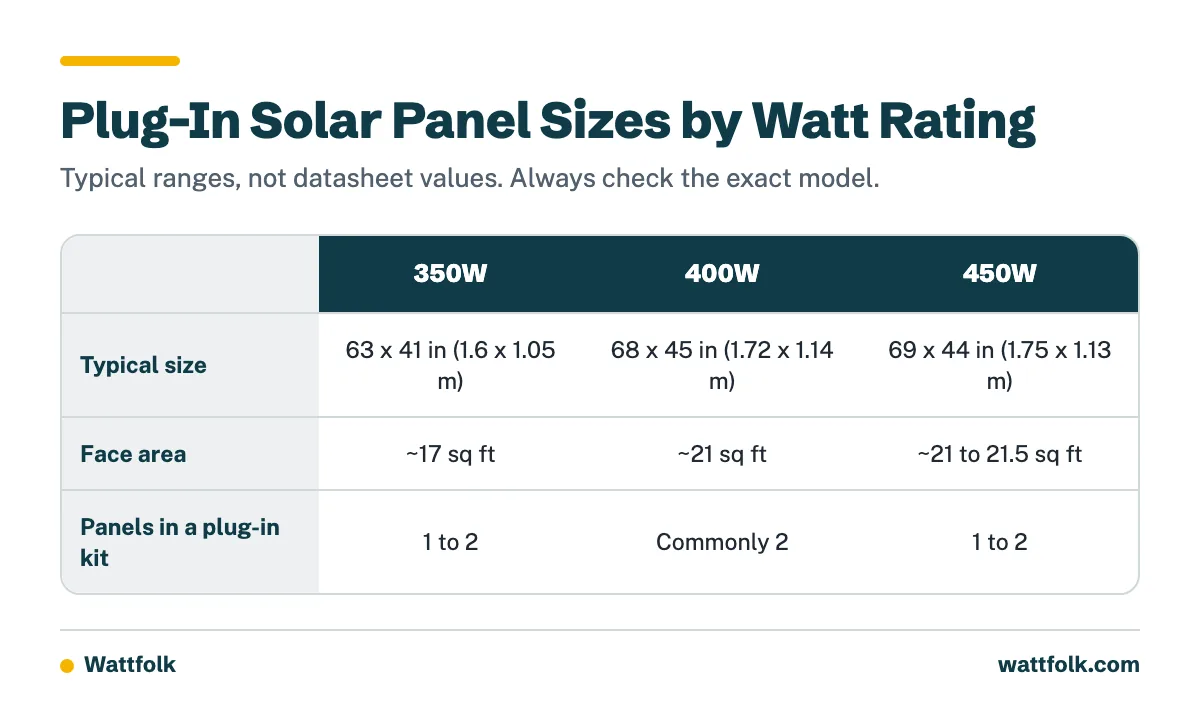
Here are real examples. A Trina Vertex S 400W panel is listed by PluginSolar at 1,754 mm by 1,096 mm by 30 mm (about 69 by 43 by 1.2 inches). A typical 400W panel is about 1.72 m by 1.14 m, or 1.96 m², according to Plugged In Solar. Another 400W example measures 1,555 mm by 1,134 mm and weighs 15 kg (about 33 pounds).
| Rated output | Typical size (approx.) | Face area | Panels in a plug-in kit |
|---|---|---|---|
| 350W | 63 x 41 in (1.6 x 1.05 m) | ~17 sq ft | 1 to 2 |
| 400W | 68 x 45 in (1.72 x 1.14 m) | ~21 sq ft | Commonly 2 |
| 450W | 69 x 44 in (1.75 x 1.13 m) | ~21 to 21.5 sq ft | 1 to 2 |
These sizes are typical ranges, not datasheet values. Always check the exact model.

Are solar panels all the same size?
No. Two 400W panels can differ by several inches in length and width. Cell layout, cell technology and frame design all change the shape. One 400W model may be tall and narrow, another short and wide. Many listings treat “400W” as one size. It is not.
Measure your space against the specific panel’s datasheet, including frame thickness. A panel that fits on paper may not fit a balcony rail or a shed roof pitch.
Does the size of a solar panel matter?
Yes, but for two reasons. Physical size decides where the panel fits and how you mount it. Watt rating decides how much power it can make in full sun. Higher efficiency panels pack more watts into the same area. A bigger panel is not always a better one.
Do not mix up three numbers:
- Panel capacity (DC watts): what the panels can make in lab-rated conditions.
- Inverter output (AC watts): the most the microinverter can send to your outlet. Check its nameplate.
- Daily energy (kWh): what you actually get over a day.
Worked example: 800W of panels
Assumptions: two 400W panels, 4.5 peak sun hours per day, 20% system losses (heat, wiring, inverter, dust), and electricity at 17 cents per kWh, near the US average from the U.S. Energy Information Administration.
- 800W x 4.5 hours x 0.80 = 2,880 Wh, or about 2.9 kWh per day.
- 2.9 kWh x 365 days = about 1,050 kWh per year.
- 1,050 kWh x $0.17 = about $179 of power per year.
At 12 cents per kWh that is about $126. At 40 cents it is about $420. Your own sun hours, shade and use will change this. The value only counts for power your home uses while the panels run.
How much space do plug-in panels need?
Two panels at about 1.75 m by 1.10 m cover about 3.85 m², or roughly 41 square feet. That is face area only. You also need room for brackets, cable routing and air flow behind the panels. Listings rarely show this.

Plan for these extras:
- Clearance: leave several inches around the frame for brackets and for wind to pass.
- Weight: a 15 kg (33 lb) panel is a lot to hang on a railing. Check what your balcony or lease allows.
- Wind loading: a large flat panel acts like a sail. Use mounting hardware rated for it.
- Cable run: measure from the panel to a wall outlet. Do not plan on an extension cord.
What size of solar panels do I need?
It depends on your space, sun and daytime power use, not on a fixed rule. For a plug-in kit, one or two panels is the common range. Start with the checklist below.
- Available area: can you fit about 21 square feet per 400W panel?
- Shading: does a tree, rail or wall shade the panel at midday? Even partial shade cuts output.
- Orientation: in the US, south-facing is usually best. East or west still works at lower output.
- Daytime load: a fridge and router run all day. Output beyond what you use may not pay you back.
- Inverter output: match the panel capacity to the inverter’s AC rating.
- Certification: buy a complete kit listed to the right US safety standard, not loose parts.
- Small balcony, partial shade: choose one smaller panel.
- Open wall or yard with full sun: consider two panels.
- Need to cover most of your bill: look at a professionally installed system.
What size are plug-in solar panels in the UK?
UK panels are the same physical size as US ones. UK kits commonly use two 400W panels with an 800VA inverter cap. Which? describes a specification allowing up to 2,000W of panels across a maximum of four panels, with no more than two in series.
Those limits are UK rules. They do not set US law. US readers should not assume the same caps, plug types or notification steps apply. Ask your utility what it requires.
Outlet, mounting and safety rules
Connect the kit directly to a wall outlet. Never use an extension cord or a multi-outlet adapter. Do not defeat or bypass the microinverter’s grid shut-off. If your outlet, wiring or panel is old or you are unsure, call a licensed electrician.
Buy the whole kit as certified by the maker, not mixed parts. Ask your utility whether you must notify them or get approval. Rules differ by state and utility, and they change often.
When to choose a professional install
A plug-in kit is a small supplement. If you want to cut most of your bill, a conventional system sized to your roof and load is a better fit. The same goes for heavy roof mounting, a main-panel connection or any job needing new wiring. These need a licensed installer and often permits.
What do owners say?
Owners like
- Simple plug-in connection compared with a conventional rooftop installation
- Compact kits can suit balconies, sheds, garden offices and small outbuildings
- Low-maintenance operation once the panels are securely mounted
- Two-panel kits are relatively easy to position and monitor
Common complaints
- Panel dimensions and mounting hardware can be awkward for balconies or small gardens
- Actual output falls noticeably with shade, poor orientation, cloudy weather or low winter sun
- The inverter may clip generation when panel capacity exceeds its AC output
- Users can underestimate the need for secure mounting, cable routing and adequate clearance
- Rules around sockets, extension leads, certification and utility notification are often unclear to buyers
Summarised from owner reviews and long-term user reports; individual experiences vary.
Frequently Asked Questions
What size are plug in solar panels?
Most are rigid panels about 5.1 to 5.7 feet long and 3.6 to 3.7 feet wide, with a face area of about 18 to 21.5 square feet. They are rated at roughly 350 to 450W. Always check the exact model’s datasheet.
What size are plug in solar panels UK?
They match standard panels: about 1.55 to 1.75 m by 1.10 to 1.14 m. UK kits often pair two 400W panels with an 800W-class microinverter. UK limits do not apply in the US.
What size of solar panels do I need?
Work from your space, shade, orientation and daytime use. One or two panels suit most plug-in setups. If you want to cover most of your bill, ask about a professional system.
What are plugin solar panels?
They are small solar kits made of a panel, microinverter, cable and plug. They send power into your home through a standard outlet. Confirm local rules and certification before buying.
Are solar panels the same size?
No. Panels with the same watt rating can differ by several inches. A 400W panel may be 1,555 mm by 1,134 mm or 1,754 mm by 1,096 mm, depending on the maker.
Does the size of a solar panel matter?
Yes. Size sets where the panel fits and how it mounts. Watt rating sets peak output. Efficiency tells you how many watts you get per square foot. Match all three to your space and inverter.
Sources