
The cheapest time to charge an electric car is generally between midnight and 6:00 AM, commonly known as off-peak hours. To get these lower prices, you must switch your home electricity plan to a Time-of-Use (TOU) or dedicated EV tariff through your utility provider. Standard flat-rate energy plans charge the same amount day and night, offering zero nighttime savings.
Quick answer
Charge your EV between midnight and 6:00 AM on a Time-of-Use (TOU) or EV-specific electricity tariff. If you stay on a standard flat-rate plan, you pay the exact same price no matter when you plug in.
- Best for standard drivers: Nighttime charging on an off-peak TOU tariff
- Best for solar owners: Daytime charging during peak sun hours (if avoiding battery storage losses)
- Off-peak charging windows typically run from midnight to 5:00 AM or 6:00 AM.
- Peak electricity demand is highest between 4:00 PM and 9:00 PM, making this the most expensive time to charge.
- Off-peak TOU rates can be 30% to 70% cheaper per kilowatt-hour (kWh) than peak afternoon rates.
- You must actively enroll in a TOU or EV rate with your utility; night charging on a flat-rate plan saves nothing.
- Car software and smart charger apps can conflict, so pick only one to manage your charging schedule.
- What is the cheapest time to charge an electric car?
- Do I automatically get cheaper rates at night, or do I need to change my plan?
- How much does it cost to charge an electric car at home?
- How do I schedule my EV to only charge during cheap hours?
- Is it cheaper to charge on weekends?
- Can solar panels make daytime charging cheaper than night charging?
- What do owners say?
- Frequently Asked Questions
What is the cheapest time to charge an electric car?
For most drivers in the United States, the cheapest time to charge an electric car is between midnight and 6:00 AM. During these early morning hours, overall demand on the electrical grid drops. Homes use less heating, air conditioning, and fewer appliances. To encourage people to use power during this quiet period, utility companies offer discounted electricity prices called off-peak rates.
Conversely, peak electricity demand generally occurs between 4:00 PM and 9:00 PM. People return home from work, cook dinner, and turn on lights and televisions. The grid works hardest during these hours. Because power is in high demand, it costs more to generate and distribute, making this the most expensive window to plug in your car.
Do I automatically get cheaper rates at night, or do I need to change my plan?
You do not automatically get cheaper rates at night. Most American homes operate on a flat-rate energy plan. On a flat-rate plan, you pay the exact same amount for electricity at 2:00 AM as you do at 2:00 PM. If you simply plug your car in at night without changing your electricity plan, you save zero dollars.
To take advantage of cheap nighttime power, you must switch your utility account to a Time-of-Use (TOU) or a dedicated EV tariff. Under these plans, the price of electricity changes based on the time of day. Off-peak TOU rates can be 30% to 70% cheaper per kWh than peak afternoon and evening rates.
Checklist: How to audit your bill and request an EV tariff
- Check your current bill: Look at your most recent electric bill. Find your rate schedule. If it says “flat rate,” “fixed rate,” or “standard residential,” you are paying the same price all day.
- Review your usage: Note your average monthly usage in kilowatt-hours (kWh).
- Contact your utility: Call your power company or visit their website. Ask if they offer EV-specific tariffs or TOU plans for residential customers.
- Verify the times: Ask for the exact times of their off-peak windows. They vary by provider. Some start at 11:00 PM, while others begin at midnight.
- Make the switch: Request the plan change. Wait for the confirmation to take effect before you rely on nighttime savings.
How much does it cost to charge an electric car at home?
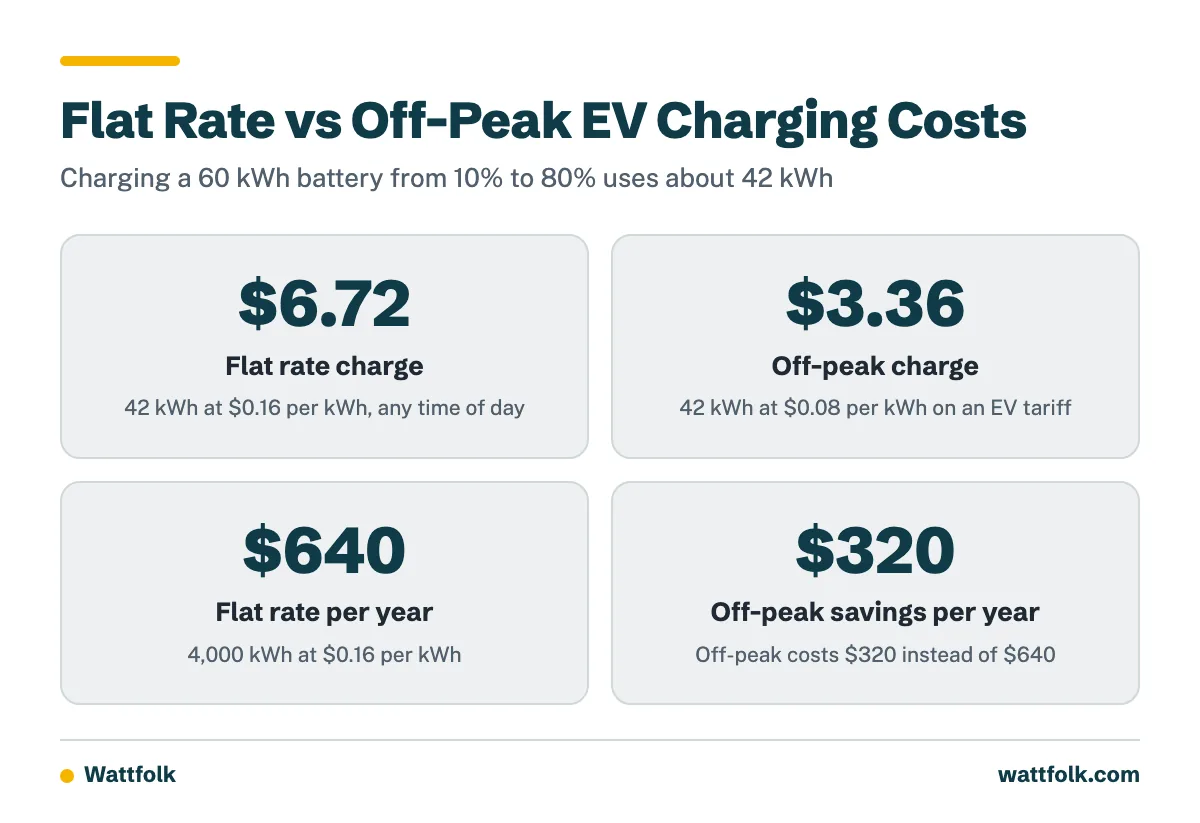
The cost to charge at home depends entirely on your rate plan. We can compare the cost of a flat-rate plan versus a TOU plan using a common charging scenario. Charging a standard 60 kWh EV battery from 10% to 80% requires approximately 42 kWh of energy. The national average US flat electricity rate is roughly $0.16 per kWh.
| Rate Type | Price per kWh | Energy Required (10% to 80%) | Total Cost to Charge |
|---|---|---|---|
| Flat Rate (Anytime) | $0.16 | 42 kWh | $6.72 |
| TOU Super Off-Peak (Night) | $0.08 | 42 kWh | $3.36 |
On a dedicated EV tariff with a super off-peak rate of $0.08 per kWh, that same 42 kWh charge costs just $3.36. This effectively cuts your charging bill in half.
Annual Savings Example
Let us look at a full year of driving. Assume you drive 12,000 miles a year and your EV gets an average efficiency of 3 miles per kWh. You will need 4,000 kWh of energy per year.
- Flat Rate ($0.16/kWh): 4,000 kWh x $0.16 = $640 per year.
- Off-Peak Rate ($0.08/kWh): 4,000 kWh x $0.08 = $320 per year.
By scheduling your car to charge only during off-peak hours on a TOU plan, you save $320 annually.
How do I schedule my EV to only charge during cheap hours?
You can automate your charging schedule using either the software built into your car or the smartphone app connected to your home smart charger. You simply input the start and end times of your utility’s off-peak window (for example, 12:00 AM to 5:00 AM). When you plug the car in at 6:00 PM, nothing happens. The system waits until midnight to send power, automatically cutting off at 5:00 AM.
From the Shop
Software conflicts are a common failure point for home charging. We frequently see owners set a charging schedule in their car’s dashboard, and then set a conflicting schedule in their smart wall charger. The charger cuts power to the cable until midnight. The car checks for power at 10:00 PM, finds none, and goes into a deep sleep mode. When the charger finally sends power at midnight, the sleeping car rejects it. The owner wakes up to an empty battery. Choose one system,either the car or the charger,to handle your scheduling, and leave the other completely open.
Is it cheaper to charge on weekends?
Depending on your utility provider, weekend charging can be cheaper. Many power companies extend their off-peak hours on Saturdays and Sundays because commercial businesses and factories are closed, lowering overall grid demand. Some TOU tariffs designate the entire weekend as an off-peak period. Always read the fine print of your specific rate plan to confirm.
Can solar panels make daytime charging cheaper than night charging?
If you have home solar panels, daytime charging can be completely free, making it much cheaper than charging from the grid at night. A standard solar system generates its maximum power during peak sun hours. If you plug your car in during this window, the power flows directly from the panels into your vehicle.
- If you have a standard grid connection: Schedule your charging between midnight and 6:00 AM on a TOU rate.
- If you have solar panels but no home battery: Plug your EV in during peak sun hours (typically 10:00 AM to 2:00 PM) to absorb excess solar generation directly, avoiding the costs of drawing from the grid later.
Using solar power directly is highly efficient. When you store daytime solar energy in a home wall battery to charge your car at night, you lose around 10% of that energy during the transfer process due to system losses. Direct daytime charging skips the middleman.
What do owners say?
Owners like
- Love the set-and-forget scheduling features on modern smart chargers
- Massive monthly savings after switching to a dedicated EV energy tariff
- Waking up to a fully charged car for just a few dollars is incredibly satisfying
Common complaints
- Frustrated when the car’s internal software and the smart charger’s scheduling conflict, resulting in the car not charging at all
- Utility companies make TOU rate structures confusing and difficult to understand
- Sometimes the charger initiates a connection outside of off-peak hours, resulting in accidental high-cost charging
Summarised from owner reviews and long-term user reports; individual experiences vary.
Frequently Asked Questions
what is the cheapest time to charge electric car?
The cheapest time to charge an electric car is typically between midnight and 6:00 AM. Utilities call this the off-peak window, and prices are significantly lower because overall demand on the power grid is at its lowest point.
is it cheaper to charge an electric car at night?
It is only cheaper to charge at night if you are enrolled in a Time-of-Use (TOU) or dedicated EV tariff with your utility provider. If you are on a standard flat-rate residential plan, night charging costs exactly the same as day charging.
cheapest time of day to charge electric car?
If you rely on grid power, early morning hours (midnight to 5:00 AM) are the cheapest. If you have home solar panels, the cheapest time of day is during peak sun hours (usually 10:00 AM to 2:00 PM) when your system produces free energy.
when is cheapest time to charge electric car?
The absolute cheapest time depends on your specific utility tariff. You must call your energy provider or check your latest bill to find the exact off-peak hours for your address, as some start at 11:00 PM while others do not begin until midnight.
how much it costs to charge electric car at home?
At the US average flat rate of $0.16 per kWh, charging a 60 kWh battery from 10% to 80% (which takes about 42 kWh) costs roughly $6.72. If you switch to an off-peak rate of $0.08 per kWh, that same charge costs $3.36.