
A common mistake people make is buying the highest-amperage wall unit available, expecting it to drastically speed up their charging times. To choose a home EV charger, select a Level 2 unit that matches your vehicle’s maximum acceptance rate (typically 32 to 48 amps), decide between a plug-in or hardwired installation based on your home’s electrical panel capacity, and determine if you want smart features like off-peak scheduling. You must also account for the National Electrical Code’s 80% continuous load rule when sizing your breaker.
Quick answer
To choose the right home EV charger, buy a Level 2 (240V) wall unit that delivers between 32 and 48 amps, matching the maximum AC charging limit of your specific vehicle. You will need to evaluate your home’s electrical panel capacity to decide between a simple plug-in model or a hardwired installation.
- Best for electrical panels with limited spare capacity: 32-amp or 40-amp plug-in chargers
- Best for maximum at-home charging speeds: 48-amp hardwired chargers
- Best for outdoors and harsh winters: Hardwired chargers with NEMA 4 ratings and cold-weather flexible cables
- Your car’s onboard charger limits charging speed, meaning buying a 48-amp charger for a car that only accepts 32 amps will not charge it any faster.
- Electrical codes dictate chargers can only run at 80% of a circuit breaker’s rating, meaning a 48-amp charger requires a dedicated 60-amp breaker.
- Standard plug-in chargers (using a NEMA 14-50 outlet) max out at 40 amps; you must hardwire the unit to achieve 48-amp speeds.
- Cable flexibility matters. Heavy-duty charging cables can become incredibly stiff and difficult to handle in freezing temperatures.
- What is the difference between Level 1 and Level 2 charging?
- How do home EV chargers work?
- How to choose home EV charger?
- Do I need a hardwired or plug-in EV charger?
- Should I choose a tethered or untethered charger?
- What size breaker do I need for a 48-amp charger?
- Do I need to upgrade my electrical panel for an EV charger?
- How are home ev chargers installed?
- What do owners say?
- Frequently Asked Questions
What is the difference between Level 1 and Level 2 charging?
Level 1 chargers operate on standard 120V household outlets and add approximately 3 to 5 miles of range per hour. Level 2 chargers operate on 240V circuits and can add 12 to over 40 miles of range per hour, depending on the unit’s amperage.
When you buy a new electric vehicle, it often comes with a basic Level 1 charging cord. This cord plugs directly into a standard wall socket. For drivers who only commute a few miles a day, this slow trickle of power is adequate. However, a Level 1 charger takes multiple days to refill a fully depleted long-range battery.
Level 2 charging uses a 240V circuit, similar to the power source required for an electric clothes dryer or oven. By delivering higher voltage and higher amperage, Level 2 stations replenish batteries overnight. This is the standard choice for home installations.
How do home EV chargers work?
Home EV chargers act as intelligent switches that safely pass alternating current (AC) from your home’s electrical panel to your car. The actual device that charges the battery is located inside the vehicle itself.
This internal component is known as the onboard charger. It takes the AC power from the wall unit and converts it into direct current (DC) power to store in the battery. The onboard charger acts as a strict bottleneck. Most modern electric vehicles have an onboard AC charger limit between 7.7 kW and 11.5 kW.
If you connect a massive 19.2 kW wall box to a car with an 11.5 kW onboard charger, the car will only draw 11.5 kW. Buying a faster wall unit won’t charge the car faster than its internal limit.
To estimate your charging time, divide your battery capacity by the charger output and add 10% for system conversion losses. For example, charging a standard 77 kWh EV battery from zero using a 9.6 kW (40-amp) home charger looks like this:
77 kWh ÷ 9.6 kW = 8.02 hours.
Adding 10% for AC-to-DC loss brings the total to about 8.8 hours.
At the US national average electricity rate of $0.17 per kWh, completely filling this 77 kWh battery will cost exactly $13.09.
How to choose home EV charger?
Selecting the right unit requires matching your car’s technical limits with your home’s electrical capacity, then deciding on physical and smart features. Let’s look at the main criteria.
Match the Amperage
Find the maximum AC acceptance rate for your specific vehicle make and model. If your car accepts a maximum of 11.5 kW, it can utilize a full 48 amps. If it maxes out at 7.7 kW, a 32-amp charger is all you need. Do not pay extra for 48-amp capabilities if your current or planned vehicle cannot use them.
Smart vs. Dumb Chargers
A “dumb” charger simply provides power when plugged in. A “smart” charger connects to your home’s Wi-Fi. Smart chargers allow you to monitor energy consumption, view charging history, and schedule charging sessions. Scheduling is highly valuable if your utility company offers time-of-use pricing, allowing you to program the car to charge automatically during cheap, off-peak hours (usually after midnight).
Cable Length and Weather Resistance
Cable length dictates where you can park. A 24- to 25-foot cable is the industry standard and provides enough reach to park front-in or backed-in, or to charge a vehicle in an adjacent driveway spot.
You must also evaluate cable thickness. Thick cables can become extremely stiff and unmanageable in freezing winter weather. If you live in a cold climate, check manufacturer specifications and owner reviews specifically regarding cold-weather flexibility. For outdoor installations, verify the unit has a NEMA 4 weather-resistance rating, which protects against windblown dust and water from any direction, rather than a less protective NEMA 3R rating.
Do I need a hardwired or plug-in EV charger?
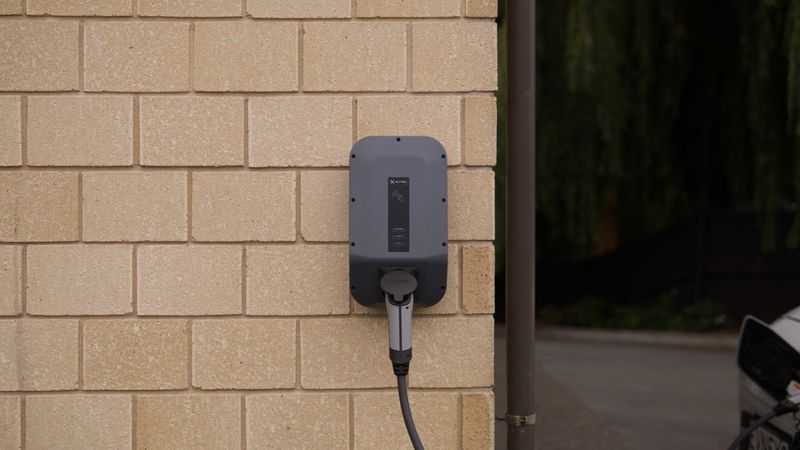
Plug-in EV chargers connect to a heavy-duty 240V wall receptacle, most commonly a NEMA 14-50 outlet. Hardwired EV chargers have their power cables routed directly from the electrical panel into the unit’s internal terminal block by an electrician.
Most standard NEMA 14-50 plug-in setups are limited to a maximum continuous output of 40 amps. If you want to charge at speeds of 48 amps or higher, hardwiring is typically required by electrical codes. Hardwiring also eliminates the need for an expensive, commercial-grade GFCI receptacle, which often causes nuisance tripping when paired with EV chargers.
- Choose Plug-in if: You already have a dedicated NEMA 14-50 outlet in your garage, you plan to move houses soon and want to take the charger easily, or you are satisfied with a maximum 40-amp charge rate.
- Choose Hardwired if: You are installing the charger outdoors, you want maximum 48-amp charging speeds, or you want to avoid installing a costly GFCI breaker and industrial-grade outlet.
Should I choose a tethered or untethered charger?
A tethered charger has the charging cable permanently attached to the wall box. An untethered charger is just a socket on the wall; you must provide your own cable to connect the wall unit to the car.
In the United States, tethered chargers are the standard. They are far more convenient because you do not have to coil up a dirty, wet cable and put it in your trunk every morning. Untethered units are common in Europe but are rarely the best choice for US homeowners unless space is severely restricted.
What size breaker do I need for a 48-amp charger?
A 60-amp circuit breaker is required to safely run a home EV charger at a maximum of 48 amps. This discrepancy exists because of electrical safety rules regarding continuous heat generation.
The National Electrical Code (NEC) dictates that EV chargers are a continuous load. A continuous load is anything that runs at maximum current for three hours or more. Because wires and breakers get hot under constant electrical pressure, the NEC states continuous loads can only operate at 80% of the circuit breaker’s maximum rating.
Here is how breaker sizes translate to safe charging speeds and estimated range.
| Dedicated Breaker Size | Max Allowed Amps (80% Rule) | Power Output (kW at 240V) | Estimated Miles Added Per Hour |
|---|---|---|---|
| 20 Amps | 16 Amps | 3.8 kW | 12 – 15 miles |
| 40 Amps | 32 Amps | 7.7 kW | 20 – 25 miles |
| 50 Amps | 40 Amps | 9.6 kW | 25 – 30 miles |
| 60 Amps | 48 Amps | 11.5 kW | 30 – 40+ miles |
Do I need to upgrade my electrical panel for an EV charger?
You might need a panel upgrade if your home currently runs on a 100-amp service. Modern homes typically have 200-amp panels, which easily accommodate the extra 50- or 60-amp breaker required for an EV charger. Adding an EV charger to a smaller panel requires a load calculation by an electrician.
Before purchasing a unit, run through this pre-installation checklist:
- Check the main breaker: Open your panel and locate the main shut-off breaker at the top. Note whether it says 100, 150, or 200 amps.
- Count the heavy loads: Note how many high-draw appliances you already have (electric oven, central air conditioning, electric water heater, hot tub).
- Look for physical space: See if you have two open slots adjacent to one another. A 240V circuit requires a double-pole breaker, which takes up two physical spaces.
From the Shop
We routinely see homeowners buy a massive 48-amp charger for an older property with a 100-amp main panel. When the electric AC kicks on at the same time the car starts charging, the panel gets overloaded and trips the main breaker, shutting off power to the entire house. If your panel is full, you don’t always need an expensive $3,000 panel upgrade. You can often install a smart load management device that automatically pauses the EV charger when the oven or AC turns on.
How are home ev chargers installed?
Unless you are simply plugging a portable unit into a pre-existing, dedicated NEMA 14-50 outlet, home EV chargers must be installed by a licensed electrician. The process involves running heavily insulated copper wire (often 6-gauge or 4-gauge) from the main electrical panel to the charging location.
The electrician mounts the wall box to a stud, routes the wiring through protective conduit, and terminates the connections inside the charger. They will also install the correctly sized double-pole breaker in your panel. In most US municipalities, this work requires an electrical permit and a post-installation inspection by the city to verify the wire size matches the breaker rating safely.
What do owners say?
Owners like
- App integration that reliably automates charging during off-peak utility rates
- Longer cables (24-25 feet) that easily reach multiple parking spots
- Compact, unobtrusive wall footprints
- Auto-resume functionality that starts charging automatically after a power outage
Common complaints
- Thick cables becoming extremely stiff and unmanageable in freezing winter weather
- Spotty Wi-Fi connectivity causing smart features and schedules to fail
- Bright, un-dimmable LED status lights illuminating the garage or driveway annoyingly at night
- Clunky proprietary apps with poor user interfaces and frequent logouts
Summarised from owner reviews and long-term user reports; individual experiences vary.
Frequently Asked Questions
how to choose home ev charger?
To choose a home EV charger, identify your vehicle’s maximum AC charging rate to select the right amperage (usually between 32 and 48 amps). Then, assess your electrical panel to see if you have the capacity for a high-amp dedicated circuit. Decide between a hardwired installation for faster speeds and outdoor durability, or a plug-in model for portability. Finally, decide if you want smart scheduling features to take advantage of cheap nighttime electricity rates.
how do home ev chargers work?
Home EV chargers function as smart relays that safely supply 240-volt AC power from your house directly to your vehicle. The wall unit itself does not convert the power; instead, an onboard charger located inside the car takes the AC electricity and converts it to DC power to fill the battery pack. The wall unit monitors the connection and stops the flow of electricity if it detects a fault.
how are home ev chargers installed?
Home EV chargers are installed by routing thick, heavy-gauge copper wiring from an available double-pole breaker in your main electrical panel to the mounting location. For plug-in models, an electrician wires a dedicated 240-volt outlet (like a NEMA 14-50). For hardwired units, the electrician connects the power lines directly to the terminals inside the charger itself. Because of the high continuous current, a licensed electrician should pull a permit and perform the installation to meet local safety codes.