
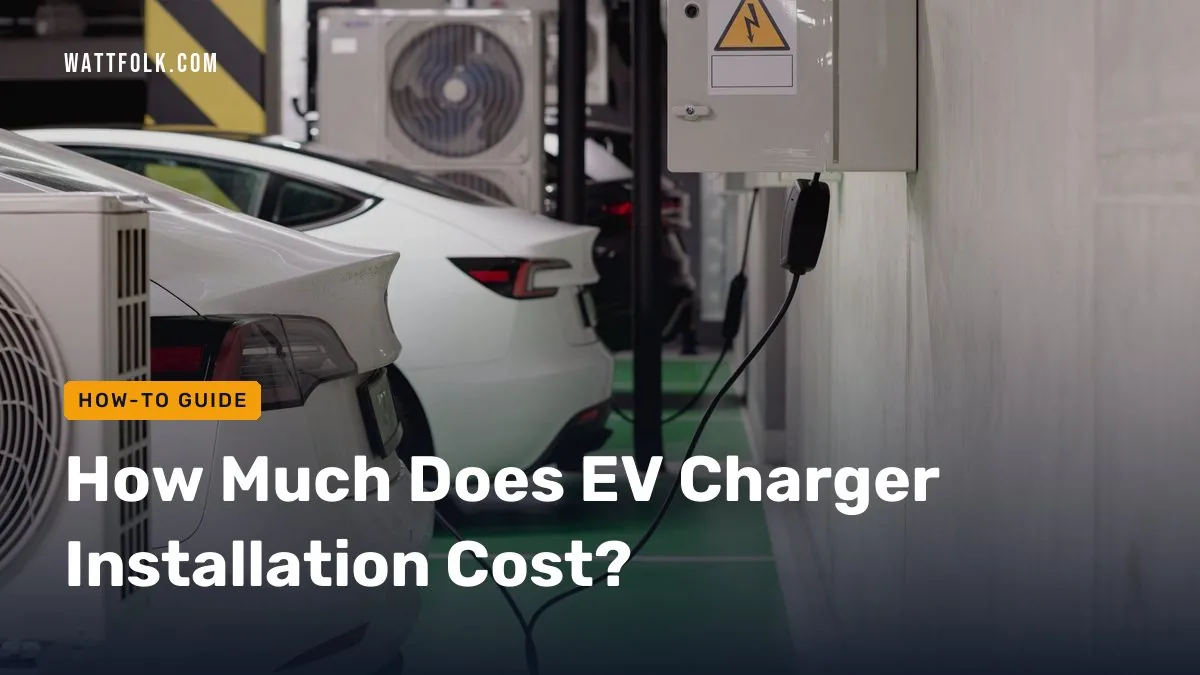
Many buyers purchase a $600 electric vehicle charger and assume they are finished spending money. The costly mistake is ignoring the installation labor and heavy-duty wiring, which often costs as much as the unit itself. In the United States, a complete standard home EV charger installation typically costs between $800 and $1,500. This includes both the hardware and the professional fitting required to charge safely.
Quick answer
A complete home EV charger installation averages $800 to $1,500 total. The charger unit accounts for $500 to $800, while licensed electrician labor and wiring for a standard 10 to 15-meter run make up the remaining $300 to $800.
- Best for standard homes: A 7kW to 9kW Level 2 smart charger on a dedicated 40-amp circuit.
- Best for older homes: Installing a load-balancing device instead of a costly full electrical panel upgrade.
- The average total cost for a home EV charger and installation is $800 to $1,500.
- Hardware and labor should be quoted separately; charger units cost $500 to $800 on their own.
- Hidden costs like long cable runs, trenching, or electrical panel upgrades can push the price above $2,000.
- Charging at home on an off-peak electricity rate offers significant savings over buying gas, often paying for the installation within two years.
- How much does EV charger installation cost on average?
- What factors make an EV charger installation more expensive?
- Are there still government grants available for home EV chargers?
- How does the cost of EV charging compare to buying gas?
- Do I need to upgrade my fuse box (consumer unit) for an EV charger?
- Tethered vs. untethered chargers: Cost and convenience
- How to choose an accredited installer
- What do owners say?
- Frequently Asked Questions
How much does EV charger installation cost on average?
To get an accurate picture of the total price, you must separate the hardware from the labor. A typical 7kW to 9kW smart charger unit costs between $500 and $800 to purchase without installation. Electricians then charge for the wiring, the circuit breaker, and their time.
A standard installation quote assumes your electrical panel is relatively close to the charging location. It typically covers a maximum cable run of 10 to 15 meters and assumes no trenching through gardens or driveways is required.
| Installation Type | Hardware Cost | Labor & Wiring Cost | Estimated Total |
|---|---|---|---|
| Low-End (Simple Install) | $400 | $300 | $700 |
| Average (Standard Run) | $600 | $600 | $1,200 |
| High-End (Complex Run) | $800 | $1,200+ | $2,000+ |
What factors make an EV charger installation more expensive?
The distance between your main electrical panel and your parking spot dictates the final price. Copper wire is expensive. If your panel is in the basement on the opposite side of the house from your driveway, the material costs multiply quickly.
Other factors that drive up costs include drilling through multiple walls, hiding cables inside finished drywall, or trenching underground to reach a detached garage. Older homes may also require a grounding rod installation if the existing earth setup does not meet current codes.
From the Shop
Detached garages are the most common source of sticker shock. Homeowners often expect a $500 labor bill, but running a new buried line under a driveway or lawn requires trenching equipment, conduit, and heavy-gauge wire. These runs routinely push the installation portion of the bill past $1,500.
Are there still government grants available for home EV chargers?
Many online guides quote outdated grant information, confusing buyers about what financial help is actually available. Programs change rapidly depending on your location.
In the US, the Federal 30C alternative fuel infrastructure tax credit provides up to 30% off the cost of the hardware and installation (up to $1,000), but it is now strictly limited to properties in non-urban or lower-income census tracts. However, many local utility companies offer their own rebates ranging from $200 to $500 if you install a qualified smart charger and agree to charge during off-peak hours.
How does the cost of EV charging compare to buying gas?
The upfront cost of installing a home charger is easily offset by the long-term savings on fuel. Charging an EV at home on a dedicated off-peak tariff costs a fraction of an equivalent gas fill-up.
Let us look at a real-world calculation based on driving 10,000 miles per year.
- Assumptions: The US national average electricity rate is roughly $0.17 per kWh. A typical EV gets 3 miles per kWh. A comparable gas car gets 25 miles per gallon, with gas priced at $3.50 per gallon.
- EV Cost: 10,000 miles / 3 = 3,333 kWh per year. 3,333 kWh × $0.17 = $566 per year.
- Gas Cost: 10,000 miles / 25 = 400 gallons per year. 400 gallons × $3.50 = $1,400 per year.
In this scenario, the EV owner saves $834 annually. If the charger installation cost $1,200, the system pays for itself in less than 18 months.
Do I need to upgrade my fuse box (consumer unit) for an EV charger?
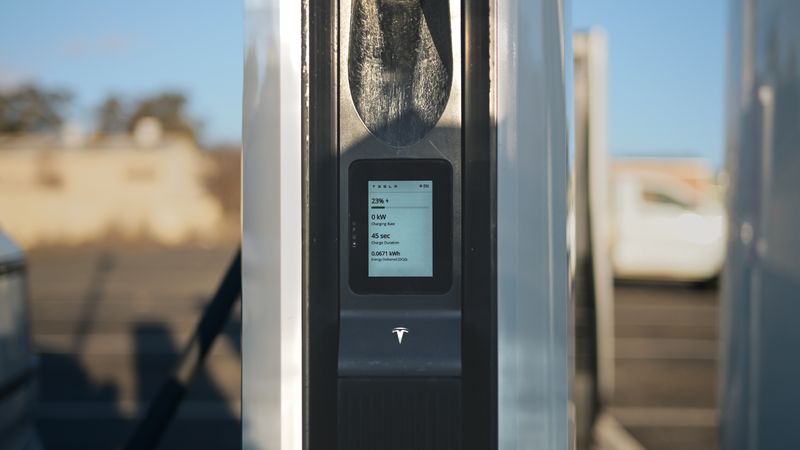
Adding a 40-amp or 50-amp circuit for an EV charger draws significant power. If your home has an older 100-amp electrical panel, it might not have the spare capacity to handle the load safely.
Upgrading a main electrical panel is expensive, often costing between $1,500 and $3,000. Fortunately, there is an alternative.
- If your panel has spare capacity: Proceed with a standard dedicated circuit installation.
- If your panel is full or undersized: Install a load-balancing device (energy management system).
Tethered vs. untethered chargers: Cost and convenience
When selecting your hardware, you must choose between a tethered and an untethered unit. A tethered charger has the charging cable permanently attached to the wall box. An untethered unit is simply a socket on the wall; you must provide your own cable and plug it in each time.
Untethered units are slightly cheaper and look tidier on the wall when not in use. However, based on verified buyer reviews, the convenience of a tethered unit far outweighs the slight cost increase. Pulling a dirty, wet cable out of the trunk every evening becomes frustrating quickly.
How to choose an accredited installer
Never hire an uncertified handyman to install an EV charger. These devices pull continuous high-amperage power for hours at a time. A loose connection will overheat and cause a fire. Always use a licensed electrician who has specific experience with EV supply equipment.
To get an accurate quote without multiple site visits, follow this pre-quote checklist:
- Take a clear, well-lit photo of your main electrical panel with the door open, showing the breakers.
- Take a photo of the manufacturer label inside the panel door.
- Measure the approximate walking distance from the panel to where you want the charger mounted.
- Note whether the cable will need to pass through interior walls, brick, or underground.
What do owners say?
Owners like
- Massive cost savings when paired with EV-specific overnight energy tariffs.
- Convenience of waking up to a full ‘tank’ every morning.
- Tethered cables are highly praised for saving time fumbling in the trunk.
Common complaints
- Unexpected ‘non-standard’ installation fees for long cable runs or new electrical panels.
- Wi-Fi connectivity dropping out on smart chargers, causing scheduled charges to fail.
- Thick tethered cables being stiff and difficult to coil in freezing weather.
Summarised from owner reviews and long-term user reports; individual experiences vary.
Frequently Asked Questions
how much ev charger installation cost?
A standard residential EV charger installation typically costs between $800 and $1,500 total. This price breaks down into $500 to $800 for the charger unit itself, and $300 to $800 for a licensed electrician to wire and mount the system.
ev charger installation cost uk?
If you are comparing overseas rates, a standard 7kW EV charger installation in the UK generally costs between $1,000 and $1,500 in equivalent US dollars. This includes both the hardware and standard fitting. The UK OZEV grant previously lowered this cost for homeowners, but it is now strictly limited primarily to renters and apartment owners.
ev charger installation cost ireland?
In Ireland, the average total cost ranges from $1,000 to $1,650 in equivalent US dollars before applying any local SEAI grants. Just like in the US, this baseline assumes a standard cable run without the need for major groundwork or electrical board upgrades.
what does an EV charger installation cost if my panel is full?
If your electrical panel lacks the capacity for a new 50-amp circuit, you face two choices. A full panel upgrade generally costs $1,500 to $3,000. Alternatively, an electrician can install a load-balancing device for roughly $300 to $600, which safely manages the power without requiring a panel replacement.
ev charging cost vs gas calculator?
To calculate your specific savings, divide your annual mileage by your EV’s efficiency (usually 3 miles per kWh) to find your total kWh. Multiply that by your local electricity rate. Then, divide your mileage by your gas car’s mpg and multiply by the local gas price. Subtract the EV cost from the gas cost to see your annual savings.
how much is ev charger installation cost for a detached garage?
Installing a charger in a detached garage is considered a non-standard installation. Because it requires digging a trench, laying conduit, and running heavy-duty wire underground, the labor and materials frequently push the total project cost well over $2,000.