
The biggest choice when buying a plug-in solar kit is deciding if you need battery storage. Basic outdoor plug-in systems cost between $400 and $800, while adding a small battery bank pushes the final price past $1,200. A standard outdoor balcony setup feeds power directly into your home to offset daytime electricity use, whereas small indoor panels only generate enough energy for basic electronics. The final price tag depends heavily on the mounting hardware, microinverter size, and local grid connection rules.
Quick answer
A standard plug-in solar kit costs between $400 and $800, which includes the solar panels, a microinverter, and basic wiring. Upgrading to a kit with custom mounting brackets or battery storage will increase the total cost past $1,200.
- Best for fast payback: Standard 800-watt kits without batteries.
- Best for evening use: Kits with small integrated battery banks.
- Plug-in solar kits typically cost $400 to $800, excluding custom mounting brackets.
- Adding a battery bank usually doubles the purchase price and lengthens the payback period.
- In Germany, registered systems allow up to 2,000 watts of panel capacity paired with an 800-watt microinverter.
- Registration for German systems via the Marktstammdatenregister is completely free.
- Indoor solar panels are not powerful enough to run heavy household appliances.
How much does plug in solar cost?
Plug-in solar kits generally range from $400 to over $1,500. The price changes based on how much power the system produces and whether you store that power for later. Buyers often see a low advertised price, only to realize that essential parts are sold separately.
To understand the realistic purchase cost, you need to look at what type of package you are buying.
| Kit Type | Included Components | Realistic Cost (USD) |
|---|---|---|
| Basic Kit | Panels, microinverter, basic cable | $400 – $600 |
| Kit with Mounting | Panels, microinverter, cable, balcony brackets | $500 – $800 |
| Kit with Battery | Panels, microinverter, cable, brackets, battery unit | $1,200 – $1,800 |
Many retailers sell the base kit cheaply to attract buyers. Always check the final cart price after adding delivery fees and mounting rails.

How much does plug in solar cost in Germany?
Plug-in solar setups, often called balcony power plants (Balkonkraftwerke), are heavily regulated but highly popular in Germany. Converted to US dollars, a standard German balcony kit costs between $400 and $800. The German market sets a strong example of how these systems are priced and regulated.
Since October 2024, tenants and apartment owners in Germany have a legal right to install plug-in solar systems. While landlord approval may still be required, refusal is strictly limited to exceptional, justified cases. This legal protection has driven hardware prices down by increasing mass production. A standard 800-watt inverter kit with two solar panels now sits at the lower end of that $400 to $800 range.
What is included in the advertised price of a plug-in solar kit?
The headline price of a plug-in solar kit typically covers the solar panels, the microinverter, and a standard plug-in connection cable. The solar panels capture sunlight and turn it into direct current (DC) electricity. The microinverter is a small box that attaches to the panels; it converts the DC electricity into alternating current (AC) electricity that your house can use.
However, the base price almost never includes heavy-duty brackets, customized cables, or delivery charges for oversized freight.
How much do plug in solar panels cost with an inverter and mounting?
Adding mounting hardware usually increases the cost of your kit by $100 to $200. You cannot safely strap a heavy glass solar panel to a balcony with zip ties. Proper mounting systems use strong metal rails, specialized hooks, and weather-resistant bolts.
From the Shop
We constantly see buyers underestimate mounting costs. A customer will buy a basic kit for $450, only to discover that the specific hooks required for their round balcony railing cost an extra $150, plus $50 in heavy shipping fees. Always measure your railing or wall space and add the exact mounting brackets to your cart before calculating your final budget.
How much more does a plug-in solar system cost with a battery?
Adding a battery to a plug-in solar system increases the total cost by $800 to $1,200. Batteries store excess electricity generated during the middle of the day so you can use it at night.
- If you work from home: A standard kit without a battery is highly cost-effective. Your home consumes the solar power directly as it is generated during the day.
- If your house is empty all day: You might send unused power back to the grid for free. In this case, a battery captures that energy for evening use, though the high upfront cost means it takes much longer to pay off.
Installation, Rules, and Registration
One major selling point of plug-in solar is the simple installation. However, grid operators have strict rules to keep the local electrical supply safe.
Do I need to pay for installation or an electrician?
In most cases, you do not need to pay an electrician if you have an accessible, weather-proof outdoor outlet. You simply mount the panels securely and plug the system in.
Never use an extension cord to connect a plug-in solar microinverter to your house. Extension cords can overheat and cause fires when handling continuous electrical generation. If you do not have a safe outdoor outlet near your installation site, you must hire a licensed electrician to install one, which generally costs $150 to $300 depending on your location.
Do I have to register a plug-in solar system in Germany?
Yes, you must register a plug-in solar system in Germany within one month of commissioning. The registration is completely free of charge. According to official guidelines, users must register their system in the Marktstammdatenregister (MaStR).
German rules are specific about system size. Germany’s current registration guidance allows up to 2,000 watts of total module capacity, as long as the microinverter capacity is limited to 800 watts.
Note: Plug-in solar rules in the United States vary by state and change quickly. Only a few local US jurisdictions have streamlined rules for plug-in systems. Always confirm current regulations, meter requirements, and connection limits with your local utility provider before buying.
Production and Savings Calculations
To determine if the purchase cost is worth it, you have to look at the money you save on your power bill. Outdoor production is strongly affected by orientation, shading, the season, and local sunlight. You should never evaluate system value based on wattage alone.

How much electricity can an 800-watt plug-in system produce?
We can estimate production using standard US metrics. Electricity rates in the US range roughly from 12 to 40 cents per kilowatt-hour (kWh), with the national average near 17 cents per kWh.
Let us look at a typical worked calculation:
- System Size: 800 watts (0.8 kW) inverter output.
- Sunlight: 4 peak sun hours per day (average US location).
- System Losses: 15% loss from heat, shading, and inverter inefficiency.
- Daily Output: 0.8 kW × 4 hours × 0.85 = 2.72 kWh per day.
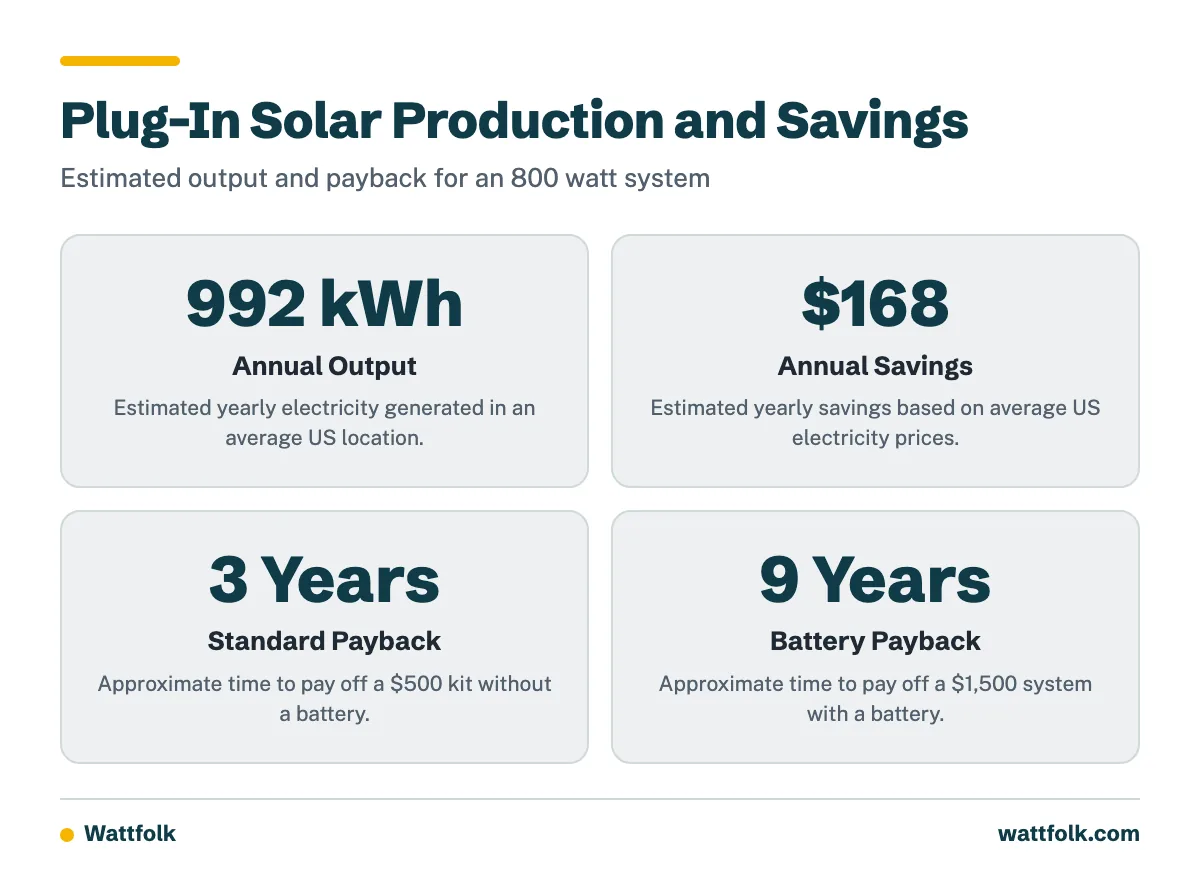
- Annual Output: 2.72 kWh × 365 days = 992 kWh per year.
If your home consumes all of this generated power, you multiply the 992 kWh by the average US electricity price of $0.17 per kWh. This system saves you roughly $168 per year.
If you paid $500 for the kit, your simple payback period is just under three years. If you paid $1,500 for a system with a battery, the payback period stretches closer to nine years.
Can solar panels charge indoors?
Many renters who lack a balcony wonder if they can put a solar panel inside against a window. Yes, indoor photovoltaic cells can generate electricity under artificial light and through window glass, but the output is drastically lower than an outdoor setup.
Is indoor solar powerful enough to charge a phone or run household appliances?
Indoor solar is intended mainly for low-power devices, not household loads. Window glass reflects and absorbs a large portion of the sun’s energy. Even in bright rooms, the available light energy is a fraction of direct outdoor sunlight.
In laboratory testing, special gallium-indium-phosphide cells successfully converted nearly 40% of cool-white LED light into electricity. However, this is an indoor-cell efficiency result under highly controlled conditions, not a typical household panel output. An indoor panel might trickle-charge a smartphone or run a small battery-powered sensor, but it will never power a refrigerator, a television, or a coffee maker. A true plug-in solar system must sit outside to be cost-effective.
What do owners say?
Owners like
- Simple installation when the kit includes preconfigured panels, inverter, and cables.
- Low operating and maintenance requirements compared with larger solar installations.
- Useful reduction in daytime grid electricity consumption.
- Compact size makes balcony or small-garden installation possible for renters and apartment residents.
Common complaints
- Actual output is often lower than the headline wattage because of shade, poor orientation, weather, and seasonal variation.
- Mounting hardware can add significant cost and may be difficult on some balconies.
- Battery versions are substantially more expensive and can lengthen the payback period.
- Cables, adapters, and installation details are not always included in the advertised base price.
- Registration, landlord approval, and meter questions can make the system less straightforward than a simple plug-in purchase suggests.
Summarised from owner reviews and long-term user reports; individual experiences vary.
Frequently Asked Questions
how much does plugin solar cost?
A standard plug-in solar system usually costs between $400 and $800. This price includes the solar panels, a microinverter, and basic connection cables. If you need specialized balcony mounting hardware or want to add a battery system, the total cost will easily exceed $1,200.
how much does plug in solar cost in germany?
In Germany, the typical cost for a plug-in balcony solar kit converts to roughly $400 to $800. Strong consumer demand and recent laws granting tenants the right to install these systems have kept hardware prices highly competitive in the German market.
how much do plug in solar cost?
The total cost depends on the parts included. You can expect to pay about $400 for a bare-bones 800-watt kit. Adding sturdy mounting rails adds $100 to $200. Adding a small battery to store energy for nighttime use adds another $800 or more to the final bill.
can solar panels charge indoors?
Yes, indoor photovoltaic cells can generate small amounts of electricity under artificial light or behind a window. However, the output is extremely low. Indoor solar is only practical for low-energy devices like calculators or small sensors; it cannot run standard household appliances.
Sources