The limit on plug-in solar depends entirely on the microinverter’s maximum output, the capacity of your wall socket, and your local utility rules. Most standard plug-in solar kits use an 800-watt inverter limit to prevent overloading household circuits, even if you connect up to 2,000 watts of solar panels to that inverter. Knowing the difference between panel size and inverter output dictates exactly what you can safely plug into your home.
Quick answer
You can safely run an 800-watt plug-in solar inverter on a standard household circuit, paired with up to 2,000 watts of solar panels. Systems larger than this typically require a dedicated circuit, hardwiring, and a licensed electrician to install.
- Plug-in solar limits apply to the inverter’s AC output, not the solar panel’s DC rating.
- Oversizing panels (e.g., 2,000 W of panels on an 800 W inverter) is standard practice to boost low-light performance.
- An 800 W system can generate roughly 3.2 kWh per day under ideal US sun conditions.
- Always inspect older circuits before connecting generation equipment to a standard wall socket.
- How much plug-in solar can you have in the UK and Europe?
- What is the difference between panel watts, inverter watts, and electricity generated?
- Can I connect 2,000 W of panels to an 800 W plug-in inverter?
- How many panels can I connect to one plug-in solar system?
- How do I figure out how much solar power I need?
- How much electricity will an 800 W plug-in system actually generate?
- Can I plug a solar system into any household socket?
- How do I check whether my circuit and wiring are suitable?
- Do I need to register plug-in solar or notify my electricity supplier?
- What do owners say?
- Frequently Asked Questions
How much plug-in solar can you have in the UK and Europe?
While US plug-in solar rules vary heavily by state and specific utility company, international regulations provide the blueprint for what is considered safe on a standard household circuit. By looking at established markets, we can see exactly where the safety limits lie.
The UK plug-in solar interim specification limits maximum apparent power supplied to the mains installation to 800 VA. At 230 V, an 800 W output corresponds to approximately 3.5 A of current. The same specification limits the maximum current to exactly 3.5 A. For the panels themselves, the UK specification permits a maximum combined PV module DC power of 2,000 W. UK guidance says consumers with total PV module maximum power above 960 W should consider a professional assessment of the existing electrical installation. Finally, UK plug-in solar devices intended for household sockets must use plugs designed to BS 1363-1.
Germany follows a similar framework. Germany permits up to 800 W of inverter output for standard balcony power plant systems. German guidance commonly permits up to 2,000 Wp of panel capacity, while Schuko household-plug installations may be limited to 960 Wp depending on the applicable requirements.
| Country Standard | Max Inverter Output | Max Panel Capacity | Professional Assessment Threshold | Plug Requirement |
|---|---|---|---|---|
| United Kingdom | 800 VA (3.5 A) | 2,000 W DC | > 960 W panel capacity | BS 1363-1 |
| Germany | 800 W | 2,000 Wp | > 960 Wp on Schuko sockets | Schuko / Wieland |
As of October 2026, these balcony solar rules represent the safest tested limits for household circuits without hardwiring. In the US, your 120V system will draw more amps for the same wattage (an 800 W inverter on a 120V US circuit pushes about 6.6 amps). You must confirm your specific limits with your local US utility company.
What is the difference between panel watts, inverter watts, and electricity generated?
Many homeowners confuse the inverter’s AC export limit with the panels’ DC rating. This confusion makes perfectly legal systems appear oversized. You need to separate the two components.
Panel watts (DC): This is the maximum direct current power your solar panels can produce under perfect laboratory conditions. A 400 W panel rarely produces exactly 400 W in the real world.
Inverter watts (AC): This is the hard limit on what the microinverter pushes into your wall socket. If you buy an 800 W plug-in inverter, it will never send more than 800 W into your home circuit, regardless of how much power the panels are generating.
Electricity generated (kWh): This is the actual usable energy over time. An 800 W inverter running at full capacity for one hour generates 0.8 kilowatt-hours (kWh) of electricity.
Can I connect 2,000 W of panels to an 800 W plug-in inverter?
Yes. This practice is completely normal. It is called panel oversizing, and it solves one of the biggest problems with small solar kits: cloudy weather.
If you connect 800 W of panels to an 800 W inverter, you will only hit 800 W at noon on a perfectly clear summer day. During early mornings, late afternoons, or overcast days, those panels might only generate 200 W.
If you connect 2,000 W of panels to that same 800 W inverter, your system behaves differently. Even on a cloudy day, that larger array might generate 700 W or 800 W, keeping your inverter running near maximum capacity for much longer. At high noon on a sunny day, the panels might be capable of 1,600 W. The inverter simply ignores the extra power. It clips the peak off the production curve, taking only the 800 W it needs.

How many panels can I connect to one plug-in solar system?
You can connect as many panels as your microinverter has inputs for, provided you stay under the total wattage and voltage limits. Most 800 W microinverters come with two separate inputs (MPPT trackers). You typically connect one large panel (e.g., 400 W) to each input.
If you want to maximize the 2,000 W legal limit allowed in many jurisdictions, you might use splitters to connect two smaller panels in parallel to each input. For example, four 400 W panels split across two inputs equals 1,600 W. This requires careful attention to the inverter’s maximum short-circuit current limit (Isc).
How do I figure out how much solar power I need?
To size a plug-in solar system, you measure your daytime background consumption. Plug-in solar systems without batteries push power directly into your household circuits. If your house is not using that power in real-time, the excess flows out to the grid. Unless you have a specific net-metering agreement, you give that excess power to the utility company for free.
Let’s run the numbers for an average US household. We want to cover the devices that run continuously while the sun is shining.
- Refrigerator: 150 W (cycles on and off, but averages out)
- Wi-Fi router and modem: 15 W
- Standby appliances (TVs, microwaves): 35 W
- Home office equipment (laptop, monitor): 100 W
This creates a continuous daytime load of roughly 300 W. A 400 W plug-in kit is perfect for this. It covers the load when the sun is shining, and you buy from the grid when a cloud passes.
- If your daytime load is under 200 W: Choose a 400 W microinverter with a single 400 W panel.
- If your daytime load is 300 W – 500 W: Choose an 800 W microinverter with two 400 W panels.
- If you work from home with AC running: Choose an 800 W microinverter and oversize the panels to 1,600 W to ensure maximum coverage from dawn to dusk.
How much electricity will an 800 W plug-in system actually generate?
An 800 W system rarely produces 800 W continuously. Generation depends on your location’s peak sun hours, system losses, and panel orientation. In the US, most locations receive an average of 4 peak sun hours per day.
Based on the specifications, an 800 W inverter operating perfectly for 4 hours generates 3,200 watt-hours, or 3.2 kWh per day. Factoring in real-world losses from heat and wiring (typically 15%), expect around 2.7 kWh per day.
At the US national average electricity rate of $0.17 per kWh, 2.7 kWh saves you $0.46 per day. Over a year, that totals $167 in savings. If you live in a state with higher electricity costs, like California or Massachusetts, where rates can exceed $0.30 per kWh, those exact same panels could save you nearly $300 a year.
Can I plug a solar system into any household socket?
No. You cannot safely plug a solar kit into just any outlet. The circuit must be in good condition, properly grounded, and correctly rated for continuous loads.
An 800 W inverter pushes continuous current for hours. If you plug this into a worn-out outdoor socket with loose contacts, the resistance will create heat. Over time, that heat melts the plastic housing and creates a fire risk. You must also account for what else is on that circuit. If you plug a solar system into a 15-amp circuit that is already heavily loaded, the added current interacting with other devices can cause breaker issues.
From the Shop
From what we’ve seen on the bench, the most common failure point for plug-in solar is not the microinverter,it is the homeowner’s outdoor wall socket. We regularly see melted AC power cables sent back for warranty claims. Nine times out of ten, the problem was a 20-year-old, weather-beaten receptacle with no grip tension left. A loose connection causes arcing. If your plug falls out easily, replace the receptacle before you attach solar.
How do I check whether my circuit and wiring are suitable?
Before installing any generation equipment, you must evaluate the electrical path. Never use extension cords to connect a microinverter to a distant socket. Extension cords cause voltage drop and heat buildup.
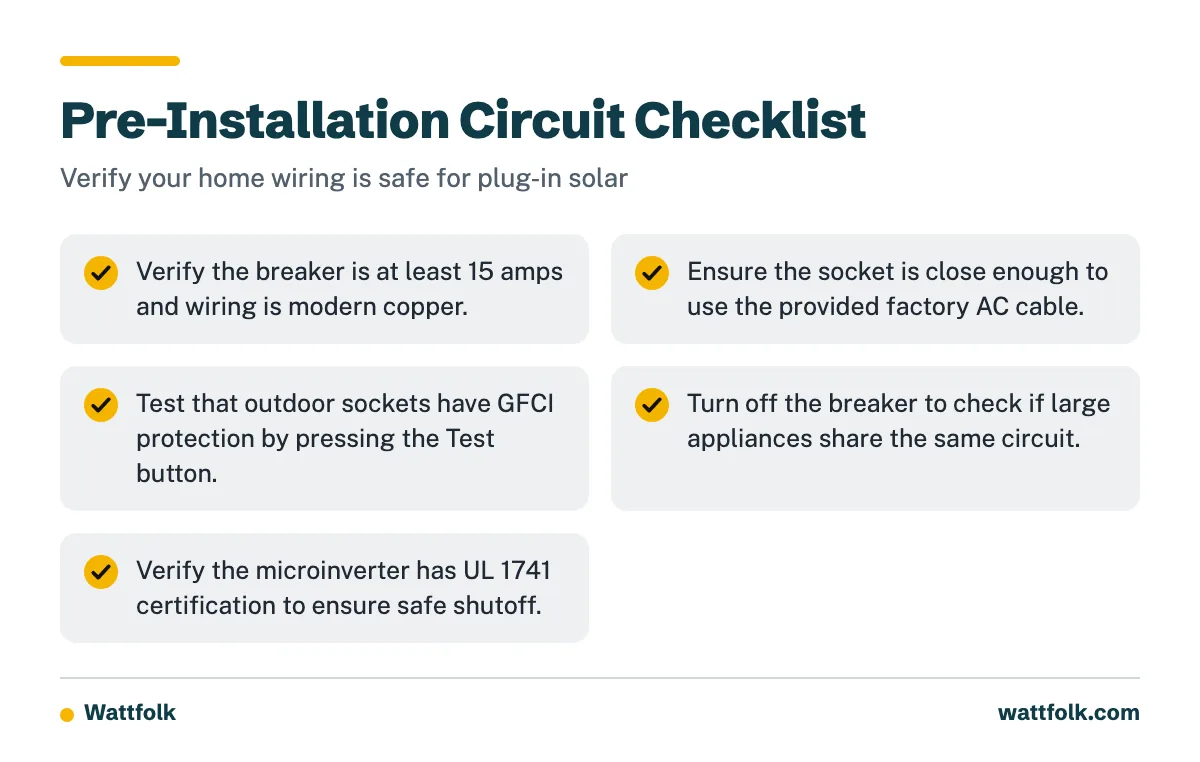
Use this pre-installation checklist:
- Circuit Condition: Verify the breaker is at least 15 amps (standard for US homes) and the wiring is modern copper, not outdated aluminum.
- Socket Location: Ensure the socket is close enough to the panels to use the provided factory AC cable.
- GFCI Protection: Outdoor sockets must have Ground Fault Circuit Interrupter (GFCI) protection. Test the socket by pressing the “Test” button.
- Shared Loads: Turn off the breaker for that outdoor socket. Walk through your house and see what else lost power. If your kitchen fridge is on that same circuit, find a different socket.
- Inverter Certification: Verify the microinverter has UL 1741 certification, which guarantees it will shut off immediately if grid power fails (anti-islanding).
If your home wiring is old, or if you plan to install more than 960 W of total panel capacity, hire a licensed electrician to inspect the circuit first.

Do I need to register plug-in solar or notify my electricity supplier?
In almost all cases in the US, yes. Plug-in solar rules vary heavily by state, but pushing power back into the grid without an interconnection agreement is universally prohibited by utility companies.
Microinverters export power. Even if you try to use all the power yourself, there will be fractions of a second where the solar outpaces your home consumption, and the excess flows past your meter. Modern smart meters track this. If your utility company sees unapproved power flowing backward, they can shut off your grid connection.
Always contact your utility company and ask for their specific interconnection rules for “under 1 kW plug-in microinverters.” Some utilities have streamlined processes for small systems, while others require the same paperwork as a full rooftop installation.
What do owners say?
Owners like
- Simple plug-in installation compared with a conventional rooftop solar installation
- Useful reduction in daytime electricity drawn from the grid
- Compact panels suit balconies, gardens, sheds, and small outdoor spaces
- Monitoring apps help owners see generation and system performance
- Low maintenance because there are no moving parts
Common complaints
- Actual generation is often much lower than the advertised panel or inverter rating
- Balcony shading, poor orientation, and seasonal weather reduce output substantially
- Cables and mounting hardware can be awkward to route and secure
- Some systems produce little financial benefit when most electricity is used at night
- Owners report uncertainty about registration, socket suitability, and changing local rules
Summarised from owner reviews and long-term user reports; individual experiences vary.
Frequently Asked Questions
How much plug in solar can you have?
You can typically install up to an 800-watt microinverter on a standard household circuit. This inverter can be paired with up to 2,000 watts of solar panels to maximize performance during cloudy weather. Anything beyond this requires dedicated wiring and an electrician.
How much solar can I have?
The total amount of solar you can have depends on your property space, circuit capacity, and local utility limits. For standard plug-in kits, you are capped by the AC output limit of the socket, usually keeping you at or below 800 watts of generation. For hardwired systems, you can install as much as your roof and main electrical panel can support, often exceeding 10,000 watts.
How do I figure out how much solar power I need?
Calculate the continuous electricity you use during daylight hours. Add up the wattage of your refrigerator, Wi-Fi router, standby appliances, and home office equipment. For most homes, this daytime baseload sits between 200 and 500 watts. Size your plug-in solar kit to match this daytime load so you use the power locally rather than exporting it for free.
Sources