
Renters and new electric vehicle owners often want to avoid the high cost of installing a hardwired wallbox. Yes, you can use a portable EV charger every day, provided it is plugged into a dedicated circuit with electrical wiring in excellent condition. However, for safe daily charging, you should leave the unit plugged into the wall constantly to prevent socket wear and ensure the outlet can handle continuous electrical loads.
Quick answer
Using a portable EV charger daily is safe if you leave it permanently plugged into a dedicated, high-quality wall outlet. Standard Level 1 chargers add 3 to 5 miles of range per hour, which covers most daily commutes overnight. However, repeatedly plugging and unplugging the cable degrades the wall socket over time and creates a severe fire hazard.
- Best for renters: Level 1 portable chargers left continuously in a dedicated 120V outlet to avoid installation costs.
- Best for high-mileage drivers: Upgrading to a 240V dedicated wallbox for faster, highly efficient charging.
- Repeatedly plugging and unplugging your charger wears out the brass contacts in standard residential receptacles, significantly increasing electrical resistance and fire risk.
- Standard Level 1 charging operates at roughly 75% to 80% electrical efficiency, making it cost slightly more in electricity over time than a Level 2 charger.
- The National Electrical Code dictates that EV charging is a continuous load, requiring circuits to be rated for 125% of the charger’s maximum power draw.
- You must support the weight of the heavy charging block so it does not pull down on the plug and damage the wall socket.
- Is it safe to plug and unplug a portable EV charger every day?
- Is a portable charger fast enough to recover my daily commute?
- Best practices for safe daily use
- Does using a Level 1 portable charger increase my electricity bill?
- Will daily use of a portable charger damage my EV battery?
- Can I use an extension cord with a portable EV charger every day?
- Are portable EV chargers waterproof enough for daily outdoor use?
- Signs it is time to upgrade to a dedicated hardwired wallbox
- What do owners say?
- Frequently Asked Questions
Is it safe to plug and unplug a portable EV charger every day?
No, plugging and unplugging a portable EV charger every single day is not safe over the long term. Standard residential wall sockets simply lack the design to handle constant insertion and removal cycles. Every time you pull the heavy plug out, it scrapes against the internal brass contacts. This mechanical wear eventually causes the receptacle to lose its physical grip on the prongs.
When a plug fits loosely, it creates electrical resistance. Resistance generates extreme heat. The National Electrical Code (NEC) classifies EV charging as a “continuous load” because power flows for many hours without a break. A loose plug handling a continuous load acts like a small space heater inside your wall. It can easily melt the socket or ignite surrounding building materials.
A standard US NEMA 5-15 outlet on a 15-amp breaker can safely provide a maximum of 12 amps for continuous EV charging. To do this safely month after month, plug the charger into the socket and leave it there.
From the Shop
We frequently see standard 120V wall sockets with scorched or melted plastic faceplates because an EV owner plugged and unplugged their mobile charger twice a day. Once the internal brass clips lose their tension, the connection fails. If the charger plug easily falls out of the wall with a light tug, the outlet is dangerously worn and must be replaced immediately.
Is a portable charger fast enough to recover my daily commute?
Yes, for most drivers, a standard Level 1 portable charger is fast enough. A standard 120-volt portable charger typically adds only 3 to 5 miles of range per hour of charging. If you park your car at home for 12 hours overnight, you will recover roughly 36 to 60 miles of range. Since the average American drives fewer than 40 miles a day, overnight trickle charging easily covers the daily deficit.
Here is a breakdown of how long it takes to recover typical daily driving distances:
| Daily Miles Driven | Level 1 (120V) Charge Time (Est.) | Level 2 (240V) Charge Time (Est.) |
|---|---|---|
| 20 Miles | 4 – 5 Hours | Under 1 Hour |
| 30 Miles | 6 – 8 Hours | 1.5 Hours |
| 40 Miles | 8 – 10 Hours | 2 Hours |
Best practices for safe daily use
To use a portable charger daily, you must prepare your charging space properly. First, inspect the outlet you plan to use. Look for any dark marks, cracked plastic, or a loose fit. If you need a new outlet installed, hire a licensed electrician to install a commercial-grade receptacle on a dedicated circuit.
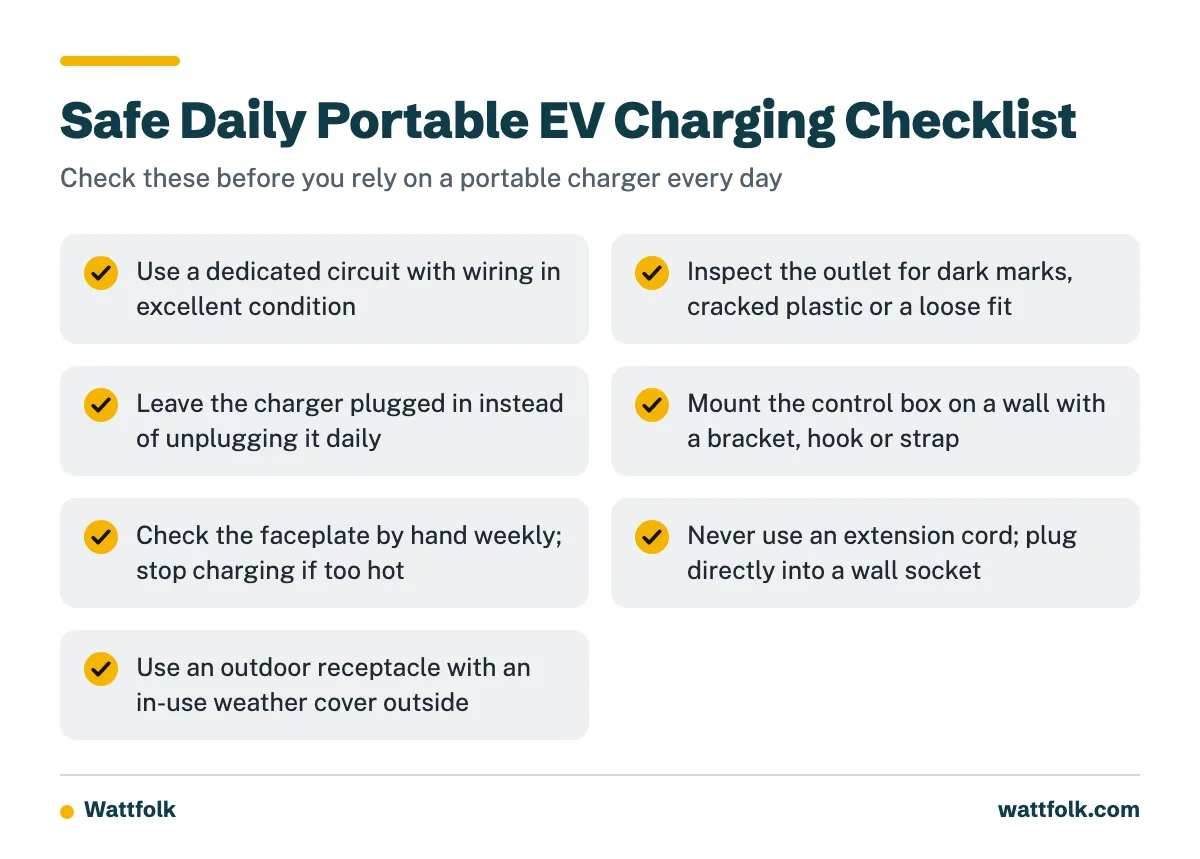
Next, you must support the weight of the charger. Portable EV chargers feature a heavy control box on the cable, often called a brick. If you let this brick hang unsupported, gravity pulls down on the plug. This bends the prongs inside the outlet and creates dangerous electrical arcing. Always mount the control box directly to the wall using a plastic bracket, a hook, or a heavy-duty strap.
Does using a Level 1 portable charger increase my electricity bill?
Yes, charging with a Level 1 portable charger increases your overall electricity costs compared to a Level 2 wallbox. This happens because standard 120V charging is less efficient. Level 1 charging operates at roughly 75% to 80% electrical efficiency, whereas Level 2 charging operates closer to 90% efficiency.
During a charge, your vehicle keeps its internal computers and cooling systems awake. This fixed overhead power draw is known as “vampire drain.” Because a Level 1 charger takes much longer to fill the battery, the car’s computers stay awake much longer, wasting more electricity.
Let us look at a practical example using US averages. The national average electricity price is near 17 cents per kilowatt-hour (kWh). Prices vary wildly,from 12 cents in some states to over 40 cents in others,but we will use 17 cents for this calculation.
Assume your daily commute requires 10 kWh of energy added to your battery:
- With a 90% efficient Level 2 charger: You pull about 11.1 kWh from the wall to get 10 kWh into the battery. This costs about $1.88 per day.
- With a 75% efficient Level 1 charger: You pull about 13.3 kWh from the wall to get the same 10 kWh into the battery. This costs about $2.26 per day.
That is a daily difference of $0.38. Over a full year of daily driving, the inefficiency of the Level 1 portable charger wastes approximately $138 in electricity.
Will daily use of a portable charger damage my EV battery?
No, daily use of a portable charger will not damage your EV battery. In fact, slow trickle charging generates very little heat inside the battery pack. Heat is the primary enemy of lithium-ion batteries. Regular Level 1 charging puts almost no thermal stress on the battery cells, which helps preserve long-term battery health.
Can I use an extension cord with a portable EV charger every day?
No, you must never use a standard extension cord with an EV charger. Extension cords cause a voltage drop over distance. When voltage drops, the charger compensates by pulling more current, which overheats the wires. Continuous, high-amperage loads melt standard extension cords and start electrical fires. Always plug the charger directly into a permanent wall socket. If the cord cannot reach your vehicle, hire a licensed electrician to install a new receptacle.
Are portable EV chargers waterproof enough for daily outdoor use?
Most portable EV chargers feature sealed control boxes designed to withstand basic rain and snow. Based on the specifications, most quality chargers carry an IP66 or IP67 rating, meaning they can handle direct water spray. However, the connection point where the plug enters your home outlet is rarely waterproof on its own. You must plug the charger into a rated outdoor receptacle with an “in-use” heavy-duty weather cover that closes completely over the cord.
Signs it is time to upgrade to a dedicated hardwired wallbox
A portable unit works wonderfully for many drivers, but certain situations demand more capability. Pay attention to how your vehicle and home electrical system behave during daily use.
- If your wall outlet routinely gets hot to the touch: Upgrade to a hardwired wallbox to eliminate the physical plug-and-socket connection entirely.
- If you consistently drive more than 50 miles a day: Upgrade to a Level 2 unit. A 120V portable charger cannot recover that distance overnight.
- If you live in a very cold climate: Upgrade to a Level 2 unit. In freezing weather, the car’s battery heater consumes most of the 120V energy, severely reducing Level 1 charging speeds to almost zero.
What do owners say?
Owners like
- Saves hundreds of dollars by avoiding a hardwired wallbox installation.
- Perfect for plug-in hybrids (PHEVs) due to smaller battery sizes.
- Highly reliable when left permanently plugged into a heavy-duty 240V receptacle (like a Tesla Mobile Connector on a NEMA 14-50).
Common complaints
- Standard wall plugs and cables get dangerously warm during 12+ hour charging sessions.
- Plugging and unplugging daily makes the household wall socket visibly loose over time.
- Level 1 charging speeds are severely reduced in winter because the battery heater consumes most of the energy.
- The heavy control box on the cable puts strain on the socket if it is not supported with a hook or strap.
Summarised from owner reviews and long-term user reports; individual experiences vary.
Frequently Asked Questions
Can an ordinary wall socket safely handle daily EV charging?
An ordinary wall socket can handle daily EV charging only if the wiring is in excellent condition, it sits on a dedicated circuit, and you leave the charger permanently plugged in. A standard NEMA 5-15 outlet safely provides 12 amps for continuous loads. If the outlet is old, worn, or shares a circuit with other appliances, it is not safe for daily charging.
Should I leave my portable charger plugged into the wall when not in use?
Yes, you should leave your portable charger plugged into the wall when not in use. Repeated insertion and removal cycles degrade the brass contacts inside the receptacle. Leaving it plugged in minimizes mechanical wear, maintains a tight electrical connection, and prevents dangerous heat buildup.
Does using a Level 1 portable charger increase my electricity bill compared to a wallbox?
Yes, it increases your bill slightly. Because a Level 1 charger operates at 75% to 80% efficiency compared to a Level 2 charger’s 90% efficiency, more power is lost as heat. Additionally, the longer charging sessions keep the car’s computers awake, consuming more total energy from the grid.