

The most critical decision when upgrading your home electric vehicle charging setup is choosing between a hardwired 48-amp unit for maximum speed or a 40-amp NEMA 14-50 plug-in model for easy replacement. The best Level 2 EV chargers deliver between 32 and 48 amps of power, feature smart Wi-Fi scheduling, and are UL safety certified. Upgrading from a standard 120V wall outlet cuts charging times significantly. Most Level 2 chargers will fully replenish an EV battery overnight.
Quick answer
Hardwired 48-amp chargers offer the fastest residential charging speeds, while plug-in 40-amp NEMA 14-50 units provide flexibility without requiring a permanent fixture. Buyers should ensure their home electrical panel has sufficient capacity for a dedicated 50-amp or 60-amp circuit before purchase.
- Best for smart integration: ChargePoint HomeFlex, offering robust scheduling.
- Best for budget maximum power: EVIQO 48A Hardwired, combining high speed and durability.
Our Winner: ChargePoint HomeFlex Level 2 EV Fast Charger
This unit excels due to its high 50-amp power delivery, flexible installation options, and a top-rated mobile app that helps drivers track energy costs.
How We Compared These Models
Based on manufacturer specifications and verified owner reports, three main criteria separate standard chargers from premium models: sustained amperage output, cold-weather cable flexibility, and software reliability. We prioritized chargers that carry independent safety certifications like UL or ETL. Models were also evaluated on their weatherproofing standards for outdoor installations.
| Product | Key Specs | Our Choice | Action |
|---|---|---|---|
| ChargePoint HomeFlex | Up to 50A, Smart App, Cold-Resistant Cable | Editor’s Choice | |
| EVIQO J1772 48A Hardwired | 48A, Hardwired, NEMA 4, Glow Holster | Best Hardwired Value | |
| EVIQO J1772 40A NEMA 14-50 | 40A, Plug-in, 25ft Cable, App Control | Best Plug-In Model | |
| Generic Level 2 Charger (B0CG8D445Q) | Standard Level 2 Output | Budget Pick | |
| Generic Level 2 Charger (B0C6DJNDWX) | Standard Level 2 Output | Compact Option |
In-Depth Reviews
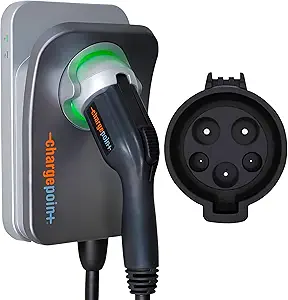
1. ChargePoint HomeFlex Level 2 EV Fast Charger – Editor’s Choice
Our Verdict: Based on the specifications and robust software ecosystem, this unit is the top choice for drivers who want to monitor their energy costs accurately over time.
According to the manufacturer, this model delivers up to 50 amps when hardwired. It is designed to charge a vehicle up to nine times faster than a standard 120V outlet. The accompanying mobile app connects seamlessly to smart home devices and allows drivers to schedule charging during off-peak hours. The J1772 connector works directly with non-Tesla EVs, while Tesla owners can use the adapter that came with their vehicle. The cold-resistant cable remains flexible in harsh winters.
Why We Like It
- Integrates with a large public charging network via a single app.
- Flexible amperage settings accommodate different home electrical panels.
Pros & Cons
Pros
- Excellent cable flexibility in cold weather.
- UL-certified for safe residential use.
Cons
- Requires a Wi-Fi connection for initial setup.

2. EVIQO Level 2 EV Charger J1772 48A – Best Hardwired Value
Our Verdict: This EVIQO model offers maximum 48-amp residential charging speed combined with a durable NEMA 4 enclosure, making it a reliable choice for outdoor hardwired installations.
- Brand: EVIQO
- Model: EVIPOWER-2
- Weight: 20.2 pounds
- Dimensions: 4 x 9.45 x 9.45 inches
To safely provide 48 amps of continuous power, the National Electrical Code requires this unit to be hardwired to a dedicated 60-amp circuit. It features a fully sealed IP66 enclosure that withstands rain, snow, and heat. The inclusion of a glow-in-the-dark holster helps drivers dock the connector easily at night. EVIQO also includes an integrated app with a strong internal Wi-Fi antenna to prevent dropouts in detached garages.
Why We Like It
- DIP switches allow the output to be lowered for older electrical panels.
- Over-the-air updates ensure software remains current.
Pros & Cons
Pros
- High-visibility holster is very practical.
- Robust steel internal shielding.
Cons
- Professional installation is mandatory.

3. EVIQO Level 2 EV Charger J1772 40A NEMA 14-50 – Best Plug-In Model
Our Verdict: For homeowners who already have a 240V NEMA 14-50 receptacle in their garage, this plug-in EVIQO charger provides excellent smart features without professional installation costs.
- Brand: EVIQO
- Amperage: 40 A
- Weight: 21 pounds
- Dimensions: 4.72 x 6.3 x 1.97 inches
This 40-amp unit utilizes an extra-long 25-foot cable that easily reaches across typical two-car garages. Because it is a plug-in model, you can unplug it and take it with you if you move. Like its hardwired counterpart, it boasts UL, ETL, and Energy Star certifications. The side reset button is a helpful feature, allowing you to restart the unit without visiting the main breaker panel.
Why We Like It
- Plug-and-play design saves on electrician labor costs.
- Comprehensive app scheduling reduces energy bills.
Pros & Cons
Pros
- Long 25-foot charging cord.
- Independent safety certifications.
Cons
- Requires an existing NEMA 14-50 outlet.

4. level 2 ev charger – Budget Pick
Our Verdict: This standard unit is a straightforward solution for drivers who want simple home charging without the added expense of Wi-Fi scheduling software.
Buyers looking for a no-frills method to add miles to their vehicle overnight will appreciate this option. While it lacks the advanced application integration found in premium models, it successfully delivers 240V power directly to the vehicle’s onboard converter. Its compact design takes up minimal wall space.
Why We Like It
- Minimalist design blends easily into any garage.
- Immediate charging operation without software pairing.
Pros & Cons
Pros
- Very simple to operate daily.
Cons
- No smart phone connectivity.

5. level 2 ev charger – Compact Option
Our Verdict: Another streamlined charging option, this unit is well-suited as a backup charger for secondary residences or guest garages.
For locations where secondary electric vehicles are parked, a simplified charger is highly effective. Based on the physical footprint, it mounts cleanly onto tight wall spaces or pillars. The lack of complex internal computers means fewer components can fail over time, ensuring a direct flow of alternating current to your vehicle.
Why We Like It
- Space-saving physical dimensions.
- Focuses solely on reliable power delivery.
Pros & Cons
Pros
- Excellent for tight spaces.
Cons
- Lacks off-peak rate scheduling.
what is level 2 ev charger
A Level 2 EV charger is a charging station that operates on 208V to 240V AC power, providing a much faster flow of electricity than standard household outlets. Level 2 charging is often about 10% more energy-efficient than Level 1 charging because the car’s internal computers are awake for a significantly shorter time. It is important to note that the wall unit itself is technically called an EVSE (Electric Vehicle Supply Equipment). The actual charger lives inside the car and converts the supplied AC power into DC power for the battery.
how to install level 2 ev charger at home
Home installation involves upgrading a circuit on your main electrical panel to handle 240V power continuously. Whether you choose a plug-in NEMA 14-50 model or a hardwired unit, you must consult a licensed electrician to ensure your panel has sufficient load capacity.
Talk to Your Electrician Checklist
- Breaker Size: To continuously draw 48 amps safely, the National Electrical Code (NEC) requires a dedicated 60-amp circuit breaker based on the 80% rule. A 40-amp charger requires a 50-amp breaker.
- Wire Gauge: Standard 6 AWG copper wire is typical for 50-amp circuits, while 4 AWG is frequently required for continuous 60-amp loads.
- Permits: Check local city requirements, as most municipalities require an electrical permit and inspection for new 240V circuits.
- Dynamic Load Management: Discuss this option if your panel is nearly full. It can save homeowners thousands by intelligently balancing power and avoiding a full service panel upgrade.
Charge Speed Calculator
| Amperage | Circuit Required | Estimated Miles per Hour |
|---|---|---|
| 32 Amps | 40 Amps | 20 to 25 miles |
| 40 Amps | 50 Amps | 28 to 35 miles |
| 48 Amps | 60 Amps | 30 to 45 miles |
do level 2 ev chargers need a neutral
Level 2 chargers generally do not require a neutral wire for the unit itself. They operate on two hot wires and a ground to achieve 240V power. However, if you are installing a NEMA 14-50 receptacle for a plug-in charger, the National Electrical Code requires the outlet to be wired with a neutral. Homeowners often overspend on costly four-strand wire for hardwired installations, unaware that hardwired units only need two hots and a ground.
Smart Features: Wi-Fi Connectivity and Apps
Wi-Fi enabled chargers allow you to take advantage of cheap overnight electricity rates. Below is a comparison of smart app ecosystems.
| App Feature | Smart Charger Benefit | Basic Charger Capability |
|---|---|---|
| Off-Peak Scheduling | Yes, programmable via app | Requires setting in the car dashboard |
| Energy Cost Tracking | Yes, tracks exact utility rates | No |
| Over-the-Air Updates | Yes, improves performance | No |
can a level 2 ev charger be installed outdoors
Yes, chargers rated NEMA 4 or NEMA 4X, equivalent to IP66, are fully weatherproof and safe for permanent outdoor installation in rain and snow. When installing outdoors, pay attention to the cable rating. A common failure point is a thick cable becoming completely rigid and unmanageable in sub-freezing weather.
does level 2 ev charging require 3 phase wiring
Residential Level 2 charging does not require 3-phase wiring. Standard US split-phase 240V residential power is entirely sufficient. Three-phase power is typically reserved for commercial buildings or DC fast-charging stations.
What do owners say?
Owners like
- App integrations that allow scheduling to take advantage of cheap overnight electricity rates.
- The Tesla Universal Wall Connector’s seamless transition between NACS and J1772 for households with two different car brands.
- Long, 24-foot cables that make it easy to charge regardless of how the car is parked.
- Compact wall footprints that do not take up much garage space.
Common complaints
- Thick cables becoming incredibly stiff and difficult to uncoil in freezing winter temperatures.
- Wi-Fi connectivity dropping out frequently when the charger is installed outside or in a detached garage.
- Flimsy plastic connector holsters breaking after a few months of daily use.
- Extremely bright LED status lights that annoy neighbors when installed outdoors.
Summarised from owner reviews and long-term user reports; individual experiences vary.
Frequently Asked Questions
what does level 2 ev charger mean
A Level 2 EV charger indicates an electrical output standard utilizing 208V to 240V alternating current. This higher voltage allows the device to transfer energy to the vehicle much faster than a standard 120V Level 1 plug.
which level 2 ev charger is best
The best charger depends on your electrical panel capacity and desired features. The ChargePoint HomeFlex is top-tier for smart scheduling, while the EVIQO 48A unit is excellent for raw, reliable hardwired power delivery.
level 2 ev charger near me
If you are looking for a public charging station rather than a home unit, many EV mapping applications can display Level 2 public chargers. However, installing a dedicated unit at your residence is the most convenient long-term solution.
Conclusion
Upgrading to a 240V charging station completely alters the electric vehicle ownership experience. Whether you select a smart unit like the ChargePoint HomeFlex to track real-time energy expenses or a rugged hardwired EVIQO model for maximum throughput, properly sizing your breaker and wiring is paramount. Always consult with a licensed electrician to verify your home electrical panel’s load capacity prior to completing your purchase.
Affiliate Disclosure: As an Amazon Associate, we may earn commissions from qualifying purchases from Amazon.com. This comes at no extra cost to you and helps support our research.