
Many drivers mistakenly buy an expensive wall charger before checking if a portable EV charger fits their needs. Evaluate your daily driving distance first to choose between the two. Portable chargers offer flexibility and lower upfront prices but charge slower via existing outlets. Hardwired Level 2 wall chargers deliver faster speeds, smart scheduling, and higher durability, but need professional installation and a larger investment.
Quick answer
Choose a portable charger if you rent your home or drive less than 40 miles a day. Install a hardwired wall charger if you own your home, commute long distances, or charge outdoors in bad weather.
- Best for renters: Level 1 portable charger (uses standard outlets, easy to pack up)
- Best for fast charging: Hardwired Level 2 wall charger (safest, permanent, top speeds)
- Level 1 portable chargers use standard 120-volt outlets and add 3 to 5 miles of range per hour.
- Hardwired Level 2 wall chargers deliver up to 48 amps, adding 30 to 45 miles of range per hour.
- Upgrading to a 240-volt outlet for a portable Level 2 charger costs roughly the same as hardwiring a wall station.
- Repeatedly plugging and unplugging a heavy portable charger can wear out household outlets over time.
- What is the exact difference between a portable EV charger and a wall charger?
- Can a portable charger charge at Level 2 speeds?
- Is a portable Level 1 charger enough for my daily commute?
- How much does it cost to install a wall charger vs using a portable one?
- Does constantly plugging and unplugging a portable charger damage the outlet?
- Is it safe to use a portable charger outside in the rain?
- How does a standard EV charger compare to a Tesla charger?
- Do I need a wall charger if I only drive 30 miles a day?
- What do owners say?
- Frequently Asked Questions
What is the exact difference between a portable EV charger and a wall charger?
A portable EV charger is a mobile cable with a heavy control box in the middle. You plug one end into a wall outlet and the other into your car. You can roll it up and put it in your trunk. A wall charger, on the other hand, mounts permanently to a wall or a pedestal. A licensed electrician either hardwires it directly into your home’s electrical panel or plugs it into a heavy-duty receptacle.
Many buyers get confused because the word “portable” applies to two completely different charging speeds. You can buy a standard 120-volt portable charger (Level 1) or a high-power 240-volt portable charger (Level 2). Dedicated wall chargers are almost always 240-volt Level 2 stations.
Can a portable charger charge at Level 2 speeds?
Yes. A portable charger can deliver Level 2 speeds, but only if you plug it into a 240-volt outlet, like a NEMA 14-50 receptacle. However, portable Level 2 chargers usually max out at 32 to 40 amps. They give you a good charging speed, but they do not reach the absolute maximum speed your car can accept.
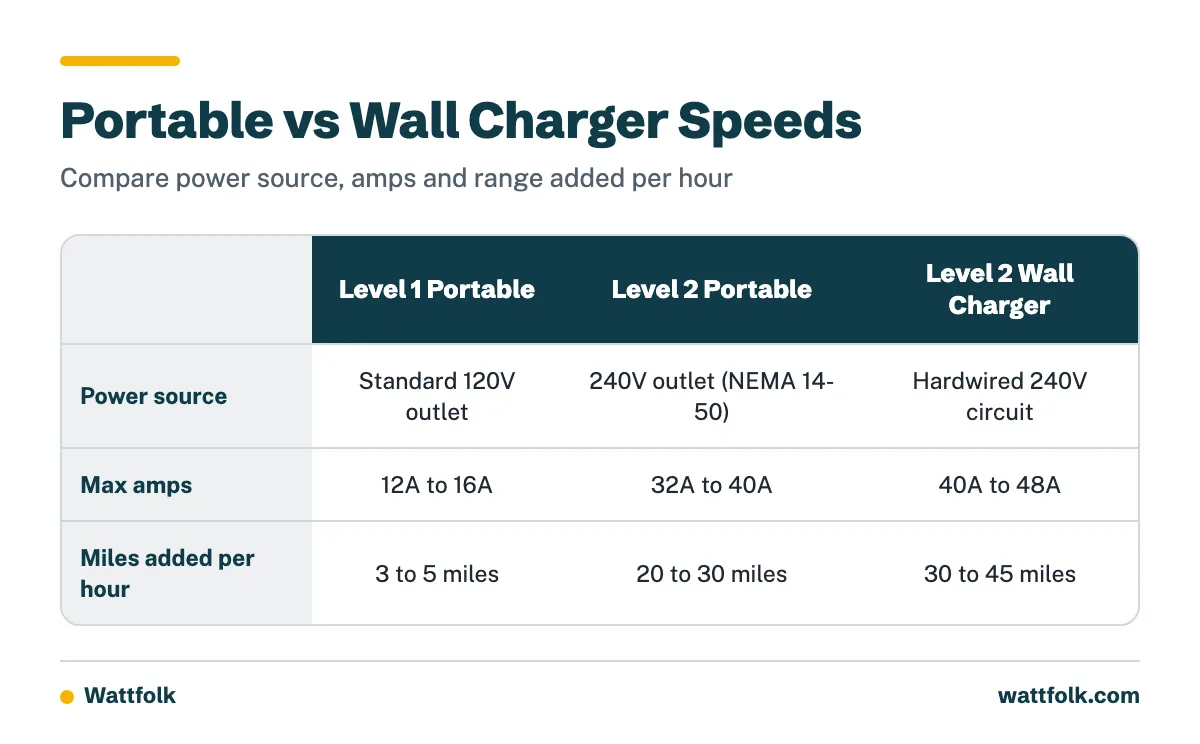
Hardwired Level 2 wall chargers deliver up to 48 amps (11.5 kW) of power. Depending on your specific vehicle’s efficiency, a hardwired station adds roughly 30 to 45 miles of range per hour of charging. Portable Level 1 chargers lag far behind, using a standard 120-volt household outlet to add just 3 to 5 miles of range per hour.
Charging Speed Comparison
| Charger Type | Power Source | Max Amps | Miles Added Per Hour |
|---|---|---|---|
| Level 1 Portable | Standard 120V Outlet | 12A to 16A | 3 to 5 miles |
| Level 2 Portable | 240V Outlet (NEMA 14-50) | 32A to 40A | 20 to 30 miles |
| Level 2 Wall Charger | Hardwired 240V Circuit | 40A to 48A | 30 to 45 miles |
Is a portable Level 1 charger enough for my daily commute?
For many drivers, a basic 120-volt portable charger handles daily driving needs perfectly. If you drive short distances, the slow charging speed overnight easily replaces what you used during the day.
Daily Commute Calculator Worksheet
Let’s find out if Level 1 works for you. (Assumptions: 120V outlet, average EV efficiency of 3 miles per kWh, charging directly from a wall plug).
- Step 1: Calculate your park time. How many hours does your car sit in the driveway overnight? (Example: 12 hours).
- Step 2: Multiply by 4. An average Level 1 charger adds 4 miles of range per hour. (12 hours x 4 miles = 48 miles of range restored).
- Step 3: Compare to your commute. Do you drive more or less than 48 miles a day?
If your daily round trip is 30 miles, a Level 1 portable charger fully replaces that energy overnight. Never use an extension cord to reach your car; always plug directly into the wall.
How much does it cost to install a wall charger vs using a portable one?
Using a Level 1 portable charger costs nothing to install if you already have a standard outlet near your parking spot. You simply pay for the electricity. Based on the US national average electricity rate of $0.17 per kWh, fully charging a 75 kWh battery costs about $12.75. (This assumes a full 0% to 100% charge with zero system losses).
The cost gap narrows significantly when you look at Level 2 charging. Many owners buy a portable Level 2 charger to save money. However, you still need a dedicated 240-volt outlet to plug it in. Installing a dedicated 240-volt circuit for either a wall charger or a Level 2 portable charger typically ranges from $500 to $1,500. This estimate depends on how far your electrical panel is from your garage, and it excludes the cost of the charger itself.
Once you pay a licensed electrician to run new copper wire and add a breaker, hardwiring a wall station costs roughly the same in labor as installing a heavy-duty NEMA 14-50 plug for a portable unit.
Does constantly plugging and unplugging a portable charger damage the outlet?
Yes, standard household outlets wear out under constant use. Portable charger control boxes (often called “bricks”) carry quite a bit of weight. If the brick hangs freely, it puts dangerous physical strain on the wall plug.
Over time, repeatedly plugging and unplugging the cable loosens the metal contacts inside the wall receptacle. Loose connections create electrical resistance. Resistance creates heat.
From the Shop
We frequently see melted garage outlets. Owners unplug their heavy EV cord every morning and plug it back in every night. Within a year, the receptacle loses its tight grip. The plug overheats during a 10-hour charge cycle, and the plastic faceplate eventually melts. If you use a portable charger daily, leave it plugged into the wall and install a simple wall hook to support the weight of the control box.
Is it safe to use a portable charger outside in the rain?
Electric vehicle chargers are built for outdoor use, but the type of charger matters. Look at the NEMA rating on the device specifications. A NEMA 4 enclosure provides excellent protection against direct water jets and heavy rain.
While the actual portable charger cable and box are sealed against water, the wall connection remains a weak point. If you plug a portable charger into an exterior 120-volt socket, the weatherproof outlet cover must close completely over the plug to keep rain out. Hardwired wall chargers remove this risk completely. The electrical connections sit safely sealed inside the unit, making them much more durable for long-term outdoor weather exposure.
How does a standard EV charger compare to a Tesla charger?
Most electric vehicles on the road today use a standard J1772 or CCS plug type. Tesla uses its own unique plug, known as the North American Charging Standard (NACS). Underneath the plastic housing, standard EV chargers and Tesla chargers operate exactly the same way.
A Tesla wall connector is just a Level 2 hardwired station with a Tesla-shaped plug on the end. If you buy a standard charger, you can use a small adapter to charge your Tesla. If you buy a Tesla charger, you can use an adapter to charge other brands of electric vehicles.
Do I need a wall charger if I only drive 30 miles a day?
For a 30-mile daily drive, a hardwired wall charger is a luxury rather than a strict necessity. A basic portable charger handles this short distance easily while you sleep.
Decision Matrix: Which charger is right for you?
- If you rent your home: Stick with a portable charger. You can take it with you when you move.
- If you own your home AND drive under 40 miles a day: A Level 1 portable charger works fine, saving you installation money.
- If you own your home AND drive over 50 miles a day: Invest in a hardwired Level 2 wall charger for fast, reliable overnight recovery.
- If you park outside year-round: Choose a hardwired wall charger for superior weather protection.
What do owners say?
Owners like
- Flexibility to take the portable charger on road trips, camping, or to holiday homes.
- Wall chargers with smart apps make scheduling for off-peak electricity rates effortless.
- Tethered wall chargers look much neater and keep the garage organized compared to draping portable cables.
- Hardwired wall chargers feel much safer and more durable for daily outdoor charging in bad weather.
Common complaints
- Standard 120-volt portable chargers are agonizingly slow for modern EVs with larger batteries.
- Repeatedly plugging and unplugging portable chargers loosens the wall receptacle over time, causing heat issues.
- Hardwired wall chargers are difficult and expensive to take with you if you move house.
- Portable charger control boxes (‘bricks’) can be heavy and put dangerous physical strain on the wall plug if not supported properly.
Summarised from owner reviews and long-term user reports; individual experiences vary.
Frequently Asked Questions
portable ev charger vs wall charger?
A portable EV charger plugs into an existing wall outlet and can be easily moved, making it great for renters or travel. A wall charger is permanently installed directly into your home’s electrical system, offering faster charging speeds, smart scheduling features, and better weather resistance for outdoor use.
ev charger vs tesla charger?
The main difference is the shape of the plug. A standard EV charger uses a J1772 connector, while a Tesla charger uses the North American Charging Standard (NACS). Both types deliver power in the exact same way. You can use simple adapters to make either charger work with any brand of electric vehicle.