
Plug-in solar can charge an EV, but only slowly. Paired with an inverter, battery or power station, and a proper charger, a small balcony kit adds a few miles a day, not a full charge.
Quick answer
A bare panel can’t plug into a car. Solar can feed an EV only through regulated equipment: an inverter, an EVSE (the charger), and a correctly rated circuit. A balcony kit adds a small trickle of range; rooftop solar does the heavy lifting.
- Best for renters: balcony kit to offset home use, grid for the car
- Best for daily commuters: rooftop solar with a wallbox
- Best for off-grid: panels with a large power station
- Never connect a bare solar panel to an EV. The car needs stable voltage, grounding, and charging communication.
- One 400 W panel makes about 1.2 kWh in 3 peak sun hours before losses. That is only a few miles of range.
- Level 1 charging needs about 1.4 kW. Most plug-in kits make less than that.
- A 6.6 kW Level 2 charger at 32 amps needs at least a dedicated 40-amp circuit.
- Grid backup makes solar charging practical. Going fully off-grid takes a lot of panels and storage.
- Can I plug a solar panel directly into my electric car?
- What equipment is needed to charge an EV from solar panels?
- Can a balcony solar system charge an EV?
- Plug-in, power station, rooftop, or grid?
- How many solar panels are needed to charge an EV?
- How slowly would a small solar setup charge an EV?
- Safety checklist
- When grid charging makes more sense
- Buyer checklist
- Frequently Asked Questions
Can I plug a solar panel directly into my electric car?
No. A bare portable solar panel usually cannot safely charge an EV, because EVs need stable voltage, charging communication, grounding, and protective equipment, according to Anker SOLIX.
A panel’s output swings with every cloud. It makes DC power at a voltage that moves with sunlight and temperature. Your car’s onboard charger expects clean AC from an EVSE. The EVSE also talks to the car, confirms the ground connection, and only then closes its contactor. A panel does none of that.
What equipment is needed to charge an EV from solar panels?
You need a chain: panels, a conversion step, an EVSE, and a circuit rated for the load. Portable panels normally need a charge controller, battery, inverter, or portable power station before they can supply an EV charger.
- Solar panels: produce variable DC power.
- Inverter or microinverter: converts DC to AC. A grid-tied microinverter shuts off when the grid drops. Never bypass that shut-off.
- Battery or power station (optional): stores energy and delivers steady AC. A portable power station converts stored solar energy into regulated AC that the car’s onboard charger can accept.
- EVSE: the charging station or cord set that handles safety checks and talks to the car.
- Circuit: wiring and breaker sized for the charger’s continuous load.
A complete home setup commonly includes panels, a wallbox, and optionally battery storage and an energy-management system, as Enphase describes.

Can a balcony solar system charge an EV?
Indirectly, yes, but only a little. A balcony kit feeds your home’s circuits. It does not plug into the car. Your home appliances use that power first, and the EV charger, if running on the same grid supply, draws the rest from the utility.
The mismatch is the problem. A Level 1 charger pulls about 1.4 kW (120 V at 12 A). Home EV charging generally needs at least about 1.4 kW available after other household demand is deducted. Kits commonly sold at 400 to 800 W cannot meet that on their own. They shave the draw rather than cover it.
Plug-in, power station, rooftop, or grid?
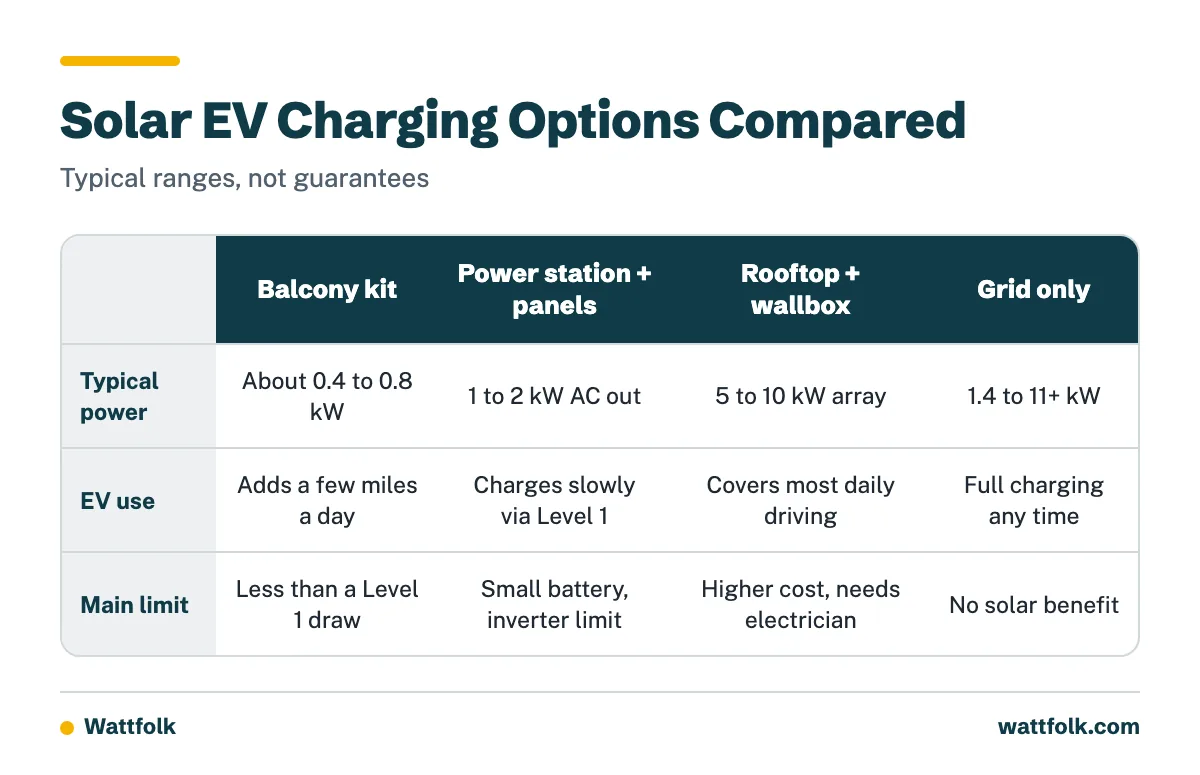
The four options differ most in power, cost, and who can install them. Figures below are typical ranges, not guarantees.
| Option | Typical power | EV use | Main limit |
|---|---|---|---|
| Bare plug-in panel | Under 0.5 kW DC | None directly | No regulation, grounding, or car communication |
| Plug-in balcony kit | About 0.4 to 0.8 kW | Offsets home load, adds a few miles a day | Less than a Level 1 charger draws |
| Portable power station + panels | 1 to 2 kW AC out, 1 to 3 kWh stored | Charges slowly through a Level 1 EVSE | Small battery, inverter limit |
| Rooftop PV + wallbox | 5 to 10 kW array, 7+ kW charger | Covers most daily driving | Higher cost, needs electrician and permits |
| Grid only | 1.4 to 11+ kW | Full charging any time | Pays utility rates, no solar benefit |
How many solar panels are needed to charge an EV?
It depends on how far you drive. Use this formula: required solar capacity (kW) = daily EV energy (kWh) ÷ (peak sun hours × system efficiency).
Assumptions: 3.5 miles per kWh for the car, 80% system efficiency (20% losses), 400 W panels, and electricity at the national average of about 17 cents per kWh. Peak sun hours vary by location; many US sites fall between about 3 and 6.
- Your daily need: 35 miles ÷ 3.5 = 10 kWh.
- At 5 peak sun hours: 10 ÷ (5 × 0.8) = 2.5 kW.
- Panels: 2.5 kW ÷ 0.4 kW = about 6 to 7 panels.
At 17 cents, those 10 kWh are worth about $1.70 a day. In cloudy regions with 3 peak sun hours, the same need calls for 4.2 kW, or about 11 panels.
Worked examples by system size
| System | Math (4 peak sun hours, 80% efficiency) | Daily energy | Approx. range |
|---|---|---|---|
| Small: one 400 W panel | 0.4 × 4 × 0.8 | 1.28 kWh | About 4 miles |
| Medium: 800 W balcony kit | 0.8 × 4 × 0.8 | 2.56 kWh | About 9 miles |
| Full: 7.5 kW rooftop array | 7.5 × 4 × 0.8 | 24 kWh | About 84 miles |
Those numbers assume the car gets every kilowatt-hour. In real homes, the fridge, AC, and lights take some first.
How slowly would a small solar setup charge an EV?
Very slowly. One 400 W panel producing for 3 peak sun hours yields 400 W × 3 h = 1.2 kWh before losses. After 20% losses that is about 0.96 kWh, worth roughly 16 cents at 17 cents per kWh. At 3.5 miles per kWh, that is about 3 to 4 miles of range for a full day of sun.
Compare that with a 6.6 kW Level 2 charger, which can add roughly 20 or more miles per hour on many EVs. A 400 W panel would need most of a week to match one hour of that.

Intermittency and losses
Solar output changes with sunlight, weather, time of day, panel orientation, household consumption, and system losses. Clouds can cut output sharply. Charging a battery first and then the car adds conversion losses at each step. Power stations lose energy in the inverter, and the car’s onboard charger loses a little more. Expect to receive well under what the panels made.
Can I use a portable power station with an EV charger?
Sometimes. A power station can run a Level 1 EVSE if its inverter handles the load continuously. A 1.4 kW charger needs a station rated with headroom above that, with pure-sine AC output. Check the EVSE manual too. Some chargers check the ground connection and may refuse to start on a power station.
Battery size sets the limit. A 2 kWh station, after losses, might deliver about 1.6 kWh to the car. That is roughly 5 to 6 miles at 3.5 miles per kWh.
If you drive under 10 miles a day and have strong sun, then a power station plus panels can cover it.
If you drive 30+ miles a day, then use a grid-tied rooftop array with a wallbox.
If you rent, then use a balcony kit for home loads and charge the car from the grid.
Safety checklist
Check every item before you connect anything to a car.
- Regulated inverter: stable output, listed for its use.
- Pure-sine AC output: avoids trouble for the onboard charger.
- EVSE compatibility: confirm it works with your power source.
- Grounding: required for the EVSE safety checks.
- Circuit capacity: a 6.6 kW Level 2 charger at 32 amps typically needs at least a dedicated 40-amp circuit.
- Weather protection: rated enclosures and connectors outdoors.
- Local electrical rules: follow your utility and local code.
Hire a licensed electrician for any new circuit, wallbox, or panel connection. Never bypass a microinverter’s grid shut-off.
When grid charging makes more sense
Most drivers charge at night, while solar makes power at noon. Grid-connected solar EV systems can automatically supplement insufficient solar generation with grid electricity, so the car still charges on cloudy days. If your state has time-of-use rates, overnight grid charging can cost less than the daytime solar you would have needed to store. Check your utility’s rate schedule.
Buyer checklist for compatible equipment
- Know your daily miles and convert them to kWh.
- Check your peak sun hours and local electricity price.
- Match inverter output to the EVSE’s continuous draw, with headroom.
- Pick a battery sized for the energy you want, after losses.
- Confirm the charger’s connector and plug type fit your car and outlet.
- Ask your utility about interconnection before buying a grid-tied kit.
Frequently Asked Questions
Does solar EV charging need a battery?
No. A grid-tied system can send solar power straight to the charger and pull the rest from the grid. A battery helps if you want to charge at night from stored solar, but it adds cost and conversion losses.
Can an EV charge from solar power without the grid?
Yes, but it takes panels, a charge controller or inverter, and enough storage to run an EVSE. Off-grid charging is slow with small setups, and you need a power source that stays within the charger’s limits.
Can a regular household outlet safely charge an EV from solar power?
A standard 120 V outlet can run a Level 1 charger if the circuit is in good shape and not shared with other heavy loads. Solar feeds the home, not the outlet directly. Never use extension cords, and have an electrician inspect older wiring.
What is the difference between plug-in solar and rooftop solar EV charging?
Plug-in solar is a small kit, often 400 to 800 W, that offsets household use. Rooftop solar is a larger array, often 5 kW or more, wired through the panel to a wallbox. Rooftop systems can cover most daily driving. Plug-in kits cover a small fraction.
Can I use a portable power station with an EV charger?
Yes, if the inverter is pure-sine, rated above the charger’s continuous load, and the EVSE accepts it. Expect only a few miles of range per charge from a typical 1 to 2 kWh unit.