
Surplus plug-in solar power flows onto the grid unless you limit it, so decide whether you accept that or want export blocked. Export happens whenever the panels make more than your home is using at that moment.
Quick answer
Yes, surplus power can flow to the grid. Whether that export is allowed, measured, or paid depends on your utility and local rules. Check with your utility before you plug in.
- Best for small homes: match the kit to your daytime base load
- Best for strict utilities: a zero-export setup with a demand meter
- Export depends on solar output minus what your home uses right now, not on panel size alone.
- “Allowed to export” and “paid for export” are two different questions.
- Zero export needs a device that measures your home’s demand all the time.
- A battery soaks up surplus but does not guarantee zero export by itself.
- U.S. rules range from export bans to full net metering to no credit at all. Confirm with your utility.
- How does plug-in solar export electricity to the grid?
- Does a plug-in solar system export automatically?
- Worked example: how much would be exported?
- Can a plug-in solar kit be configured for zero export?
- Does a battery stop plug-in solar from exporting?
- Will my meter record plug-in solar exports?
- Do I need utility approval?
- Can I get paid for exported electricity?
- What happens if it exports without permission?
- Is plug-in solar safe to connect to a household socket?
- Checklist before you buy or connect
- What do owners say?
- Frequently Asked Questions
How does plug-in solar export electricity to the grid?
A microinverter turns the panel’s DC power into AC power that matches the grid’s voltage and timing. Your home’s wiring is connected to the grid, so any power your appliances do not use flows out through your meter.
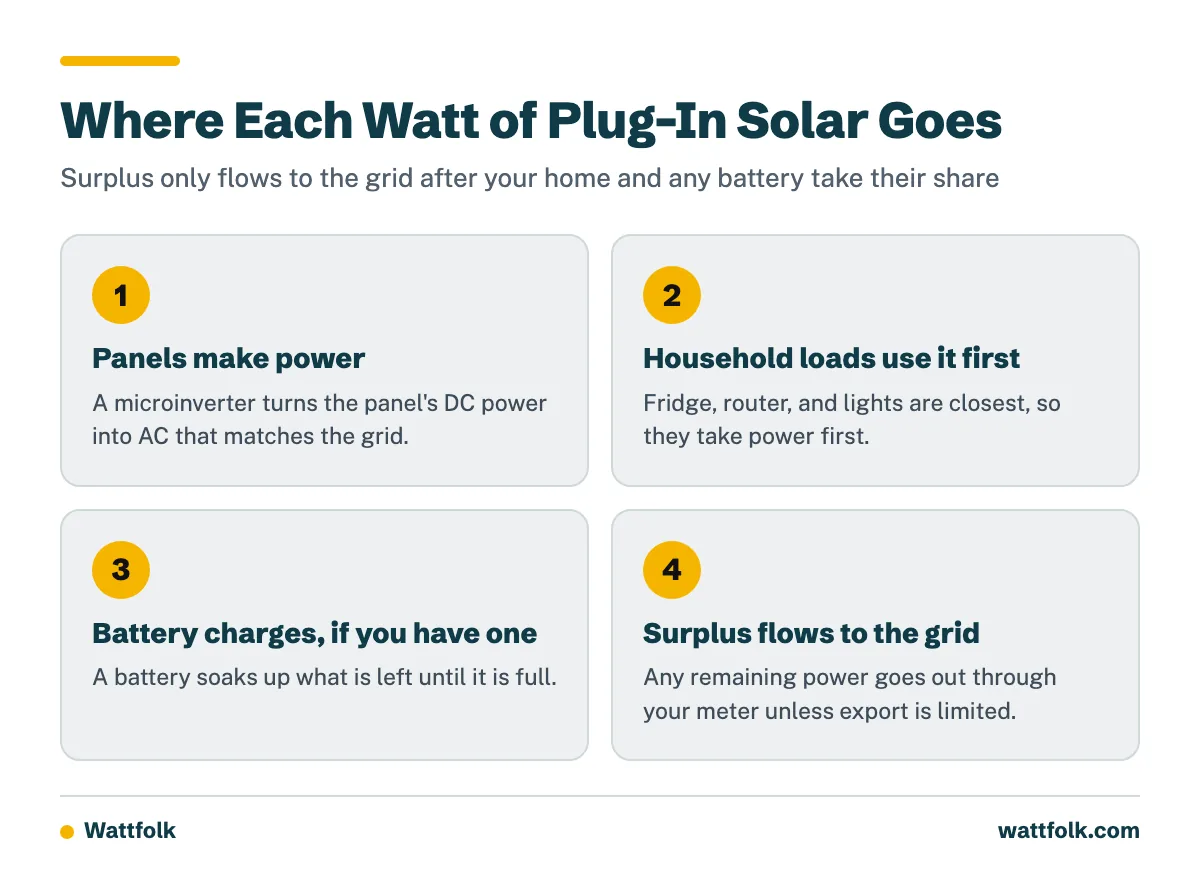
Power takes the easiest path. Your own loads come first, because they are closest. Whatever is left over goes outward. The diagram below shows the order.
Where each watt goes:
1. Solar panels make power → 2. Household loads use it first (fridge, router, lights) → 3. A battery, if you have one, charges with what is left → 4. Any remaining surplus flows out to the grid.
This is why microinverters must shut off when the grid goes down. That feature is called anti-islanding. It protects utility workers from live wires during an outage. Never bypass it.
Does a plug-in solar system export automatically?
Yes. Unless it is set to limit export, a standard grid-tied microinverter sends surplus out without any action from you. There is no switch you flip. The inverter simply delivers all the power the panels make, and the home uses what it needs.
This is the gap many guides skip. Export is about instant generation minus instant demand. It is not about the size on the panel label. A small kit in a home with a busy kitchen may export almost nothing. The same kit in an empty apartment at noon may export a lot.
Worked example: how much would be exported?
Take a kit that makes 800 W at midday. Your home is drawing 300 W from the fridge, router, and standby devices.
800 W generated − 300 W used = 500 W potentially exported.
Now add a daily view. These are estimates, so you can redo them with your own numbers:
- Panel rating: 800 W
- Peak sun hours: 4 per day (a common mid-range figure for many U.S. locations)
- System losses: 15% (wiring, heat, inverter, dirt)
- Electricity price: 17 cents per kWh (near the U.S. average reported by the U.S. Energy Information Administration)
800 W × 4 hours × 0.85 = about 2.7 kWh per day. If your home uses all of it, that is worth roughly $0.46 per day, or about $169 per year. Any part that gets exported may earn less, or nothing.

Can a plug-in solar kit be configured for zero export?
Yes, but it takes extra hardware. The system must know your home’s demand every second. That usually means a meter or current transformer (CT clamp) connected at your electrical panel. It tells the inverter to turn output down when demand drops.
A plain plug-in kit with no demand sensor cannot do this. It does not know what the rest of your home is doing. If your utility bans export, ask whether the kit supports a zero-export control, and have a licensed electrician install any panel-side meter or CT.
Does a battery stop plug-in solar from exporting?
Not by itself. A battery can absorb surplus and cut export, but once it is full, extra power has nowhere to go. To guarantee zero export, you still need control equipment that limits output.
Here is how the main setups compare:
| Setup | Does it export? | What it needs | Main catch |
|---|---|---|---|
| Normal grid-tied | Yes, when output beats demand | Microinverter with anti-islanding | Export may be banned or unpaid |
| Zero-export control | Should not | Demand meter or CT, controllable inverter | Wasted solar when demand is low |
| With battery | Only after the battery is full | Compatible battery and controls | Higher cost; full battery can still export |
| Disconnected / off-grid | No | Separate wiring, not tied to the home grid | No grid backup; electrician needed |
Will my electricity meter record plug-in solar exports?
It depends on the meter. Older analog meters may spin backward or may be locked to prevent it. Many smart meters record import and export separately. Some record only what you pull from the grid.
To see if you are exporting, you can check the inverter’s app, a plug-in energy monitor, or the meter’s display if it shows export. Buyers often mention that some kits show panel output but not whole-home use, which makes export hard to judge. A demand meter fixes that.
From the Shop
A common pattern in buyer reports: the app shows 600 W of solar output, so the owner assumes it is all saved. In reality the home used 200 W, and 400 W went out. Without a consumption reading, the numbers look better than they are.
Do I need utility approval or an interconnection application?
Often, yes, but it varies. Plug-in solar rules in the U.S. change fast and differ by state and utility. Some places are making room for small plug-in systems. Others still treat any grid-connected generator as needing a formal application.
Do not assume your state’s rule from a news headline. Call your utility and ask these questions: Is a plug-in kit allowed? Do I need to apply? Is export allowed? Do I need a different meter? Keep the answers in writing.
Also keep two things apart. Utility rules cover how you connect to the grid. Electrical codes cover safe wiring, outlets, and circuits. A kit can pass one and fail the other.
Can I get paid for electricity exported by plug-in solar?
Maybe, maybe not. Being allowed to export is not the same as being paid for it. According to the Clean Energy States Alliance’s Plug-In Solar report, U.S. treatment can include export bans, retail-rate net metering, lower-rate net billing, or no compensation.
In plain terms:
- Net metering at retail rate: exported kWh offset your bill at about the same price you pay.
- Net billing: exported kWh earn a lower rate than you pay.
- No compensation: surplus is given to the grid for free.
For comparison, Great Britain’s Smart Export Guarantee needs a certified installation, a half-hourly export meter, and an export MPAN. As explained by Solar Energy UK, self-installed plug-in systems generally do not qualify. The lesson for U.S. buyers is the same: payment needs proper metering and paperwork.
Because export often pays little or nothing, most owners get the best value by using the power at home.
What happens if plug-in solar exports without permission?
Outcomes differ by utility. Possible results include a request to disconnect the system, a required application after the fact, or issues with your lease or home insurance. Small amounts of accidental export are less of a concern than a system you installed while hiding it. Ask first and you avoid the problem.
Is plug-in solar safe to connect to a household socket?
It can be, when the equipment is certified and the circuit is suitable. Look for a microinverter listed to a recognized grid-interconnection safety standard, such as UL 1741, with anti-islanding built in. Check the product’s documentation for this.
- Plug the kit into a proper wall outlet on a circuit that is not overloaded.
- Never use an extension cord or power strip.
- Never bypass or defeat the inverter’s grid shut-off.
- Use a licensed electrician if your outlet is old, loose, ungrounded, or shared with big loads, or if you need a panel-side meter.

Checklist before you buy or connect
- Local approval: confirm in writing with your utility whether plug-in solar and export are allowed.
- Socket and circuit: grounded, in good condition, not overloaded, no extension cords.
- Anti-islanding certification: listed microinverter that shuts off when the grid is down.
- Meter capability: ask if your meter records export or blocks it.
- Monitoring: pick a system that shows home consumption, not just panel output.
- Export payment: ask what rate, if any, applies and what paperwork it needs.
- Rental or HOA rules: get landlord or association approval.
If your utility bans export, choose a zero-export setup with a demand meter, or size the kit below your daytime base load.
If export is allowed but unpaid, size the kit to your daytime use and skip the extra panels.
If export earns credit, ask about meter changes and application steps first.
What do owners say?
Owners like
- Low installation effort compared with a conventional rooftop system
- Useful for renters, flats, balconies, gardens, and small roof spaces
- Lower upfront cost for modest solar generation
- Simple monitoring and the ability to use solar directly during daylight
Common complaints
- Confusion about whether exported electricity is permitted or compensated
- Low or nonexistent export payments compared with the value of self-consuming the energy
- Output varies significantly with shading, orientation, and daytime household demand
- Approval, meter, and monitoring requirements can be unclear
- Some systems do not provide clear visibility of household consumption and grid export
Summarised from owner reviews and long-term user reports; individual experiences vary.
Frequently Asked Questions
Does plug-in solar export to the grid?
Yes, when the panels make more power than your home uses at that moment, the extra flows out. A system set up for zero export is the exception.
How can I tell whether my system is exporting?
Compare solar output with whole-home use. A monitor that shows only panel output cannot tell you. A smart meter that logs export, or a demand meter on your panel, can.
Do I need utility approval or an interconnection application?
Often, but it depends on your state and utility. Call your utility and get the answer in writing before connecting.
Can I get paid for electricity exported by plug-in solar?
Sometimes. U.S. treatment ranges from retail-rate net metering to lower-rate net billing to no payment. Many small kits earn nothing for export.
Does a battery stop plug-in solar from exporting?
It reduces export while it has room to charge. When full, surplus can still flow out unless controls limit output.
Is plug-in solar safe to connect to a household socket?
It can be with a certified microinverter that has anti-islanding, a healthy outlet, and no extension cords. Hire a licensed electrician if the wiring is questionable.