Choose plug-in solar if you want to cut your electric bill during the day. Choose a solar generator if you want portable power or backup during an outage. Plug-in solar feeds panel power into your home’s wiring through a microinverter and normally shuts off when the grid goes down. A solar generator is a battery with an inverter that powers only what you plug into it.
Quick answer
Plug-in solar is for recurring bill savings. A solar generator is for portable and emergency power. They are not substitutes: one offsets power you use right now, the other stores power for later. Some households need both.
- Best for lower bills: plug-in solar, because it offsets daytime use
- Best for outages and camping: a solar generator, because it stores energy
- Best for both needs: own one of each
- Plug-in solar offsets power your home is using at that moment. It has no battery.
- Plug-in solar normally shuts off during a blackout because of anti-islanding protection.
- A solar generator stores energy and runs only the devices plugged into its own outlets.
- Heaters, kettles and other heating appliances drain a portable battery within minutes to an hour or two.
- Never use extension cords or bypass a microinverter’s grid shut-off. Rules vary by state, so confirm with your utility.
- What is plug-in solar and how does it work?
- What is a solar generator, and is it really a generator?
- Plug-in solar vs solar generator: side by side
- Does plug-in solar reduce my electricity bill?
- Can plug-in solar provide power during a blackout?
- Can a solar generator run a refrigerator, heater, or other large appliance?
- How much solar panel and battery capacity do I need?
- Is plug-in solar safer or cheaper than a solar generator?
- Do I need utility approval, permits, or a dedicated circuit?
- Worked scenarios
- Should I choose plug-in solar, a solar generator, or both?
- What do owners say?
- Frequently Asked Questions
What is plug-in solar and how does it work?
Plug-in solar is a small grid-tied system. It pairs one or more panels with a microinverter and a permitted connection to a building circuit. Panels make DC power. The microinverter converts it to AC and matches it to your home’s wiring. Your appliances use that power first, so you pull less from the grid.
There is no battery. Power not used in the moment is either wasted or, depending on your utility, sent back to the grid. That makes daytime demand the key number.
Output limits depend on local rules and equipment ratings. Wattrank’s comparison and other sources note that some U.S. state pathways discuss systems up to 1,200 W. One UK specification caps microinverter output at 800 W. Check what applies where you live.
Why plug-in solar shuts off when the grid fails
A grid-tied microinverter must stop sending power when the grid goes down. This is called anti-islanding protection. It keeps power from flowing into lines where utility workers may be repairing damage. It is a safety feature, not a defect. You should never try to bypass it.
What is a solar generator, and is it really a generator?
No, not in the traditional sense. A solar generator has no engine and burns no fuel. It is a portable battery with a built-in inverter and outlets, charged by solar panels, a wall outlet or a car port. EnergySage’s overview describes it the same way: portable battery storage powered by solar panels.
Four specs matter:
- Battery capacity (Wh): how much energy it stores.
- Continuous inverter output (W): the most it can run at once.
- Surge rating (W): a brief burst for motor startup.
- Solar input (W): how fast panels can recharge it.
It powers devices through its own outlets. It does not automatically feed your home’s wiring.
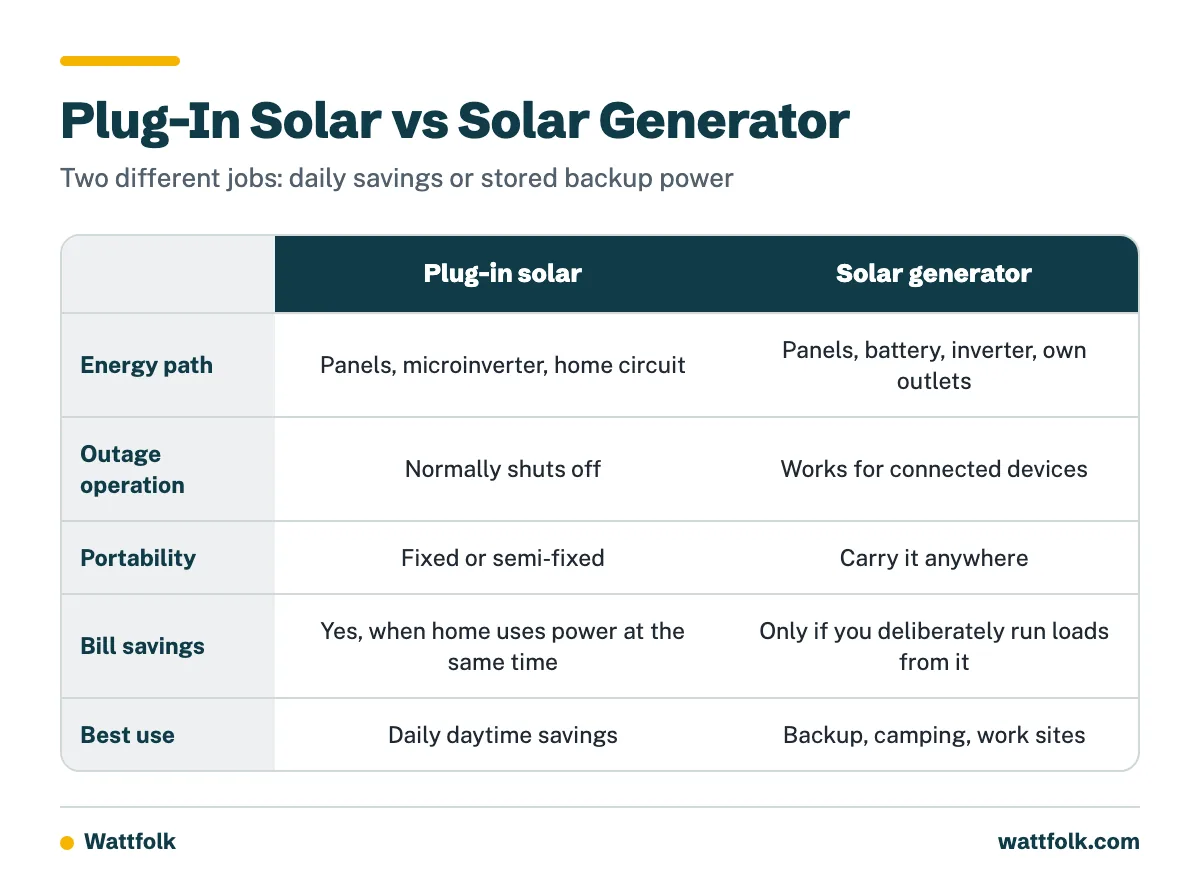
Plug-in solar vs solar generator: side by side
| Feature | Plug-in solar | Solar generator |
|---|---|---|
| Energy path | Panels, microinverter, home circuit | Panels, battery, inverter, its own outlets |
| Outage operation | Normally shuts off | Works, for the devices connected |
| Portability | Fixed or semi-fixed | Carry it anywhere |
| Bill savings | Yes, when the home uses power at the same time | Only if you deliberately run loads from it |
| Installation | Mounting, permitted connection, local rules | Unbox and plug in |
| Capacity | Limited by panel watts and local cap | Limited by battery Wh and inverter W |
| Best use | Daily daytime savings | Backup, camping, work sites |

Does plug-in solar reduce my electricity bill?
Yes, but only for power you use while the panels produce. Savings depend on simultaneous household demand.
Worked example (assumptions stated):
- Panels: 800 W
- Peak sun hours: 4 per day (a common mid-range US figure; check your area)
- System losses: 20 percent
- Electricity price: 17 cents per kWh (near the U.S. national average from the U.S. Energy Information Administration)
Daily output: 0.8 kW x 4 hours x 0.80 = 2.56 kWh. Daily value: 2.56 x $0.17 = about $0.44. Over 365 days that is roughly 934 kWh, or about $159 a year.
That assumes you use all of it. If your fridge, router and a few electronics draw only 150 W midday and nobody is home, much of the output goes unused. In a 40 cent state, the same 934 kWh is worth about $374. In a 12 cent state, about $112. Swap in your own rate to redo the math.
Can plug-in solar provide power during a blackout?
Normally, no. Anti-islanding protection stops the microinverter when grid power fails. Even in daylight, the panels go quiet. If you want outage power, you need a battery system, such as a solar generator.
Can a solar generator run a refrigerator, heater, or other large appliance?
It can run a refrigerator if the inverter covers the startup surge. A heater or kettle is a different story. Heating appliances pull high continuous watts and drain a battery fast.
Here is an outage-load example using typical appliance wattages (your labels will vary) and a 1,000 Wh battery, with 85 percent usable (850 Wh):
| Load | Typical watts | Approx. runtime on 850 Wh |
|---|---|---|
| Refrigerator (averaged over a cycling day) | about 60 W average | about 14 hours |
| Wi-Fi router | about 10 W | about 85 hours |
| LED lights (a few) | about 30 W | about 28 hours |
| Phone charging | about 10 W | about 85 hours |
| Space heater | 1,500 W | about 34 minutes |
| Electric kettle | 1,500 W | about 34 minutes |
Runtimes are simple division: usable Wh divided by watts. Running several loads at once shares the same battery. A 1,500 W heater also exceeds many small units’ inverter rating, so it may not start at all.
How much solar panel and battery capacity do I need?
Add up the watts of your essential loads, multiply by hours, then add a loss allowance.
Battery example: fridge 60 W average x 24 h = 1,440 Wh. Router 10 W x 24 h = 240 Wh. Lights 30 W x 6 h = 180 Wh. Phones 10 W x 4 h = 40 Wh. Total: 1,900 Wh. Divide by 0.85 for losses: about 2,235 Wh. A 2,000 to 2,500 Wh unit covers one day. Also check that the inverter’s continuous rating exceeds the combined running watts and its surge rating covers the fridge compressor startup.
Recharge example: 400 W of panels x 4 peak sun hours x 0.80 = 1.28 kWh a day. Refilling 2,235 Wh would take about two sunny days. Cloudy weather slows that down.
Plug-in solar sizing: start from your daytime baseline. If your home typically draws 300 to 500 W during the day, a panel setup near that range is more likely to be fully used than one far above it.
Is plug-in solar safer or cheaper than a solar generator?
Neither is simply safer or cheaper. They carry different risks and costs.
A solar generator is self-contained, so it has few installation risks. Plug-in solar touches your home’s wiring, so certified equipment and correct connection matter. Look for listed, certified gear and follow the manufacturer’s instructions.
Cost factors:
- Plug-in solar: panels, microinverter, mounting, possible electrician work. No battery to replace, so it tends to hold value over time.
- Solar generator: battery, inverter, and charge controller in one box. Battery capacity declines with use, and a replacement or new unit is a future cost. Unused solar potential is also a loss if you rarely use it.
Per dollar, plug-in solar usually delivers more yearly bill savings. A solar generator delivers something plug-in solar cannot: power when the grid is down.
Do I need utility approval, permits, or a dedicated circuit?
It depends on where you live. Requirements vary by state, utility, equipment certification and system output. Bluetti’s overview of U.S. rules shows how much the picture differs. Some states are creating pathways for systems up to 1,200 W, but do not assume yours has one. Call your utility before buying, and ask about notification, approved equipment and whether a dedicated circuit is required.
Can I connect plug-in solar to an extension cord or power strip?
No. Do not use extension cords or power strips for plug-in solar. They are not designed for continuous generation and can overheat. Connect only through the method your local rules and the manufacturer allow, such as a proper fixed receptacle. If you are unsure, hire a licensed electrician. Never bypass the microinverter’s grid shut-off.

Worked scenarios
- Renter with a sunny balcony: plug-in solar, if your landlord and utility allow it. Low upfront cost, daily savings.
- Homeowner with high daytime use (home office, AC): plug-in solar. More simultaneous demand means more of the output gets used.
- Short outages that threaten food and communication: a solar generator sized for a fridge, router, lights and phones.
- Camper or job-site worker: a solar generator. Plug-in solar can’t go with you.
- Empty home all day, mild outages: a solar generator may be the better buy, since plug-in output would go mostly unused.
Should I choose plug-in solar, a solar generator, or both?
Use this checklist:
- Want lower bills every month? Choose plug-in solar.
- Want power during outages or away from home? Choose a solar generator.
- Have both needs, and a budget for both? Buy both. They do different jobs and do not replace each other.
- Cannot get approval for plug-in solar? A solar generator needs none and still gives you usable solar power.
For more on the differences, Wattbuild’s plug-and-play solar page is a helpful read.
What do owners say?
Owners like
- Easy setup, and the ability to power phones, laptops, lights, routers and small appliances without fuel.
- Quiet, indoor operation compared with combustion generators.
- Useful outage backup and portability for camping, travel and work sites.
- Plug-in solar is simple to install and offsets daytime use automatically when properly configured.
Common complaints
- Slow solar charging in weak sunlight or cloudy weather.
- Battery capacity feels lower than expected after inverter losses and heavy heating or cooking loads.
- Large appliances exceed the inverter rating through startup surges or continuous draw.
- High price, heavy weight, and battery capacity that declines over time.
- Plug-in solar owners can be frustrated by approval, certification, circuit, mounting and utility-notification requirements that vary by location.
Summarised from owner reviews and long-term user reports; individual experiences vary.
Frequently Asked Questions
Plug in solar vs solar generator: which is better?
Neither wins on every point. Plug-in solar is better for recurring daytime bill reduction. A solar generator is better for portable and backup power. If you have both needs, the two work well together.
Solar generator vs solar panels: what is the difference?
Solar panels only make DC electricity. A solar generator is a complete portable package: battery, inverter and outlets, usually charged by panels. Plug-in solar uses panels plus a microinverter to feed your home’s wiring, with no battery.
Does plug-in solar work when the power is out?
Normally not. The microinverter shuts down during a grid outage as a safety measure.
Can I plug a solar generator into my house?
Not through a regular outlet. Backfeeding is dangerous. Ask a licensed electrician about a proper transfer switch or inlet.
Does a solar generator save money on my bill?
Only a little, if at all. It is built to store and supply power, not to offset household use throughout the day. Its main value is backup and portability.
Sources