Most renters and apartment dwellers need only one or two plug-in solar panels, because the outlet, the inverter and local rules set the limit, not the panel count. Two 400 W panels (800 W of nameplate DC capacity) is the common starting point, and covering a whole house would take roughly 20 or more panels, which is a job for a wired rooftop system.
Quick answer
For a plug-in kit, plan on one to two 400 W panels feeding one microinverter. That makes about 876 kWh a year, or roughly $149 at 17 cents per kWh, under the assumptions below. Whole-home needs call for a wired system.
- Best for renters: one or two panels on a balcony or rail
- Best for big bills: a professionally installed rooftop system
- Panel count is limited by rules, outlet capacity and inverter size, not just by how many panels fit.
- Panel watts (DC) and inverter watts (AC) are different numbers. Do not mix them up.
- Two 400 W panels make roughly 876 kWh a year under our stated assumptions, not 800 W all day.
- A typical US home using about 10,500 kWh a year would need around 24 panels to offset all of it.
- You do not need three-phase power. Most US homes have single-phase (split-phase) service.
- Rules vary by state and change quickly. Confirm with your utility before you plug in.
- Plug-In Solar vs. Rooftop Solar
- How Many Plug-In Solar Panels Can I Have?
- Panel Wattage vs. Inverter Output
- How Many Plug-In Solar Panels Do I Need for My Electricity Use?
- How Many 400 W Solar Panels Do I Need to Power My Home?
- Can I Use Two Kits on Different Outlets?
- Do I Need Three-Phase Power?
- Can Solar Panels Power My House on Their Own?
- Orientation, Shading and Season
- When Should I Choose a Rooftop System?
- Frequently Asked Questions
Plug-In Solar vs. Rooftop Solar
A plug-in kit is a small system: one or two panels and a microinverter that sends power into your home wiring. A rooftop system is a bigger, wired-in system installed by a contractor. The difference in size is large.
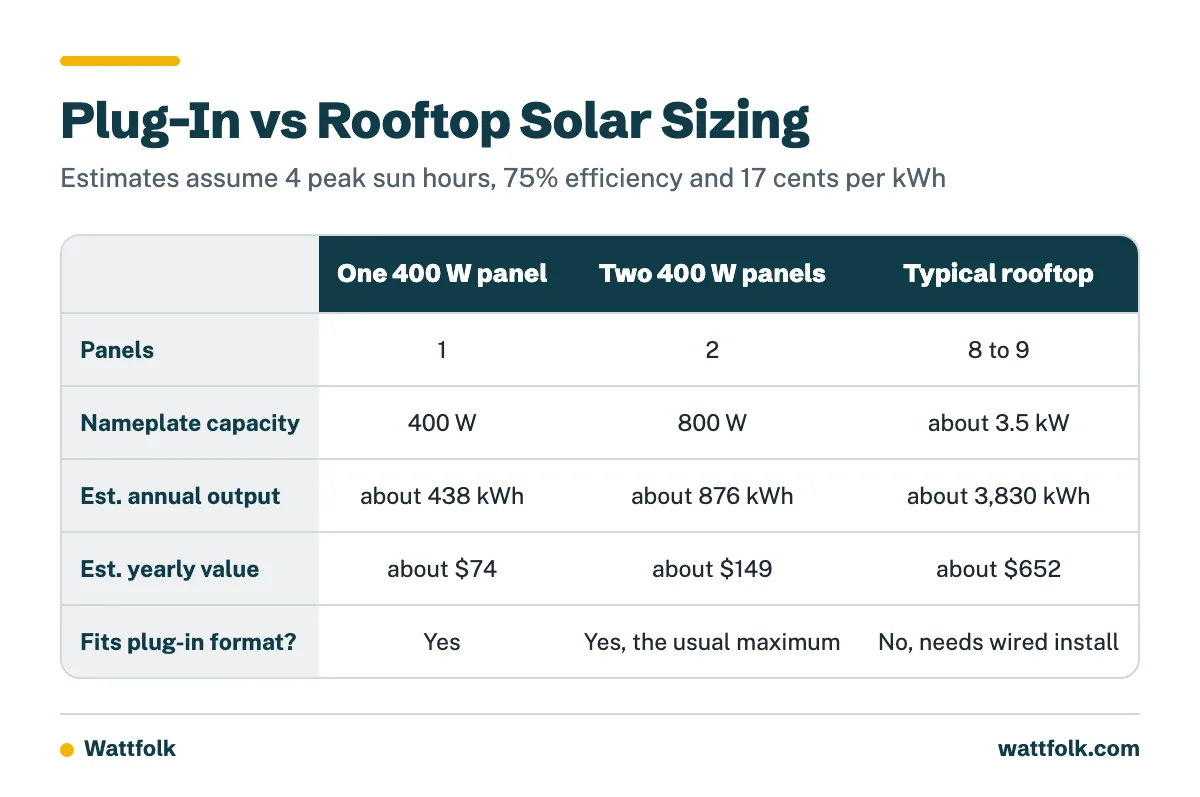
The table below compares three setups. Annual output assumes 4 peak sun hours per day, 75% system efficiency after losses, and 365 days. Value assumes 17 cents per kWh, near the national average reported by the U.S. Energy Information Administration. Your state may be anywhere from about 12 to 40 cents.
| Setup | Panels | Nameplate capacity | Est. annual output | Est. yearly value | Fits plug-in format? |
|---|---|---|---|---|---|
| One 400 W panel | 1 | 400 W | about 438 kWh | about $74 | Yes |
| Two 400 W panels | 2 | 800 W | about 876 kWh | about $149 | Yes, the usual maximum |
| Typical rooftop system | 8 to 9 (400 to 450 W each) | about 3.5 kW | about 3,830 kWh | about $652 | No, needs wired install |
The 3.5 kW size and the panel count of eight or nine modern 400 to 450 W modules come from the Energy.org.uk sizing guide, which describes a typical home system. Output there is based on UK sunlight. The figures in our table use US assumptions, so you can redo the math for your area.
How Many Plug-In Solar Panels Can I Have?
There is no single national answer in the US. Plug-in solar rules vary by state and change quickly, so check with your utility before you buy or connect anything. Do not rely on a product page alone.
It helps to know how other countries set limits, because the same numbers show up in many articles. The UK interim specification for plug-in devices caps inverter output at 800 VA and current at 3.5 A. It also allows up to 2,000 W of total panel capacity for one compliant device. These details come from the Ofgem decision on plug-in microgeneration. They are UK rules, not US law. Treat them as a reference point only.
Notice what that UK rule does and does not say. It limits devices per household, not panels. One device may contain more than one panel. The inverter limit and the panel limit are two separate numbers, and many web pages blur them together.
What Is the Difference Between Panel Wattage and Inverter Output?
Panel wattage is the DC rating under lab test conditions. Inverter output is the AC power that actually enters your outlet. The inverter is the gate, and it can pass only so much at once.
A 400 W panel is a nameplate rating. It is not a promise of 400 W all day. Heat, haze, panel angle, shading and wiring losses all pull the number down. Real output usually sits below nameplate for most of the day.
Worked example: two 400 W panels
- Two panels at 400 W each is 800 W of DC capacity, or 0.8 kW.
- Multiply by 4 peak sun hours: 0.8 x 4 = 3.2 kWh per day before losses.
- Apply 75% system efficiency: 3.2 x 0.75 = 2.4 kWh per day.
- Multiply by 365: about 876 kWh per year.
- At 17 cents per kWh: about $149 per year.
Assumptions: 4 peak sun hours, 75% efficiency after inverter, heat and wiring losses, 17 cents per kWh, and all the power used inside your home. Sunnier states have more peak sun hours. Cloudy or shaded sites have fewer.
What is clipping?
Clipping happens when the panels could produce more than the inverter will pass. If you pair 2,000 W of panels with an 800 W inverter, midday power above 800 W is cut off. You still gain extra output in mornings, evenings and cloudy weather. With an 800 W inverter and 800 W of panels, clipping is rare, because panels seldom reach full nameplate output.

How Many Plug-In Solar Panels Do I Need for My Electricity Use?
Start with your yearly kWh, then divide by what one panel makes. Check your utility bill for annual or monthly usage. According to the U.S. Energy Information Administration, an average US home uses roughly 10,500 kWh a year, but apartments often use far less.
The formula
Panels needed = annual kWh divided by (panel kW x peak sun hours x 365 x system efficiency).
With a 400 W panel, 4 peak sun hours and 75% efficiency, one panel makes about 438 kWh per year. That is 0.4 x 4 x 365 x 0.75.
| Home | Yearly use | Panels to offset 100% | Share two panels cover |
|---|---|---|---|
| Small apartment | 3,000 kWh | about 7 | about 29% |
| Larger apartment | 5,000 kWh | about 12 | about 18% |
| Average US home | 10,500 kWh | about 24 | about 8% |
Two panels will not zero out a bill. They trim it. That is still useful. Daytime loads such as a fridge, router, laptop and standby devices use the power as it is made.
From the Shop
A common mistake is sizing to the whole bill. A better first question is: how much power is my home using at noon on a sunny day? If your baseline daytime draw is 150 to 300 W, one or two panels will be used almost fully. If you are away all day with nothing running, much of the output goes unused.
How Many 400 W Solar Panels Do I Need to Power My Home?
For a full house, plan on roughly 20 to 25 panels at 400 W, using the assumptions above. That is a wired rooftop system, not a plug-in kit. For a plug-in kit, one or two 400 W panels is the realistic range.
The Energy.org.uk guide notes that a typical 3.5 kWp UK home system uses about eight or nine modern panels and needs roughly 20 square meters of roof. A US home using more power than that needs a larger array. Your final size depends on your yearly kWh, roof space, shading, and what your utility pays for exported power.
Can I Connect Two or More Plug-In Solar Kits to Different Outlets?
Do not assume you can. Most plug-in rules and product instructions allow one device per household or per circuit. Adding a second kit on another outlet can overload shared wiring and may break your utility agreement.
The UK interim specification says only one plug-in device should be used per household final ring circuit, and Ofgem describes the arrangement as effectively one device per household. US wiring differs, but the idea is the same: the more power you push back into one circuit, the more the wiring has to handle.
Do plug-in solar panels need to be connected to a dedicated circuit?
It depends on the product, local code and your utility. Some setups call for a dedicated circuit and some do not. If you are unsure, hire a licensed electrician to check the outlet, the breaker and the wiring.
Do I Need Three-Phase Power for Solar Panels?
No. Solar panels do not inherently need three-phase power. Most US homes have single-phase service, delivered as split-phase 120/240 V, and standard residential solar works fine on it.
Three-phase supply is mostly found in commercial and industrial buildings. Larger systems may need phase-specific design and utility approval. A plug-in kit is a single-phase device, so this question rarely matters for one or two panels.

Can Solar Panels Power My House on Their Own?
Not by themselves. Panels make power only when the sun shines, and a grid-tied inverter shuts off when the grid goes down. At night, you pull from the grid or a battery.
To run a house through an outage, you need a battery, a hybrid or backup-capable inverter, and proper transfer equipment. A licensed electrician must install that. A plug-in kit alone will not keep your lights on during a blackout, and it is not designed to.
Orientation, Shading and Season
Output depends on where and how your panels sit. In the US, south-facing panels tilted near your latitude usually do best. East or west faces lose some yearly output but may match morning or evening use. Vertical balcony mounting loses more in summer.
- Shading: Even partial shade on one panel can cut output sharply, depending on the inverter and wiring.
- Season: Winter days are shorter and the sun is lower, so output drops.
- Heat: Hot panels lose a little efficiency.
- Self-consumption: Power you do not use at the time may be wasted or sent to the grid, depending on your utility’s rules.
When Should I Choose a Professionally Installed Rooftop System?
Choose rooftop solar when you own the home, want to cover most of your bill, want battery backup, or want to export power under a net metering or similar program. Installation by a licensed pro also covers permits and utility approval.
Simple flowchart
- Start: Do you want to cover most of your yearly electricity use?
- No, you want to trim daytime baseload and may rent: Plug-in solar (1 to 2 panels).
- Yes: Do you own your roof?
- No: Ask about community solar or a small plug-in kit.
- Yes: Do you want battery or outage backup, or to export power?
- Yes: Professionally designed wired system.
- No: Still a wired rooftop system, since the size is beyond plug-in.
Decision checklist
- Annual electricity use: Find your yearly kWh on your bill.
- Daytime use: Is something running while the sun is out?
- Space: Do you have a balcony, yard or roof area with sun?
- Shading: Check for trees, buildings and railings at noon.
- Outlet location: Is a safe, grounded outlet close by, with no extension cord needed?
- Certification and utility approval: Is the kit certified, and does your utility allow it?
- Battery or backup: If you need either, plug-in is not the right tool.
For background on rooftop costs and savings, see the Energy Saving Trust solar panel overview. Its prices are UK prices, so use it for concepts, then get US quotes from local installers.
Frequently Asked Questions
How many plug in solar panels do I need?
Most people start with one or two 400 W panels. Two panels make about 876 kWh a year under 4 peak sun hours and 75% efficiency. That offsets a share of your use, not all of it.
How many plug in solar panels can I have?
It depends on your state, your utility and the product. Many plug-in rules and instructions allow one device per household, and that device may hold one or two panels. Ask your utility before connecting.
How many plug in solar panels can I have UK?
Under the UK interim specification, a compliant device may supply up to 800 VA to the mains, with up to 2,000 W of panel capacity, and the practical limit is one device per household. UK rules do not apply in the US, so check your own state and utility.
How many 400 watt solar panels do I need?
For a plug-in kit, one or two. For a whole average US home using 10,500 kWh a year, about 24, based on 4 peak sun hours and 75% efficiency. Sunnier locations need fewer.
Do solar panels need 3 phase power?
No. Standard residential solar works on single-phase service, which is what most US homes have.
Do I need 3 phase power for solar panels?
No. Three-phase matters mainly for larger commercial systems, where phase-specific design and utility approval can apply.
Can you power your house with only solar panels?
Not on their own. Grid-tied panels stop when the grid goes down, and they make nothing at night. A battery and backup-capable equipment, installed by a licensed electrician, are needed for that.
Sources