
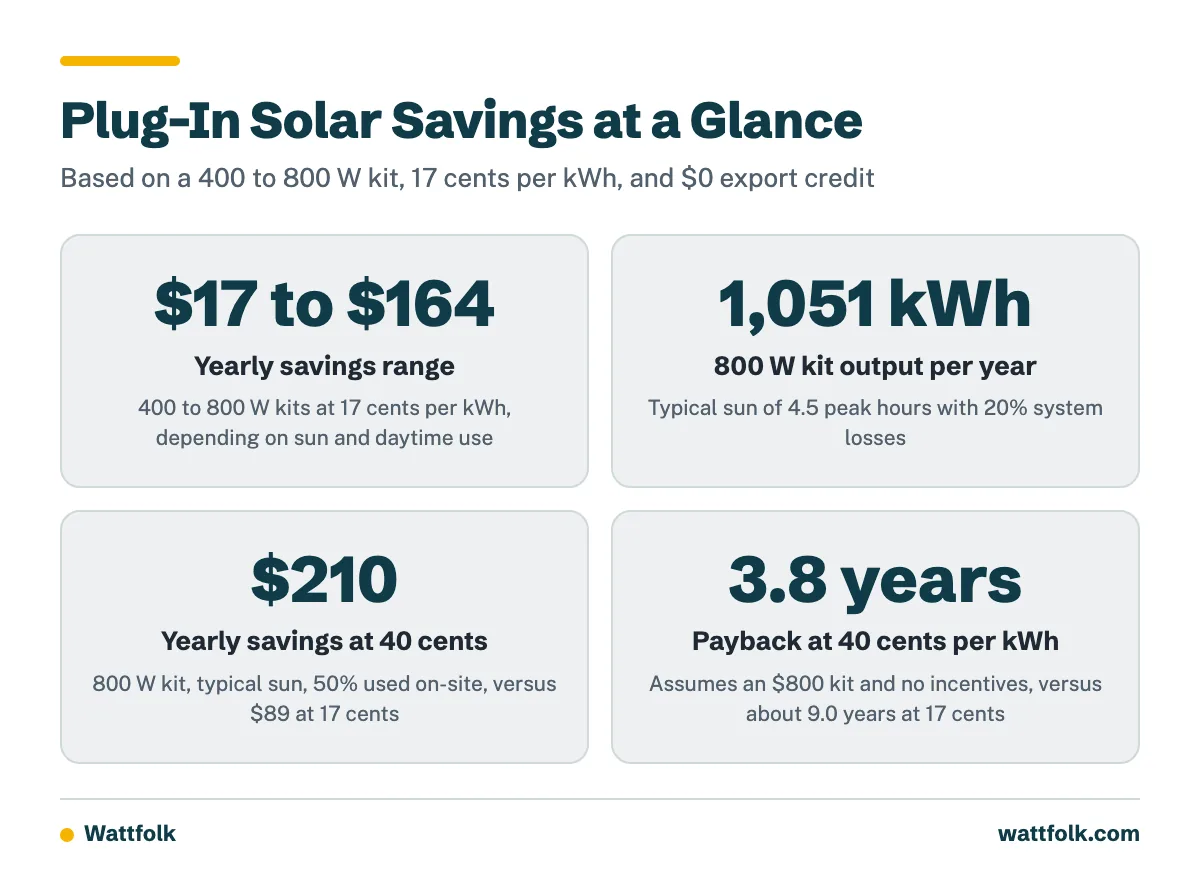
Many people assume plug-in solar will wipe out their power bill, but a 400 to 800 W kit saves about $17 to $164 a year at 17 cents per kWh. EnergySage’s rooftop examples run higher, from about $896 in Florida to $1,493 in California, but cost far more and need a roof. Instead, estimate it as kWh you use or get credited for, times the rate you avoid paying.
Quick answer
Most plug-in kits save tens of dollars a year, and up to a few hundred in sunny, high-rate areas. Savings depend on sun, your rate, and how much power you use during the day.
- Best for high rates and daytime use: 800 W kit, faster payback
- Best for empty homes by day: small kit, or skip it
- Annual savings = on-site kWh used x retail rate, plus exported kWh x export credit, minus ongoing costs.
- An 800 W kit in typical sun makes about 1,050 kWh a year under the assumptions below.
- Power used in your home at the time it is made is worth the full retail rate. Exported power may earn little or nothing.
- Higher electricity rates shorten payback a lot. At 40 cents per kWh, the example kit pays back in under 4 years.
- Rules differ by state and utility. Confirm with your utility before you buy.
- What Plug-In Solar Is
- The Savings Formula
- How Many kWh Can a Plug-In System Produce?
- How Much Would Plug-In Solar Save Me?
- Will It Help If I Use Most Power at Night?
- Does Exported Power Earn a Credit?
- How Long Does Plug-In Solar Take to Pay for Itself?
- Plug-In vs. Rooftop vs. Community Solar
- Pre-Purchase Checklist
- When It Saves Money and When It Does Not
- Frequently Asked Questions
What Plug-In Solar Is and How It Differs From Rooftop Solar
Plug-in solar is a small set of panels with a microinverter that feeds power into your home’s wiring through an outlet or a dedicated connection. Balcony kits usually run 400 to 800 W. A rooftop system is often several thousand watts, wired in by an installer, and sized to cover most of a household’s use.
That size gap drives the savings gap. A small kit usually offsets only part of a household bill. A typical whole-home load is too large for it to cover.
How Much Does Plug-In Solar Save? The Simple Formula
EnergySage explains that a basic savings estimate is the electricity produced in kWh multiplied by the cost of the electricity it replaces. For plug-in solar, split that into two parts, because used power and exported power are worth different amounts.
Annual savings = (solar kWh used on-site x retail rate) + (exported kWh x utility export credit) – ongoing costs
Many top pages skip this split. It matters because power you use in your home as it is made offsets the full retail rate. Exported power may earn a lower credit, or none. In the examples below, I assume a $0 export credit and $0 ongoing costs so the numbers stay on the safe side.
How Many kWh Can a Plug-In Solar System Produce?
Use this formula: watts / 1,000 x peak sun hours x 365 x 0.80. The 0.80 is an assumed 20% for system losses. Those losses come from heat, wiring, the inverter, dust, and imperfect angles. Balcony panels are often mounted vertically or partly shaded, so real output can sit well below the label rating.
Peak sun hours are the hours per day with the equivalent of full midday sun. Many US locations fall between roughly 3.5 and 5.5. I use 3.5 (low), 4.5 (typical), and 5.5 (high). Check a solar resource map for your zip code.
| Sun case | Peak sun hours | 400 W kWh/year | 800 W kWh/year |
|---|---|---|---|
| Low | 3.5 | 409 | 818 |
| Typical | 4.5 | 526 | 1,051 |
| High | 5.5 | 642 | 1,285 |
For scale, the EIA national average is near 17 cents per kWh, so even 1,000 kWh is worth about $170 at retail. A shaded, north-facing, or vertical balcony can fall under these figures.

How Much Would Plug-In Solar Save Me? Worked Examples
Self-consumption is the share of your solar kWh that your home uses right away. A home with a fridge, router, and a work-from-home setup might reach 75%. A home that sits empty all day might reach 25%. The tables use 17 cents per kWh (near the national average), a $0 export credit, and no ongoing costs.
800 W kit: annual savings at 17 cents per kWh
| Sun case | 25% used | 50% used | 75% used |
|---|---|---|---|
| Low (818 kWh) | $35 | $70 | $104 |
| Typical (1,051 kWh) | $45 | $89 | $134 |
| High (1,285 kWh) | $55 | $109 | $164 |
400 W kit: annual savings at 17 cents per kWh
| Sun case | 25% used | 50% used | 75% used |
|---|---|---|---|
| Low (409 kWh) | $17 | $35 | $52 |
| Typical (526 kWh) | $22 | $45 | $67 |
| High (642 kWh) | $27 | $55 | $82 |
To redo the math, multiply the kWh by the self-consumption share, then by your rate. Example: 1,051 x 0.50 x $0.17 = about $89.
How much does your electricity rate change the answer?
A lot. EnergySage notes that higher electricity rates generally produce greater savings from the same generation. Take the 800 W kit in typical sun at 50% use, which is 526 kWh used on-site:
| Rate per kWh | Annual savings |
|---|---|
| 12 cents | $63 |
| 17 cents | $89 |
| 40 cents | $210 |
Those rates match the rough range of US state averages published by the U.S. Energy Information Administration. Look at your own bill for your actual per-kWh rate.
Will Plug-In Solar Reduce My Bill If I Use Most Power at Night?
Only a little, unless the utility credits the power you send out. Panels make power in daylight. If nobody is home and the only daytime load is a fridge and a router, much of the output may go to the grid. That is the 25% case in the tables above.
You can raise self-consumption by shifting daytime loads such as laundry, dishwashing, or charging devices. Working from home also helps. Do not change habits that cost you more than you save.
- Home most of the day and a rate above 25 cents: a larger kit is worth pricing.
- Home mostly at night and a low rate: a small kit, or look at efficiency upgrades first.
- Your utility pays a fair export credit: self-consumption matters less.
Does Exported Plug-In Solar Power Earn a Credit From My Utility?
Sometimes, but do not count on it. Small plug-in systems often do not have a meter set up to measure exports. Where a credit exists, it may be lower than the retail rate. Some utilities set export limits or require an interconnection application, even for small units.
Net metering means the utility credits exported power against what you buy. Where it applies, savings can rise above the tables. Where it does not, exported kWh are worth $0, as I assumed. Plug-in solar rules vary by state and change fast, so ask your utility in writing what it allows.
What happens to savings under fixed utility charges?
Fixed monthly charges stay on your bill. Solar cuts the energy part of the bill, not the customer charge. Some utilities also have minimum bills. Check your bill for fixed lines, because they limit how low any solar system can push your total.
How Long Does Plug-In Solar Take to Pay for Itself?
Payback equals purchase cost divided by annual savings. EnergySage advises subtracting system price and incentives from the value of avoided or credited electricity. For a clean example, I assume an $800 price for an 800 W kit with no incentives. Check current prices, since they vary by brand and shipping.
| Scenario (800 W, typical sun) | Annual savings | Payback |
|---|---|---|
| 17 cents, 25% used | $45 | about 17.8 years |
| 17 cents, 50% used | $89 | about 9.0 years |
| 17 cents, 75% used | $134 | about 6.0 years |
| 12 cents, 50% used | $63 | about 12.7 years |
| 40 cents, 50% used | $210 | about 3.8 years |
Will solar save me money after panel, inverter, mounting, and permit costs?
It can, if you include every cost. Add mounting hardware, any permit or utility fee, and a possible electrician visit to the $800. Panels commonly carry 25-year performance warranties, but inverters can fail sooner, so check the inverter warranty. A replacement can erase years of savings.
How much energy do solar panels save over their usable lifetime?
Using 1,051 kWh a year over 25 years gives about 26,000 kWh before aging. A commonly cited loss is about 0.5% per year, which brings it to roughly 24,500 kWh. Only the part you use or get credited for saves money. At 50% use and 17 cents, that is about $2,100 over 25 years, before inverter replacement.

How Much Do Plug-In Solar Panels Save Compared With Rooftop and Community Solar?
Far less in dollars, but with far less cost and effort. EnergySage reports an average US homeowner solar savings estimate of about $60,500 over 25 years, with many shoppers between $41,000 and $155,000. Those figures describe conventional rooftop solar, so do not apply them to a plug-in kit. See EnergySage’s breakdown of how much solar panels save and its annual solar savings by state.
| Plug-in solar | Small rooftop system | Community solar | |
|---|---|---|---|
| Output | About 400 to 1,300 kWh/year (examples above) | Several times higher | Share of an off-site array |
| Installation effort | Low, but check mounting and wiring | High, professional install | None, a sign-up |
| Bill impact | Small, partial offset | Can cover most of a home’s use | Credits vary by program |
| Export rules | Often unclear or no credit | Usually metered with interconnection | Handled by the program |
| Payback | Roughly 4 to 18 years in the examples | Depends on quote and incentives | No upfront cost in many programs |
Renters who cannot touch a roof may find community solar, where offered, a better fit. Cheap efficiency upgrades, like LED bulbs or a smart power strip, can also beat a small kit on cost per kWh saved.
Checklist Before You Buy
- Utility approval: Ask whether plug-in systems are allowed and whether you must file anything.
- Compensation: Ask if exported kWh earn any credit, and at what rate.
- Inverter certification: Look for a listing to the UL 1741 grid-interconnection standard, which covers the automatic shut-off if the grid goes down.
- Dedicated circuit: Ask if your local rules require one. A licensed electrician must add it.
- Balcony or mounting safety: Confirm the rail, wall, or stand can hold the panel weight and wind load. Check your lease or HOA rules.
- Wiring: Never use an extension cord. Never bypass the microinverter’s grid shut-off.
- Real cost: Add the kit, mounting, fees, and electrician time. Then divide by your savings estimate.
When Plug-In Solar Saves Money and When It Does Not
It saves best where electricity is expensive, the panels get clear sun, and someone is home by day. It saves little where rates are low, the balcony is shaded, or nothing runs in the daytime. In those cases it works more as a small, flexible add-on than as a serious bill cutter. If you are unsure, start with the formula and a quote. EnergySage’s home solar guide covers rooftop options if your savings math points that way.
Frequently Asked Questions
How much do plug in solar panels save?
In the examples above, a 400 to 800 W kit saves about $17 to $164 a year at 17 cents per kWh. The range depends on sun hours, system losses, and how much power you use during the day. Exported power is counted at $0.
How much does solar really save?
It depends on the system size, your rate, and utility credits. EnergySage reports about $60,500 on average over 25 years for conventional home solar, with many shoppers between $41,000 and $155,000. Plug-in kits save a small fraction of that.
Will solar save me money?
Usually yes over its life, but only if savings exceed the full cost. Subtract the system price and any incentives from the value of electricity avoided or credited. Include mounting, fees, and a possible inverter replacement.
How much can you save on electricity with solar panels?
Some households offset nearly all of their use with a right-sized rooftop system. A small plug-in kit cannot cover a typical whole-home load. Expect a partial offset instead.
How much energy do solar panels save?
Panels make energy rather than save it. An 800 W kit makes about 1,050 kWh a year with 4.5 peak sun hours and 20% losses. Only the part you use on-site or get credited for lowers your bill.
Does plug-in solar still work if exports earn nothing?
Yes, but savings come only from power you use as it is made. That is why the 25%, 50%, and 75% self-consumption cases matter. Confirm your utility’s export rules before you buy.
Sources