
Panels outlast microinverters: the panels usually keep producing for 25 to 30 years or more, while the microinverter is the part most likely to quit first. Panels wear out slowly and predictably, but an inverter can fail suddenly, so judge them separately when working out whether a kit pays for itself.
Quick answer
Panels typically last 25-30+ years, and warranties usually guarantee about 80-87% of rated output at year 25-30. Microinverters are commonly warrantied for 10-25 years and are the first part you may replace. The whole kit can outlast its payback period if you buy well and keep it secure.
- Panels rarely “die.” They lose a small share of output each year, typically 0.3-0.7%.
- The microinverter, connectors and cables fail more often than the panels do.
- An 800 W kit can still make roughly 80-85% of its early output after 25-30 years.
- Check the datasheet for the degradation rate, glass type and both warranties before you buy.
- A 10-minute yearly inspection catches most problems early.
- How Long Do Plug-In Solar Panels Last?
- Do Solar Panels Go Bad?
- How Much Power Will My System Lose Each Year?
- Does the Microinverter or the Panel Fail First?
- Why Do Solar Panels Go Bad?
- Do Plug-In Panels Wear Out Faster Than Roof Panels?
- Which Solar Panels Last the Longest?
- How to Read the Warranty
- What Happens to Solar Panels After They Go Bad?
- How Do I Make Plug-In Panels Last Longer?
- Frequently Asked Questions
How Long Do Plug-In Solar Panels Last?
The panels last about 25 to 30 years, and many keep working past that. The microinverter is the shorter-lived part, so think of a plug-in kit as having three lifespans.
- Panel: 25-30+ years, with output slowly fading.
- Microinverter: often 10-25 years, based on manufacturer warranties. Enphase, for example, offers up to 25 years in some markets.
- Whole kit: as long as you keep the cables, connectors and mounts in good shape and swap the inverter if it fails.
How long do solar panels last before they need to be replaced?
Most panels do not need replacing at 25 or 30 years. That number is the end of the performance warranty, not the end of the panel. Replace one when it is cracked, when it makes far less power than its siblings, or when output falls so low that it no longer makes sense to keep it.
Do Solar Panels Go Bad, or Do They Just Lose Output?
Mostly they lose output. Solar panels have no moving parts, so they fade gradually instead of stopping. Sudden failure does happen, but it usually comes from a crack, a bad connector or a failed inverter, not from the cells wearing out.
Degradation has two stages:
- First-year loss. New panels drop a little in the first months because of light-induced degradation (LID) and, in some cells, LeTID. Modern TOPCon and premium monocrystalline modules often specify about 1-2% in year one, according to their datasheets.
- Annual loss. After that, NREL’s research on photovoltaic degradation found a median of about 0.5% per year, with newer modules often lower, around 0.3-0.5%. Many TOPCon datasheets list about 0.4%, against about 0.55% for older PERC modules.
How Much Power Will My Plug-In System Lose Each Year?
Over 25 years, a typical 800 W kit loses roughly 10-20% of its output, depending on the degradation rate. The table below shows two 400 W panels (800 W total) under three annual loss rates, all with a 1.5% first-year drop.
Assumptions: 4 peak sun hours per day (many US locations fall between about 3 and 6), 20% system losses for heat, wiring, dirt and inverter conversion, and 365 days a year. That gives about 934 kWh in a year at full nameplate output. Change these numbers to match your location and redo the math.
| Year | 0.4%/yr: Watts | 0.4%/yr: kWh | 0.5%/yr: Watts | 0.5%/yr: kWh | 0.8%/yr: Watts | 0.8%/yr: kWh |
|---|---|---|---|---|---|---|
| 1 | 788 | 920 | 788 | 920 | 788 | 920 |
| 5 | 775 | 905 | 772 | 902 | 763 | 891 |
| 10 | 760 | 887 | 753 | 879 | 733 | 856 |
| 15 | 745 | 870 | 735 | 858 | 704 | 822 |
| 20 | 730 | 853 | 716 | 836 | 676 | 790 |
| 25 | 716 | 836 | 699 | 816 | 650 | 759 |
| 30 | 702 | 819 | 681 | 796 | 624 | 729 |
Here is what that means for money. At the 0.5% rate, the kit makes about 21,700 kWh over 25 years. At 17 cents per kWh, the US national average near the EIA figure, that is about $3,700 if you use every kilowatt-hour. At 0.8%, the total is about 20,900 kWh, only around $130 less. Degradation matters, but it is a smaller factor than your electricity price or how much of the output your home actually uses.
For a simple payback check, suppose a kit costs $1,000. Year-one output of 920 kWh at 17 cents saves about $156, so payback is roughly 6.4 years. At 30 cents per kWh, it drops to about 3.6 years. Savings only count for power your home uses at the time, so a small, always-on load like a fridge helps.
Does the Microinverter or the Panel Fail First?
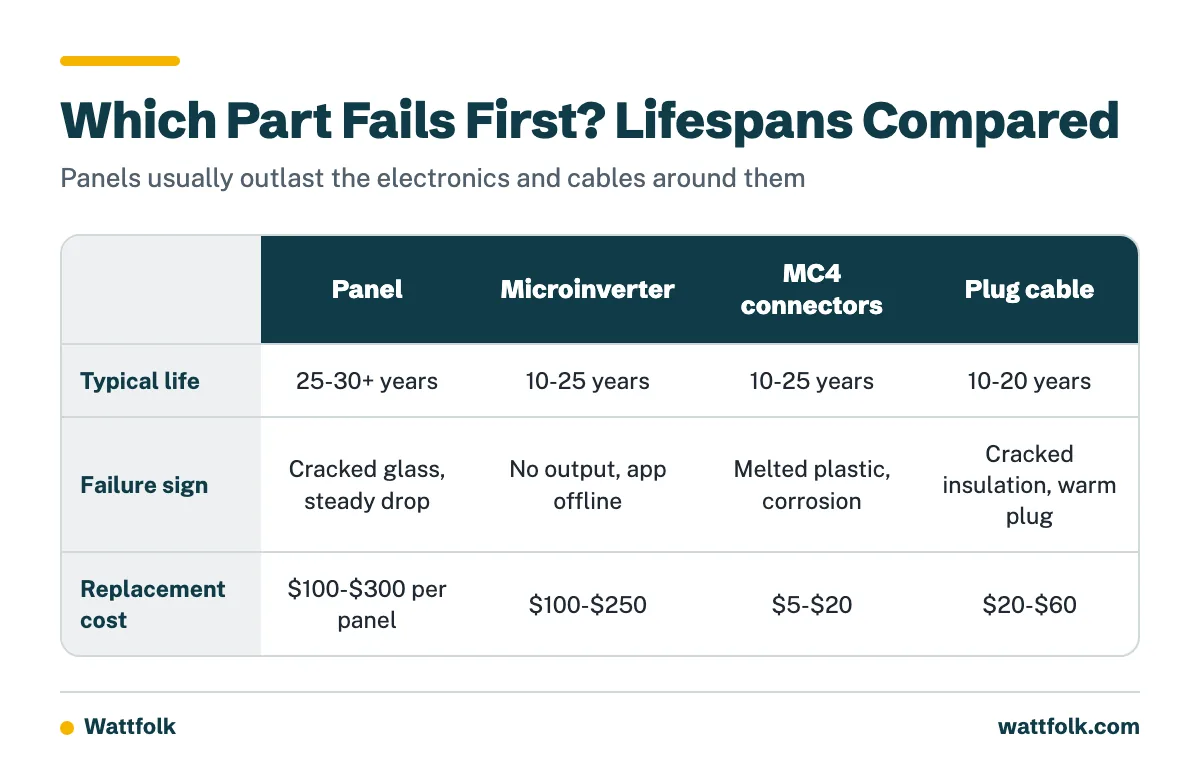
The microinverter is more likely to fail first. It contains electronics that heat up and cool down every day, and it often sits right behind the panel in the sun. The panel itself is glass, cells and a frame.
The microinverter also does a safety job: it shuts off when the grid goes down. Never bypass that shut-off, and never run a kit through an extension cord. If anything about the inverter or wiring looks wrong, stop using it and call a licensed electrician.
| Part | Typical life | Common failure signs | Rough replacement cost* |
|---|---|---|---|
| Panel | 25-30+ years | Cracked glass, browned cells, steady output drop | $100-$300 per panel |
| Microinverter | 10-25 years (warranty range) | No output, app offline, error codes | $100-$250 |
| MC4 connectors | 10-25 years | Melted plastic, loose fit, corrosion | $5-$20 |
| Plug cable | 10-20 years | Cracked insulation, warm plug, loose pins | $20-$60 |
| Mounting hardware | 10-25 years | Rust, loose bolts, bent brackets | $30-$150 |
*These are rough estimates, not quotes. Prices vary by brand and retailer. Check current prices before you budget.

Why Do Solar Panels Go Bad?
Panels go bad from heat, sunlight, moisture and physical stress. Most of it is slow. A few causes are sudden.
- Heat. Output drops as cells get hot, with a typical temperature coefficient of -0.3 to -0.4% per °C above 25°C. A cell at 65°C can lose about 12-16% of its output at that moment. Sustained heat also speeds up ageing.
- UV and thermal cycling. Daily heating and cooling stresses solder joints and the backsheet.
- Moisture. Water ingress can corrode contacts and cause delamination, where layers separate.
- Microcracks and hot spots. Tiny cracks in cells, often from hail, impacts or rough handling, can create hot spots that cut output.
- PID (potential-induced degradation). Voltage stress can drain cell output in some modules.
- Connector and junction box failures. Poor crimps, loose fit or water inside cause many “dead panel” cases.
Do Plug-In Panels Wear Out Faster Than Roof Panels?
The panels themselves do not age faster, but the setup around them often gets rougher treatment. Balcony railings, fences and ground stands add stresses that fixed roof arrays avoid.
- Wind loads. Panels on a railing act like a sail. Weak clamps loosen and bend.
- Vibration. Constant movement can wear brackets and connectors.
- DIY handling. Stepping on a panel, bending cables or over-tightening clamps can cause microcracks.
- Exposed cabling. Cables on a balcony see sun, rain and foot traffic. Use only the cable that came with the kit, and never an extension cord.
- Moving the kit. Every move adds a chance for drops, scratches and loose parts.
- No output but panels look fine: check the inverter and app first, then the connectors.
- Cracked glass or burn marks: disconnect the system and replace the panel. Do not keep using it.
- Warm or damaged plug or cable: stop using it. Replace it, or ask a licensed electrician.
- Output down 5% or more from last year: clean the panels, check for shade, then contact the seller.
Which Solar Panels Last the Longest?
Panels with low degradation rates, glass-glass construction and long warranties from established brands tend to last the longest. Cheap kits often hide the details.
- Cell technology. Monocrystalline cells dominate plug-in kits. TOPCon and premium monocrystalline modules often list about 0.4% annual loss, against about 0.55% for older PERC datasheets. Check each datasheet.
- Glass-glass vs. glass-backsheet. Glass-glass modules typically carry longer warranties, often 30 years, because the rear glass resists moisture and UV better.
- Brand strength. A well-known manufacturer is more likely to still exist when you need a warranty claim.
Buyer’s checklist for a long-lasting kit
- Product warranty of 12 years or more, and a performance warranty of 25-30 years.
- Stated first-year loss and annual degradation on the datasheet.
- Glass type: glass-glass if you can get it.
- IEC 61215 and IEC 61730 certification.
- Microinverter warranty length, plus a clear grid shut-off feature.
- IP rating for the inverter and connectors (IP67 or better for outdoor parts is common).
- Wind-load rating for the panel and the mounting hardware.
How to Read the Warranty
Every kit has two panel warranties, and they cover different things.
- Product warranty (materials and workmanship): typically 10-15 years, with some premium brands offering 25. It covers defects like delamination or a failed junction box.
- Performance warranty: typically guarantees roughly 80-92% of nameplate output at 25-30 years. It only pays out if output drops below the guaranteed line.
Find out who handles claims. Some sellers pass you to the manufacturer overseas, and shipping a panel back can cost more than the panel. Also check whether the inverter has its own warranty, since it is usually shorter than the panel’s performance cover.
What Happens to Solar Panels After They Go Bad?
They can be repaired in part, reused or recycled. A dead panel is rarely just trash.
- Replace the inverter only. If the panels still make power, a new microinverter is far cheaper than a new kit.
- Resell or reuse. A working panel with minor fade can power a shed, camper or garden project.
- Recycling. In the EU, the WEEE Directive makes producers pay for collection and recycling. The US has no federal PV-specific take-back rule, and rules vary by state. Washington, for example, has a take-back law. Ask the seller, your city waste office or your state environmental agency what is available.
How Do I Make Plug-In Panels Last Longer?
Secure mounting, gentle cleaning, shade control and cable care do the most. A few simple habits can add years.
- Mount for wind. Use hardware rated for your panel and railing, and recheck bolts each season.
- Clean softly. Use water and a soft cloth or sponge. Skip pressure washers and harsh scrapers.
- Avoid shade. Partial shade can cause hot spots and cut output.
- Protect cables. Keep them off sharp edges and standing water, and never replace the supplied cable with an extension cord.
- Give panels airflow. A small gap behind the panel helps shed heat.
- Watch the app. Most microinverter apps show daily output. A sudden drop is an early warning.

10-minute yearly inspection checklist
- Look for cracked glass, browned or discolored cells, or burn marks.
- Shake the mounts gently. Tighten loose bolts and replace rusty ones.
- Check cables, plugs and connectors for cracks, melting or heat marks.
- Compare app output on a clear day with last year’s. A drop of more than about 1% a year deserves a closer look.
- Clear leaves, dirt and bird droppings.
If you find damaged wiring or a hot plug, unplug the system and call a licensed electrician.
Frequently Asked Questions
How long do plug in solar panels last?
The panels typically last 25-30 years or more, while the microinverter is often warrantied for 10-25 years. Many kits keep working well past their payback period if the mounts and cables stay in good condition.
How long do solar panels last before they need to be replaced?
Most panels do not need replacing at 25-30 years, since that is the end of the performance warranty and not of the panel’s working life. Replace a panel if it is cracked, has burn marks or its output falls far below the others.
What happens to solar panels after they go bad?
You can replace only the failed part, resell or reuse working panels, or recycle them. US rules vary by state, so ask the seller or your local waste agency about take-back options.
Why do solar panels go bad?
Common causes are heat, UV exposure, thermal cycling, moisture, microcracks, hail, wind stress and connector failures. Most of these cause slow decline, while cracks, water ingress and bad connectors can cause sudden loss.
Do solar panels go bad?
They usually fade slowly, by about 0.3-0.7% per year, instead of failing outright. Sudden failure is more often caused by a microinverter, connector or cable than by the panel cells.
Which solar panels last the longest?
Look for low listed degradation (about 0.4% per year or better), glass-glass construction, IEC 61215 and IEC 61730 certification, and a 25-30 year performance warranty from an established brand.