Renters and homeowners setting up plug-in solar should skip extension cords, power strips, and adapters. Mount the panels securely, wire them only as the microinverter allows, and plug straight into a weatherproof outlet. Check utility rules first, and hire an electrician for new outlets.
Quick answer
Confirm permission, mount the panels with approved hardware, match the panel wiring to the microinverter’s limits, and plug directly into a protected outdoor outlet. Never use an extension cord. Have an electrician check anything uncertain.
- Best for most renters: a complete certified kit, so parts are matched
- Best for custom builds: parallel or single-panel inputs, checked against the datasheet
- Get permission and confirm utility and local rules before you buy.
- Plug the system directly into a protected, weatherproof outlet. No extension cords, adapters, or power strips.
- Series wiring adds voltage. Cold-weather voltage must stay under the microinverter’s maximum.
- Output is panel watts times peak sun hours times a loss factor, not the number on the label.
- Keep balconies, walkways, and exits clear of panels and cables.
- If anything trips, buzzes, smells, or looks damaged, unplug it and call an electrician.
- What is in a plug-in solar system?
- Do I need permission before I install?
- Pre-installation checklist
- Where can I install plug-in solar panels?
- Can I plug solar panels into any outdoor outlet?
- Can I use an extension cord or adapter?
- How do I set up plug-in solar panels step by step?
- How do I connect solar panels in series?
- How many panels can one microinverter take?
- How much power will it make?
- What if the system trips, buzzes, or smells hot?
- Frequently Asked Questions
What is in a plug-in solar system?
A plug-in system has six parts: panels, a mount, DC cables, a microinverter, an AC cable, and a plug. The panels make direct current (DC). The microinverter turns it into 120V alternating current (AC) that matches your home. The AC cable carries it to the plug.
Here is the key safety point. A grid-tied microinverter shuts off when the grid goes down. That feature protects utility workers and you. Never bypass it or modify it.
There is also a big difference between a complete certified kit and a pile of parts. A kit comes with panels, connectors, inverter, and cables designed to work together. Mixing separate panels, connectors, and inverters can create voltage or connector mismatches that are easy to miss. If you are new to this, buy a complete kit.
Do I need permission from my landlord, building manager, or utility?
Most likely yes, at least for one of them. Renters usually need written approval from the landlord. Condo and co-op owners often need board or building manager approval, especially for anything on a shared balcony or exterior wall.
Utility rules are the part most guides skip. Plug-in solar rules vary by state and change quickly. Some utilities want to be told about any system that feeds power back into the home. Others require a formal interconnection process. Call your utility before you plug in and ask what applies at your address.
For comparison, UK fire brigade guidance says the local network operator should be notified within 28 days after installation in that country. That is a UK rule. It does not apply to you, but it shows why you should ask first.
Pre-installation checklist
Go through this list before you buy anything. If you cannot tick a box, stop and fix it first.
- Permission: written approval from your landlord or building, and a utility check.
- Mounting: a manufacturer-approved method that suits your wall, rail, or ground.
- Escape routes: no panels or cables across shared balconies, walkways, windows, or exits.
- Outlet: an outdoor-rated, weatherproof outlet that is in good condition.
- Circuit protection: GFCI protection and a breaker an electrician has judged suitable.
- Direct connection: the plug reaches the outlet with no cord or adapter in between.
- Shutdown access: you can reach the plug and the breaker quickly.
- Compatibility: panel and inverter specs checked against each other.
Can I install plug-in solar panels on a balcony, roof, wall, or garden structure?
Often yes, but the mount must be approved for the spot. Use the hardware the panel or kit maker specifies. Zip ties, bungee cords, and homemade brackets are how panels end up in the street during a storm.
Balconies need extra care. UK fire brigade guidance for residents says plug-in equipment and cables must not block shared balconies, walkways, windows, corridors, or designated escape routes. Apartment buildings also bring other risks: combustible balcony materials, cladding that is being repaired, and neighbors who share the space. Ask your building manager before you drill or clamp anything.

For a wall, roof, or garden frame, check that the structure can hold the panel weight and wind load. If you are unsure, ask a contractor or engineer. Roof work also carries fall risk, so hire a pro.
Can I plug solar panels into any outdoor outlet?
No. The outlet must be weatherproof, in good condition, and on a circuit that can handle power flowing both ways. UK fire brigade guidance recommends at least an IP65-rated outdoor installation to reduce water ingress and fault risk. IP65 means the equipment is dust-tight and protected against water jets.
Circuit protection matters too. Electrical Safety First, a UK charity, recommends a minimum Type A bidirectional RCD for circuits used with plug-in solar and advises against basic Type AC protection without an upgrade. In US homes the equivalent device is usually a GFCI outlet or breaker. I cannot tell you which models work with back-fed power. Ask a licensed electrician to check yours.
Circuit loading is the other gap. A typical 15-amp, 120V circuit is rated for 1,800 watts, and continuous loads are usually kept to 80 percent, or 1,440 watts. A microinverter feeds power into that same circuit, and the breaker does not see it the way it sees a normal load. Keeping the system small and having the circuit assessed reduces that risk. The IET, a UK engineering body, recommends limiting plug-in systems to about 1 kW peak.
Installing a new outdoor outlet is electrical work. Hire a licensed electrician. Read more at the Electrical Safety First plug-in solar guidance.
Can I use an extension cord, adapter, cable reel, or plug-in GFCI with a plug-in solar system?
No. Safety guidance in the sources says plug-in solar systems should not connect through extension leads, adapters, cable reels, multiway adapters, travel adapters, or plug-in RCD adapters. Each one adds a joint that can overheat, and a cord can carry power in a direction it was not designed for.
If the plug does not reach the outlet, do not add a cord. Move the panels or have an electrician install an outlet closer. The London Fire Brigade safety advice explains why.
How do I set up plug-in solar panels step by step?
Work in this order. Keep the system unplugged until the last step.
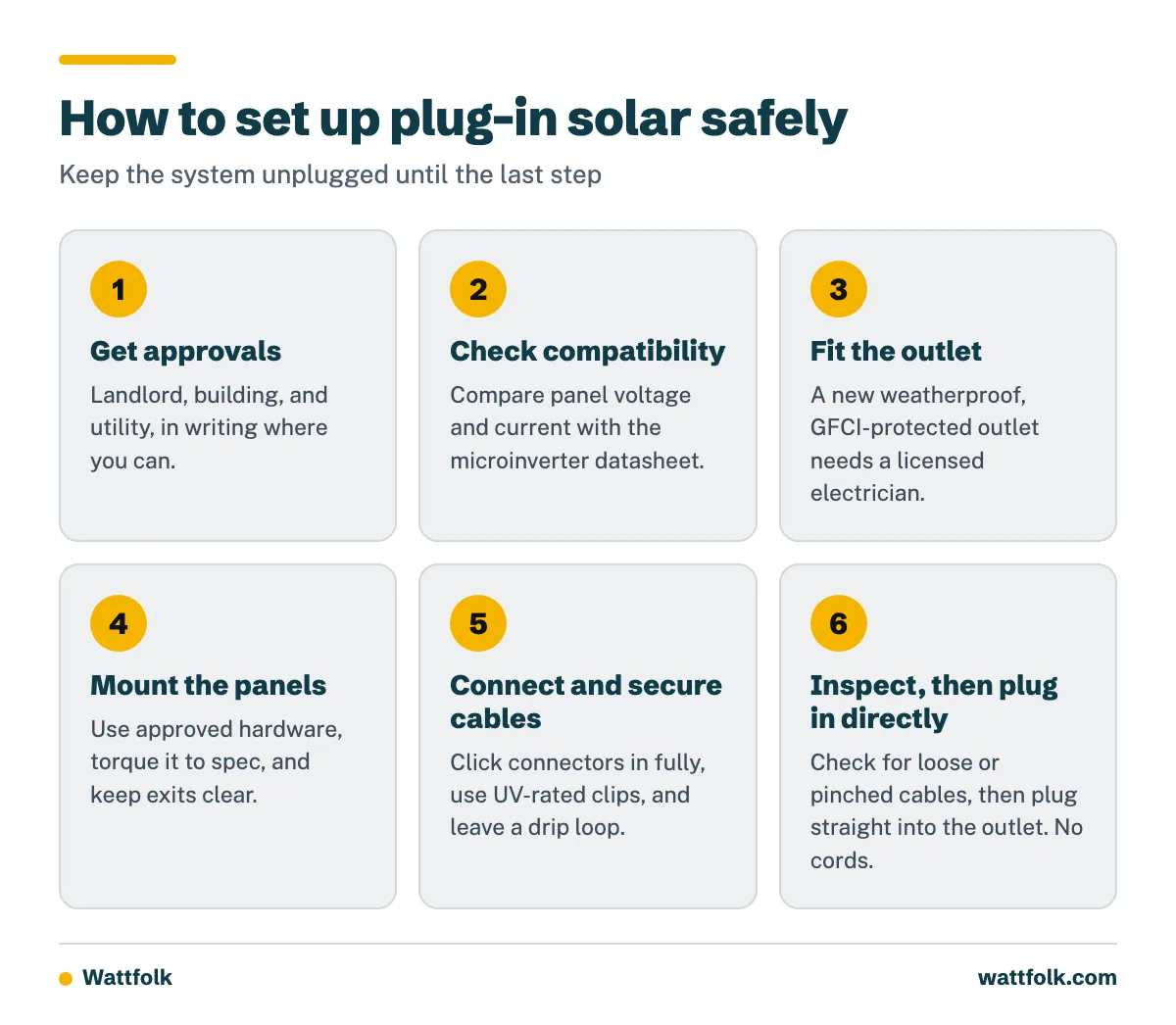
- Get approvals. Landlord, building, and utility, in writing where you can.
- Check compatibility. Compare panel voltage and current with the microinverter datasheet (see the worked example below).
- Fit the outlet. If you need a new weatherproof, GFCI-protected outlet, hire a licensed electrician.
- Mount the panels. Use approved hardware, torque it to spec, and keep exits clear.
- Place the microinverter. Mount it where the maker says, usually behind the panel, out of standing water.
- Connect the DC side. Click the connectors together fully. Use only the connector type your kit supplies.
- Route and secure cables. Use UV-rated clips. Leave a small drip loop so water runs off before it reaches a connection.
- Inspect. Look for loose connectors, pinched cables, and sharp edges.
- Plug in directly. Push the plug straight into the outlet. Watch the inverter light to confirm it has started.

How do I connect solar panels in series?
You connect the positive terminal of one panel to the negative terminal of the next. Panel voltages add up, while current stays about the same as one panel, according to Essentra’s guide to wiring solar panels. The free positive and negative ends then go to the microinverter.
When should solar panels be wired in series rather than in parallel?
Use series only when the combined voltage fits the microinverter. Many small microinverters take one or two low-voltage panels per input. Many are designed for panels on separate inputs, which is a different setup. Always follow the inverter’s manual.
| Option | Voltage | Current | Shading response | Complexity | Safety notes |
|---|---|---|---|---|---|
| Series | Adds up | Same as one panel | One shaded panel can drag down the whole string | Medium | Cold-weather voltage can exceed the inverter’s limit |
| Parallel | Same as one panel | Adds up | Better, but shaded panels still lose output | Medium | Current can exceed the inverter’s input limit |
| Manufacturer plug-in kit | Pre-matched | Pre-matched | Depends on design | Low | Parts are designed to work together |
Worked compatibility check
These numbers are examples only. Use your own datasheets. Say a microinverter allows a maximum DC input of 60V, an MPPT range of 22V to 48V, and a maximum input current of 14A. Two small panels each show an open-circuit voltage (Voc) of 22.5V, a maximum power voltage (Vmp) of 18.5V, and a current (Imp) of 5.4A. The panel’s temperature coefficient for Voc is assumed at -0.27% per °C, and the coldest expected morning is -10°C (35°C below the 25°C test condition).
- Series Voc: 22.5V + 22.5V = 45V.
- Cold correction: 35 × 0.27% = 9.45%, so 45V × 1.0945 = about 49.3V. This is under 60V, so it passes.
- Operating voltage: 18.5V + 18.5V = 37V, inside the 22V to 48V MPPT range.
- Current: 5.4A, well under 14A.
Now try two larger panels, each with a Voc of 41.5V. In series that is 83V, or about 90.8V when cold. That is far over 60V and could damage the inverter. Those panels would need to go on separate inputs or in parallel, within the current limit.
- If the cold series voltage is under the inverter’s maximum and inside its MPPT range, series is fine.
- If current stays under the input limit and voltage is the problem, use parallel or separate inputs.
- If you are not sure, buy a complete kit or ask an electrician.
How many panels can I connect to one microinverter?
It depends on the inverter’s input count, voltage window, and current limit. Check the datasheet for maximum DC voltage, maximum input current, MPPT range, and rated AC output. Do not exceed any of them.
Also think about the whole property. The IET position paper recommends limiting plug-in systems to about 1 kW peak and strongly favors one unit per property in the context it discusses. Read the IET position paper for the reasoning. Your own utility and local code decide what is allowed in the US.
How much power will it make?
Far less than the label suggests. Shading, orientation, tilt, inverter limits, and wiring losses all cut output. This is an estimate, not a guarantee.
Assumptions: one 400W panel, 4.5 peak sun hours per day (a common mid-range US figure; look up yours), a 20% loss factor (0.80) for heat, wiring, and inverter losses, and 17 cents per kWh (about the US average, per the U.S. Energy Information Administration).
- 400W × 4.5 hours × 0.80 = 1,440 Wh, or 1.44 kWh per day.
- 1.44 kWh × 365 = about 526 kWh per year.
- 526 kWh × $0.17 = about $89 per year.
| Electricity price | Estimated yearly savings |
|---|---|
| 12 cents per kWh | about $63 |
| 17 cents per kWh | about $89 |
| 40 cents per kWh | about $210 |
Savings only count for power you use at home. If the panel makes power while nobody is home and little is running, some of it may be wasted or sent to the grid with no credit. A south-facing, unshaded spot gives the best result. Many balconies face other directions, which lowers it further.
What should I do if the system trips, overheats, buzzes, smells of burning, or shows visible damage?
Unplug it, but only if you can do so safely. If you smell burning, see smoke, or see scorch marks, leave the area and call emergency services. Do not touch a hot or wet plug.
- Switch off the circuit at the breaker if you can reach it safely.
- Unplug the system once the outlet is not hot or wet.
- Do not reset a tripping GFCI or breaker repeatedly.
- Keep the system off until a licensed electrician inspects it.
Buzzing, a warm plug, a cracked panel, a frayed cable, or water in a connector are all reasons to stop. Panels still make DC power in daylight even when the plug is out, so cover or leave damaged parts alone and call a professional.
Inspection and maintenance
Check the mount, connectors, cables, and plug every few months and after storms. Wipe dust off the panels with water and a soft cloth. Watch the inverter light or app for output drops. A sudden fall on a sunny day points to shading, a loose connector, or a fault.
Frequently Asked Questions
How to set up plug in solar panels?
Get permission, check that panels and microinverter are compatible, and mount the panels with approved hardware. Connect the DC cables, secure the cables, and plug the microinverter directly into a weatherproof, GFCI-protected outlet. Never use an extension cord. Have a licensed electrician install the outlet or assess the circuit if you are unsure.
How to set up solar panels in series?
Connect the positive terminal of one panel to the negative terminal of the next, then connect the free ends to the microinverter. Voltages add and current stays about the same. Before you do, confirm that the cold-weather total voltage stays under the inverter’s maximum, the operating voltage fits its MPPT range, and the current is within its limit.
How to set up solar panels?
For a plug-in system, follow the steps above. For a larger roof system wired into your breaker panel, you need a licensed solar installer, permits, and a utility interconnection agreement. Those systems are outside the scope of a plug-in setup.
Do I need a licensed electrician?
Yes for any new outlet, circuit change, or doubtful wiring. Even for a plain plug-in setup, an assessment is wise if you do not know the age or condition of your outlet and breaker. Also confirm your state and utility rules before plugging in.
Sources