
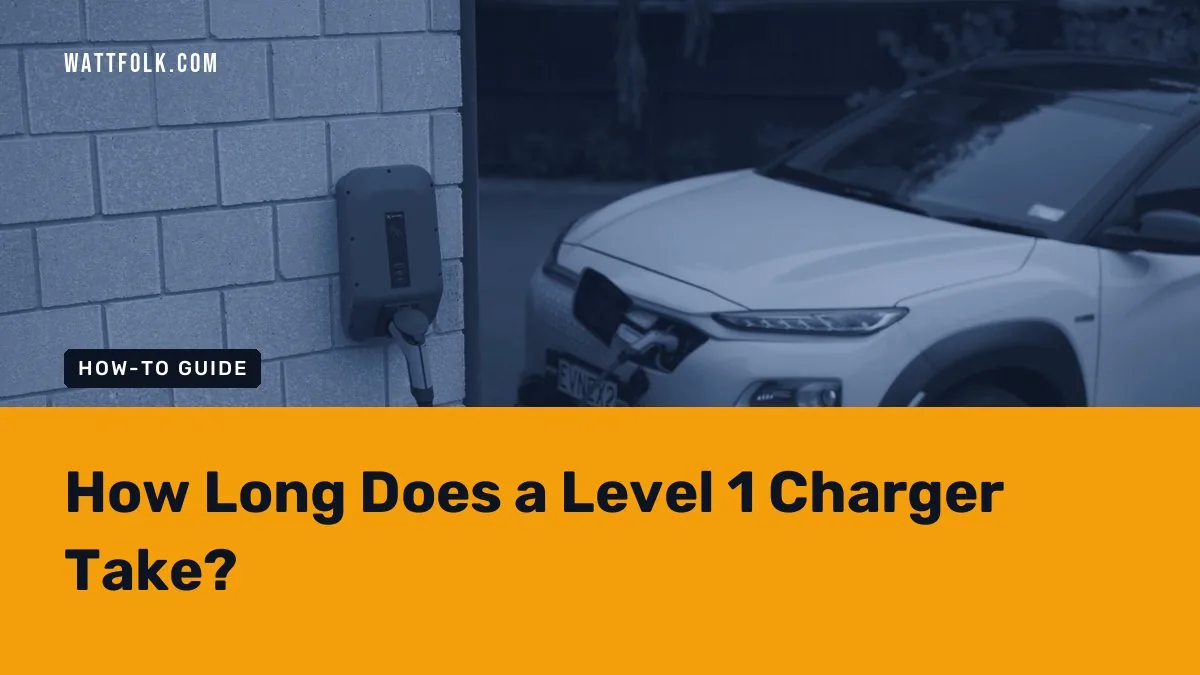
Installing a 240-volt Level 2 charger costs hundreds of dollars, while the basic 120-volt Level 1 cord that comes with your car plugs right into a normal wall outlet. A Level 1 charger adds roughly 3 to 5 miles of range per hour of charging. Fully charging a typical pure electric vehicle (60 to 80 kWh battery) from empty takes 40 to 60 hours, while a plug-in hybrid (PHEV) takes about 8 to 12 hours. The trade-off is clear: you save money on electrical work upfront, but you accept a very slow charging speed.
Quick answer
A standard Level 1 charger restores 3 to 5 miles of range for every hour it is plugged in. This speed works well for drivers who commute less than 40 miles a day and park at home overnight, but it is too slow for high-mileage drivers.
- Best for plug-in hybrids (PHEVs): Vehicles with small batteries that easily refill over a single night.
- Best for short commutes: Drivers who use less than 30 to 40 miles of range per day.
- Level 1 chargers run on standard 120-volt US household outlets.
- Most EVs gain 3 to 5 miles of driving range per hour of charging.
- Replacing a 40-mile daily commute takes 10 to 14 hours.
- Cold weather severely slows down Level 1 charging times.
- Never use an extension cord; plug directly into a dedicated wall outlet.
- How long does a level 1 charger take to charge a car from empty?
- How many miles of range per hour does a Level 1 charger add?
- Is a Level 1 charger enough for my daily commute?
- Why is Level 1 charging so slow compared to other stations?
- Does cold weather affect how long Level 1 charging takes?
- Should I upgrade to a Level 2 charger or stick with Level 1?
- What do owners say?
- Frequently Asked Questions
How long does a level 1 charger take to charge a car from empty?
Charging a pure electric vehicle from 0% to 100% on a Level 1 charger takes between 40 and 60 hours. For a plug-in hybrid electric vehicle (PHEV), a full charge takes just 8 to 12 hours. The exact time depends entirely on the size of the battery inside the vehicle.
Battery capacity is measured in kilowatt-hours (kWh). Think of it like the size of a gas tank. A plug-in hybrid like the Toyota Prius Prime has a small 13.6 kWh battery. A standard 120-volt wall outlet can fill that small “tank” overnight without any trouble. However, large electric trucks have massive batteries. Charging a large 131 kWh battery, like the one found in the Ford F-150 Lightning, from 0 to 100% on Level 1 takes over 3 days (90+ hours).
How many miles of range per hour does a Level 1 charger add?
Level 1 charging adds approximately 3 to 5 miles of driving range per hour for most EVs. This specific rate comes from the power limit of standard US household outlets. Level 1 charging operates on standard 120-volt AC household power.
A typical Level 1 charger delivers 1.4 kilowatts (kW) of power at its maximum continuous load. This is calculated by multiplying the standard 12 amps of current by 120 volts. Highly efficient sedans make the most of this 1.4 kW, turning it into 4 or 5 miles of range. Heavy, boxy electric trucks use more energy to move, so that same 1.4 kW only yields about 2 to 3 miles of range per hour.
Overnight (12-Hour) Level 1 Range Recovery Estimates:
| Vehicle Type | Battery Size | Miles Added in 12 Hours | Time to Full Charge (0-100%) |
|---|---|---|---|
| Tesla Model 3 (Efficient Sedan) | 60 kWh | ~50 miles | ~45 hours |
| Toyota Prius Prime (PHEV) | 13.6 kWh | Full battery (40+ miles) | ~10 hours |
| Chevy Bolt EV (Hatchback) | 65 kWh | ~45 miles | ~50 hours |
| Hyundai Ioniq 5 (SUV) | 77.4 kWh | ~40 miles | ~60 hours |
| Ford F-150 Lightning (Heavy Truck) | 131 kWh | ~30 miles | 90+ hours |

Is a Level 1 charger enough for my daily commute?
If you drive less than 40 miles a day, a Level 1 charger is usually enough. The biggest mistake new EV owners make is looking at the 40-to-60-hour full charge time and panicking. In reality, daily drivers rarely charge from 0 to 100%. This is known as the “Top-Off” reality.
Instead of driving the car until it dies, you plug it in when you get home. If you drive 30 miles to work and back, you only need to replace 30 miles of range. Replacing 40 miles of daily commuting range takes roughly 10 to 14 hours on a Level 1 charger.
The Commute vs. Charge Time Calculator
To see if Level 1 works for you, use this simple formula based on the 4 miles per hour average:
Daily Miles Driven ÷ 4 = Hours of Charging Needed.
If your daily commute is 32 miles, you divide 32 by 4. You need 8 hours of charging. If your car sits in the driveway for 12 hours every night, Level 1 easily covers your routine.
Running a 1.4 kW Level 1 charger for 10 hours uses 14 kilowatt-hours (kWh) of electricity. Based on the US Energy Information Administration’s national average of roughly 17 cents per kWh, this overnight top-off costs about $2.38. (Formula: 1.4 kW x 10 hours = 14 kWh. 14 kWh x $0.17 = $2.38). Rates vary by state, so confirm local pricing with your utility provider.
- If you drive under 40 miles a day AND park at home for 12+ hours: Yes, Level 1 is perfectly sufficient.
- If you drive over 50 miles a day: No, you will slowly lose battery percentage over the work week.
- If you own a heavy electric truck: No, the poor efficiency means you need Level 2 to recover decent range overnight.
Why is Level 1 charging so slow compared to other stations?
Level 1 charging is slow because standard wall outlets limit how much electricity can safely flow through the wires. A normal household circuit is 120 volts. Public stations and Level 2 home chargers use 240 volts, instantly doubling the potential power.
There is another common reason Level 1 seems abnormally slow: the amperage setting. Many EVs have internal menus that let you change the charging speed from 12 amps to 8 amps. Car manufacturers often set the default to 8 amps. They do this to prevent the charger from tripping an older garage circuit breaker. At 8 amps, the power drops from 1.4 kW to just 0.96 kW. This cuts your charging speed down to barely 2 miles of range per hour.
Does cold weather affect how long Level 1 charging takes?
Yes, winter weather severely impacts charging times. In freezing temperatures, a portion of the incoming Level 1 power goes toward warming the battery to a safe operating temperature. Because Level 1 only provides 1.4 kW of total power, diverting even 1 kW to the battery heater leaves almost nothing to actually charge the battery.
When the temperature drops below freezing, Level 1 charging speed can plummet to 1 mile of range per hour, or sometimes stop adding range entirely until the battery warms up. Drivers in cold northern states often find that Level 1 charging is insufficient during the winter months.
Should I upgrade to a Level 2 charger or stick with Level 1?
If your daily drive is short, stick with Level 1 and save your money. If you frequently drain the battery on long trips, or if you live in a cold climate, a Level 2 upgrade becomes necessary.
Safety is also a factor. Safety codes require plugging the EV supply equipment directly into a wall receptacle. We never suggest using extension cords for EV charging, as they can overheat and cause fires. If your nearest outlet is too far from the car, or if your Level 1 charger constantly trips the garage breaker because a fridge turns on at the same time, you need a licensed electrician. If you are paying an electrician to run a new dedicated circuit anyway, it makes sense to install a 240-volt line for Level 2 charging.
From the Shop
Based on what we see with new EV buyers, panic often drives bad purchases. Customers routinely rush to spend $1,500 on a panel upgrade and a hardwired Level 2 unit during their first week of ownership. A month later, they realize their 15-mile round-trip commute could have easily been covered by the free Level 1 cord sitting in their trunk. We always advise trying Level 1 for a full month before calling an electrician.
What do owners say?
Owners like
- No extra electrical installation or permitting costs required.
- Perfectly sufficient for work-from-home schedules or commutes under 30 miles.
- Can easily be packed in the trunk for emergency use at relatives’ houses.
Common complaints
- Too slow to recover enough range over a single night after a long weekend road trip.
- Cold weather in winter makes Level 1 charging almost useless for actually adding range.
- Often trips the garage breaker if another appliance (like a fridge or freezer) turns on.
Summarised from owner reviews and long-term user reports; individual experiences vary.
Frequently Asked Questions
How long does level 1 charger take to charge?
A Level 1 charger takes 40 to 60 hours to completely charge a standard electric vehicle from 0% to 100%. For plug-in hybrids with smaller batteries, a full charge takes 8 to 12 hours.
How long does level 1 charger take to add range for a normal commute?
To add 40 miles of driving range, a Level 1 charger takes about 10 to 14 hours. Most drivers plug their cars in overnight, easily recovering the distance they drove that day by the next morning.
How long does level 1 charging take in the winter?
In freezing temperatures, Level 1 charging takes much longer. The vehicle must use some of the low power supply to warm the battery block. This can cut the charging speed down to just 1 or 2 miles of range added per hour.