
Public DC fast charging stations typically charge between $0.25 and $0.60 per kilowatt-hour (kWh). Charging an EV at a public station typically costs between $10 and $30 for a full charge, depending on your battery size, local electricity rates, and the charger type. Fast charging costs more than charging at home, but it still beats the price of a standard tank of gas.
Quick answer
Expect to pay about $14 to $18 to fast-charge a typical EV from 20% to 80% on a road trip. Costs drop significantly if you use slower Level 2 chargers or sign up for network monthly memberships.
- Best for road trips: DC Fast Charging (adds 100+ miles fast, but costs the most)
- Best for daily errands: Level 2 Charging (cheaper per kWh, tops up the battery while you shop)
- Public DC fast chargers bill energy at a premium, usually between $0.25 and $0.60 per kWh.
- Charging a standard 60 kWh battery from 20% to 80% costs approximately $14.40 at typical public rates.
- Idle fees can reach up to $1.00 per minute if you leave your car plugged in after it finishes charging.
- Frequent drivers can save about 25% on per-kWh rates by joining network membership plans.
- How much does it cost to charge an EV at a public charging station?
- Do charging stations charge by the minute or by the kWh?
- What is the exact cost to charge an electric car at a charging station?
- Are there hidden fees, like idle fees or connection charges?
- How do you charge an electric vehicle at a charging station?
- Public Charging Costs vs. Home Charging Costs
- Do you have to pay to use EV charging stations or are some free?
- What do owners say?
- Frequently Asked Questions
How much does it cost to charge an EV at a public charging station?
Public EV charging costs depend heavily on the speed of the station you choose. Level 2 chargers deliver AC power slowly, adding about 20 to 30 miles of range per hour. These stations often cost $1 to $3 per hour, or they bill a low per-kWh rate similar to residential electricity.
DC Fast Chargers (DCFC) are entirely different. They supply high-voltage direct current straight to your vehicle’s battery. This hardware is expensive to install and draws massive amounts of peak power from the grid. To cover these costs, charging networks pass the expense onto the driver.
Tesla Supercharger rates fluctuate by location and time of day, but generally average between $0.25 and $0.50 per kWh. Other major networks like Electrify America, EVgo, and ChargePoint have their own pricing structures. If you charge publicly often, signing up for a network membership slashes these costs.
Cost Comparison of Major US Charging Networks
| Charging Network | Standard Guest Rate (Estimated) | Membership Rate (Estimated) | Monthly Fee |
|---|---|---|---|
| Electrify America | $0.48 per kWh | $0.36 per kWh | $4.00 / month |
| EVgo | $0.30 – $0.60 per kWh + Session fee | Discounted per kWh + No session fee | $0.99 – $12.99 / month |
| Tesla Supercharger | $0.25 – $0.50 per kWh | N/A (Standard for Tesla owners) | $0 (Tesla) / $12.99 (Non-Tesla) |
Note: Rates vary widely based on local utility costs and time-of-day pricing.
Do charging stations charge by the minute or by the kWh?
Most EV drivers prefer to pay by the kilowatt-hour. It makes sense. You pay for the exact amount of energy flowing into your battery. However, you will still find stations that bill by the minute.
Some states legally require non-utility charging stations to bill by the minute rather than by the kWh. This happens due to outdated electricity resale regulations. In these states, only a heavily regulated utility company is legally allowed to sell electricity by the unit. Charging networks get around this by selling you “time spent parked at the charger” instead of electricity.
Per-minute billing hurts drivers with slow-charging EVs. If your car can only accept 50 kW of power, but you are paying the same per-minute rate as a car pulling 250 kW, you are effectively paying five times more for the same amount of electricity.
What is the exact cost to charge an electric car at a charging station?
Let’s calculate a real-world scenario. You are driving a popular electric car like a Chevy Bolt or a standard range Tesla Model Y. Both have roughly a 60 kWh battery pack. You are on a road trip, you pull into a station at 20% state of charge (SOC), and you want to charge up to 80%.
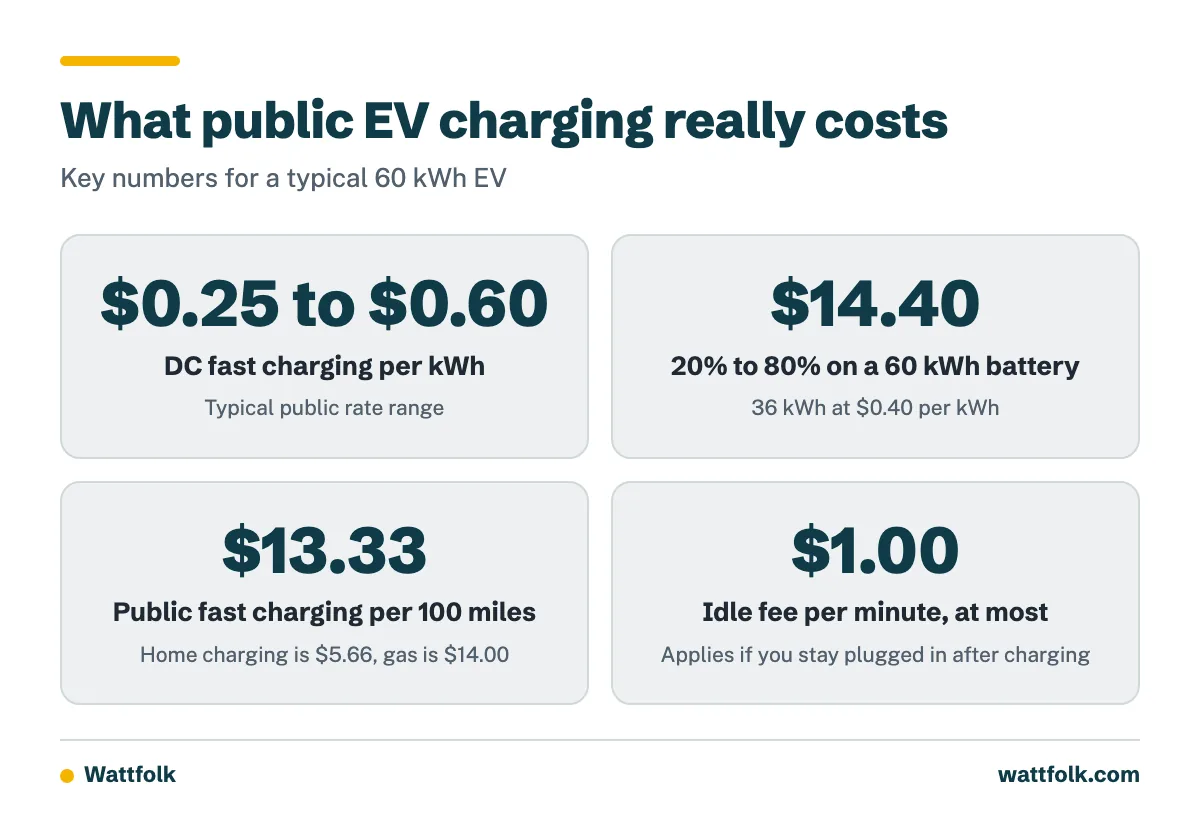
Charging a standard 60 kWh EV battery from 20% to 80% requires approximately 36 kWh of energy. If the public DC fast charger costs $0.40/kWh, the math is simple:
- 36 kWh × $0.40 = $14.40.
You pay $14.40 to add about 140 to 160 miles of highway driving range. Charging past 80% slows down dramatically to protect the battery, which is why veteran EV drivers unplug at 80% and hit the road.
- If you need 150 miles in 20 minutes: Use a DC Fast Charger (Pay premium rates, $0.40+ per kWh).
- If you are parking for 4 hours at a mall: Use a Level 2 Charger (Pay low rates, often $1-$2 per hour).
- If you are staying overnight at a hotel: Look for a free Level 2 destination charger in the parking lot.
Are there hidden fees, like idle fees or connection charges?
Your charging cost is not always just the price of the electricity. Charging networks impose extra fees to keep stations functional and available for other drivers. The most common surprise charge is the session fee. Some networks charge $1.00 or $2.00 just to initiate the session, regardless of how much electricity you buy.
Then there are idle fees. These apply when your car finishes charging, but you do not move it. Idle fees at public charging stations can range from $0.40 to $1.00 per minute if a vehicle remains plugged in after reaching a 100% charge (or your preset limit).
From the Shop
We constantly hear from new EV owners who get burned by idle fees on their first road trip. One driver plugged into a 350 kW fast charger and went inside a sit-down restaurant. The car finished charging in 25 minutes. The driver took an hour to eat. Because they ignored the notifications on their phone, they returned to a $15 charging bill attached to a $35 idle fee penalty. Always move your car the moment it finishes charging.
How do you charge an electric vehicle at a charging station?
Pulling up to a public station for the first time feels confusing. Unlike gas stations, EV chargers require you to verify payment before the electricity flows.
Here is a quick-start checklist for your first public charge:
- Check the connector: Make sure the station has the right plug for your car (CCS, CHAdeMO, or NACS).
- Initiate payment: Open the specific network’s app on your phone, or tap your credit card on the RFID reader on the terminal.
- Plug it in: Push the heavy cable into your car’s charge port until it clicks firmly into place.
- Wait for communication: The charger screen will say “Connecting” or “Initiating.” The station and your car are talking to verify safety protocols.
- Listen for the click: You will hear a loud clunk from the station. That is the contactor closing. The electricity is now flowing.
Public Charging Costs vs. Home Charging Costs
Public charging is expensive. Home charging is cheap. In the United States, electricity prices average roughly 17 cents per kWh, depending on your state (ranging from about 12 cents in parts of the Midwest to 40 cents or more in Hawaii and California).
When you charge at home, you pay your standard residential utility rate. When you charge publicly, you pay the network’s markup. Here is how that translates to driving costs, assuming a vehicle efficiency of 3 miles per kWh and gas at $3.50 per gallon for a 25 MPG car.
| Fuel Source | Assumed Rate | Cost per 100 Miles |
|---|---|---|
| Home EV Charging | $0.17 per kWh | $5.66 |
| Public Fast Charging | $0.40 per kWh | $13.33 |
| Gasoline Car | $3.50 per gallon | $14.00 |

Do you have to pay to use EV charging stations or are some free?
You generally have to pay for DC fast charging. Some automakers include promotions with a new car purchase,like two years of free 30-minute sessions at Electrify America,but once that expires, you pay full price.
Free charging does exist, but mostly for Level 2 chargers. Many grocery stores, municipal parking garages, and hotels offer complimentary Level 2 charging to attract customers. Networks like Volta feature large advertising screens on their chargers; the ad revenue subsidizes the electricity, allowing you to top up for free while you buy groceries.
What do owners say?
Owners like
- Plug-and-charge technology (where the car communicates billing info directly to the charger) makes the process incredibly seamless.
- Network apps that show real-time availability save drivers from pulling up to full stations.
- Fast chargers located near amenities like grocery stores, coffee shops, or clean restrooms are highly valued.
Common complaints
- App fatigue: having to download, register, and add a credit card to a different app for every single charging network.
- Broken or unresponsive touch screens and credit card readers at the terminal.
- Confusing pricing tiers where stations throttle charging speeds but still charge premium rates.
- Unexpectedly high idle fees when drivers are delayed in returning to their fully charged car.
Summarised from owner reviews and long-term user reports; individual experiences vary.
Frequently Asked Questions
how much is it to charge ev at charging station?
It typically costs between $10 and $30 to fully charge an EV at a public station. The total depends on the size of your vehicle’s battery, the current state of charge, and the station’s per-kWh or per-minute rates. Fast charging a standard 60 kWh battery from 20% to 80% usually costs around $14 to $18.
how to charge electric vehicle at charging station?
To charge at a public station, park near the terminal and select the correct connector for your car. Initiate the session by tapping a credit card on the reader or activating the specific network’s app on your smartphone. Once authorized, plug the cable into your car’s charge port and listen for it to lock in. The station will communicate with your car and begin delivering power.
do you have to pay to use ev charging stations?
Yes, you must pay for most public DC fast chargers. However, you can often find free Level 2 charging stations at hotels, shopping malls, and public municipal lots. These locations cover the cost of the electricity to attract visitors.
how much does it cost to have a ev charging station?
If you want to install an EV charging station at your home, a quality Level 2 hardwired charger costs between $400 and $700. Hiring a licensed electrician to run a dedicated 240-volt circuit to your garage typically adds another $500 to $1,500, depending on the distance from your main electrical panel.