Your electric bill is likely high due to a recent utility rate increase, extreme weather causing your HVAC system to work harder, or a malfunctioning major appliance like a water heater or refrigerator. Other common culprits include phantom energy drains from plugged-in electronics, poor home insulation, or a sudden shift to Time-of-Use (TOU) billing by your utility provider. Let us look at exactly what drives these utility costs up and how you can stop the drain on your wallet.
Quick answer
To fix a high power bill, first check your statement for rate hikes, estimated readings, or a shift to Time-of-Use pricing. If your rate and weather are unchanged, test your breaker panel to find hidden energy drains from failing 240V appliances like a water heater.
- Best for tracking power: A smart home energy monitor (like Sense or Emporia) to pinpoint failing devices.
- Best for rate shock: Budget billing plans to smooth out seasonal spikes.
- Heating and cooling systems account for roughly 47% to 50% of the average home’s energy use.
- A faulty well pump or failing water heater element can add over $100 to a monthly bill without obvious signs.
- Switching to Time-of-Use (TOU) billing can increase peak-hour electricity costs by 20% to 50%.
- Phantom loads, or vampire energy, can consume up to 10% of a household’s monthly electricity usage.
- Why is my electric bill so high all of a sudden 2026?
- What is making my electric bill so high this month?
- How is my energy bill so high when I haven’t changed my daily habits?
- Could a faulty meter or estimated reading cause a high electric bill?
- What appliances use the most electricity in a home?
- How can I test what is running up my power bill?
- What do owners say?
- Frequently Asked Questions
Why is my electric bill so high all of a sudden 2026?
As of October 2026, many utility providers across the US are restructuring how they charge for electricity. Even if you use the exact same amount of power as last year, your bill can spike rapidly. To understand this, you need to read your utility bill carefully. Most bills are split into two main sections: supply charges and delivery charges.
The supply charge covers the actual cost of generating the electricity. The delivery charge pays for maintaining the local grid, poles, and wires. Lately, utility companies have raised delivery charges heavily to pay for grid upgrades. So, even if the raw cost of electricity drops, your total bill goes up. Your utility may have also moved you to a new billing tier automatically without a clear warning.
What is making my electric bill so high this month?
Your bill depends on how many kilowatt-hours (kWh) your home consumes. The national average electricity rate in the US sits near 17 cents per kWh, according to the U.S. Energy Information Administration. Depending on your state, you might pay anywhere from 12 cents to over 40 cents per kWh. A sudden spike this month usually points to a change in the weather.
Extreme summer heat or unexpected winter freezes force your HVAC system to run continuously. Because climate control takes up half of your energy budget, a hotter-than-average month directly causes a higher bill. Below is a breakdown of how a typical monthly energy budget looks for a home using 1,000 kWh.
| Appliance Category | Typical Share of Total Bill | Monthly Usage (1,000 kWh total) | Cost at $0.17 / kWh |
|---|---|---|---|
| Heating & Cooling (HVAC) | 47% – 50% | 500 kWh | $85.00 |
| Water Heating | 18% | 180 kWh | $30.60 |
| Phantom Loads / Vampire Energy | 10% | 100 kWh | $17.00 |
| Lighting & General Electronics | 22% | 220 kWh | $37.40 |
How is my energy bill so high when I haven’t changed my daily habits?
If you turn your lights off, set your thermostat correctly, and use your appliances normally, a high bill is frustrating. The most common cause here is Time-of-Use (TOU) billing. Many US utility companies are replacing standard flat-rate plans with TOU plans. On a TOU plan, the cost of electricity changes based on the time of day.
During off-peak hours (like late at night or mid-morning), power is cheap. During peak hours (typically 4:00 PM to 9:00 PM), power is very expensive. If you run your dishwasher, dryer, and air conditioner after work, you get hit with the highest rates of the day.
Worked Example: Flat Rate vs. TOU Rate
Let us calculate how TOU affects a home using 1,200 kWh in a summer month.
Under a flat rate plan:
1,200 kWh x $0.17 = $204.00
Under a typical TOU plan:
Assume you use 700 kWh off-peak (at $0.12) and 500 kWh on-peak (at $0.34).
Off-peak: 700 x $0.12 = $84.00
On-peak: 500 x $0.34 = $170.00
Total TOU Bill = $254.00
Simply by using power in the evening, the same energy habits cost $50 more.

Could a faulty meter or estimated reading cause a high electric bill?
Meters rarely break in a way that makes them spin too fast. However, utility billing errors happen frequently. The most common billing issue is an estimated reading. Sometimes, the utility company cannot read your smart meter due to a signal failure, or the meter reader skips your property. When this happens, they estimate your usage based on the same month from the previous year.
Months later, when they finally read the real numbers, they send a “true-up” bill. If you used more power than they estimated over the last six months, they charge you for all that missing usage on a single month’s bill.
From the Shop
Homeowners often call out an electrician for a suspected electrical leak. Recently, a customer noticed their bill doubled in one month and thought a wire was shorting out. We checked every circuit in the main panel. Everything drew normal power. The real issue? Their utility company replaced a broken communication module on their smart meter. The company had been estimating their usage all winter and sent one massive true-up bill to cover the difference.
What appliances use the most electricity in a home?
Heating and cooling account for roughly 47% to 50% of the average home’s energy use. But when your HVAC is running fine, you need to look for hidden appliance failures. Water heating is the second largest energy expense, typically accounting for about 18% of a residential utility bill. If a water heater element deteriorates from hard water sediment, the unit has to work twice as hard. It runs constantly, spinning your meter without giving you hotter water.
Another major hidden cost is a faulty well pump. A continuously running toilet leak causes your home’s water pressure to drop. This forces the well pump to run non-stop to rebuild pressure. A running well pump can easily add over $100 to a monthly electric bill.
Old appliances also hurt your budget. Refrigerators older than 15 years can use up to twice as much energy as modern Energy Star certified models. Finally, do not ignore vampire energy. Phantom loads from electronics plugged into the wall but turned off (like TVs on standby, cable boxes, and smart speakers) can account for up to 10% of a household’s monthly electricity usage.
How can I test what is running up my power bill?
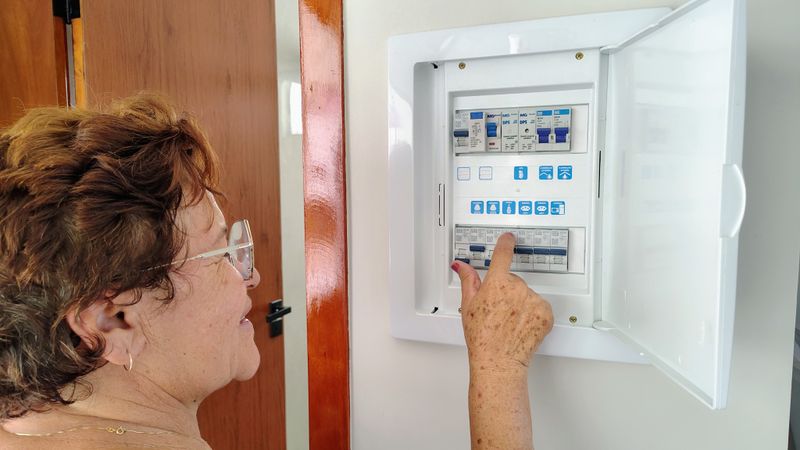
You can conduct a simple DIY home energy audit using your main breaker panel. By turning off circuits one by one, you can isolate exactly which appliance is draining power.
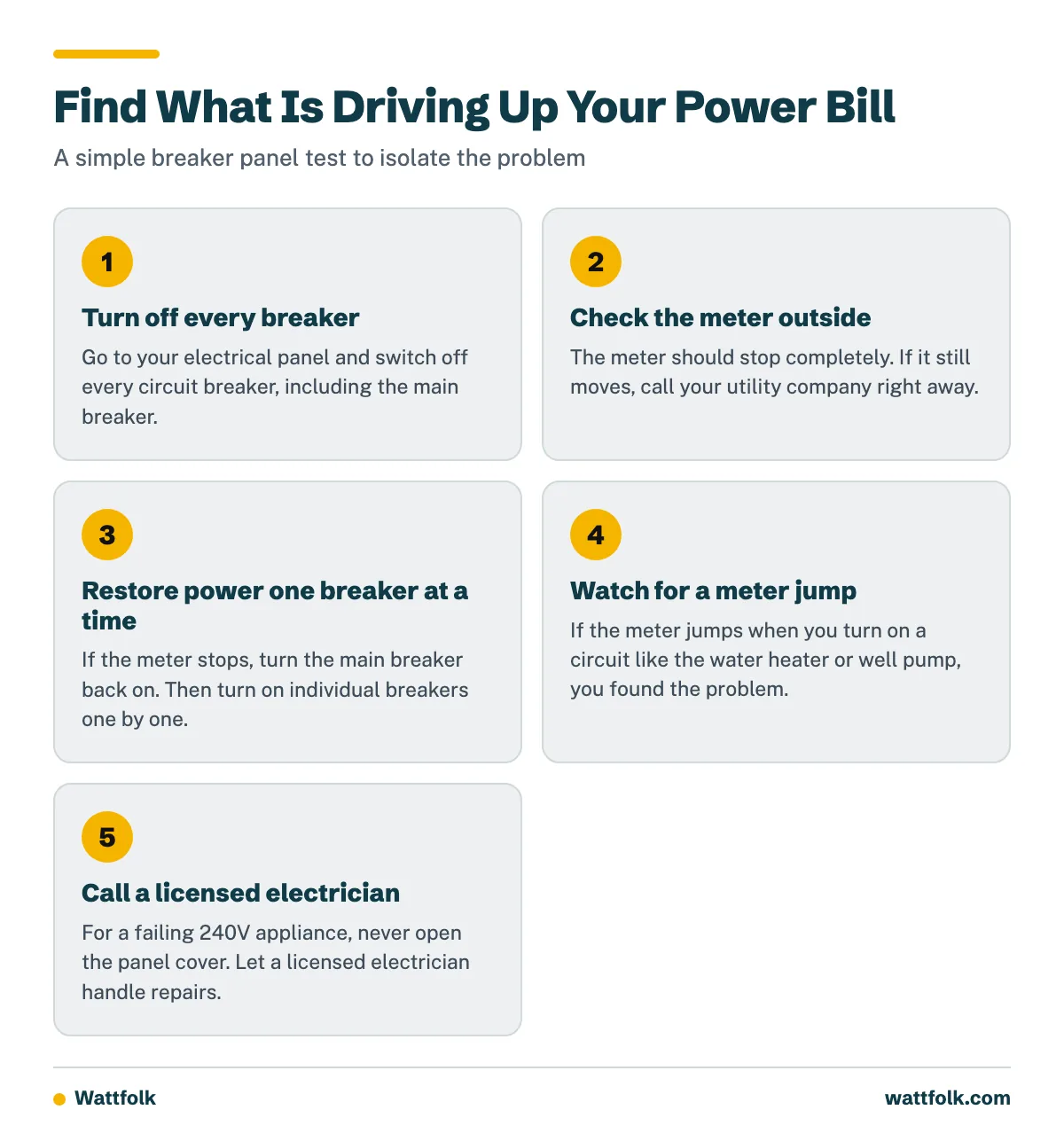
- Step 1: Go to your electrical panel and turn off every circuit breaker, including the main breaker.
- Step 2: Check your electric meter outside. The digital screen or dial should stop completely. If it is still moving, call your utility company immediately; power is draining before your panel.
- Step 3: If the meter stops, turn the main breaker back on. Then, turn on individual breakers one at a time.
- Step 4: Watch the meter as you flip each breaker. If the meter jumps significantly when you turn on a specific circuit (like the water heater or well pump), you have found your problem.
Safety reminder: Never remove the metal cover of your panel to expose live wires. If you find a failing 240V appliance, always call a licensed electrician to handle the repairs.
What do owners say?
Owners like
- Using a smart home energy monitor (like Sense or Emporia) helped pinpoint exactly which appliance was failing.
- Switching to budget billing or levelized billing helped smooth out unpredictable winter and summer spikes.
- Upgrading to a smart thermostat provided data reports that clearly showed when the AC was overworking.
Common complaints
- Utility companies are often unhelpful and default to blaming the customer when calling to dispute a sudden spike.
- Smart meters sometimes report estimated data rather than actuals for months, leading to massive, unexpected true-up bills.
- Time-of-use rate changes were not communicated clearly by the utility, doubling summer afternoon costs without warning.
Summarised from owner reviews and long-term user reports; individual experiences vary.
Frequently Asked Questions
how is my electric bill so high?
Your electric bill is high because your total cost is a product of your usage multiplied by your rate. Extreme weather forces your HVAC system to use more power, and rising supply or delivery rates make each kilowatt-hour more expensive.
how is my energy bill so high?
Hidden energy drains often raise energy bills silently. Failing water heater elements, constantly running well pumps, and vampire energy from electronics left plugged in all consume heavy amounts of power.
how is my power bill so high?
Your power bill usually peaks during the coldest and hottest months. Heating and cooling make up 50% of the average home’s consumption. Poor insulation forces your climate control to run continuously to maintain the set temperature.
what is my electric bill so high?
If you see a sudden increase, the charges themselves may have changed. Review your bill for split costs between supply and delivery. Utilities frequently raise delivery charges to cover grid maintenance, causing higher totals.
what is making my electric bill so high?
Old appliances are a major factor. Refrigerators over 15 years old can use double the electricity of modern Energy Star models. Additionally, check for running toilets that trigger well pumps to cycle constantly.
why is my electric bill so high this month?
A single-month spike is often the result of an estimated reading true-up. If your utility company estimated your power usage for previous months, they will add all unbilled usage to your current month’s statement once they get an actual reading.
why is my electric bill so high?
Beyond usage, rate structures matter. If your utility company moved you to a Time-of-Use plan, running heavy appliances like dryers or air conditioners between 4:00 PM and 9:00 PM will cause your bill to soar.
why is my electric bill so high all of a sudden 2026?
Throughout 2026, many utility companies transitioned customers to mandatory Time-of-Use pricing and increased their grid delivery fees. This means your bill can suddenly increase even if you have not changed a single daily habit.
why does my electric bill so high?
When you feel your bill sits too high and you suspect an error, you must verify it. Check your meter to ensure it matches the reading on your statement. If the numbers are wrong, call your utility provider to dispute the overcharge and request a manual meter check.