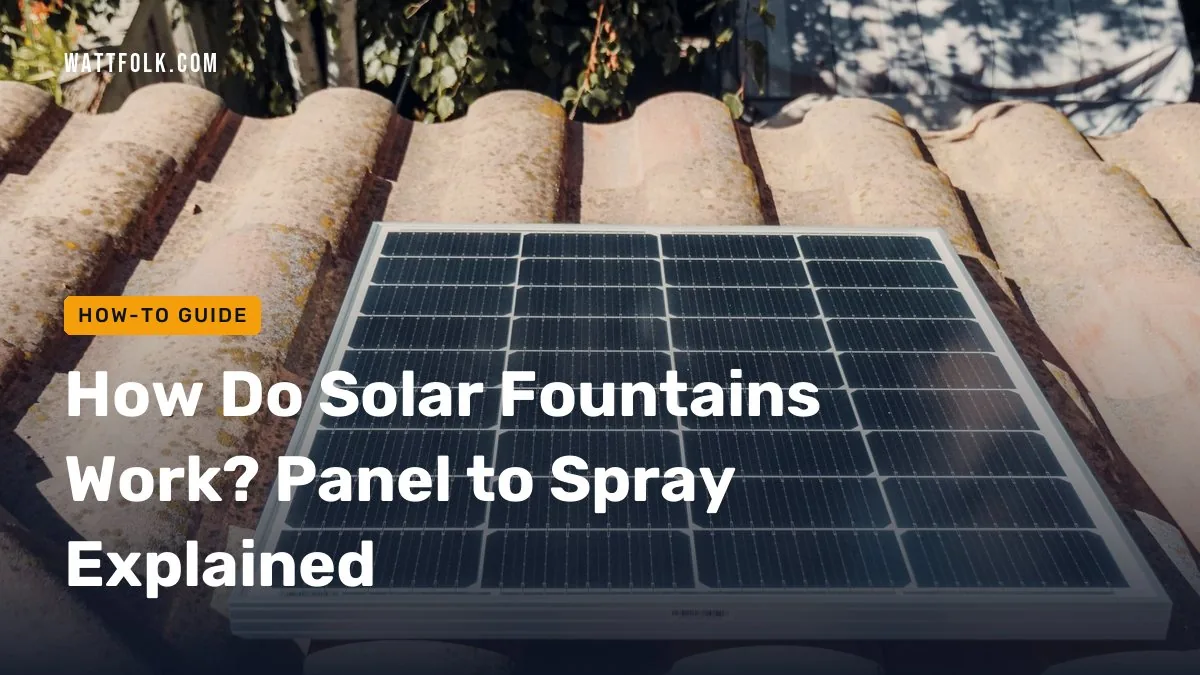
A solar fountain uses a small photovoltaic panel to turn sunlight into DC electricity, and that power runs a submersible pump that pushes water through a nozzle. Most basic models have no battery, so the spray rises and falls with the sun and stops in darkness. This guide explains each step and shows how to tell if one will work in your bird bath or pond.
Quick answer
Sunlight hits a panel, the panel makes DC power, and a small pump uses it to push water out of a nozzle. Without a battery, spray strength follows the light. Clouds mean a weak trickle, and night means nothing.
- Best for bird baths: a 1-3 W direct-drive unit in full sun
- Best for small ponds: a 5 W+ panel, ideally with a battery
- Best for night or shade: a mains-powered fountain
- Direct-drive pumps speed up and slow down with light, so clouds give a weak spray, not an on/off result.
- Advertised spray height assumes strong direct sun.
- Battery models help with clouds and evenings, but runtime is short.
- Most failures come from a clogged pump or nozzle, a dirty panel, shade or low water.
- Never let the pump run dry, especially in a shallow bird bath.
- How do solar fountains work, step by step?
- Direct-drive vs battery-backed
- How well do solar fountains work?
- Night, shade and cloudy days
- How does a solar fountain work in a bird bath?
- What size panel and pump do I need?
- Why do solar fountains stop working?
- Maintenance
- What do owners say?
- Frequently Asked Questions
How Do Solar Fountains Work, Step by Step?
A solar fountain moves power from a panel to a pump in five simple steps. There is no wiring to your house and no electric bill.
- Sunlight hits the panel. The panel holds photovoltaic cells, usually monocrystalline or polycrystalline silicon. Consumer fountain panels are typically rated about 1-10 W.
- The cells make DC power. Light knocks electrons loose in the silicon, which creates a direct current.
- A cable carries it to the pump. The cable is short, so panel placement is limited by cable length.
- The pump spins. Most solar fountain pumps are low-voltage DC brushless pumps. They last longer than brushed motors because no carbon brushes wear out.
- Water leaves the nozzle. The pump pulls water in through a small intake, sends it up tubing and forces it through a nozzle. The nozzle shape sets the spray pattern.
Some kits add a small rechargeable battery and a controller. The controller decides whether power goes to the pump, the battery or both.
What Is the Difference Between Direct-Drive and Battery-Backed Solar Fountains?
A direct-drive fountain sends panel power straight to the pump. A battery-backed one stores some power first. That one choice changes how the fountain behaves all day.
Direct-drive pumps scale with light. More sun means more power, so the spray climbs higher around midday. Thin light means a lower, weaker spray. Many pages say a fountain “needs sunlight,” but the truth is a sliding scale.
| Feature | Direct-drive | Battery-backed | Mains-powered |
|---|---|---|---|
| Night use | No | Short, limited by battery size | Yes |
| Shade tolerance | Poor | Fair | Excellent |
| Cost | Lowest | Middle | Pump is cheap, but outdoor power may need an electrician |
| Spray consistency | Varies with light | More even | Steady |
| Best use | Sunny bird bath | Pond with patchy sun | Shady or all-day features |
How Well Do Solar Fountains Work Compared With Mains Fountains?
They work well in full sun for small features and poorly anywhere else. A mains pump gives the same spray every hour of the day. A solar unit does not.
Panel output depends on irradiance. Full sun is about 1,000 W/m² under standard test conditions, while overcast skies can cut output to roughly 10-25% of that. Pump output follows panel power, so advertised spray heights assume strong direct sunlight. Expect less than the box says on most days.
Solar wins on setup. There is no trenching, no outdoor outlet and no extension cord. Use one only where it is safe and legal, and call a licensed electrician if you want a mains fountain in a spot with no outdoor outlet.
Do Solar Fountains Work at Night, in the Shade or on Cloudy Days?
At night: No. A direct-drive unit stops in darkness. A battery model may run briefly after dusk, then stops when the battery is empty.
In the shade: Barely. Dappled light from trees often gives a pulsing or very weak spray. Shade on even part of the panel can cut output sharply.
On cloudy days: Yes, but weakly. With roughly 10-25% of full-sun output, a direct-drive pump may only trickle or not start at all. Morning and evening light also gives a gentle spray.
How Does a Solar Fountain Work in a Bird Bath?
It works the same way, just smaller. A 1-3 W panel sits in the sun and a floating or submersible pump sits in the bowl. Small bird bath fountains commonly use panels around 1-3 W.
- Water depth: Keep the pump intake fully covered. Running a pump dry can damage it. Evaporation is fast in sunny weather, so check the level daily in summer.
- Floating vs submersible: Floating units rise and fall with the water and have the panel on top. Submersible pumps sit on the bottom and use a separate panel, which you can place in better sun.
- Nozzle choice: Pick a low bubbler or soft fountain nozzle. A tall jet blows water out of a small bowl and empties it.
- Panel placement: Aim it at the sun, away from tree shade.

What Size Panel and Pump Do I Need?
Match the panel to the pump. A pump that needs more power than the panel makes will stall or pulse. A bigger panel than needed just gives a stronger spray in good light.
Here is a worked example. These are rough planning figures, not measured results. Assume full sun, about 5 peak sun hours a day (a common figure across much of the US), and 25% system losses from heat, dust and the angle of the panel.
| Setup | Panel | Daily energy (panel W × 5 hrs × 0.75) | Expected behavior |
|---|---|---|---|
| Bird bath | 3 W | about 11 Wh | Gentle bubbler or low arc in midday sun |
| Small pond | 5 W+ | about 19 Wh or more | Taller spray or small waterfall, stronger in full sun |
Pump power draws only while the sun is up. Without a battery, you get the fountain only during bright hours. To redo the math, multiply panel watts by your local peak sun hours and by 0.75.
If your bowl is shallow and under about 2 feet wide, then choose a 1-3 W panel.
If you have a small pond with a bigger spray, then choose 5 W or more, and consider a battery.
If your best spot gets under 4 hours of direct sun, then consider a mains fountain instead.
Do solar fountains need direct sunlight, and how many hours?
Yes. Aim for at least 4-6 hours of direct sun. Use this placement checklist:
- Check sun hours at the planned spot in the morning, noon and late afternoon.
- Tilt the panel toward the sun, usually south in the US.
- Check the cable reaches without stretching.
- Look for shadows from fences, eaves and trees at different times of day.
Why Do Solar Fountains Stop Working or Spray Weakly?
Check the causes in this order, from most to least likely. Each test takes about two minutes.
| Order | Cause | Quick test |
|---|---|---|
| 1 | Clogged pump or nozzle | Lift the pump out, remove debris and rinse the filter and nozzle. Try again. |
| 2 | Dirty panel | Wipe with a damp cloth and compare spray. |
| 3 | Shade | Move the panel into full sun for a few minutes and watch the pump. |
| 4 | Low water | Top up so the intake is fully covered. |
| 5 | Loose connector | Unplug and firmly reconnect the pump cable. Check for corrosion. |
| 6 | Worn pump | If all else is fine in bright sun, the pump may be at end of life. |
From the Shop
Based on patterns in owner reports, the most common “dead” fountain is a pump choked with algae or grit, not a broken panel. Clean the pump first before you buy anything.
A cheap pump is often the part that fails after a season or two. Many kits sell a replacement pump separately, so check before you buy.
How Do I Keep a Solar Fountain Running?
- Panel: Wipe off dust, pollen and bird droppings every few weeks.
- Pump filter: Rinse it often. Algae and mineral build-up slow the flow.
- Water: Change bird bath water often and scrub the bowl.
- Mineral scale: Soak parts in diluted white vinegar, then rinse well.
- Winter: In areas with freezing weather, drain the pump, dry it and store it indoors so ice does not crack it.

What do owners say?
Owners like
- No wiring or running costs, and easy to set up anywhere
- Moving water attracts birds to bird baths
- Quiet operation
- Cheap and simple to try out
Common complaints
- Weak or intermittent spray in shade, cloud or morning and evening light
- Pump clogs with algae, debris or mineral build-up and needs frequent cleaning
- Stops working after a season or two, often the cheap pump
- Spray too forceful or blows water out of small bird baths
- Battery-backed units run only briefly and batteries degrade
Summarised from owner reviews and long-term user reports; individual experiences vary.
Frequently Asked Questions
How do solar fountains work?
A photovoltaic panel turns sunlight into DC power. That power runs a small submersible pump, which pushes water through a nozzle to make the spray.
How well do solar fountains work?
They work well in full, direct sun for bird baths and small ponds. In shade or cloud, spray gets weak, and stated spray heights assume ideal light.
How do solar water fountains work?
The steps are the same: panel, cable, pump, tubing, nozzle. Larger pond kits use higher-wattage panels and sometimes a battery to even out the flow.
Do solar fountains work at night?
Direct-drive models do not. Battery-backed models may run for a short time, limited by battery capacity.
Do solar fountains work in the shade?
Poorly. The panel needs direct light, so the best fix is to place the panel in sun, with a long enough cable to reach the water.
Why do solar fountains stop working?
Usually a clogged pump or nozzle, a dirty panel, shade, low water or a loose connector. An old, cheap pump is the next suspect.
How does a solar fountain work in a bird bath?
A small 1-3 W panel powers a floating or submersible pump in the bowl. Keep the intake covered with water, use a gentle nozzle and top up often to cover evaporation.