
MPPT controllers cost more than PWM ones, but for LiFePO4 they are usually the better buy. Either way, the setup follows one chain: solar panel, then charge controller, then a LiFePO4 battery with a BMS. The controller must use a lithium profile or settings from the battery maker, and you must never charge the cells below the battery’s approved cold limit. This guide covers wiring order, settings, panel sizing, cold weather, and fixes for common problems.
Quick answer
Wire the battery to a solar charge controller first, then connect the panels. Set the controller to a lithium profile or to the battery maker’s voltages. Use an MPPT controller in most systems. Do not charge when the battery cells are below freezing unless the maker approves it.
- Best for most systems: MPPT, for higher efficiency and flexible panel wiring
- Best for tiny setups: PWM, only if panel and battery voltages match
- Follow the battery manual first. Voltage numbers online vary, and the maker’s limits win.
- Connect the battery to the controller before the panels, with a fuse on the battery side.
- Check that the panels’ cold open-circuit voltage stays under the controller’s maximum PV voltage.
- Turn equalization off. Use a low float voltage or disable float, as the manual says.
- Size panels from the energy you need, your peak sun hours, and about 25% system losses.
- Battery temperature matters, not air temperature. Do not charge cells below 32°F (0°C) without approval.
- How Does a Solar LiFePO4 Charging System Work?
- Do I Need an MPPT Controller for a Lithium Solar Battery?
- Can I Use a Lead-Acid Solar Charge Controller With LiFePO4?
- How Do I Charge a LiFePO4 Battery With a Solar Panel?
- What Voltage Should I Set for a 12V LiFePO4 Battery?
- Should Equalization Be Disabled for LiFePO4 Batteries?
- How Many Watts of Solar Panels Do I Need?
- Can LiFePO4 Batteries Be Charged in Cold Weather?
- How Do I Know When the Battery Is Full?
- Pre-Installation Checklist
- Troubleshooting Low Charge and BMS Disconnects
- Frequently Asked Questions
How Does a Solar LiFePO4 Charging System Work?
The panels make DC power. The charge controller turns that power into the right voltage and current for the battery. The BMS (battery management system) inside or beside the battery guards the cells.
LiFePO4 batteries use constant-current/constant-voltage charging. The controller first pushes in as much current as the panels and settings allow. When the battery reaches the target voltage, the controller holds that voltage and the current tapers off.
Cell count sets the voltage. A common 12V LiFePO4 battery has four cells in series and a nominal voltage near 12.8V. The 24V and 48V versions usually use eight and sixteen cells.
Do I Need an MPPT Controller for a Lithium Solar Battery?
You do not strictly need one, but MPPT is the better choice for most systems. An MPPT controller converts extra panel voltage into extra charging current. A PWM controller simply pulls the panel voltage down to the battery voltage and wastes the difference.
That matters because panels often run well above battery voltage. MPPT also lets you wire panels in series, which means thinner wire and less voltage drop. It does better in cold weather and weak light too.
| Feature | MPPT | PWM |
|---|---|---|
| Panel voltage | Can be much higher than battery voltage | Should match battery voltage |
| Efficiency | Higher, especially in cold or low light | Lower when panel voltage is high |
| Cost | Higher | Lower |
| Best use | Most RV, boat, cabin, and backup systems | Very small systems with matched panels |
What solar charge controller is best for a LiFePO4 battery?
Pick an MPPT controller with a built-in lithium or LiFePO4 profile, or one with fully adjustable voltages. Then check three numbers: maximum PV voltage, maximum charge current, and battery system voltage. Controller names often hint at the first two. A Victron SmartSolar MPPT 100/30, for example, is built for up to 100V of PV input and 30A of output. Read the datasheet for the exact limits.
Can I Use a Lead-Acid Solar Charge Controller With LiFePO4?
Only if you can set every voltage by hand. Many basic controllers offer fixed gel, AGM, and flooded presets. Those presets may use higher absorption voltages, long timers, and equalization. None of that suits lithium.
If the controller has a user-defined mode, you can enter the battery maker’s values and turn equalization off. If it does not, replace it. A controller with a lithium profile removes most guesswork.
How Do I Charge a LiFePO4 Battery With a Solar Panel?
Connect the battery to the controller first, then the panels. Use fuses or breakers on both sides of the controller. Follow this order:
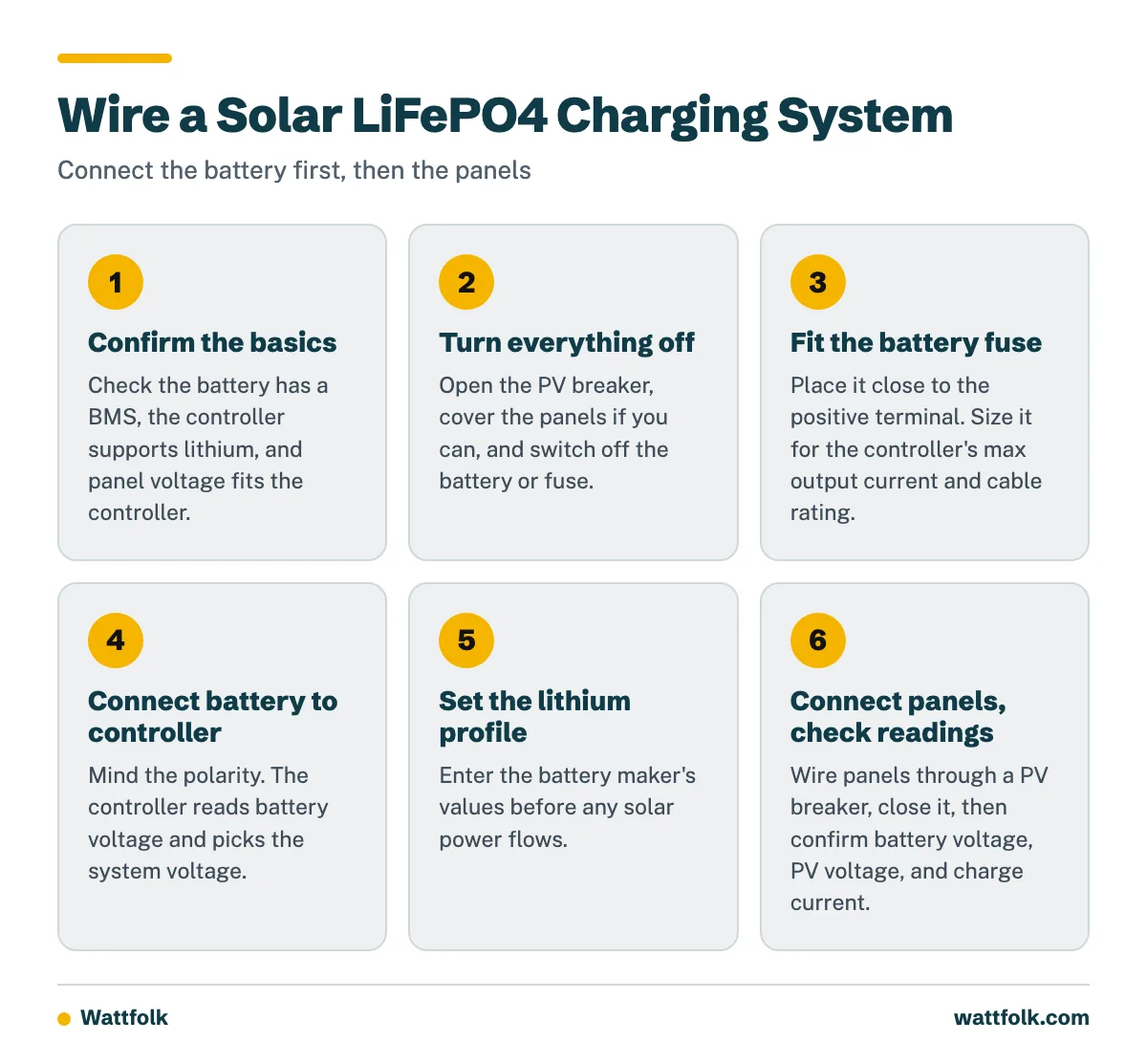
- Confirm the basics. Check that the battery has a BMS, the controller supports lithium, and the panels’ voltage fits the controller.
- Turn everything off. Open the PV breaker and cover the panels if you can. Switch off the battery or fuse.
- Fit the battery fuse. Place it close to the positive terminal. Size it for the controller’s maximum output current and the cable rating.
- Connect the battery to the controller. Mind the polarity. The controller reads the battery voltage and picks the system voltage.
- Set the lithium profile. Enter the battery maker’s values before any solar power flows.
- Connect the PV side. Wire the panels through a PV breaker or disconnect, then close it.
- Check readings. Confirm battery voltage, PV voltage, and charge current on the controller display.
Use proper wire, lugs, and a crimp tool. Size the cable for the current and the run length, using the controller manual’s wire table. Short, thick cable cuts voltage drop. Never use extension cords. Never bypass the grid shut-off on a microinverter. If any part touches household wiring, hire a licensed electrician.
What Voltage Should I Set for a 12V LiFePO4 Battery?
Use the voltage in your battery’s manual. Many web pages give 14.6V as the target. That number is the ceiling, since individual cells are commonly specified up to about 3.65V. The battery maker’s limit takes precedence, and many makers recommend less.
Victron’s lithium profile in its MPPT manuals, for example, lists 14.2V absorption and 13.2V float for a 12V system. Compare that with your battery’s own numbers.
| System | Cells | Nominal | Cell ceiling at 3.65V | Victron lithium absorption | Victron lithium float |
|---|---|---|---|---|---|
| 12V | 4 | 12.8V | 14.6V | 14.2V | 13.2V |
| 24V | 8 | 25.6V | 29.2V | 28.4V | 26.4V |
| 48V | 16 | 51.2V | 58.4V | 56.8V | 52.8V |
Warning: Do not copy this table blindly. Battery makers differ. Use it to sanity-check your settings, and let the manual decide. See the Victron SmartSolar MPPT manual for its lithium operation and settings.
Also set the maximum charge current. A 100Ah battery charged at 0.2C to 0.5C takes roughly 20A to 50A. The battery’s stated maximum charge current must control your design, per guidance like the LiFePO4 charging guide from AS Power.
Should Equalization Be Disabled for LiFePO4 Batteries?
Yes, turn it off. Equalization is a lead-acid routine that raises voltage on purpose to balance cells and stir the electrolyte. LiFePO4 does not need it, and the extra voltage can trip the BMS or stress the cells. Victron specifies equalization as disabled in its lithium profile.
What about bulk, absorption, and float?
- Bulk: The controller delivers all available current until the battery reaches the absorption voltage.
- Absorption: The controller holds the voltage while current falls. Victron’s cited manuals list a two-hour absorption time for lithium. Some batteries want the stage to end when current drops to a set level, so check yours.
- Float: This is not lead-acid trickle charging. A LiFePO4 pack does not need to sit at a high voltage. Many systems use a low storage float, like the 13.2V Victron value for 12V, and some makers say to disable float.
How Many Watts of Solar Panels Do I Need?
Divide the energy you need to replace by your peak sun hours and a loss factor. Real systems lose power to heat, dirt, wiring, controller conversion, and battery charging. This example uses a 25% total loss, so the factor is 0.75.
| Step | Calculation | Result |
|---|---|---|
| Battery energy | 12.8V x 100Ah | 1,280 Wh |
| Energy to refill (drained to 20%) | 1,280 Wh x 0.80 | 1,024 Wh |
| Peak sun hours (assumed) | 4 hours per day | 4 h |
| System efficiency (assumed) | 25% total loss | 0.75 |
| Panel watts for a one-day recharge | 1,024 / (4 x 0.75) | about 341 W |
So two 200W panels (400W) refill this battery in about one good day. Add daily loads on top. If you also run 300 Wh of loads during the day, the math becomes (1,024 + 300) / 3, or about 441W.
Peak sun hours change by location and season. Many US sites see 4 to 6 in summer. Winter in northern states can drop far lower. Redo the math with 2 hours: 1,024 / (2 x 0.75) is about 683W for a one-day recharge. If you can wait two days, half that is fine.
Now check the controller. At 400W of panels and a 14.2V charge voltage, the most you could see is about 28A before losses. A 40A controller leaves a margin. That current sits inside the 20A to 50A range for a 100Ah battery, but confirm your battery’s own limit.

Can LiFePO4 Batteries Be Charged in Cold Weather?
Not below freezing, unless the manufacturer approves it. Standard LiFePO4 batteries generally should not be charged below 32°F (0°C). Charging frozen cells can cause lithium plating and permanent damage. Many BMS units disconnect charging near that point.
Two details matter:
- Battery temperature is not air temperature. A battery in a heated cabin may be fine at 20°F outside. A battery in an unheated shed may be below freezing even when the air is mild by afternoon.
- The BMS cutoff is a backup, not a plan. Thresholds vary, so read the product specification. The Kon-TEC LiFePO4 user guide shows the type of limits makers publish.
For cold sites, use a battery with built-in heating, insulate the battery box, or add a controller input that cuts charging by battery temperature sensor. Discharging is usually allowed at lower temperatures than charging, but check the same spec sheet.
How Do I Know When a Solar-Charged LiFePO4 Battery Is Full?
Look for charge current tapering to near zero while the voltage holds at the absorption setting, then the controller moving to float or finishing. Voltage alone is a poor gauge, since LiFePO4 stays flat through most of its range.
Better signs include a battery monitor with a shunt reading 100% state of charge, and a BMS display or app showing full. If you only have a voltmeter, read it after the battery has rested with no load or charge. Treat that as a rough guide.
Pre-Installation Checklist
- Battery has a BMS, and you have its charge current, voltage, and temperature limits.
- Controller has a lithium profile or fully adjustable settings.
- Controller’s maximum PV voltage exceeds the panels’ cold Voc.
- Controller’s output current matches the battery’s maximum charge current.
- Fuses or breakers are fitted on the battery and PV sides.
- Cable size matches current and run length.
- Polarity is checked with a meter before connecting.
- Temperature protection is in place (BMS cutoff, heater, or sensor).
- Equalization is off, and the float setting matches the manual.
- Commissioning check: record battery voltage, PV voltage, and charge current in sun.
Troubleshooting Low Charge and BMS Disconnects
| Symptom | Likely cause | What to check |
|---|---|---|
| Zero charge | BMS has disconnected, a fuse is open, or polarity is reversed | Battery voltage at the controller, fuse status, BMS app or lights |
| Low charge current | Shade, dirty panels, low sun, voltage drop, or a current limit set too low | PV voltage and current, panel wiring, maximum charge setting |
| Controller shuts down | BMS cut the battery off during charging, or overvoltage from the PV side | Battery protection log, cold Voc, absorption setting |
| Reads full too early | Absorption voltage set too low or the timer too short | Maker’s values, battery monitor state of charge |
| Charging stops in cold | BMS low-temperature cutoff | Battery temperature, heater function, insulation |
One warning: if the BMS disconnects the battery while panels are producing, some controllers can be damaged by the open circuit. Check that your controller manual allows for that case, and fix the cause rather than resetting repeatedly.
Frequently Asked Questions
How to charge lifepo4 battery with solar?
Fuse the battery, connect it to an MPPT controller set to a lithium profile, then connect the panels through a PV breaker. Enter the battery maker’s voltage and current limits. Turn equalization off. Never charge below the battery’s approved low-temperature limit.
How to charge lifepo4 battery with solar panel?
Choose panels whose cold open-circuit voltage stays under the controller’s PV limit. Size them from the energy you need, your peak sun hours, and about 25% losses. For a 12.8V 100Ah battery, about 400W covers a one-day recharge at 4 peak sun hours. Wire and fuse everything to the controller manual.
How to charge lithium solar battery?
Use a charge controller with a lithium setting or adjustable voltages. Follow the battery manual for absorption and float values. Confirm the battery has a BMS, and watch battery temperature in cold weather. For any wiring tied to your home, hire a licensed electrician.
Sources