Utah is the clearest example of a state that explicitly allows plug-in solar, with qualifying systems up to 1,200 watts connected to a standard outlet. Maine, Maryland, Vermont, Colorado, Connecticut, Virginia, New Hampshire, New Jersey, and California have also enacted laws, but effective dates, wattage caps, and conditions differ. Before you buy, check your state, your system size, the product certification, and your utility’s rules.
Quick answer
Plug-in solar is explicitly authorized in Utah and in several other states that have passed laws. Not every passed law is in effect yet. Confirm your state’s effective date and your utility’s notice rules before you plug anything in.
- Best for Utah residents: a qualifying system up to 1,200 watts
- Best for everyone else: verify the effective date first
- Utah’s HB 340 took effect in May 2025 and allows qualifying systems up to 1,200 watts.
- A law that is passed is not always a law that is in effect. New Jersey’s law starts March 1, 2027.
- Caps differ: 1,200 watts is common, Colorado is summarized at 1,920 watts, and Maine’s self-install limit is 420 watts.
- Solar access laws and plug-in solar laws are different things.
- Local electrical, fire, and balcony rules can still apply to a legal kit.
- Never use an extension cord, and never bypass a microinverter’s grid shut-off.
- What Plug-In Solar Means
- What States Allow Plug-In Solar Right Now?
- Passed Law vs. Law Already in Effect
- How Many Watts Can a Plug-In Solar System Produce?
- Do I Need Utility Approval or Notification?
- Do Systems Need UL Certification or an Electrician?
- Renters, Landlords, and HOAs
- Solar Access Laws by State
- Local Building, Fire, and Balcony Rules
- Worked Example: A 1,200-Watt System
- How to Verify Legality in Your State
- Pre-Installation Checklist
- Frequently Asked Questions
What Plug-In Solar Means and How It Differs From Rooftop Solar
Plug-in solar is a small solar kit, usually one to four panels with a microinverter, that sends power into a household circuit through a standard 120-volt outlet. Rooftop solar is wired into your electrical panel by an installer, usually after a permit and a utility interconnection approval.
The plug-in idea is simple. The panels make direct current. The microinverter turns it into household alternating current. That power is used by whatever is running in your home first, which lowers what you pull from the grid.
What States Allow Plug-In Solar Right Now?
Utah is the one state in this research with a law that is clearly in effect: HB 340 took effect in May 2025. Maine, Maryland, Vermont, Colorado, Connecticut, Virginia, New Hampshire, New Jersey, and California have enacted frameworks, but you must check each effective date.
Legal-Status Key
- In effect: the law is active now.
- Enacted, confirm effective date: the law passed, but the start date or conditions may not have arrived.
- Enacted, not yet effective: the law passed, and the start date is in the future.
- Pending legislation: a bill exists but is not law.
- No explicit statewide authorization: no plug-in solar law. That does not mean illegal. It means unclear, so ask your utility.
Is Plug-In Solar Legal in My State? State-by-State Comparison
The table uses published summaries of each state’s framework. “Confirm” means the summaries did not give a clear answer, so check before you buy.
| State | Status | Max watts | Self-install | Utility notice | Certification | Renter / HOA |
|---|---|---|---|---|---|---|
| Utah | In effect (May 2025) | 1,200 | Standard outlet, qualifying systems | Confirm | Qualifying systems only | Confirm |
| Maine | Enacted, confirm effective date | 420 self-install; up to 1,200 with electrician | Up to 420 W | Required for the 1,200 W tier | Confirm | Confirm |
| Maryland | Enacted, confirm effective date | 1,200 per meter | Confirm | Confirm | Confirm | Confirm |
| Vermont | Enacted, confirm effective date | 1,200 per meter (smart meter homes) | Confirm | Confirm | Confirm | Renter notice; limits on unreasonable landlord or HOA restrictions |
| Colorado | Enacted, confirm effective date | 1,920 | Confirm | Confirm | Confirm | Some protections start later than the law |
| Connecticut | Enacted, confirm effective date | 1,200 | Confirm | Confirm | Confirm | Confirm |
| Virginia | Enacted, confirm effective date | 1,200 | Confirm | Confirm | Confirm | Confirm |
| New Hampshire | Enacted, confirm effective date | 1,200 | Confirm | Confirm | Confirm | Confirm |
| New Jersey | Enacted, not yet effective (March 1, 2027) | 1,200 | Confirm | Confirm | Confirm | Protections for certain renters, HOA, and landlord situations |
| California | Enacted, confirm effective date | 1,200 | Confirm | Confirm | UL or equivalent; auto shutoff in an outage | Confirm |

What Is the Difference Between a Passed Law and a Law That Is Already Effective?
A passed law has been signed. An effective law is the one you can act on. The gap between them can be months or years, and some laws turn on pieces in stages.
New Jersey shows why this matters. Its law is summarized as allowing up to 1,200 watts, but the effective date is March 1, 2027. Today is October 2026, so it is not yet in effect. Colorado is another case: certain landlord and HOA protections begin later than the law’s initial effective date.
Many list articles blur these lines. They put enacted laws, pending bills, and future start dates in one “legal states” list. That can make plug-in solar look legal in places where the rules have not started.
How Many Watts Can a Plug-In Solar System Produce in Each State?
Most summarized state laws cap systems at 1,200 watts. Colorado is summarized at 1,920 watts. Maine splits its rule into tiers: up to 420 watts can be self-installed, and up to 1,200 watts needs a licensed electrician and utility notification.
Maryland and Vermont use a per-meter limit of 1,200 watts. Vermont’s summary adds that homes need a smart meter. If your building has several units on one meter, ask how the cap applies.
Do the amp math. At 120 volts, 1,200 watts is 10 amps. A standard 15-amp circuit is typically limited to 80% for continuous loads, or 12 amps, so 10 amps fits on paper. Colorado’s 1,920 watts is 16 amps at 120 volts. That is more than a 15-amp circuit is meant to carry continuously, so confirm the circuit requirements for any system near that size.
Do I Need Utility Approval or Notification Before Plugging In Solar Panels?
It depends on the state and on system size. Maine’s 1,200-watt tier requires utility notification, according to published summaries. For most other states, the summaries do not give a clear answer, so ask your electric utility directly.
Meters matter too. Older analog meters can spin backward when power flows out, and utilities often want to swap them. Vermont’s rule is tied to smart meters. A call or web form to your utility can settle this in minutes.
Notification is not the same as approval. Notice tells the utility a small system exists. Approval means the utility can say no or require a study. Know which one your state requires.
Do Plug-In Solar Systems Need UL Certification or a Licensed Electrician?
Certification rules are state-specific. California’s framework is summarized as requiring UL certification or an equivalent standard and automatic cessation of grid feeding during an outage. Maine requires a licensed electrician for its larger 1,200-watt tier.
Even where a law does not demand it, buy certified gear. A listed microinverter is built to shut off when the grid goes down. This is called anti-islanding. It protects utility workers who assume a downed line is dead.
What Happens If the Power Grid Goes Out?
A grid-tied plug-in system should stop sending power when the grid fails. It will not keep your lights on. Without a battery and a transfer setup, plug-in solar does not work as backup power.
Are Plug-In Solar Panels Legal If the System Is Connected to a Normal 120-Volt Outlet?
In Utah, yes, for qualifying systems up to 1,200 watts. In other states, a standard outlet is only allowed where that state’s law and effective date say so. Where a state has no explicit rule, a standard-outlet connection is an open question for your utility.
Can Renters Install Plug-In Solar Without Landlord Permission?
Not automatically. Vermont’s law is summarized as requiring renter notice and limiting unreasonable landlord or HOA restrictions. New Jersey’s law is summarized as protecting certain renters and some HOA or landlord situations. In states without such terms, your lease still controls.
Read your lease for clauses on balcony attachments, exterior changes, and electrical modifications. Get any approval in writing.
Can an HOA or Condo Association Ban Balcony or Backyard Solar?
In states with protections, an HOA cannot always impose an outright ban, but it can often set reasonable rules, such as how panels attach. Colorado’s protections begin later than the law’s initial effective date. Ask your association for its current rules before you buy.
- You own a house with no HOA: check state law, utility rules, and local codes.
- You rent: check your state’s renter terms, then get written landlord approval.
- You live in a condo or HOA: request the governing documents and any exterior-modification policy.
- Your state has no explicit rule: contact your utility before you buy.
Solar Access Laws by State
Solar access laws protect your right to use sunlight or install solar despite certain private restrictions. They do not, on their own, make it legal to plug generation into a household outlet. Those are two separate legal questions.
A state may protect your right to install rooftop solar and still have no rule for plug-in kits. The reverse can also happen. When you search “solar access laws by state,” read the result as a note on HOA and neighbor rights, not as permission to connect a kit.
Local Building, Fire, Electrical, and Balcony Rules
A legal kit can still run into local rules. Cities and counties may regulate electrical work, fire safety, structural loads, and balcony attachments. Multi-family buildings often have fire code rules for balconies and egress.
Wind is a real risk on upper floors. A panel is a sail. Use mounts rated for the load, and never rely on loose clamps. If you are unsure about the structure, ask the building manager or a licensed professional.
For more background on how these kits work and what experts say about them, see the Solar United Neighbors plug-in solar consumer guide.

Worked Example: A 1,200-Watt Plug-In System
Here is how to estimate output and savings. These are assumptions, not guarantees, so swap in your own numbers.
- System size: 1,200 watts (1.2 kW)
- Peak sun hours: 4.5 per day, a reasonable mid-range figure for much of the US
- System losses: 20% (a 0.80 factor) for heat, wiring, inverter, and shading
- Electricity price: 17 cents per kWh, near the national average from the U.S. Energy Information Administration
Annual output: 1.2 kW × 4.5 hours × 365 days × 0.80 = about 1,577 kWh per year.
Value if every kilowatt-hour offsets your bill: 1,577 × $0.17 = about $268 per year. At 12 cents it is about $189. At 40 cents it is about $631.
Why Production Does Not Equal Household Load Reduction
Panels make power when the sun shines, not when you use it. If your home uses less than the system produces at noon, the extra flows to the grid. Many plug-in setups get no credit for that. Say only 70% of the output is used in the home. That is about 1,104 kWh, or about $188 a year at 17 cents.
Your refrigerator, router, and standby loads help. Empty homes during the day help less. Solar.com offers a useful overview of these tradeoffs in its guide to balcony and plug-in solar.
Outlet limits still apply. The system adds about 10 amps to the circuit at full output. Other loads on the same circuit add on top. If the circuit is shared with a space heater or microwave, ask an electrician to check it.
How to Verify Legality in Your State
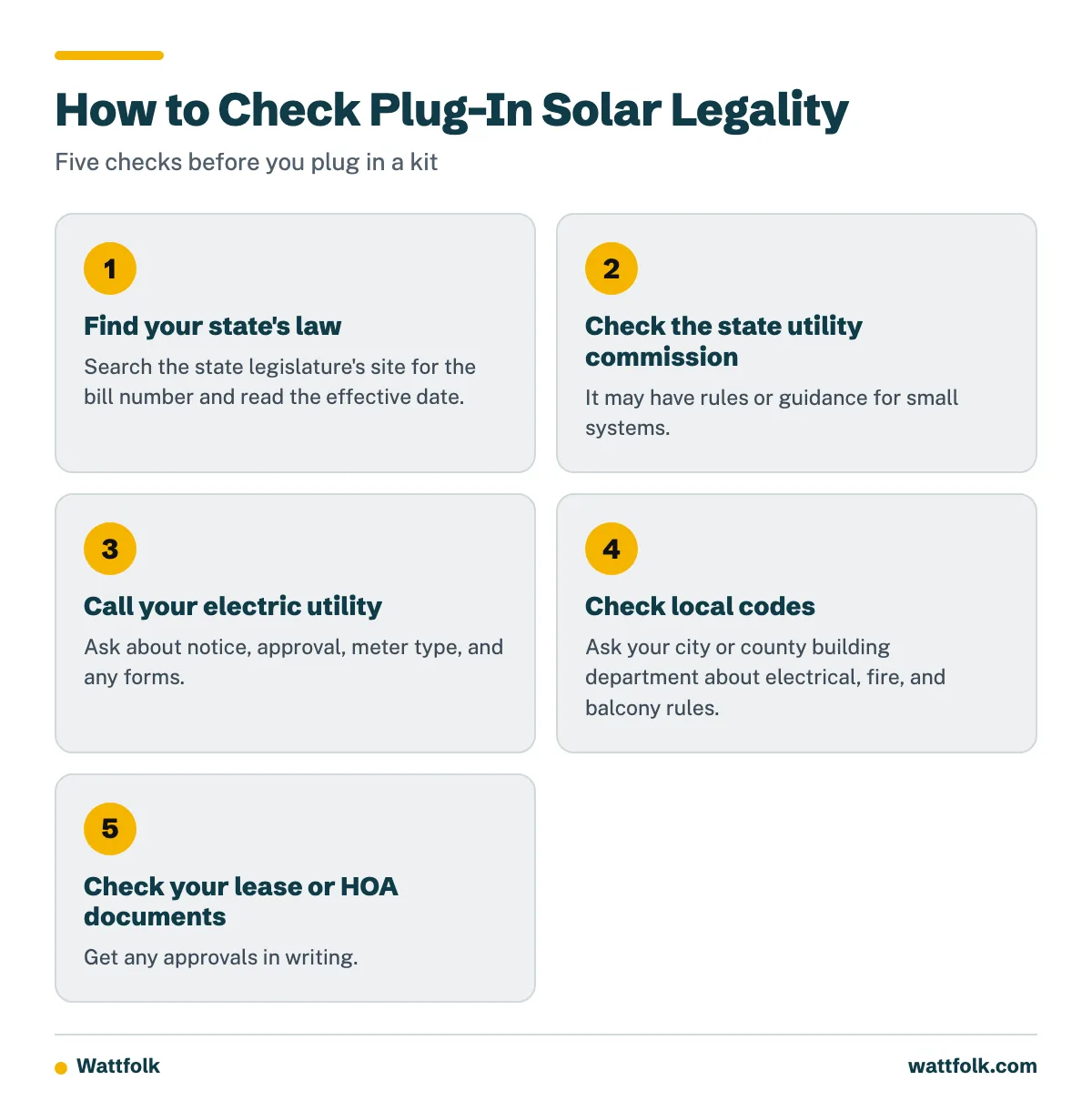
- Find your state’s law. Search the state legislature’s site for the bill number and read the effective date.
- Check the state utility commission. It may have rules or guidance for small systems.
- Call your electric utility. Ask about notice, approval, meter type, and any forms.
- Check local codes. Ask your city or county building department about electrical, fire, and balcony rules.
- Check your lease or HOA documents. Get approvals in writing.
A Vermont legislative witness document, What States Need to Know about Plug-In Solar, explains the policy questions states weigh. It is useful if you want to understand why the rules differ.
Pre-Installation Checklist and Common Compliance Mistakes
- State law: confirm it is in effect, not just passed.
- Utility rules: confirm notice, approval, and meter requirements.
- Outlet and circuit: check that the outlet is grounded, tight, and not overloaded. Use an electrician if unsure.
- Product certification: buy a UL-listed or equivalent system with automatic grid shut-off.
- Mounting safety: use rated hardware and plan for wind.
- Landlord or HOA approval: get it in writing.
- Outage shutoff: confirm the microinverter stops feeding the grid.
Common Mistakes
- Buying a kit because a blog listed the state as “legal” when the law is not yet effective.
- Using an extension cord to reach the outlet.
- Assuming a solar access law covers plug-in connections.
- Oversizing past the state cap or the circuit’s capacity.
- Skipping utility notice where it is required.
Frequently Asked Questions
States where plug in solar is legal
Utah has a clear law in effect, with HB 340 taking effect in May 2025 for qualifying systems up to 1,200 watts. Maine, Maryland, Vermont, Colorado, Connecticut, Virginia, New Hampshire, New Jersey, and California have enacted frameworks, but effective dates and conditions differ. New Jersey’s starts March 1, 2027. Confirm each date with your utility.
Solar access laws by state
Solar access laws protect your ability to use solar despite certain private restrictions. They are not the same as plug-in solar authorization. A state may have one without the other, so check both.
Is plug in solar legal?
It depends on your state and the date. Utah explicitly allows qualifying systems up to 1,200 watts. Other states have passed laws that may not be in effect yet. Where a state has no explicit rule, ask your utility before connecting a kit.
Can renters install plug-in solar without landlord permission?
Not safely. Vermont and New Jersey have renter-related terms, but your lease and local rules still matter. Get written approval before you attach panels or change anything on the building.
What happens if the power grid goes out?
A properly certified grid-tied system shuts off automatically. California’s framework is summarized as requiring this. The system will not power your home during an outage unless it includes separate battery backup.
Sources