

Choosing plug-in RV solar by panel wattage alone is the most common mistake, because the power station or charge controller on the other end sets the real limits. For most RVers, the simplest setup is a portable LiFePO4 power station paired with compatible folding panels through the station’s rated solar input. Verify panel voltage, current, connector type, battery capacity, and inverter wattage before you buy.
One caution up front: none of the five products below is a power station. They are 12V panel kits, battery maintainers, and SAE connector cables, so they suit RVs that already have a 12V battery. Based on the listings, the ECO-WORTHY 200W kit is the strongest option here. Everything is ranked on the data provided, not on hands-on use.
Quick answer
Pair a portable LiFePO4 power station with folding panels if you want AC outlets. If your RV already has a 12V battery, a panel kit with a charge controller is the direct route.
- Best for 12V battery charging: ECO-WORTHY 200W kit, the most solar power here
- Best for easy hookup: 2FT 10AWG SAE adapter kit with RV side-wall port
- Best for tight budgets: 20W MPPT maintainer kit at $25.19
Our Winner: ECO-WORTHY 200 Watts 12 Volt/24 Volt Solar Panel Kit
This kit has two 100W monocrystalline panels, a 30A PWM charge controller, Z mounting brackets, and 16.4 ft of 10 AWG cable. The manufacturer lists up to 800Wh per day under 4 hours of full sun. That is far more than any 20W kit here can produce, and it can be wired in parallel for 12V or in series for 24V.
How We Compared These Models
Based on the listing specifications and buyer feedback patterns, four criteria matter most. These are rated solar wattage against daily energy needs, charge controller type and amp rating, connector and cable gauge, and weather protection. We did not run hands-on tests, and the listings give no detailed specification sheets, so the table relies on the features each seller states.
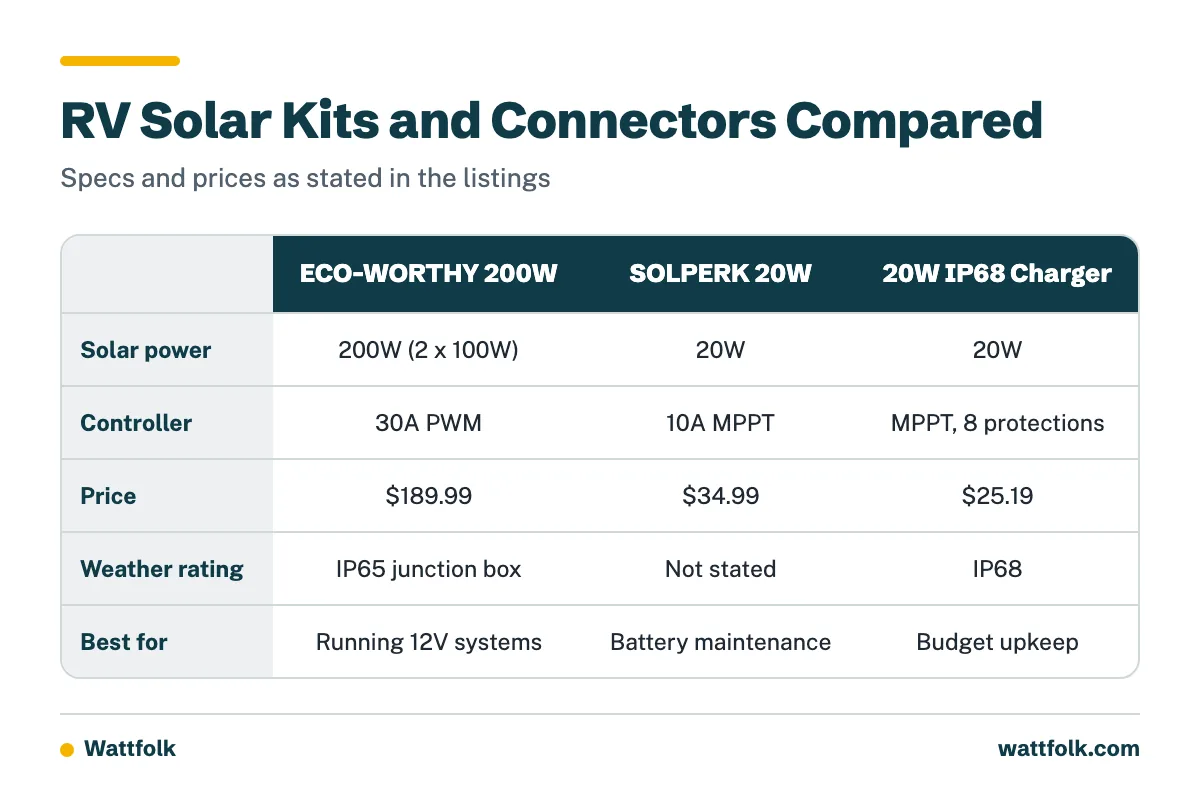
| Product | Key Specs | Our Choice | Action |
|---|---|---|---|
| ECO-WORTHY 200W Kit | 2 x 100W mono panels, 30A PWM controller, 12V/24V wiring, $189.99 | Editor’s Choice | |
| 2FT 10AWG Solar to SAE Adapter + RV Side Wall Port | Two 2 ft 10 AWG cables, solar connector to SAE, polarity reversing plugs, $16.99 | Best Plug-In Connector Kit | |
| SOLPERK 20W Solar Panel Kit | 20W panel, 10A MPPT controller, 360° bracket, $34.99 | Best for Battery Maintenance | |
| 20W 12V Solar Battery Charger Kit (IP68) | 20W panel, MPPT controller, 8 protections, IP68, $25.19 | Best Budget | |
| SAE Power Socket Sidewall Port Connector | 10AWG 2-pin SAE, flush mount, 50 cm cable, $9.99 | Best Basic Port |
In-Depth Reviews

1. ECO-WORTHY 200 Watts 12 Volt/24 Volt Solar Panel Kit – Editor’s Choice
Our Verdict: The only product here with enough solar capacity to meaningfully run a 12V RV system, such as lights, a water pump, a 12V fridge, and device charging.
The kit includes two 100W monocrystalline panels, Z mounting brackets, a 30A solar controller, and a pair of 16.4 ft 10 AWG cables. The seller lists a 35.2 x 23.1 x 1.37 inch panel size and ratings of 2400Pa wind load and 5400Pa snow load. The junction box is rated IP65. The panels use pre-drilled backs and plug-and-play leads, and they can be wired in parallel for 12V or in series for 24V.
The controller is PWM, which is typically less efficient than MPPT when panel voltage is well above battery voltage. For a 12V parallel setup, that tradeoff is common at this price. At 12V, 200W works out to roughly 17A, well inside the 30A rating.
This is a mount-and-wire kit, not a true plug-in. The Z brackets suggest a fixed roof or rack installation, and it charges a battery, not a power station’s solar input. Do not connect it to a power station without checking voltage limits.
Why We Like It
- 200W total from two panels, the highest capacity in this group
- Wind and snow load ratings are stated by the seller
- Flexible 12V parallel or 24V series wiring
- Cables and brackets included
Pros & Cons
Pros
- Seller lists up to 800Wh per day in 4 hours of full sun
- Complete kit with controller and brackets
- 4.6/5 rating on Amazon
Cons
- PWM controller, not MPPT
- Not portable once mounted
- Only 1 year of support

2. 2FT 10AWG Solar Plug Outlet to SAE Adapter + RV Side Wall Waterproof Port – Best Plug-In Connector Kit
Our Verdict: The most practical accessory here for a true plug-in feel, since it lets you connect a portable panel from outside the RV.
The kit includes a 2 ft solar connector to SAE adapter cable and a 2 ft SAE socket sidewall port cable, both 10 AWG and polarity-labeled. The seller says it supports up to 30A/600V DC and includes polarity reversing plugs. The sidewall flange is described as weatherproof when mounted on a sidewall or battery box.
The kit is a connector, not a power source. You still need a panel and a charge controller between the port and the battery. Confirm that your panel’s connector type matches the adapter, and that the port wiring ends at a controller, not straight into the battery.
Why We Like It
- Two cables in one kit, with polarity labels
- 10 AWG tinned copper limits voltage drop on short runs
- Reversing plugs help fix polarity mistakes before they matter
Pros & Cons
Pros
- Lets you connect portable panels without opening the RV
- Adapter and port included together
- Moderate price at $16.99
Cons
- No panel or controller included
- Requires cutting a hole in the sidewall
- Short 2 ft cables may need extension

3. SOLPERK Solar Panel Kit 20W – Best for Battery Maintenance
Our Verdict: A good trickle charger for a parked RV, but too small to run loads.
The kit includes a 20W monocrystalline panel, a 10A MPPT controller, a 360° adjustable bracket, an alligator clip, and an O-ring. The listing says it can charge and maintain 12V LiFePO4, lithium-ion, AGM, SLA, GEL, and EFB batteries. It describes a low-iron tempered glass surface and an aluminum frame.
Using a planning allowance of 4 peak sun hours and 75% system efficiency, 20W yields about 60Wh per day. That offsets slow self-discharge and small standby draws. It will not keep up with a fridge or inverter loads.
Why We Like It
- MPPT controller with three-stage charging, per the listing
- Adjustable bracket for sun angle
- Works with several 12V battery chemistries
Pros & Cons
Pros
- Low price at $34.99
- Includes controller and clips
- Rated 4.5/5 on Amazon
Cons
- 20W is maintenance-level only
- Not suited to a power station’s solar input

4. 20W 12V Solar Battery Charger Trickle Maintainer Kit – Best Budget
Our Verdict: The lowest-cost way to keep an RV battery topped up during storage.
This 20W monocrystalline kit pairs with an MPPT controller that lists eight protections: overcharge, discharge, reverse polarity, over current, over voltage, backflow, short circuit, and high temperature. The listing rates both panel and controller IP68 and says LED indicators show charging status. It also includes a 360° adjustable bracket.
The same 60Wh-per-day planning figure applies as for the SOLPERK. It is a maintainer, not a power source for appliances.
Why We Like It
- Lowest-cost solar kit here at $25.19
- Reverse polarity and backflow protection listed
- IP68 rating stated for panel and controller
Pros & Cons
Pros
- Cheapest entry point
- Simple plug-and-play wiring
- Broad battery chemistry support
Cons
- Very limited output
- Newer listing with a 4.4/5 rating

5. SAE Power Socket Sidewall Port Connector, 10AWG – Best Basic Port
Our Verdict: A low-cost flush-mount SAE port for a DIY install, best when you already own the adapter and controller.
The title lists a 2-pin SAE quick connect, 10 AWG wire, a weatherproof flush mount, and a 50 cm (1.6 ft) cable. The listing provides no feature bullets, so details such as amp rating and sealing are unverified. It does not mention a solar-connector adapter, so buyers with MC4 panels will likely need one.
Why We Like It
- Lowest price here at $9.99
- 10 AWG wire gauge
Pros & Cons
Pros
- Inexpensive
- Rated 4.5/5 on Amazon
Cons
- Sparse listing details
- Likely needs a separate adapter
What does plug-in solar for an RV actually mean?
It means solar panels connect to a battery or power station through a cable and connector, with no roof drilling or hardwiring to the RV’s AC panel. Two designs dominate. One charges a power station through its solar input. The other sends panel power through a charge controller to the RV’s 12V battery.
Neither design powers the RV’s built-in AC outlets by itself. That distinction matters for safety, covered below.
Is a portable power station better than a permanent RV solar installation?
It depends on your loads and how often you camp off-grid. A power station is simpler and portable. Permanent roof solar generates power while you drive and while parked, with no setup.
| Setup | Complexity | Usable Power | Portability | Safety Notes |
|---|---|---|---|---|
| Portable power station with folding panels | Low | Limited by station capacity and inverter | High | Check solar input limits; do not backfeed RV wiring |
| Direct 12V battery charging (panel plus controller) | Medium | Depends on battery bank and controller | Medium to low | Fuse and wire correctly; match controller to battery type |
| Permanent roof solar | High | Highest, scalable | None | Professional install recommended for AC integration |
How many watts of solar do I need for an RV?
Add up your daily watt-hours, then divide by realistic panel output. A portable-panel sizing guide recommends about 100W for stations up to 500Wh, 200W for 1 to 2kWh stations, and 300W or multiple panels for 3 to 5kWh stations. Manufacturer ranges for foldable portable panels run from 100 to 300W.
How much energy will a 100W, 200W, or 300W panel produce in a typical day?
Using a planning assumption of 4 peak sun hours and 75% system efficiency, which are estimates, not measurements:
- 100W: about 300Wh per day
- 200W: about 600Wh per day
- 300W: about 900Wh per day
Shade, heat, tilt, and cloud cover can cut these figures significantly. The ECO-WORTHY listing claims 800Wh for 200W at 4 hours of full sun, which is the theoretical maximum and above this conservative estimate.
How much battery capacity do I need for a refrigerator, CPAP, TV, lights, or laptop?
Multiply load watts by hours of use, then add a margin for inverter losses. Worked example one: a 614Wh power station running a 60W load. At an 85% planning allowance for inverter overhead, usable energy is about 522Wh. Dividing by 60W gives about 8.7 hours, not the theoretical 10.
Worked example two: a 1 to 2kWh station paired with 200W of panels. At 600Wh per day from solar, you can recover about half a day’s use of a 1.2kWh station if it was drained. Plan on one to two days to refill, weather permitting.
| RV Load | Typical Running Watts | Typical Startup Watts |
|---|---|---|
| CPAP machine | 30 to 60W | About the same |
| Compressor refrigerator | 45 to 150W | Several times running |
| Microwave | 1,000 to 1,500W input | Similar to running |
| Coffee maker | 600 to 1,000W | Similar to running |
| Television | 30 to 100W | Small surge |
| Rooftop air conditioner | 1,200 to 1,800W | 2,500W or more |
These are typical ranges. Check each appliance’s nameplate.
How do I check whether a solar panel is compatible with a power station?
Compare the panel’s electrical ratings to the station’s solar-input limits, not just the connector. Portable folding panels commonly use MC4 connectors, but a matching plug does not guarantee electrical compatibility.
- Open-circuit voltage (Voc): must stay under the station’s maximum input voltage. A 41V panel exceeds a 35V limit.
- Operating voltage and current: a 200W portable panel example is specified at 24.6V and 9.52A, so check both against the station.
- Wattage: do not exceed the station’s maximum solar input wattage.
- Connector polarity: confirm positive and negative orientation.
- Series or parallel limits: series adds voltage; parallel adds current. For reference, a 100W Renogy portable panel lists 21.6V open-circuit, 18.0V at maximum power, 6.17A short-circuit, and 5.71A at maximum power. Two in series reach about 43.2V open-circuit, which exceeds a 35V input.
Should I choose LiFePO4 or lithium-ion for RV solar storage?
LiFePO4 is generally the better fit for frequent cycling and warm RV interiors, since it is typically rated for more charge cycles and is more thermally stable. Standard lithium-ion packs are often lighter and cheaper per unit weight. Check the cycle rating on the specific model.
What inverter size is needed for a 30-amp or 50-amp RV?
A 30-amp RV circuit is rated for about 3,600W at 120V, and a 50-amp service for up to 12,000W across two legs. A 614.4Wh station example is rated for 1,000W continuous and 2,000W peak, which falls far short of either. A rooftop air conditioner alone may need 2,500W or more at startup.
Size the inverter to your continuous load plus the largest startup surge. Most plug-in power stations cannot run an air conditioner, microwave, and coffee maker together.
Can I plug an RV shore-power cord directly into a solar generator?
Only if the station has a matching RV outlet and a wattage rating that covers every connected load. Never use a male-to-male adapter to push power into an RV inlet, because exposed energized prongs are a shock hazard. The safe method to feed RV wiring is a properly installed transfer switch.
What safety issues apply when connecting an inverter or transfer switch to RV wiring?
An automatic transfer switch routes between two 120V AC sources and is intended to prevent simultaneous connection or dangerous backfeeding. This explanation of RV transfer switches covers how they work.
One 30A automatic transfer-switch specification, the PowerMax PMTS-30A, recommends professional installation and warns that incorrect installation can cause shock, fire, or death. Hire a qualified electrician for any work that ties an inverter to the RV’s AC distribution panel, including grounding and neutral bonding.
Setup tips: tilt, shade, storage, and weather
Aim panels at the sun and reposition them through the day. Even partial shade on one cell can cut output sharply. Secure folding panels against wind, and store them flat in a protective case. Use 10 AWG or heavier cable for longer runs to limit voltage drop.
What do owners say?
Owners like
- Portable systems are easy to deploy without drilling into the RV roof.
- Folding panels can be repositioned during the day to improve exposure.
- Power stations provide convenient AC, USB, and 12V outputs in one device.
- Silent battery operation is preferable to running a gasoline generator for small loads.
Common complaints
- Advertised panel wattage is often difficult to achieve because of shade, angle, heat, and weather.
- Portable panels can be bulky to store and vulnerable to wind when deployed.
- Power-station batteries drain faster than expected when using AC outlets because of inverter overhead.
- High-draw appliances such as air conditioners, microwaves, and electric heaters quickly exceed small-system capacity.
- Users frequently encounter compatibility problems when panel voltage or connector specifications do not match the power station.
Summarised from owner reviews and long-term user reports; individual experiences vary.
Frequently Asked Questions
Will a 20W solar kit power anything in my RV?
Not meaningfully. At roughly 60Wh per day under planning assumptions, a 20W kit maintains a battery or adds a small trickle. It will not run a refrigerator or inverter loads.
Can I use the ECO-WORTHY kit with a power station?
Not safely without checking specifications. The kit is built for 12V or 24V battery charging through its PWM controller. Series wiring raises voltage, which can exceed a station’s solar-input limit.
Do I need the SAE port if I have MC4 panels?
You need an adapter. The 2FT 10AWG kit converts a solar connector to SAE. The standalone port listing does not mention an adapter.
Is a transfer switch required to power my RV from a power station?
Only if you want to feed the RV’s built-in AC wiring. Plugging appliances directly into the station does not require one. Use a professionally installed switch for any wiring tie-in.
Conclusion
For RVs with a 12V battery, the ECO-WORTHY 200W kit is the best option here, and the 2FT 10AWG SAE adapter kit makes connecting portable panels easier. The two 20W kits are suited to battery maintenance, not appliance power. If you want AC outlets, choose a LiFePO4 power station and verify solar-input voltage, current, wattage, and connector polarity before buying panels. Never backfeed RV wiring without a properly installed transfer switch.
Sources
Affiliate Disclosure: As an Amazon Associate, we may earn commissions from qualifying purchases from Amazon.com. This comes at no extra cost to you and helps support our research.