
Lithium iron phosphate (LFP) is the best choice for most home solar systems, because it lasts the longest and wastes the least energy. Lead-acid costs less up front, flow batteries suit large long-duration sites, and nickel-based batteries are rare. This guide explains each type, compares them in one table, and shows a sizing example with US numbers.
Quick answer
There are three main types of solar batteries: lithium-ion, lead-acid, and flow. Nickel-based is a fourth, rarer group. For most US homes, LFP lithium-ion is the best pick. It offers high usable capacity, long cycle life, and good efficiency.
- Best for most homes: LFP, long life and low upkeep
- Best for a tight budget: AGM or gel lead-acid
- Best for large, long-duration sites: flow batteries
- The common groups are lithium-ion, lead-acid, and flow. Some guides add nickel-based.
- LFP and NMC are both lithium-ion, but they are not the same. LFP is known for long life and thermal stability.
- Flooded lead-acid needs watering and ventilation. AGM and gel are sealed.
- Always compare usable kWh, not the label size. Depth of discharge changes everything.
- Cheap batteries can cost more per kWh delivered over their life.
- Hardwired batteries need a licensed electrician. Never use extension cords for battery or solar connections.
- How many types of solar batteries are there?
- Lithium-ion: LFP versus NMC
- Lead-acid: flooded, AGM, and gel
- Flow batteries
- Nickel-based batteries
- What types of deep-cycle batteries are used with solar panels?
- Solar battery types compared
- What kind of battery is best for solar power at home?
- How much battery capacity do you need?
- Purchase price versus lifetime value
- Safety, temperature, warranty, and installation checks
- What do owners say?
- Frequently Asked Questions
How many types of solar batteries are there?
Most guides name three: lithium-ion, lead-acid, and flow batteries. Some add nickel-based as a fourth. The count differs because writers mix three different things: chemistry, construction, and product format.
- Chemistry: what stores the energy, such as lithium iron phosphate or lead and acid.
- Construction: how it is built, such as flooded, AGM, or gel lead-acid.
- Product format: how you buy it, such as a wall-mounted home battery, a rack of server-style modules, a plug-in unit, or a bank of single batteries.
This article sorts by chemistry first, then by construction inside each chemistry. That gives seven practical options: LFP, NMC, flooded lead-acid, AGM, gel, flow, and nickel-based. Solar.com and EnergySage both use the same broad grouping in their guides, such as this EnergySage overview of battery types.
Lithium-ion: LFP versus NMC
Lithium-ion is the most common choice for new home systems. But LFP and NMC are different chemistries, and treating them as the same is a common mistake.
LFP (lithium iron phosphate)
LFP uses iron and phosphate instead of nickel and cobalt. Buyers and installers often praise its long life and strong thermal stability. Residential LFP systems are commonly rated around 6,000 to 10,000 cycles at about 80% depth of discharge, according to industry sources. That is a manufacturer-style rating. Real life depends on heat, charge rate, and the product.
NMC (nickel manganese cobalt)
NMC packs more energy into less space. That is why it shows up in cars and some slim wall batteries. The trade-off is that it generally has a shorter cycle life than LFP and is less thermally stable. If space is tight, NMC can make sense. If you have a garage wall, LFP is usually the safer long-term bet.
How lithium batteries age
Lithium does not last forever. NREL measured lithium-ion systems in a field-aging study and reported capacity losses of roughly 20% to 35% over 10 years, depending on use and conditions. The same study showed about 85% round-trip efficiency in a behind-the-meter PV test bed. You can read the details in the NREL field-aging test bed report. Those are results for specific systems, not promises for every product.
Lead-acid: flooded, AGM, and gel
Lead-acid is the oldest rechargeable technology still used with solar. It usually costs less up front. It also needs more space, more care, and more capacity for the same usable energy. There are three kinds.
- Flooded lead-acid: Liquid electrolyte in open cells. It needs regular watering, ventilation, and terminal cleaning because it can release gas and corrode.
- AGM (absorbent glass mat): Sealed, with the electrolyte held in glass mats. It generally needs no watering.
- Gel: Sealed, with the electrolyte thickened into a gel. It also generally needs no watering and is often chosen for slow, steady cycling.

Lead-acid does not like deep discharge. A common rule is to use only about 50% of the label capacity to protect the battery. Owners also report shorter life when lead-acid is deeply discharged or kept hot. So a 10 kWh lead-acid bank may give you only about 5 kWh of daily use.
Flow batteries
Flow batteries store energy in liquid electrolytes held in tanks. Pumps move the liquid through a membrane to charge and discharge. They can tolerate deep discharge and suit long-duration storage.
The downsides are real for homes. They take far more space than a typical residential lithium battery. They need pumps, so there is more that can fail. Reports also show lower efficiency than lithium-ion. Flow batteries make the most sense for large sites, farms, or small microgrids, not a typical house.
Nickel-based batteries
Nickel-based batteries, such as nickel-iron and nickel-cadmium, are a smaller category. Some guides include them because they can handle harsh use and many cycles. They are specialist products with fewer installers and fewer inverter pairings. Most homeowners will not need one. If a seller offers nickel-based storage, ask which inverters are approved and who services it.
What types of deep-cycle batteries are used with solar panels?
Deep-cycle batteries for solar are mainly flooded, AGM, and gel lead-acid, plus lithium (usually LFP). A deep-cycle battery is built to be drained and recharged again and again. A car starter battery is not. It gives a short burst and fails quickly when drained deeply.
Four numbers describe how a deep-cycle battery behaves:
- Depth of discharge (DoD): How much of the battery you use per cycle. Lower DoD usually means longer life.
- Cycle life: How many charge-and-discharge cycles it lasts. Always ask at what DoD and temperature that number was rated.
- Round-trip efficiency: How much energy you get back for each unit you put in.
- Charge and discharge rate: How fast you can fill or drain it. Fast rates add heat and stress.
A cycle count with no DoD, temperature, or test source is not useful. A rating of 6,000 cycles at 80% DoD and a rating of 6,000 cycles at 30% DoD are very different products.
Solar battery types compared
The table below uses typical ranges. Cycle-life and efficiency figures come from manufacturer ratings and published test data, such as NREL’s lithium-ion measurements. Individual products differ, so check each datasheet.
| Type | Typical use | Usable DoD | Cycle life | Efficiency | Maintenance | Space | Relative cost |
|---|---|---|---|---|---|---|---|
| LFP | Home backup, daily cycling, off-grid | High (often around 80% to 100%, per datasheet) | About 6,000 to 10,000 at around 80% DoD | Around 85% measured by NREL for a lithium-ion system | Very low | Compact | Higher up front, lower per kWh over life |
| NMC | Space-limited homes | High | Generally fewer than LFP; check datasheet | Similar to other lithium-ion | Very low | Most compact | Higher up front |
| Flooded lead-acid | Budget off-grid, cabins | About 50% recommended | Lower; depends heavily on DoD | Lower than lithium | High: watering, venting, cleaning | Large | Lowest up front |
| AGM | Budget backup, small off-grid | About 50% recommended | Lower than lithium | Lower than lithium | Low: sealed | Large | Low to medium |
| Gel | Slow, steady cycling | About 50% recommended | Lower than lithium | Lower than lithium | Low: sealed | Large | Low to medium |
| Flow | Large, long-duration sites | Deep discharge tolerated | Long, product-specific | Lower than lithium-ion | Moderate: pumps, tanks | Very large | High; complex |
| Nickel-based | Specialist, harsh use | Varies | Varies | Varies | Varies | Medium to large | Varies; niche |
What kind of battery is best for solar power at home?
For most homes, LFP is the best kind of battery for solar. It gives high usable capacity, a long rated life, and little upkeep. Lead-acid can win on first cost for rarely used backup. Flow suits big, long-duration jobs.
Is lithium iron phosphate better than AGM, gel, or flooded lead-acid?
For daily cycling, usually yes. LFP lets you use more of its label capacity, loses less energy, and needs no watering. AGM and gel are better than flooded for people who want sealed, low-fuss lead-acid. If the battery only runs a few times a year during outages, a cheaper lead-acid bank can be reasonable.
What battery chemistry is best for off-grid solar?
LFP is the usual pick for off-grid homes too, because off-grid systems cycle every day. Lead-acid still works for cabins on a tight budget, if you accept the extra weight, space, and upkeep. Off-grid users in cold or hot places should check the temperature range on the datasheet first.
If this, do that:
- Grid-tied, want outage backup and daily bill savings: choose LFP that is approved for your inverter.
- Grid-tied, rare outages only, tight budget: consider AGM or gel, sized for about 50% DoD.
- Off-grid, daily cycling: choose LFP. Add a generator input if you have long cloudy spells.
- Small space, such as a closet or garage corner: choose LFP, or NMC if space is the main limit.
- Large property, many hours of storage: ask about flow batteries.
Decision checklist
- Is the system grid-tied or off-grid?
- How often will it cycle: daily, weekly, or only in outages?
- How many hours or days of backup do you want?
- How much installation space do you have?
- What temperature range will the battery see?
- How much maintenance are you willing to do?
- Is the battery on your inverter’s approved list?
How much battery capacity do you need?
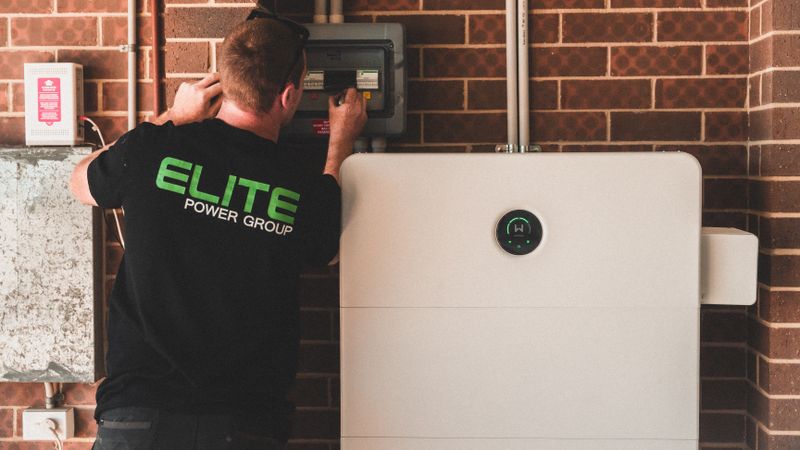
Start with the energy you want to cover, then adjust for depth of discharge, inverter losses, and a safety margin. The formula is:
Nominal capacity = daily load × backup days ÷ (DoD × inverter efficiency) × (1 + safety margin)
Worked example: critical-loads backup
These are example assumptions. Swap in your own numbers.
- Daily critical load: 10 kWh (fridge, lights, internet, phone charging, some outlets). Many US homes use more in total, so this assumes you back up only key circuits.
- Backup days: 1
- Inverter efficiency: 95%
- Safety margin: 20%
- LFP depth of discharge: 90%
- AGM depth of discharge: 50%
LFP: 10 ÷ (0.90 × 0.95) = 11.7 kWh. Add 20%, and you need about 14 kWh nominal.
AGM: 10 ÷ (0.50 × 0.95) = 21.1 kWh. Add 20%, and you need about 25 kWh nominal.
The AGM bank must be almost twice as big for the same usable energy. That means more weight, more floor space, and more cost than the cheap label price suggests.
Check that your panels can refill it
Assume a 5 kW array, 4.5 peak sun hours, and 80% system losses factored in (a 0.80 multiplier). That gives 5 × 4.5 × 0.80 = 18 kWh per day. Sun hours vary by state and season, so use your local figure. That is enough to refill the 14 kWh battery above on a decent day while also serving daytime loads.
Estimating daily savings
Say you shift 10 kWh from midday export to evening use. At the US national average near 17 cents per kWh, that is $1.70 per day. At about 85% round-trip efficiency, you actually deliver about 8.5 kWh, so the value is about $1.45 per day, or roughly $530 per year. In a state with 30-cent power, that is about $930 per year. Your actual savings depend on your rate plan and whether your utility pays for exports.
Purchase price versus lifetime value
A cheap battery can be expensive per kWh delivered. To compare fairly, divide the cost by the total usable kWh the battery delivers over its life.
The prices below are illustrative assumptions, not quotes. Real prices vary by brand, installer, and state.
| Item | LFP (example) | AGM (example) |
|---|---|---|
| Assumed cost per nominal kWh | $800 | $200 |
| Rated cycles | 6,000 at 80% DoD (low end of the commonly cited range) | 500 at 50% DoD (assumed) |
| Lifetime kWh per nominal kWh | 6,000 × 0.80 = 4,800 | 500 × 0.50 = 250 |
| Cost per kWh delivered | about $0.17 | about $0.80 |
On these assumptions, the “cheap” AGM bank costs about four to five times more per kWh delivered. Two cautions apply. First, one cycle a day is about 3,650 cycles in 10 years, so age, not cycle count, may end the battery’s life. Second, NREL’s field-aging results show lithium capacity can fade 20% to 35% over 10 years, so do not assume you will reach the full rated number. The comparison still shows why daily cycling favors lithium.
Safety, temperature, warranty, and installation checks
Use this list before you sign or buy.
- Ventilation: Flooded lead-acid can release gas while charging. It needs a vented space. Sealed batteries need far less, but still follow the manual.
- Temperature: Check the charge and discharge range on the datasheet. Heat shortens the life of lead-acid and lithium. Many lithium batteries limit or stop charging near freezing.
- Certifications: Ask whether the product is listed to recognized safety standards, such as UL listings for battery systems. Your installer and local inspector will check this.
- Warranty: Read the years, the throughput limit in kWh or cycles, and the capacity left at the end (for example, a guaranteed percentage). Note any DoD or temperature conditions.
- Compatibility: Confirm that the inverter and battery BMS are approved to work together.
- Recycling: Ask what happens at end of life. Lead-acid is widely recycled. Ask lithium sellers about take-back programs.
- Installation: Hardwired batteries and any connection to your home’s electrical panel need a licensed electrician and often a permit and utility approval. Never use extension cords to connect batteries, inverters, or panels. Never bypass a microinverter’s grid shut-off. It exists to protect utility workers.
- Rules: Plug-in solar and storage rules differ by state and change quickly. Confirm with your utility before installing.
For more background on how batteries fit into a solar system, this beginner overview from Solar Energy World is a helpful read.
What do owners say?
Owners like
- Lithium batteries are praised for low maintenance, compact size, high usable capacity, and steady performance.
- LFP batteries are commonly praised for long cycle life and strong thermal stability.
- AGM and gel batteries are valued for being sealed and easier to maintain than flooded lead-acid.
Common complaints
- Lithium systems are often criticized for higher upfront cost and the need to verify BMS and inverter compatibility.
- Lead-acid owners report shorter life when batteries are deeply discharged or exposed to heat.
- Flooded lead-acid draws complaints about watering, ventilation, corrosion, and routine upkeep.
- Flow batteries are criticized for large footprint, pumps, added complexity, and lower efficiency than lithium-ion.
Summarised from owner reviews and long-term user reports; individual experiences vary.
Frequently Asked Questions
How many types of solar batteries are there?
Most guides list three main types: lithium-ion, lead-acid, and flow. Some add nickel-based as a fourth. If you count by construction, lead-acid splits into flooded, AGM, and gel, and lithium-ion splits into LFP and NMC. That gives seven practical options.
What types of solar batteries are there?
The main ones are LFP, NMC, flooded lead-acid, AGM, gel, flow, and nickel-based. LFP is the most common choice for new homes. Lead-acid is still used where first cost matters most.
What types of deep cycle batteries are there?
For solar, the deep-cycle types are flooded, AGM, and gel lead-acid, plus lithium, mainly LFP. All are built to be discharged and recharged repeatedly. Lead-acid should usually be used to about 50% depth of discharge. LFP can usually be used much deeper, per the datasheet.
What kind of battery for solar is best for a home?
LFP is best for most homes. It combines high usable capacity, long rated cycle life, good efficiency, and low maintenance. Always check that it is approved for your inverter.
Which type of solar battery is best?
It depends on how you use it. LFP is best for daily cycling and most homes. AGM or gel can work for rare backup on a budget. Flow batteries suit large, long-duration sites. Match the type to your cycling, space, climate, and upkeep tolerance.
What are the different types of solar power batteries?
Lithium-ion (LFP and NMC), lead-acid (flooded, AGM, gel), flow, and nickel-based. They differ in cost, life, size, efficiency, and maintenance. The comparison table above puts them side by side.
What type of battery for solar works best off-grid?
LFP is the usual choice because off-grid batteries cycle daily. Lead-acid can work for a cabin on a tight budget, but you need roughly twice the nominal capacity at 50% DoD, plus space and upkeep. Use the sizing formula above and confirm your inverter’s approved batteries first.
Sources