
Pick solar if your spot gets several hours of direct sun daily; pick wired if it’s shaded or you want constant power. Solar skips cable runs and manual charging but needs sun and a healthy battery. Wired keeps running through winter and cloudy spells but costs more to install.
Quick answer
Choose solar when the camera spot has no outlet and gets several hours of direct sun. Choose wired when you want 24/7 recording or the spot is shaded. Many homes do best with both.
- Best for remote sheds and gates: solar, no trenching needed
- Best for 24/7 evidence: wired (mains or PoE)
- Best for shaded side yards: wired
- Solar cameras are only as reliable as their sun exposure and battery reserve.
- Wired cameras give constant power, but not all of them work without Wi-Fi or the cloud.
- Continuous recording drains a solar battery far faster than motion-only recording.
- Solar hardware costs more up front. Wired often costs more to install.
- Winter, shade, and aging batteries are the main solar weak points.
- A hybrid setup, wired near the house and solar in remote spots, fits many properties.
- What is the difference between a solar and a wired security camera?
- Are solar powered security cameras any good?
- Which is more reliable: solar or wired?
- Do solar cameras work at night and in cloudy weather?
- How long can a solar camera run without sun? A worked example
- Do solar cameras need Wi-Fi?
- Are wired cameras better for 24/7 recording?
- Which option is cheaper after installation and maintenance?
- Solar vs wired side by side
- Where should you use solar, wired, or both?
- Climate and location checklist
- What do owners say?
- Frequently Asked Questions
What is the difference between a solar and a wired security camera?
A solar camera runs on a rechargeable battery that a small solar panel tops up. A wired camera gets power through a cable, either from a mains adapter or over an Ethernet cable using Power over Ethernet (PoE). That one difference drives almost everything else: install effort, reliability, recording style, and cost.
Be careful with the word “wired.” It can mean two very different things. A PoE camera on a network video recorder (NVR) gets power and data over one cable and can record with no internet at all. A plug-in Wi-Fi camera has constant power but still needs your Wi-Fi and often a cloud plan. Many comparison pages lump these together. They should not be.
Are solar powered security cameras any good?
Yes, when they are placed and sized correctly. They are a strong fit for spots with no outlet, such as a driveway end, a gate, or a shed. They are a weak fit for shaded walls or for owners who want every second recorded.
Buying guides, including this solar security cameras buying guide, stress the same point. The panel is a trickle charger, not a power plant. It works well for a camera that sleeps until motion wakes it.
One bonus is worth knowing. Because a solar camera charges its own battery, it can keep working through a household power outage. A mains-powered Wi-Fi camera goes dark unless it has a backup supply.
Which is more reliable: solar or wired security cameras?
Wired cameras are generally more reliable because power is constant. Solar cameras depend on panel output and stored battery energy, so their reliability changes with sun, season, and settings.
Here is where each can fail:
- Solar: shaded or dirty panels, weeks of overcast skies, short winter days, an aging battery, and heavy motion alerts.
- Wired: a cut or damaged cable, a power outage, a failed adapter, or a router that drops out (for Wi-Fi models).
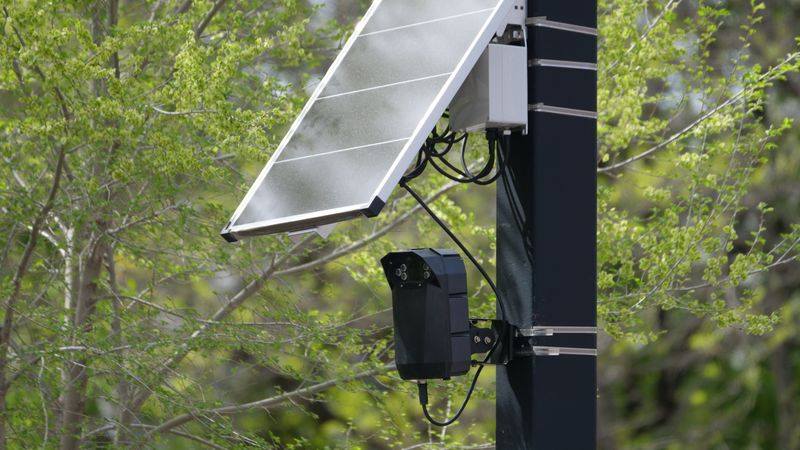
The main solar risk is slow. A camera can look fine in July and quietly run low by January. That is why winter planning matters more than the spec sheet.
Do solar cameras work at night and in cloudy weather?
Yes to both, because the camera runs from its battery, not from live sun. The panel only recharges during daylight. Night vision, whether infrared or a spotlight, uses battery power. Color night vision with a spotlight drains more than plain infrared.
Clouds cut panel output but do not stop it. A few gray days are usually fine. A long stretch of overcast weather in winter is the real test. During that time the battery covers the gap, and if the reserve runs out, the camera shuts down until you charge it by hand.
How long can a solar security camera run without sunlight?
It depends on battery size and recording style. Published tests report solar systems running from about one week to more than three months between charges, depending on battery size, settings, sunlight, and use. Another source puts typical battery endurance at roughly one to six months per charge. That range is huge, so do the math for your own setup.
Here is a worked example. You can swap in your own numbers.
Assumptions: 10,000 mAh battery at 3.7 V (about 37 Wh), 80% usable (about 30 Wh), a 4 W panel, 25% system losses from angle, dust, and charging, and a price of 17 cents per kWh (the U.S. national average is close to this, per the U.S. Energy Information Administration). Peak sun hours: 5 in summer, 2 in a northern winter. These are example figures, not specs for a particular model.
- Daily solar energy, summer: 4 W × 5 hours × 0.75 = 15 Wh
- Daily solar energy, winter: 4 W × 2 hours × 0.75 = 6 Wh
- Motion-only camera: average 0.4 W × 24 hours = about 10 Wh per day
- Continuous recording: average 3 W × 24 hours = 72 Wh per day
What this tells you:
- In summer, the motion-only camera gains about 5 Wh a day. It stays full.
- In winter, it loses about 4 Wh a day. The 30 Wh battery lasts around 7 winter days before it is empty.
- With no sun at all, the same battery covers about 3 days (30 ÷ 10).
- Continuous recording at 72 Wh a day would drain the battery in about 10 hours with no sun. To break even you would need roughly a 19 W panel in summer and about 48 W in winter (72 ÷ (peak sun hours × 0.75)).
That last line is why most solar cameras record on motion only. Your own numbers will differ. Check the manufacturer’s rated battery capacity and panel wattage, and look up your local peak sun hours.
Do solar cameras need Wi-Fi, or can they work without internet?
Most solar cameras need Wi-Fi or a cellular connection for live view and phone alerts. Without internet, many can still record to a microSD card, but you cannot watch or get alerts remotely. You would pull the card to review clips.
There are three common setups:
- Wi-Fi solar camera: the cheapest to run, but the signal must reach the mounting spot. Far sheds and gates often fall outside router range.
- Cellular solar camera: works anywhere with a signal, but it usually needs a monthly data plan. Cellular radios also draw more power.
- Local-storage camera: keeps clips on a card for more privacy, with less remote access.
For privacy, local storage keeps footage off company servers. Cloud plans add convenience, but your clips live on someone else’s system. Read each brand’s policy before you buy.
Are wired cameras better for 24/7 recording?
Yes. Constant power is what makes continuous recording possible. A PoE camera writing to an NVR can record around the clock with no battery concerns, and the footage stays on a drive in your home.
The trade-off is simple. Motion-only recording saves energy and storage, but it can miss the moments just before a trigger. Continuous recording catches everything, which matters if you need evidence of an incident. If that is your goal, wire the camera.
Which option is cheaper after installation and maintenance?
It depends on distance from power. Solar hardware usually costs more because you pay for a panel, battery, and mount. Wired systems can cost more to install because of cable runs, conduit, trenching, or electrician time. A solar versus wired comparison from Truelook makes the same point, though it is written for construction sites.
Break the cost into pieces:
- Hardware: higher for solar. Lower for a basic wired camera.
- Installation: low for solar. For wired, it grows with each foot of cable and any electrician work.
- Electricity: close to zero for solar. A 5 W wired camera running all year uses about 44 kWh (5 W × 24 hours × 365 days). At 17 cents per kWh that is about $7.50 a year. At 12 cents it is about $5, and at 40 cents about $17.50.
- Battery replacement: solar only. Rechargeable batteries in solar cameras often last around one to three years before they need replacing.
- Data plans: cloud storage or cellular fees, on either type.
So electricity is not the deciding cost. Installation labor and battery replacement are. For a spot 100 feet from the nearest outlet, solar often wins on total cost. For a spot on the back wall next to a power outlet, wired usually does.
Solar vs wired side by side
| Factor | Solar camera | Wired camera (mains or PoE) |
|---|---|---|
| Power reliability | Depends on sun and battery | Constant, unless the power fails |
| Installation | Mount and connect to Wi-Fi | Cable routing, drilling, maybe an electrician |
| Recording | Usually motion-triggered | Continuous or motion |
| Weather resilience | Hurt by shade, winter, long clouds | Not tied to weather, but cables need protection |
| Maintenance | Clean panel, replace battery, occasional manual charge | Little, apart from cable checks |
| Privacy and connection | Wi-Fi, cellular, or microSD | PoE with NVR can work with no internet |
| Relocation | Easy | Hard once cables are run |
| Total cost | Higher hardware, low install | Lower hardware, higher install |
Where should you use solar, wired, or both?
Put solar where running power is hard and the sun is good. Put wired where you need steady power or have shade. Use both when your property has a mix of those spots.
| Location | Best pick | Why |
|---|---|---|
| Driveway | Solar, if the panel gets sun | Far from outlets, motion alerts suit it |
| Front door | Wired | Power is near, and package theft footage matters |
| Remote shed | Solar (cellular if no Wi-Fi) | Avoids trenching a long cable |
| Shaded side yard | Wired | Panel would starve |
| Continuous evidence recording | Wired PoE with NVR | Constant power and local storage |
- No outlet nearby and 4+ hours of direct sun? Choose solar.
- Need 24/7 recording? Choose wired.
- Heavy shade or a northern winter? Choose wired, or add a larger panel and expect manual charging.
- Large property with both near and far zones? Use a hybrid system.

Climate and location checklist
Run through this list before you buy. Each item affects whether a solar camera will stay charged.
- Panel orientation: in most of the U.S., point the panel south, as close to the sun’s path as you can.
- Shade: check the spot at 9 a.m., noon, and 3 p.m. Even partial shade can cut charging a lot.
- Winter sunlight: shorter days and a low sun angle mean fewer peak sun hours. Plan for the worst month, not the best.
- Temperature: cold weather can reduce battery performance. Check the manufacturer’s rated operating range.
- Mounting height: high enough to deter tampering, but low enough that you can reach it to clean or charge.
- Wi-Fi reach: test your phone signal at the exact mounting spot. A weak signal drains the battery as the camera keeps retrying.
- Access: you will need to wipe the panel and eventually swap or charge the battery. Don’t mount it where you can’t reach it safely.
What do owners say?
Owners like
- No need to run power cables to remote outdoor locations
- Fast installation with less drilling, trenching, and electrician work
- Fewer ladder trips to remove cameras for routine battery charging
- Useful operation during household power outages
- Easy relocation when monitoring needs change
Common complaints
- Battery levels fall during winter, extended cloudy weather, or periods of heavy camera activity
- Some owners need occasional manual charging despite having a solar panel
- Poor panel placement or partial shade causes inconsistent charging
- Continuous recording and frequent motion alerts drain batteries faster than motion-only use
- Panels and cameras require accessible placement for cleaning, inspection, and occasional maintenance
Summarised from owner reviews and long-term user reports; individual experiences vary.
Frequently Asked Questions
Solar security camera vs wired: which should I choose?
Choose solar if the camera spot has no power and gets steady direct sun. Choose wired if you want continuous recording, the area is shaded, or you live where winters are dark and long. If your property has both kinds of spots, mix them. You can compare current models in this roundup of the best solar-powered security cameras.
Are solar powered security cameras any good?
They are good for the right job. They work well for driveways, gates, and sheds with decent sun, and they keep running in a power outage. They struggle in deep shade, long winter overcast, and with constant recording. Poor panel placement is the most common cause of trouble.
Do solar security cameras work at night?
Yes. They run from the battery after dark. Night vision and spotlights use extra power, so a camera with frequent night alerts will drain faster.
How long do solar camera batteries last?
On one charge, from about a week to several months depending on model and settings. Over their life, rechargeable batteries often need replacing after roughly one to three years.
How long does it take to charge a solar camera?
A full charge commonly takes about 6 to 8 hours in testing conditions. In real use, a small panel can take several sunny days to refill a battery that has run low.
Do solar cameras need Wi-Fi?
Most need Wi-Fi or cellular for remote viewing and alerts. Some can record to a microSD card without internet, but you must collect the card to see the footage.
Do I need an electrician for a wired camera?
Not for a plug-in camera near an existing outlet. You do need a licensed electrician for new outdoor outlets or any mains wiring. PoE cameras use low-voltage Ethernet, but long outdoor runs still need proper weatherproof cable and installation. Check local codes and ask your utility or electrician if unsure.
Sources