
The most common mistake is treating a plug-in solar kit like a lamp and pushing it into whatever outlet is closest. Plug-in solar can work alongside an existing rooftop system, but only on a suitable dedicated circuit, within your inverter and panel limits, and with your state and utility rules confirmed first. Here is how the two systems share your home, where the extra power goes, and when the add-on is worth it.
Quick answer
Plug-in solar can be technically compatible with a grid-tied rooftop system. Rules differ by state and utility, so confirm yours before buying. Extra power feeds your home first, then a battery, then the grid.
- Best for small daytime loads: one plug-in kit, if your rules allow it
- Best for big gaps in output: rooftop expansion by a licensed installer
- Best for evening use: battery storage
- Never use extension cords, power strips, or adapters for plug-in solar.
- Surplus power goes to your home loads first, then a battery, then the grid.
- Off-grid systems curtail output when the battery is full and loads are met.
- Solar flares threaten satellites and grid equipment far more than home panels.
- If your rooftop array already covers daytime use, a plug-in kit adds little value.
- Rules vary by state. Confirm with your utility before you buy.
- Can you use plug-in solar with existing solar panels?
- Can a plug-in solar system connect to the same home electrical system?
- Will adding plug-in solar overload a circuit or affect the inverter?
- Do you need permission from the utility?
- How many plug-in solar systems are allowed at one property?
- What happens to extra electricity from solar panels?
- Would a solar flare destroy solar panels?
- Is plug-in solar worthwhile when you already have rooftop solar?
- Pre-installation checklist
- Frequently Asked Questions
Can you use plug-in solar with existing solar panels?
Often yes in principle, but never by simply adding it to any outlet. A plug-in kit is a small panel set with a microinverter that feeds AC power into a home circuit. Your rooftop system does the same thing, just larger and wired in by an installer.
The two differ in how they connect. A rooftop extension adds panels to your existing inverter or a new inverter, wired through the main panel with permits and inspection. A plug-in kit skips that work and relies on built-in protections and local rules to stay safe. That is why the rules matter so much. The Institution of Engineering and Technology (IET), a UK body, recommends treating plug-in PV as a tightly controlled installation. That is a sound way to think about it anywhere.
Can a plug-in solar system connect to the same home electrical system as rooftop solar?
It can share the same house wiring, but the combined setup must be safe and permitted. Your rooftop array already pushes power into the panel. A plug-in kit pushes power the other way, from an outlet back toward the panel, through a circuit built to carry power in one direction.
Not every circuit suits that. Consumer guidance from the UK’s Electrical Safety First says plug-in systems should not connect through extension leads, cable reels, multiway adapters, travel adapters, or lighting circuits. They also should not connect to circuits that feed fixed equipment like ovens and hobs. The same logic applies in US homes. Use a dedicated, correctly rated circuit that a licensed electrician has identified.
Will adding plug-in solar overload a circuit or affect the existing inverter?
It can overload a circuit if the circuit is wrong for it, but it normally does not disturb a rooftop inverter. Two separate inverters can run side by side, since each follows the grid voltage on its own side of the meter.
The real risks are in the wiring:
- Circuit loading: Power from the kit and power from the grid both flow into the same wires. A circuit with many outlets and heavy loads can be stressed in ways the breaker was not sized for.
- Panel limits: The electrical code limits how much generation can feed a main panel’s busbar. Your rooftop system may already use most of that allowance.
- Protection: Ask an electrician whether the circuit has GFCI or AFCI protection that works with backfed power.
- Monitoring and batteries: If you have a hybrid inverter, battery, or energy monitor, the extra generation may confuse its readings. Ask your installer.
Do you need permission from the utility?
Probably, or at least notification. Most utilities require approval for any device that sends power to the grid, even a small one. Some states are changing rules for plug-in solar, and the details differ. This guide does not name a state rule, so call your utility and ask three things: whether plug-in kits are allowed, whether you must register or notify, and whether your net metering terms change.
UK guidance, for comparison, says approved devices must be registered on the Energy Networks Association Connect Direct Register, and a network operator notification may be required. Expect something similar here: paperwork, a certified product, or both. Renters should also get their landlord’s written approval.
How many plug-in solar systems are allowed at one property?
Usually one, where plug-in solar is allowed at all. The IET describes a strong presumption of one unit per property, limited to roughly 1 kW peak. UK consumer guidance says one system up to 800 W is currently permitted per household. That limit applies to the microinverter’s output, not just the panel’s nameplate rating.
These are UK numbers, and US limits will differ. The lesson carries over. Limits usually apply to inverter output, and they count the whole property. Your rooftop array may count toward the total, so ask your utility.
What happens to extra electricity from solar panels?
Surplus power follows a set order. As Strawberry Solar explains, grid-connected systems use solar on site first, then charge a battery if you have one, then export the rest once loads are met and the battery is full.
Does surplus solar power charge a battery automatically?
Usually yes, if the battery is on the same system and set to charge from solar. A battery on an AC-coupled or hybrid system takes surplus before export. Check your settings, since some owners set a battery to charge only off-peak.
What happens to excess electricity if the battery is full?
On a grid-tied system, it exports to the grid. On an off-grid system, there is nowhere to send it. The charge controller cuts panel output, which is called curtailment.
Worked energy-flow example
Assumptions: a 5 kW rooftop array producing 3.5 kW at midday, plus a 400 W plug-in kit. The home draws 0.8 kW. A battery can accept 2.0 kW.
| Step | Grid-tied with battery | Off-grid, battery full |
|---|---|---|
| Total solar (3.5 + 0.4 kW) | 3.9 kW | 3.9 kW available |
| 1. Household loads | 0.8 kW | 0.8 kW |
| 2. Battery charging | 2.0 kW | 0 kW (full) |
| 3. Grid export | 1.1 kW | None possible |
| Curtailed | 0 kW | 3.1 kW |

Would a solar flare destroy solar panels?
No. Solar flares do not destroy household panels on the ground. NASA’s overview of solar storms and flares explains that these events can damage satellite electronics and even panels in space. Earth’s atmosphere and magnetic field shield people and most ground equipment from the direct radiation.
The larger risk is indirect. A strong geomagnetic storm can induce currents in long power lines and stress transformers and other grid equipment. That is a utility problem, not a roof problem. Panels themselves are simple semiconductors with no long wire runs acting as antennas. Microinverters and the grid connection are the parts that would matter, and they shut down if grid conditions go out of range.
Is plug-in solar worthwhile when you already have rooftop solar?
Only sometimes. If your rooftop system already covers your daytime use and exports the rest, a plug-in kit mostly adds to what you already export. Its value then depends on your export rate, which is often below the retail rate you pay.
Simple sizing calculation
Assumptions: a 400 W plug-in kit, 4.5 peak sun hours (a typical US figure, which varies by region), 15% system losses, and a retail price of 17 cents per kWh (about the US national average from the U.S. Energy Information Administration).
- Daily output: 0.4 kW × 4.5 hours × 0.85 = about 1.53 kWh
- Yearly output: 1.53 × 365 = about 558 kWh
- If 100% is used at home: 558 × $0.17 = about $95 per year
- If 70% is used at home: 391 kWh × $0.17 = about $66 per year, plus whatever credit your utility pays for the exported 167 kWh
Now check your base load. If your home draws only 300 W in the daytime and your rooftop array already makes several times that, almost all of the plug-in output is surplus. The kit pays off most when your rooftop panels are shaded, face the wrong way, or sit far from the loads you want to cover. It also pays off if your utility gives full retail credit for exports.
Decision table for homes with existing PV
| Option | Best when | Main limit |
|---|---|---|
| Rooftop expansion | You need a lot more output and have roof space | Needs permits, installer, and panel capacity |
| Plug-in solar | You need a small boost and rules allow it | Strict output limits and circuit requirements |
| Battery storage | You export a lot and use power at night | Does not add generation |
- If you export most of your solar, add a battery or shift loads to midday.
- If you run short of power in the daytime, call an installer about expansion.
- If you only want a small top-up and your utility allows it, consider one plug-in kit.
Pre-installation checklist
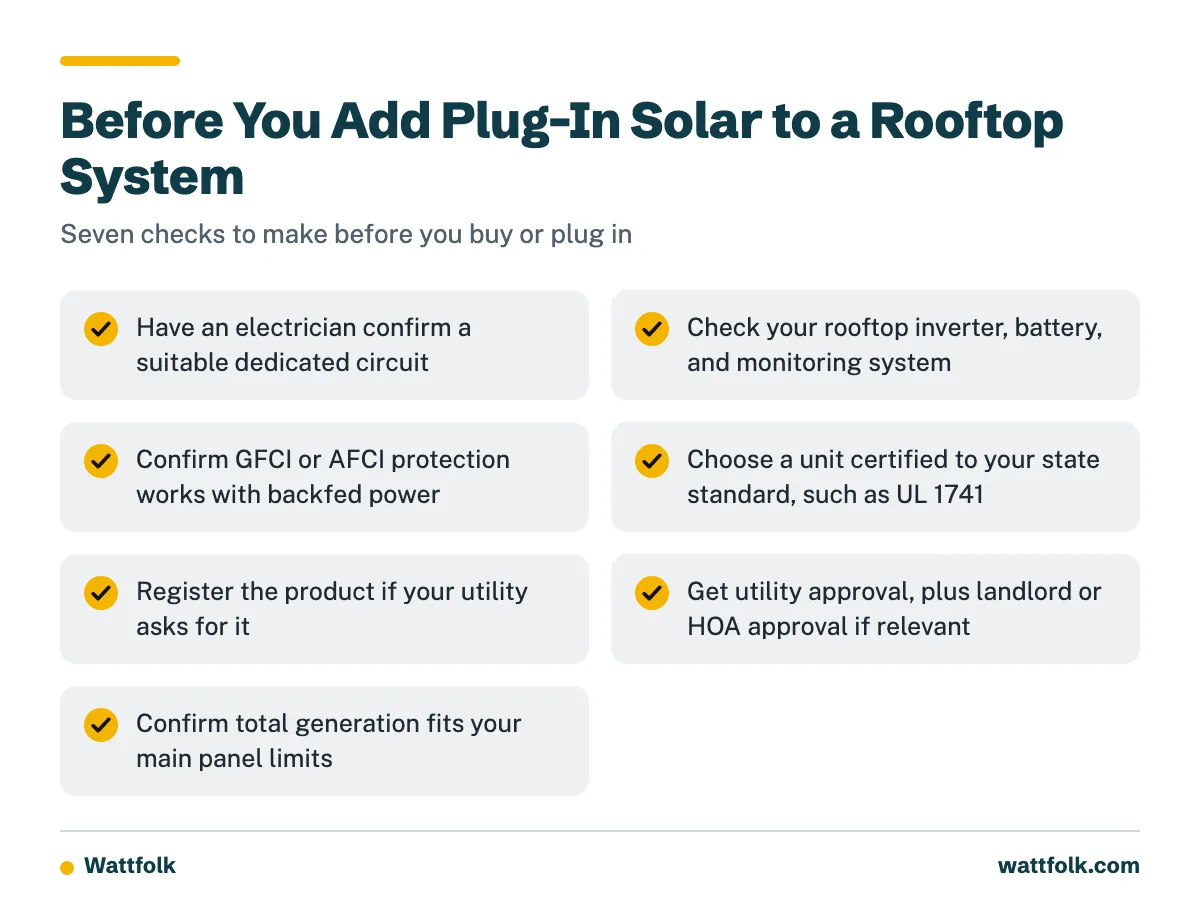
- Circuit identification: an electrician confirms a suitable dedicated circuit.
- Inverter compatibility: check your rooftop inverter, battery, and monitoring system.
- Protection: confirm GFCI or AFCI protection works with backfed power.
- Product certification: choose a unit certified to the standard your state requires, such as UL 1741.
- Registration: register the product if your utility asks for it.
- Permissions: get your utility’s approval, plus your landlord’s or HOA’s if relevant.
- Panel capacity: confirm the total generation fits your main panel’s limits.
Hire a licensed electrician if you have a battery, a sub-panel, a crowded main panel, or any doubt about circuits.
Frequently Asked Questions
Can you use plug in solar with existing solar panels?
Often yes, if your state and utility allow it and you use a suitable dedicated circuit. The kit must stay within inverter output limits, and the total generation must fit your panel’s capacity. Check with your utility and a licensed electrician first.
Would a solar flare destroy solar panels?
No. Solar flares can damage satellites and panels in space, but the atmosphere and magnetic field protect ground equipment, as NASA explains. The bigger risk from a strong geomagnetic storm is to long power lines and grid equipment.
What happens to extra electricity from solar panels?
Grid-tied systems use it in the home first, then charge a battery if you have one, then export the rest. Off-grid systems curtail output when the battery is full and loads are met. Export credit depends on your utility’s rules.
Sources