
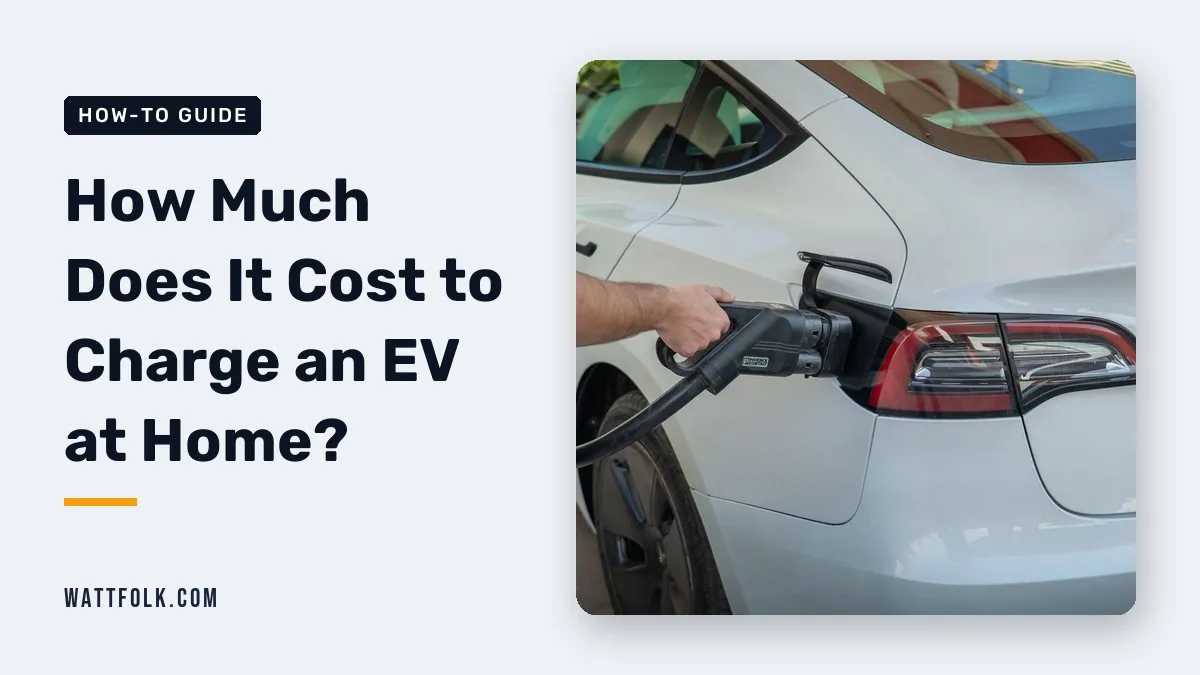
Current and future EV owners can estimate home charging costs with one formula: kilowatt-hours (kWh) used multiplied by your electricity rate. A 54-kWh battery at $0.107 per kWh costs about $5.78 to fill from empty, and an EV that uses 35 kWh per 100 miles adds about $45.50 a month at $0.13 per kWh over 12,000 miles a year. The charger and its installation are separate, one-time costs.
Quick answer
Most drivers pay roughly $25 to $75 a month in electricity, depending on miles driven, vehicle efficiency, and local rates. Charger hardware and installation add about $850 to $1,900 once. Home charging is usually cheaper than public fast charging.
- Best for low mileage: Level 1, no hardware cost
- Best for daily commuters: Level 2, faster and overnight-ready
- Best for lower bills: off-peak time-of-use rates
- Cost per charge = kWh added × price per kWh.
- Monthly cost = (monthly miles ÷ 100) × kWh per 100 miles × rate.
- Rates range widely by state, so use your own utility bill.
- Level 1 and Level 2 use the same kind of electricity. Level 2 is faster but needs hardware and installation.
- Panel upgrades, long wire runs, and permits can raise installation costs.
- How much does it cost to charge an EV at home?
- How do I calculate the cost of charging my EV?
- How much does a full electric car charge cost?
- How much does it cost to charge an EV at home per month?
- Does Level 1 charging cost less than Level 2 charging?
- How much does a home EV charger and installation cost?
- Home charging vs a charging station
- Can time-of-use rates or incentives reduce costs?
- Reader checklist
- What do owners say?
- Frequently Asked Questions
How much does it cost to charge an EV at home?
For most drivers, it costs a few dollars per charge and tens of dollars per month. Your home’s electricity rate and your car’s efficiency set the number.
The formula is simple:
Cost = kWh used × price per kWh
Here are the worked examples, using figures from the research behind this guide:
- Full charge: 54 kWh × $0.107 = about $5.78. Many sources round this to about $6.
- Per 100 miles: An EV rated at 27 kWh per 100 miles costs about $2.89 per 100 miles at $0.107, or roughly $0.029 per mile.
- Adding 100 miles of range: A car using 20 kWh per 100 miles at $0.123 per kWh costs about $2.46.
Rates differ a lot by place. An Alternative Fuels Data Center (AFDC) source reports roughly $0.11 per kWh in Utah and $0.45 in Hawaii, with an average near $0.17 in its April 2024 data. The same car can cost four times as much to charge in one state as in another.
How do I calculate the cost of charging my EV?
Find three numbers, then multiply. You need your electricity rate, your car’s kWh per 100 miles, and how far you drive.
- Electricity rate: Look at your utility bill. Divide the electricity charges by the kWh used. This blended figure includes some fees. Your plan’s listed rate per kWh works too.
- Vehicle efficiency: Use the kWh per 100 miles figure on the EPA label. FuelEconomy.gov lists it for each model. Real driving can differ, especially in cold weather or at highway speeds.
- Monthly miles: Divide your yearly miles by 12.
Then use: (monthly miles ÷ 100) × kWh per 100 miles × rate.
Take the 35 kWh per 100 miles example. Driving 12,000 miles a year is 1,000 miles a month. That is 10 × 35 = 350 kWh. At $0.13 per kWh, the cost is $45.50.
How much does a full electric car charge cost?
A full charge on a 54-kWh battery costs about $5.78 at $0.107 per kWh. Bigger batteries cost more, and expensive electricity raises it further.
Two cautions apply. First, a battery’s listed size is not always the same as the usable energy. Second, most drivers rarely go from empty to full. A daily top-up from 40% to 80% adds far less energy than a full fill. Price each session by the kWh you actually add.

How much does it cost to charge an EV at home per month?
Most drivers land between about $25 and $75 a month. High-mileage drivers or those in costly states can pay more. This table uses the formula above. The rates and efficiencies are examples, not predictions. Charging losses are not included.
| Monthly miles | kWh per 100 miles | Rate per kWh | Monthly kWh | Monthly cost |
|---|---|---|---|---|
| 500 | 30 | $0.17 | 150 | $25.50 |
| 1,000 | 27 | $0.107 | 270 | $28.89 |
| 1,000 | 35 | $0.13 | 350 | $45.50 |
| 1,000 | 30 | $0.17 | 300 | $51.00 |
| 1,500 | 30 | $0.17 | 450 | $76.50 |
| 1,000 | 30 | $0.45 | 300 | $135.00 |
One more point for homes with rooftop solar. To estimate how much of 350 kWh a panel can cover, assume a 400-watt panel, 4 peak sun hours a day, and 20% system losses. That is 0.4 kW × 4 hours × 0.8 = 1.28 kWh a day, or about 38 kWh a month per panel. Covering 350 kWh would take about nine panels. Your sun hours and losses will differ. Rooftop systems need a licensed installer. Plug-in solar rules vary by state and are changing quickly, so check your state’s current rules before buying anything.
Does Level 1 charging cost less than Level 2 charging?
Not per kWh. Both pull electricity at your home rate, so the electricity cost for the same miles is about the same. The difference is speed and upfront cost.
Level 1 uses a standard 120-volt outlet and often comes with the car, so the hardware is free. It is slow. Level 2 uses 240 volts. According to the figures behind this guide, a 240-volt, 32-amp unit typically adds about 25 miles of range per hour, and many EVs can fill overnight. FuelEconomy.gov explains the charging levels in more detail: Charging Your Plug-in Electric Car.
If you drive under about 30 miles a day and park near a good outlet, then Level 1 may be enough.
If you drive more, or want a fast top-up, then plan for Level 2.
If you rent, then ask your landlord before any wiring work.
How much does a home EV charger and installation cost?
Plan on about $850 to $1,900 for a Level 2 setup with no major electrical upgrade. That comes from hardware of roughly $350 to $700 plus installation of roughly $500 to $1,200.
| Item | Typical cost | Notes |
|---|---|---|
| Level 1 cord | Often included with the car | Uses a 120-volt outlet |
| Level 2 unit | About $350 to $600 basic; about $500 to $700 wall-mounted | Varies by brand and features |
| Level 2 installation | About $500 to $1,200; recent estimates about $550 to $1,380 | Depends on distance to the panel |
| Permits | Varies by city | Ask your local building department |
| Panel or wiring upgrade | Quote needed | More likely in older homes |
Here is the first-year picture. Add about $546 of electricity ($45.50 × 12) to the $850 to $1,900 above and you get roughly $1,400 to $2,450 in year one. That leaves out panel upgrades and incentives. After year one, only electricity remains. AFDC covers planning steps in Procurement and Installation for Electric Vehicle Charging.

How much does it cost to charge an EV at home vs at a charging station?
Home charging is usually cheaper for everyday driving. Public stations add their own margins, and prices vary by network and location.
Public AC (Level 2) charging is slower and often priced closer to home rates. DC fast charging is quicker and usually costs more per kWh. Check the price in the network’s app before you plug in. As a hypothetical, a 54-kWh fill at $0.45 per kWh would be $24.30. At the $0.13 home rate it is $7.02. Those are example prices, not quotes.
Fast charging still has a place. It suits road trips and drivers without home parking. For routine use, home charging also saves detours and waiting.
Can time-of-use electricity rates or incentives reduce home charging costs?
Yes, they can. Time-of-use (TOU) plans charge less during off-peak hours, often overnight. Most EVs and chargers let you schedule charging.
As a hypothetical, say off-peak power is $0.09 per kWh instead of $0.13. The 350 kWh month falls from $45.50 to $31.50. Read the plan carefully. Peak rates can be higher than a flat rate, and hours change by season.
Some utilities offer EV rate plans or charger rebates, and some states do too. Federal and state incentives have changed in recent years, so check current rules and deadlines before you buy. Ask your utility first. Incentives can also lower the first-year total.
Reader checklist
- Utility rate per kWh, from your bill or plan
- Vehicle kWh per 100 miles, from the EPA label
- Monthly miles
- Charger type: Level 1 or Level 2
- Charging losses: add about 10% as a planning buffer
- TOU plan, utility rebates, and available incentives
- Electrician quote, including permits and any panel work
What do owners say?
Owners like
- Overnight home charging means the car starts the day charged.
- Level 2 is much faster than a standard household outlet.
- Home charging is commonly seen as cheaper than public charging for routine driving.
- There are no detours or waits at public stations.
Common complaints
- Installation can cost more than expected when it needs a panel upgrade, long cable run, trenching, or permits.
- Cost estimates can be confusing because rates, charger losses, and vehicle efficiency vary.
- Level 1 can be too slow for high-mileage driving.
- Time-of-use plans can complicate billing because rates change by hour and season.
Summarised from owner reviews and long-term user reports; individual experiences vary.
Frequently Asked Questions
How much does it cost charge ev at home?
Multiply the kWh you add by your electricity rate. A 54-kWh battery at $0.107 per kWh is about $5.78 from empty to full. Monthly bills are usually in the tens of dollars.
How much does it cost charge electric car at home?
The same formula applies to any electric car. At $0.123 per kWh, adding 100 miles to a car using 20 kWh per 100 miles costs about $2.46. A less efficient car or a higher rate raises that.
How much does it cost to charge ev at home per month?
Use (monthly miles ÷ 100) × kWh per 100 miles × rate. At 1,000 miles, 35 kWh per 100 miles, and $0.13 per kWh, it is $45.50. Add about 10% if you want to allow for charging losses.
How much does it cost to charge an ev at home vs at a charging station?
Home is usually cheaper, especially against DC fast charging. Public AC charging is slower and can be priced closer to home rates. Compare the per-kWh price shown on the station’s app with your own rate.
How much does a full electric car charge cost?
It depends on battery size and your rate. A 54-kWh battery at $0.107 per kWh costs about $5.78 for a full charge. Most drivers charge partway, so their real cost per session is lower.