
Most buyers should choose monocrystalline panels. They make more power from each square foot of roof, and today’s price gap is smaller than it used to be. Polycrystalline panels can still work on a large, open roof or a ground mount, where a lower price per panel matters more than saved space.
Quick answer
Monocrystalline panels have higher efficiency, so they fit more watts on a small roof. Polycrystalline panels usually cost less per panel but need more space. Compare datasheets and total installed cost, not cell type alone.
- Best for small or shaded roofs: monocrystalline, for more watts per square foot
- Best for big, open roofs on a tight budget: polycrystalline, if the price is lower
- Modern mono modules are commonly published at about 20-23% efficiency. Poly modules are about 15-18%.
- Mono usually handles heat slightly better, but check the Pmax temperature coefficient on each datasheet.
- An 8 kW system needs about 20 mono panels (400 W each) or about 27 poly panels at 16% efficiency.
- Panel price is not system price. Racking, labor, wiring, and roof space change the final math.
- Color is a hint, not proof. The model label and datasheet tell you the real cell type.
- Do not mix panel types in one string unless voltage, current, and inverter limits all match. Ask a licensed electrician.
- What Are Monocrystalline and Polycrystalline Solar Panels?
- What’s the Difference Between Monocrystalline and Polycrystalline Solar Panels?
- How Can I Identify Monocrystalline and Polycrystalline Panels?
- How Do Efficiency, Heat, Lifespan, and Cost Compare?
- How Much Roof Space Does Each Type Need?
- What Are the Disadvantages of Monocrystalline Solar Panels?
- Which Is Better: Monocrystalline or Polycrystalline?
- Can I Mix Monocrystalline and Polycrystalline Panels?
- How to Compare Datasheets Before You Buy
- Frequently Asked Questions
What Are Monocrystalline and Polycrystalline Solar Panels?
Both are silicon solar panels. The difference is how the silicon inside each cell is made.
Monocrystalline cells are cut from a single silicon crystal. Because the crystal is uniform, electricity moves through it with less resistance. Polycrystalline cells are made from many silicon crystals melted together. The crystal edges add some resistance, which is one reason poly cells are usually less efficient.
Both types turn sunlight into direct current (DC). An inverter then changes it to alternating current (AC) for your home. Both come in the same common formats, like 60-cell and 72-cell layouts. The cell type is only one part of the product.
What’s the Difference Between Monocrystalline and Polycrystalline Solar Panels?
The main differences are efficiency, appearance, heat performance, and price. Mono generally wins on efficiency and space. Poly has often won on price per panel.
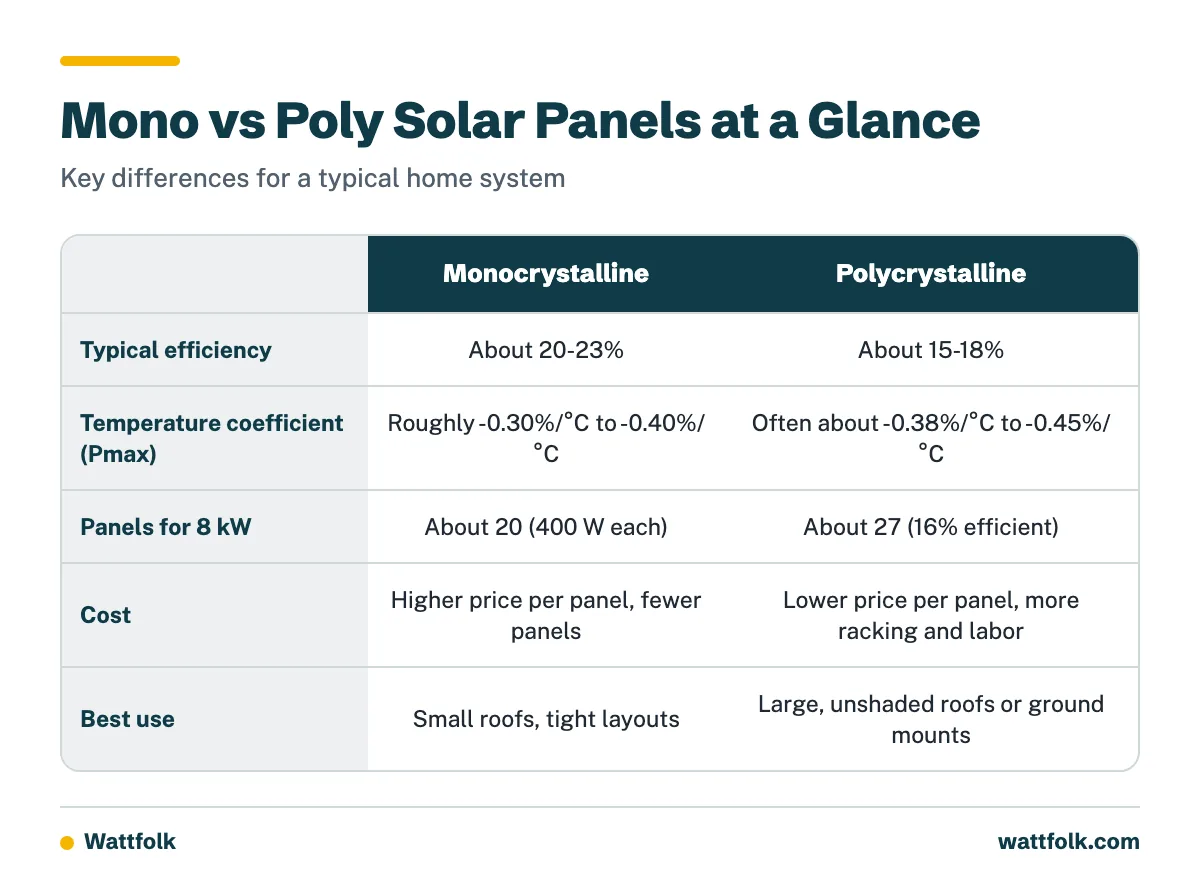
Published efficiency ranges are about 20-23% for modern mono modules and 15-18% for poly modules, according to sources like the American Solar Energy Society. Exact numbers depend on the product generation. Many older poly modules were compared with new mono ones in the past, so be careful with old charts.
| Feature | Monocrystalline | Polycrystalline |
|---|---|---|
| Cell structure | Single silicon crystal | Many silicon crystals |
| Typical look | Dark or black, uniform | Blue, speckled, or marbled |
| Typical efficiency | About 20-23% | About 15-18% |
| Temperature coefficient (Pmax) | Roughly -0.30%/°C to -0.40%/°C | Often about -0.38%/°C to -0.45%/°C |
| Space needs | Less roof for the same watts | More roof for the same watts |
| Cost considerations | Higher price per panel in many cases, but fewer panels to install | Often a lower price per panel, but more racking and labor |
| Best use case | Small roofs, tight layouts, high-output goals | Large, unshaded roofs or ground mounts with tight budgets |
How Can I Identify Monocrystalline and Polycrystalline Panels?
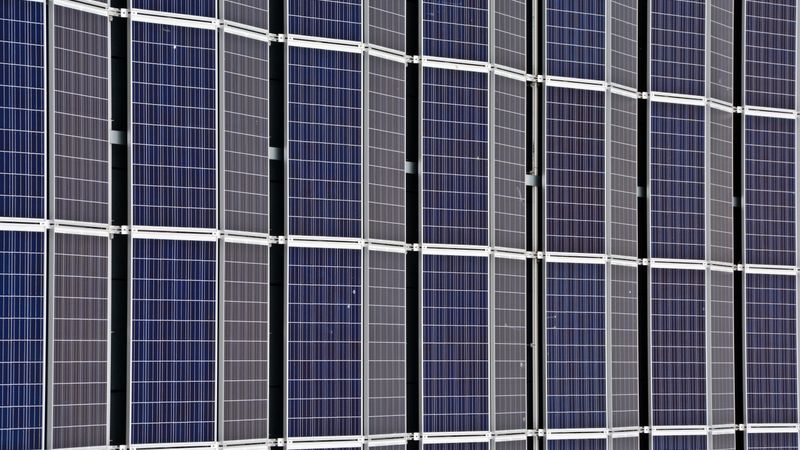
Look at the cell color first. Then confirm with the model label. Poly cells usually look blue, speckled, or marbled. Mono cells usually look darker and more even.
Color alone can fool you. Glass coatings, frame color, back sheet color, and cell layout all change how a panel looks. An all-black mono panel looks very dark. A standard mono panel with a white back sheet and silver frame can look bluish in some light.
Here is a better way to check:
- Read the label on the back of the panel. It lists the model number and the rated watts.
- Search that model number and open the manufacturer’s datasheet.
- Look for the words “mono,” “monocrystalline,” “poly,” or “multi-crystalline.”
- Check the cell corners. Many older mono cells have clipped corners. This is a clue, not proof.
How Do Efficiency, Heat, Lifespan, and Cost Compare?
Mono leads on efficiency and often on heat. Lifespan is similar when the product quality is similar. Cost depends on the whole system.
Efficiency
Efficiency is the share of sunlight a panel turns into power. Ratings are measured at Standard Test Conditions: a 25°C cell temperature, 1,000 W/m² of sunlight, and an AM1.5 light spectrum. Real roofs rarely match these exactly. Use the number to compare panels, not to predict your exact output.
Heat performance
Solar cells lose power as they get hot. The temperature coefficient tells you how much per degree Celsius above 25°C. Typical mono panels fall around -0.30%/°C to -0.40%/°C. Poly is often around -0.38%/°C to -0.45%/°C.
Here is a worked example. Assume the cells reach 65°C on a hot roof. That is 40°C above the reference.
- A 400 W mono panel at -0.35%/°C loses 14% (40 × 0.35). That leaves about 344 W.
- A 304 W poly panel at -0.43%/°C loses 17.2% (40 × 0.43). That leaves about 252 W.
These numbers ignore dirt, wiring, and inverter losses. The point is the gap. A small coefficient difference adds up on a hot afternoon. Always check the exact number on the datasheet, because some poly panels do better than some mono panels.
Lifespan and warranty
Both types can last for decades. The cell type matters less than the build quality. Many makers offer a 25-year performance warranty, but terms differ. Compare the first-year degradation, the yearly degradation, and the guaranteed power at the end of the term. Also check the separate product warranty, which covers defects in the frame, glass, and junction box.
Cost
Poly panels have often cost less per watt. That does not always mean a cheaper system. The next section shows why.
How Much Roof Space Does Each Type Need for the Same Energy Output?
Poly needs more roof for the same watts. In this example, an 8 kW system takes about 20 mono panels or about 27 poly panels.
Assumptions: a target of 8,000 W. Every panel is about 1.9 m² (about 20.5 square feet). The mono panels are 400 W, which is about 21% efficient. The poly panels are about 16% efficient, so each makes roughly 304 W.
| Item | Mono (400 W) | Poly (about 304 W) |
|---|---|---|
| Panels needed for 8 kW | 20 | 27 (26.3 rounded up) |
| Roof area used | About 410 sq ft | About 552 sq ft |
| Extra area for poly | None | About 140 sq ft more |
Real panels differ in size, and you also need walkway and fire-code setbacks. Your installer will draw the final layout.
Now the energy math, so you can redo it. Assume 4.5 peak sun hours a day (common in many US regions, but look up your own), 80% system efficiency after losses, and 17 cents per kWh, near the national average.
- 8 kW × 4.5 hours × 0.80 = 28.8 kWh per day
- 28.8 × 365 = about 10,512 kWh per year
- 10,512 × $0.17 = about $1,787 of electricity per year
Notice that both systems make about the same energy if they have the same rated watts. Efficiency does not add output. It saves space. If your roof only fits 20 panels, poly cannot reach 8 kW at all.
Is the Cheaper Panel Really the Cheaper System?
Not always. Panel price is only one line on the quote. Racking, rails, clamps, wiring, labor, permits, and the inverter all count. Many of those costs grow with the number of panels.
Here is a simple example with made-up numbers. Say poly panels cost $0.05 less per watt. On 8,000 W, that saves $400. But 7 extra panels need extra rails, more roof attachments, more wiring, and more labor. If those cost more than $400, the savings are gone. Your own quote may land either way.
A better test is installed cost per annual kilowatt-hour. Divide the total installed price by expected yearly output. For example, a $24,000 system making 10,512 kWh per year costs about $2.28 per annual kWh. Run the same math on each quote. Use the same assumptions for both.
What Are the Disadvantages of Monocrystalline Solar Panels?
The main drawback is price. Mono panels often cost more per panel than poly. Some other points are worth knowing.
- Higher upfront cost in many cases. This matters most on large roofs where space is not a problem.
- Not always better on the datasheet. A budget mono panel may have a weaker warranty than a good poly panel. Compare each model.
- Shade is still a problem. Shade loss depends on bypass diodes, half-cut cell design, and module-level electronics. It does not depend on cell type alone.
- Higher efficiency does not mean more total power. It means more watts per square foot.
Poly has its own downsides: lower efficiency, more roof needed, and often a weaker heat coefficient. Poly also has fewer new models today, because the industry has moved toward mono. The peer-reviewed analysis of mono and poly modules in this area is worth a read if you want the technical side.
Which Is Better: Monocrystalline or Polycrystalline Solar Panels?
For most homes, monocrystalline is the better pick. It fits more power in limited space and tends to lose a little less in heat. Are mono panels the best for every home? No. Poly can win on a large, flat, unshaded roof or a ground mount if the full system quote is lower.
If your roof is small or has many obstacles: choose mono. You need every watt per square foot.
If you live in a hot climate: compare Pmax temperature coefficients. Mono often has the edge, but the datasheet decides.
If your roof is partly shaded: look at half-cut cells, bypass diodes, and optimizers or microinverters. These matter more than cell type.
If you have a big open roof and a tight budget: get a poly quote and a mono quote. Pick the lower installed cost per annual kWh.
If you rent: you likely cannot change the roof. Ask your landlord, and confirm any plug-in solar rules with your utility, since they vary by state.
Higher electricity prices also favor mono. In states near 30-40 cents per kWh, each extra kWh is worth more, so squeezing more watts onto the roof pays back faster. In states near 12 cents per kWh, the extra cost of mono is harder to recover.
Can I Mix Monocrystalline and Polycrystalline Solar Panels?
Sometimes, but only with care. Mixing is not about cell type. It is about whether the electrical numbers match. Panels with different voltage or current in one string can drag the whole string down to the weakest panel.
Use this checklist before you add any panel to an existing array:
- Maximum voltage: the cold-weather string voltage must stay under the inverter’s limit.
- Operating voltage (Vmp): it must fall inside the inverter’s MPPT range.
- Current (Imp and Isc): panels in one series string should have close current ratings. The lowest one sets the limit.
- MPPT inputs: if panels differ, put each type on its own MPPT input, if the inverter has one.
- String length: do not make strings of different lengths share one input.
- Shading: shaded panels need their own string or module-level electronics.
- Module-level electronics: microinverters or optimizers handle each panel on its own and make mixing easier.
How to Compare Datasheets Before You Buy
The datasheet tells you more than the technology name. A good poly panel can beat a poor mono panel. A solar panel types overview is a useful start, but your final choice should come from the numbers.
Use this buyer checklist, in order:
- Module efficiency: higher efficiency means more watts per square foot.
- Pmax temperature coefficient: closer to zero is better, such as -0.30%/°C over -0.45%/°C.
- Degradation warranty: check first-year loss, yearly loss, and the guaranteed power at year 25.
- Product warranty: look at the term and who handles claims.
- Dimensions and weight: make sure the panels fit your roof layout and racking.
- Installed cost per annual kWh: total price divided by yearly output. Use the same assumptions for every quote.
For new installs, use this list to compare two or three models. For replacements, match the new panel’s voltage and current to the old ones, or plan for module-level electronics.
Frequently Asked Questions
How to identify monocrystalline and polycrystalline solar panels?
Check the cell color, then confirm with the label. Mono cells are usually dark and even. Poly cells are usually blue and speckled. Search the model number on the back label and read the datasheet to be sure, since glass and frame color can change the look.
Which solar panel is better, monocrystalline or polycrystalline?
Monocrystalline is better for most homes because it has higher efficiency and needs less roof space. Polycrystalline can be better when the roof is large and open, and the total installed cost is lower. Compare datasheets and full quotes.
What’s the difference between monocrystalline and polycrystalline solar panels?
Mono cells come from one silicon crystal. Poly cells come from many crystals melted together. Mono is usually darker and more efficient, at about 20-23% versus about 15-18% for poly. Poly has often cost less per panel.
What is monocrystalline and polycrystalline solar panels?
They are two kinds of silicon solar panels. Both turn sunlight into electricity. They differ in how the silicon cells are made, which affects efficiency, look, space needs, and price.
Can I mix monocrystalline and polycrystalline solar panels?
You can if the voltage, current, and inverter limits match. Different panels in one string can cut output. Separate MPPT inputs, or microinverters and optimizers, make mixing safer. Ask a licensed electrician to review the plan.
What are the disadvantages of monocrystalline solar panels?
They often cost more per panel. They are not always better on every datasheet, and they do not fix shade problems alone. On a big, open roof, the extra cost may not pay back.
Are monocrystalline or polycrystalline solar panels better in hot weather?
Mono often has a slightly better temperature coefficient, which means less power loss when hot. Typical mono is around -0.30%/°C to -0.40%/°C, and poly is often around -0.38%/°C to -0.45%/°C. Check the exact figure for each model.
Sources