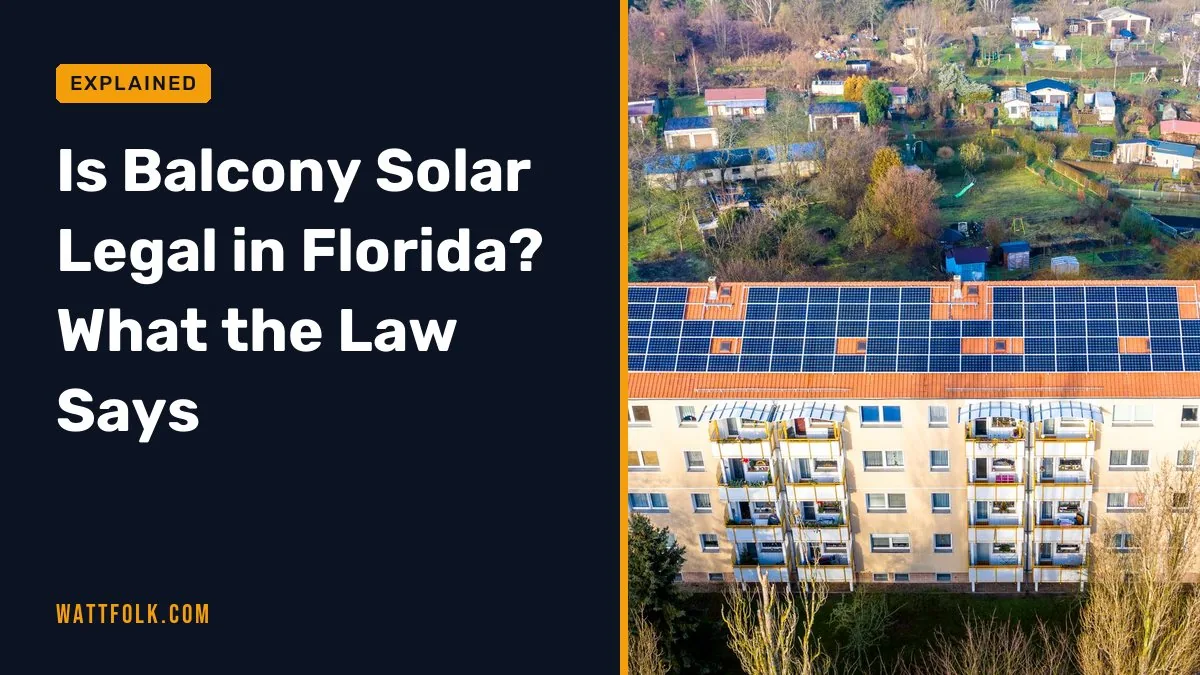
Balcony solar is not banned in Florida, but no statewide law specifically allows plug-in balcony systems. Florida’s solar rights statute also leaves out patio railings in condominiums, cooperatives, and apartments, so a railing-mounted panel usually needs several separate approvals.
Quick answer
Balcony solar is not illegal in Florida, but it is not protected either. Get written permission from your landlord or association first. Then ask your building department and utility what they require before you connect anything to your home’s wiring.
- Best for renters: written landlord approval or a portable off-grid kit
- Best for condo owners: board approval plus a licensed electrician
- Florida Statute 163.04 blocks many bans on solar devices, but it says it does not apply to patio railings in condos, co-ops, or apartments.
- Florida has no specific statewide authorization for plug-in balcony solar.
- Landlord, condo board, building department, and utility approvals are separate. Passing one does not clear the others.
- A panel is not the same as a legal grid connection. The inverter, wiring, and interconnection all matter.
- Never use an extension cord or bypass an inverter’s grid shut-off.
- Is balcony solar legal in Florida?
- Does Florida’s Solar Rights Act protect balcony solar panels?
- Does the patio-railing exception apply to apartments and condominiums?
- Rooftop, balcony, portable, and plug-in solar compared
- Can an HOA or condo association ban solar panels on a balcony?
- Do I need a permit for a balcony solar system in Florida?
- Can I plug balcony solar panels directly into a wall outlet?
- Worked example: a 400-watt panel
- What safety rules apply to mounting panels on a balcony railing?
- Florida balcony solar approval checklist
- What if an association or utility says no?
- Frequently Asked Questions
Is balcony solar legal in Florida?
It is not categorically illegal, but it is a gray area. Florida has no specific statewide law that authorizes plug-in balcony systems. Utility interconnection review, permits, and fees may still apply. Bright Saver tracks the status of plug-in solar in Florida if you want a current summary.
So the real question is not “is it banned?” It is “who must say yes?” In Florida, that can be up to five parties: your landlord or association, the local building department, the electrical inspector, and your utility.
Does Florida’s Solar Rights Act protect balcony solar panels?
Mostly no. Florida Statute 163.04 bars ordinances, deed restrictions, covenants, and similar rules that prohibit or effectively prohibit solar collectors and other renewable-energy devices. That is a strong protection for many rooftop systems.
The statute has limits, though:
- An entity that controls property alterations may choose a roof collector’s location within 45 degrees east or west of due south, as long as the choice does not impair effective operation.
- An HOA cannot add rules that impair solar performance or raise system cost.
- None of this removes building-code, electrical, utility, or safety requirements.
Many articles stop at “Florida protects solar.” That is only half the story.
Does the patio-railing exception apply to apartments and condominiums?
Yes. The statute expressly says it does not apply to patio railings in condominiums, cooperatives, or apartments. That is the key line for balcony solar.
In plain language:
- Condo owner: You may have some protection for solar on the roof or other allowed areas. A panel hanging on your patio railing is outside that protection. The board can say no.
- Apartment renter: The statute mainly addresses ordinances, deed restrictions, and property-control rules. It does not give you a right to attach panels to a landlord’s building. Your lease and your landlord decide.
- Single-family homeowner: A balcony on your own house is not a condo or apartment patio railing. Still, check your deed restrictions and permits.
Rooftop, balcony, portable, and plug-in solar compared
These setups get lumped together online. They face different rules.
| Type | Legal protection | Likely approvals |
|---|---|---|
| Rooftop solar | Strongest. Covered by 163.04 against many bans | Permit, licensed electrical work, utility interconnection, association review of placement |
| Balcony-railing solar | Weak. Patio railings in condos, co-ops, and apartments are excluded | Landlord or board consent, structural review, possible permit |
| Portable battery solar (off-grid) | No specific statute. Not tied to the grid | Lease or association rules, safe placement |
| Plug-in, grid-connected solar | None specific statewide | Utility interconnection review, building and electrical approval, certified equipment |
Can an HOA or condo association ban solar panels on a balcony?
Often, yes. Because of the patio-railing exception, a condo board can usually refuse railing-mounted panels. An HOA covering single-family homes is different. It cannot prohibit or effectively prohibit solar devices, but it can still manage placement within the statute’s limits.
Renters face a simpler rule. Your lease controls. Get permission in writing, not by text or a casual yes.

Do I need a permit for a balcony solar system in Florida?
Often you should expect to. Florida solar contractors must perform applicable work under local, state, and national building codes. Rules differ by city and county, so call your local building department and describe the exact setup. Palm Beach County, for example, publishes solar energy information that shows how one county handles it.
Wiring is the bigger issue. Florida’s exemption for certain residential solar-panel installations still requires a licensed electrical contractor for panel wiring and interconnection to the home’s electrical wiring. See Florida Statutes § 489.103. If any part touches your electrical system, hire a licensed electrician.
Can I plug balcony solar panels directly into a wall outlet?
Do not assume you can. Florida has no specific statewide authorization for it, and utility interconnection review may apply. Does Florida’s utility require interconnection approval for plug-in solar? It may. Ask your utility before you connect.
Owning a panel is one thing. Sending power back through a household outlet is another. That second step is a grid connection, and utilities care because lineworkers rely on equipment shutting off during an outage.
Two safety rules never change:
- Never use an extension cord to connect a solar system to your home.
- Never bypass a microinverter’s grid shut-off.
Worked example: a 400-watt panel
A 400-watt panel does not equal a legal 400-watt grid connection. Here is the output math, with assumptions you can change:
- Panel: 400 watts
- Peak sun hours: 5 per day (assumed for Florida)
- System losses: 20% (heat, wiring, inverter), so 80% delivered
- Electricity price: $0.15 per kWh (assumed)
400 W × 5 hours × 0.80 = 1,600 Wh, or 1.6 kWh per day. At $0.15, that is about $0.24 per day, or roughly $88 per year.
That is the energy. The legal side is separate. To feed that power to the grid you still need an inverter certified for grid use (grid-tied inverters are typically certified to UL 1741), approved wiring, utility interconnection, and building approval. Missing any one can make the setup noncompliant, even if the panel itself is fine.
- You rent: get written landlord consent, or use a portable off-grid kit.
- You own a condo: ask the board in writing, then call the building department.
- You want grid export: contact your utility and hire a licensed electrician.
What safety rules apply to mounting panels on a balcony railing?
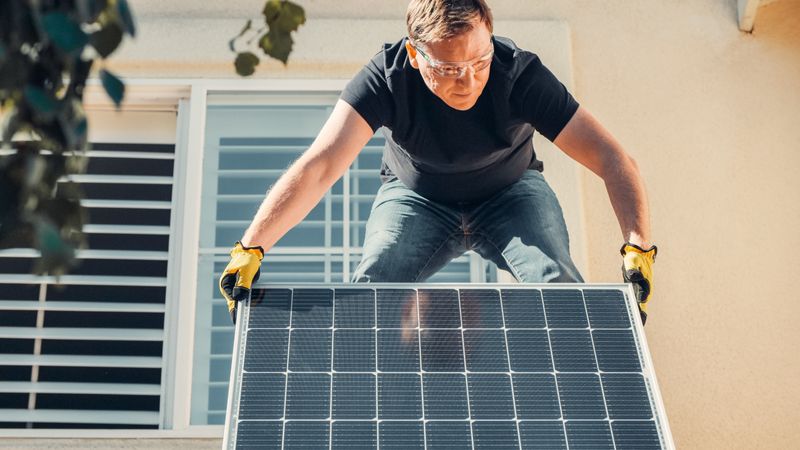
Railings are built to keep people from falling, not to carry panels in a storm. Check these points:
- Wind loading: A panel acts like a sail. Florida storms can load a railing far beyond normal use.
- Attachment: Clamps must fit the railing and be rated for the load. Ask the building owner or an engineer.
- Falling objects: A loose panel can injure people below.
- Emergency egress: Panels must not block exits or fire access.
- Hurricane plans: Know how you will remove and store panels before a storm.
Florida balcony solar approval checklist
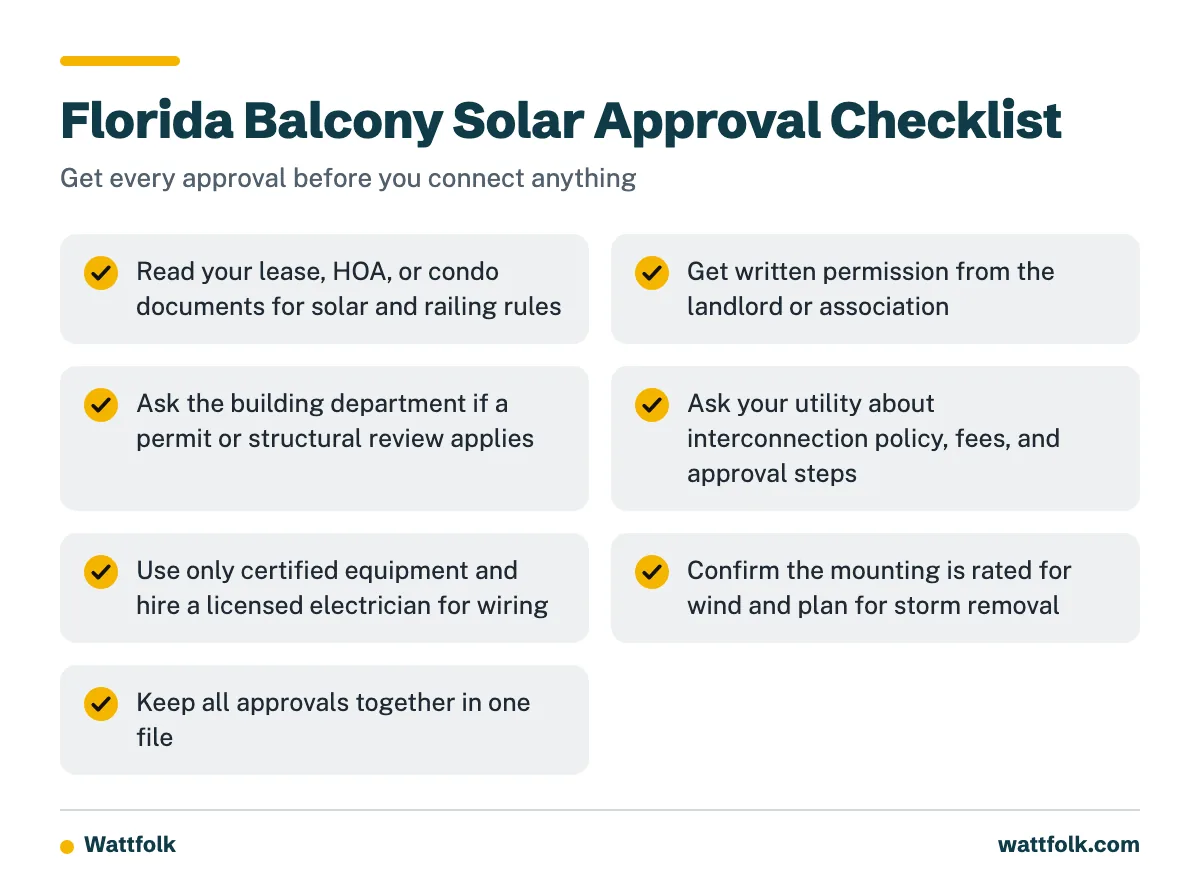
- Read your lease, HOA, or condo documents for solar and railing rules.
- Get written permission from the landlord or association.
- Call the local building department and ask whether a permit or structural review applies.
- Ask your utility about its interconnection policy, fees, and approval steps.
- Use only certified equipment, and hire a licensed electrician for any wiring.
- Confirm the mounting is rated for wind and add a storm removal plan.
- Keep all approvals together in one file.
What if an association or utility says no?
Ask for the denial in writing and the rule it relies on. For a condo or apartment railing, the patio-railing exception means you probably cannot force approval. You can propose changes, like a ground-level or free-standing panel, a portable off-grid kit, or an exemption request to the board.
If a utility rejects interconnection, ask what would make the system approvable, such as a different inverter or a licensed installation. For a legal dispute, talk to a Florida attorney.
Frequently Asked Questions
Is balcony solar legal in Florida?
It is not categorically illegal, but Florida has no specific statewide law authorizing plug-in balcony systems. Landlord, association, building, electrical, and utility approvals may all apply.
Florida solar laws: what should I know first?
Florida Statute 163.04 prohibits rules that prohibit or effectively prohibit solar devices. It does not apply to patio railings in condominiums, cooperatives, or apartments. Building codes, electrical rules, and utility requirements still apply.
Are solar panels illegal in Florida?
No. Solar panels are legal, and state law protects many installations from bans. The protection has limits, especially for balcony railings in multi-family buildings.
Does Florida’s utility require interconnection approval for plug-in solar?
It can. Utility interconnection review, permits, and fees may still apply. Contact your utility before connecting any panel to household wiring.
Sources