

LEDs use up to 75 to 90 percent less energy and last up to 25 times longer than traditional incandescent lighting. The best LED light bulbs balance a high Color Rendering Index (CRI over 80), appropriate color temperature, and reliable electrical components that prevent flickering. Transitioning from older incandescent or compact fluorescent (CFL) bulbs requires matching the correct lumen output and Kelvin rating to your specific room fixtures.
Quick answer
Upgrading your home lighting to modern LEDs drastically reduces energy consumption while offering brighter and more consistent light. Most homeowners should choose standard A19 60-watt equivalent bulbs for general use, and higher lumen options for garages or large workspaces.
- Best for bulk upgrades: dalattin 24 Pack LED Bulbs Daylight White 5000K for replacing whole-house lighting on a budget
- Best for maximum brightness: evelor 6-Pack 100 Watt Equivalent for basements or offices needing intense 1500-lumen output
- Best for smart home integration: Govee Smart Light Bulbs for app-controlled colors and customized routines
Our Winner: dalattin 24 Pack LED Bulbs Daylight White 5000K
Based on specifications and overall value, this 24-pack provides an economical way to switch an entire home to 800-lumen, 9-watt energy-saving bulbs with an 80+ CRI rating.
How We Compared These Models
To determine the most practical lighting solutions, we analyzed standard A19 bulbs based on their lumen-to-watt efficiency, Color Rendering Index (CRI), and predicted longevity. Verified buyer feedback frequently highlights the importance of consistent color temperature and the absence of buzzing. We prioritized models that clearly state their dimming compatibility and offer robust thermal management to ensure they reach their advertised 10,000 to 15,000-hour lifespans.
| Product | Key Specs | Our Choice | Action |
|---|---|---|---|
| dalattin 24 Pack LED Bulbs | 9W (60W Eq), 800 Lumens, 5000K, Non-Dimmable | Best Overall | Check Price |
| evelor 6-Pack LED Light Bulbs | 13W (100W Eq), 1500 Lumens, 5000K, Non-Dimmable | Brightest Option | Check Price |
| Govee Smart Light Bulbs | 800 Lumens, 16 Million Colors, App/Voice Control | Best Smart Features | Check Price |
| Amazon Basics 24-Pack | 60W Eq, 5000K, 10,000 Hrs, Non-Dimmable | Best Budget Value | Check Price |
In-Depth Reviews

1. dalattin 24 Pack LED Bulbs Daylight White 5000K – Best Overall
Our Verdict: This large pack of daylight bulbs offers an exceptional balance of efficiency and color accuracy, ideal for households seeking a complete lighting overhaul.
These dalattin bulbs replace standard 60W incandescents using only 9 watts of power while delivering a full 800 lumens of brightness. Based on the manufacturer’s data, they reduce energy usage by up to 85 percent compared to older technologies. The 5000K daylight color temperature is crisp and invigorating, making it highly suitable for home offices, kitchens, and bathrooms where task lighting is necessary.
A notable feature is the 80+ Color Rendering Index (CRI). This ensures that colors within the room appear natural rather than washed out. The non-flicker technology utilized in these bulbs is designed to minimize eye strain. They are non-dimmable, so they must be used on standard on/off switches to prevent hardware damage.
Why We Like It
- Excellent 80+ CRI rating provides accurate and vivid color representation.
- Massive 24-pack size covers the lighting needs of most average-sized homes in one purchase.
- Constructed without lead or mercury for safer residential use.
Pros & Cons
Pros
- High energy savings (only 9W per bulb)
- UL Listed for safety compliance
- No delay or warm-up time
Cons
- Strictly non-dimmable
- 5000K daylight may be too harsh for cozy bedrooms
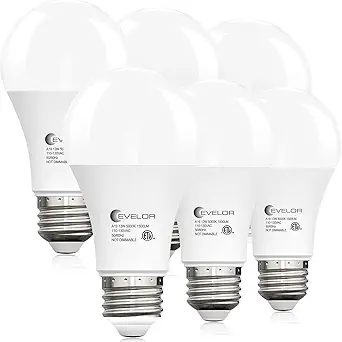
2. evelor 6-Packs A19 LED Light Bulbs, 100 Watt Equivalent – Brightest Option
Our Verdict: For spaces that demand intense illumination, this 100-watt equivalent model delivers 1500 lumens while drawing only 13 watts, making it a powerful utility choice.
When an 800-lumen bulb is insufficient for a large garage, basement, or detailed workspace, the evelor A19 bulbs step in with 1500 lumens. They match the output of traditional 100W incandescent bulbs but achieve up to 90 percent energy savings. Rated for an impressive 15,000-hour lifespan, these bulbs reduce the frequency of climbing ladders to replace dead units in high ceiling fixtures.
Similar to the dalattin model, these feature an 80+ CRI and a 5000K daylight temperature. The manufacturer emphasizes a flicker-free design to ensure stable, strain-free lighting. Buyers should note these are strictly non-dimmable and require a standard E26 base socket.
Why We Like It
- Provides a massive 1500 lumens for dark workspaces, basements, or outdoor covered fixtures.
- Uses only 13 watts, keeping heat generation incredibly low compared to older 100W bulbs.
- Long 15,000-hour rated lifespan lowers maintenance frequency.
Pros & Cons
Pros
- Exceptional brightness per watt
- Crisp 5000K output for task clarity
- Fits standard A19/E26 sockets despite high output
Cons
- Non-dimmable design
- Only includes 6 bulbs per pack

3. Govee Smart Light Bulbs, A19 Color Changing – Best Smart Features
Our Verdict: These Wi-Fi-enabled smart bulbs offer unparalleled control over your home’s ambiance, allowing for custom scheduling and millions of color variations.
Govee provides a massive upgrade over static lighting. These 800-lumen smart bulbs operate on a 2.4GHz Wi-Fi network and connect directly to the Govee Home App. Users can adjust brightness, switch between 16 million colors, and apply 54 preset scene modes directly from a smartphone or via voice commands. The bulbs even feature a music sync mode that changes color based on audio detected by your phone’s microphone.
Routines are simplified with built-in timers. You can program the bulbs to gently brighten at sunrise or dim gradually at bedtime. Note that these smart bulbs contain their own internal dimming hardware. As specified by the manufacturer, they must not be used on circuits controlled by physical smart switches or traditional wall dimmers, as this will cause severe flickering and hardware failure.
Why We Like It
- Full app control removes the need for physical dimmer switches.
- Customizable schedules align lighting with your daily circadian rhythm.
- Group control functionality lets you operate multiple Govee devices simultaneously.
Pros & Cons
Pros
- 16 million color options
- Voice control compatibility
- Dynamic music sync modes
Cons
- Requires a stable 2.4GHz Wi-Fi connection
- Incompatible with physical wall dimmers

4. Amazon Basics A19 LED Light Bulbs, 60W Equivalent – Best Budget Value
Our Verdict: A highly dependable, no-frills bulk lighting solution that provides years of consistent 5000K daylight illumination at a minimal cost per bulb.
The Amazon Basics line offers a straightforward replacement for typical 60-watt incandescents. Rated at a 10,000-hour lifespan, the manufacturer calculates this will provide over 9 years of service based on a standard 3-hour daily usage rate. These bulbs fit the standard E26 base found in the majority of North American lamps and overhead ceiling fixtures.
Producing a crisp daylight white atmosphere, they work well for utility spaces, hallways, and kitchens. Like many budget-friendly LED options on the market, these are explicitly labeled as non-dimmable. Installing them on a dimmable circuit will void the warranty and cause erratic performance.
Why We Like It
- Extremely low upfront cost for a generous 24-pack of bulbs.
- Reliable 10,000-hour lifespan significantly reduces replacement chores.
- Provides instant, full-brightness daylight without any warm-up delay.
Pros & Cons
Pros
- Excellent price-to-volume ratio
- Standard E26 base compatibility
- Consistent 5000K color output
Cons
- Lower rated lifespan (10,000 hrs) compared to premium competitors
- Not rated for enclosed fixtures
Buying Guide: Lumens, Kelvin, and CRI Explained
Understanding modern lighting terminology helps prevent purchasing mistakes. Wattage no longer measures a bulb’s brightness. Instead, check the lumen rating. A standard 60-watt incandescent equivalent LED uses only about 8 to 10 watts to produce 800 lumens of light.
| Lumens (Brightness) | LED Wattage | Incandescent Wattage Equivalent |
|---|---|---|
| 450 Lumens | 4-5W | 40W |
| 800 Lumens | 8-10W | 60W |
| 1100 Lumens | 11-13W | 75W |
| 1500 Lumens | 13-15W | 100W |
Color temperature is measured in Kelvin (K). Warm white light falls between 2700K and 3000K on the Kelvin scale, creating a cozy atmosphere ideal for living rooms. Daylight bulbs, like the 5000K models reviewed above, mimic bright midday sun and work best in garages, home offices, and kitchens.
The Color Rendering Index (CRI) goes up to 100. A CRI of 90 or higher is recommended for accurate, vibrant color representation in residential spaces, though a CRI of 80+ is standard and perfectly adequate for utility and general use.
Solving the Flicker Problem: Bulb Quality vs. Switch Compatibility
Why led light bulb flickering? Most flickering issues arise from installing modern LEDs on outdated dimmer switches designed for incandescent bulbs. Older switches require a higher minimum wattage load to function. Because LEDs draw very little power, the switch cannot regulate the voltage properly, causing a strobe effect.
Additionally, putting a non-dimmable bulb (like the dalattin or Amazon Basics models) on any dimmer switch will immediately cause flickering and eventual bulb failure. To fix flickering, confirm that your bulb is marked ‘dimmable’ and ensure your wall switch is an LED-compatible model.
Health, Safety, and Proper Installation
Does an LED light bulb get hot or can it catch fire? LEDs operate at significantly lower temperatures than incandescents, usually around 140 degrees Fahrenheit (60 degrees Celsius) at the heat sink. This virtually eliminates fire risks under normal conditions. However, a major reason LEDs fail early is improper installation in fully enclosed fixtures. Enclosed ceiling domes trap heat. If a standard LED lacks an “enclosed fixture” rating, its internal electronic components will overheat and burn out prematurely.
Environmental Impact: Disposal and Recycling
Can LED light bulbs go in the trash or be recycled? Unlike compact fluorescent (CFL) bulbs, LEDs do not contain toxic mercury. Consequently, they are legally permitted to go in standard household trash in most municipalities. However, because they contain complex microchips and electronic waste components, recycling them at a designated e-waste facility is the most environmentally responsible choice.
What do owners say?
Owners like
- Massive reduction in monthly electricity bills.
- Instant, full brightness the second the switch is flipped, unlike older CFLs.
- Bulbs last for years without needing replacement.
- Excellent color clarity and skin tone representation with high-CRI models.
Common complaints
- Cheaper generic brands flicker horribly or buzz on older dimmer switches.
- Bulbs dying after a few months because they were installed in fully enclosed ceiling domes without proper ratings.
- The ‘warm’ color from budget brands often looks unnaturally yellow or greenish.
- Noticeable high-pitched humming noises in quiet rooms when dimmed low.
Summarised from owner reviews and long-term user reports; individual experiences vary.
Frequently Asked Questions
What led light bulbs are the best?
The best overall bulbs provide a high CRI rating, consistent Kelvin color temperatures, and feature internal heat sinks that prevent overheating. Models from the dalattin 24-pack line offer excellent general-purpose reliability and energy savings for standard home fixtures.
What led light bulbs are the brightest?
The brightest standard A19 bulbs are usually 100-watt equivalents, producing around 1500 to 1600 lumens. The evelor 6-Pack model reviewed in this guide delivers a full 1500 lumens while consuming only 13 watts of power.
What led light bulbs don t flicker?
To avoid flickering, you must either purchase high-quality non-dimmable bulbs and use them exclusively on standard on/off switches, or purchase dimmable LEDs and pair them with a modern, LED-compatible dimmer switch.
Can led light bulbs catch fire?
LEDs operate at much lower temperatures than older bulbs, virtually eliminating normal fire risks. The primary safety concern is heat buildup in fully enclosed fixtures, which will destroy the bulb’s internal circuitry rather than start a fire.
How led light bulbs work?
LED stands for Light Emitting Diode. Instead of heating a delicate wire filament until it glows, LEDs pass an electrical current through a semiconductor material, which illuminates tiny light sources called diodes. This process is vastly more efficient and generates minimal heat.
Conclusion
Replacing older lighting with modern LED bulbs is one of the easiest ways to lower home energy consumption. For comprehensive upgrades, the dalattin 24-pack offers unmatched efficiency and 800-lumen daylight illumination. If you need intense task lighting, the evelor 100W equivalent models provide 1500 lumens of reliable output. Always ensure your chosen bulbs match your switch type to prevent flickering and maximize their multi-year lifespan.
Affiliate Disclosure: As an Amazon Associate, we may earn commissions from qualifying purchases from Amazon.com. This comes at no extra cost to you and helps support our research.