
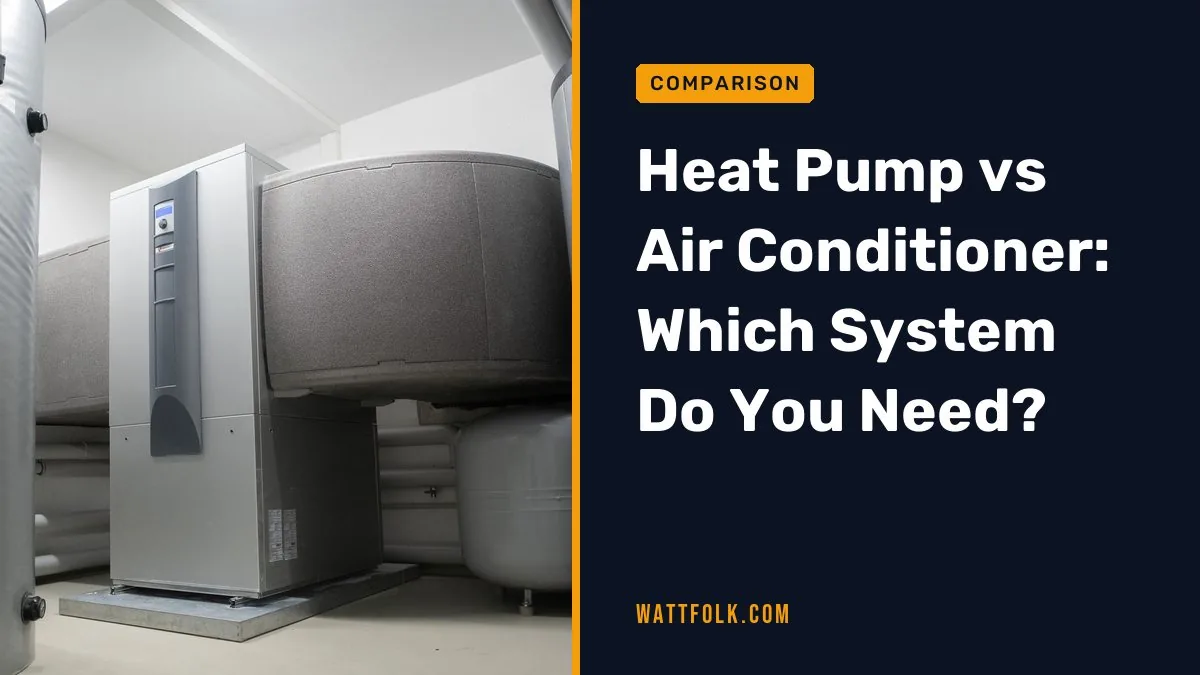
Air conditioners only cool, while heat pumps offer identical cooling plus winter heating. Both cool your home using the exact same refrigeration cycle. The physical difference is a heat pump’s reversing valve, which pumps heat indoors during winter. Because the cooling hardware is identical, a heat pump completely replaces an air conditioner without sacrificing summer cooling.
Quick answer
A heat pump acts as both an air conditioner and a heater. It can fully replace a standard AC unit because it uses the exact same compressor and refrigerant cycle to cool your home.
- Best for total HVAC replacement: Whole-home ducted heat pumps
- Best for cooling specific rooms: Ductless mini-split heat pumps
- Best for homes with gas furnaces: Dual-fuel heat pump systems
- Heat pumps and air conditioners use the exact same mechanical components for cooling.
- A reversing valve lets a heat pump switch directions to provide winter heat.
- In cooling mode, a heat pump has the exact same SEER2 efficiency rating as a standard AC unit.
- Modern cold-climate heat pumps can extract outdoor heat even when temperatures hit -13°F (-25°C).
- What is a heat pump vs an air conditioner?
- How does a heat pump air conditioner work?
- Can a heat pump replace an air conditioner?
- Are heat pump air conditioners any good at cooling?
- Cost Analysis: Total Cost of Ownership
- Do heat pumps cost more to run than traditional AC units?
- Is a heat pump a good choice for UK homes?
- What do owners say?
- Frequently Asked Questions
What is a heat pump vs an air conditioner?
An air conditioner is basically a one-way heat pump. Both systems move heat from one place to another using refrigerant.
Inside the metal box sitting outside your house, both machines share the same four mechanical components: a compressor, a condenser, an expansion valve, and an evaporator. When you turn on an air conditioner, it absorbs the warm air inside your living room, transfers that heat into the refrigerant, and pumps it outside.
A heat pump does this exact same job in the summer. But when winter arrives, a standard air conditioner shuts down. A heat pump goes to work. It uses a specific part called a reversing valve to change the direction of the refrigerant. Instead of pushing heat out, it absorbs trace amounts of heat from the cold outdoor air and pushes it inside.
How does a heat pump air conditioner work?
A heat pump air conditioner works by manipulating the pressure of chemical refrigerant. When refrigerant expands, it gets very cold and absorbs heat. When it compresses, it gets very hot and releases heat.
The reversing valve is what changes the game. This simple brass valve shifts back and forth, physically changing the path the refrigerant takes through the system.
| Component Role | Cooling Mode (Summer) | Heating Mode (Winter) |
|---|---|---|
| Indoor Coil | Acts as the evaporator (absorbs heat) | Acts as the condenser (releases heat) |
| Outdoor Coil | Acts as the condenser (releases heat) | Acts as the evaporator (absorbs heat) |
| Reversing Valve | Directs hot gas outside | Directs hot gas inside |
Because these systems move heat rather than generate it through combustion or electrical resistance, they are highly efficient. Based on manufacturer specifications, heat pumps routinely achieve efficiencies of 300% to 400%. This is known as a Coefficient of Performance (COP) of 3.0 to 4.0.
Can a heat pump replace an air conditioner?
Yes. A heat pump can completely replace a dedicated air conditioner. You will not notice any difference in how your home feels during the summer.
However, you will notice a difference in the winter. Heat pumps have a “defrost cycle.” When outside temperatures drop near freezing, moisture in the air freezes on the outdoor coil. The heat pump must temporarily switch back into cooling mode to send hot gas outside and melt the ice.
From the Shop
Every winter, first-time heat pump owners call in a panic because their outdoor unit is “smoking.” We always explain the defrost cycle. That is not smoke; it is steam rising from the melting ice. During this 5-to-10-minute cycle, the system might briefly blow cool air into the house. This is completely normal behavior.
Are heat pump air conditioners any good at cooling?
They are excellent at cooling. In cooling mode, a heat pump has the exact same cooling capacity and efficiency as an equivalently sized air conditioner.
Efficiency is measured by a SEER2 rating (Seasonal Energy Efficiency Ratio). A 3-ton air conditioner with an 18 SEER2 rating will cool your home just as fast, and use the exact same amount of electricity, as a 3-ton heat pump with an 18 SEER2 rating.
Cost Analysis: Total Cost of Ownership
Upfront installation costs for a heat pump are usually higher than simply replacing a broken AC unit. To see the real value, you must look at a 10-year Total Cost of Ownership (TCO).
The following example compares replacing an entire central AC and gas furnace system versus installing a whole-home heat pump. Assumptions: 3-ton system. US national average electricity price of $0.17 per kWh (EIA data). Natural gas at $1.50 per therm. 2,000 kWh used for summer cooling. Heating load requires either 500 therms of gas or 5,000 kWh of heat pump electricity annually.
| Expense Category | New AC + Gas Furnace | Whole-Home Heat Pump |
|---|---|---|
| Estimated Upfront Install | $9,500 | $11,500 |
| Annual Cooling Cost | $340 (2,000 kWh) | $340 (2,000 kWh) |
| Annual Heating Cost | $750 (500 therms) | $850 (5,000 kWh) |
| Total Energy Cost (10 Years) | $10,900 | $11,900 |
| 10-Year TCO | $20,400 | $23,400 |
In this strict example, the heat pump costs slightly more over a decade. However, this does not factor in federal or state tax credits. When you apply US tax credits (often up to $2,000 under current federal programs), the lifetime costs become nearly identical.
Do heat pumps cost more to run than traditional AC units?
For summer cooling, they cost exactly the same. For winter heating, the cost depends entirely on your local utility rates.
- If electricity is cheap (under 15 cents/kWh) and you lack natural gas: A heat pump will drastically lower your heating bills compared to propane, oil, or electric baseboards.
- If you pay high electricity rates (over 25 cents/kWh) but have cheap natural gas: A heat pump will cost more to heat your home than a high-efficiency gas furnace.
- If you want the best of both: Install a dual-fuel system. This pairs a heat pump with a gas furnace. The heat pump runs during mild weather, and the furnace kicks on only during severe freezing temperatures.

Is a heat pump a good choice for UK homes?
Many US buyers read about the massive shift toward heat pumps in the UK and wonder how it affects the industry. In the UK, dedicated ducted AC is rare, but ductless air-to-air heat pumps are gaining massive traction for year-round climate control.
UK buyers face a specific hurdle: air-to-air heat pumps do not currently qualify for their national Boiler Upgrade Scheme (a grant worth roughly $9,500 USD), which is restricted to air-to-water systems.
For US homeowners, the situation is much more favorable. The US tax system generally rewards air-to-air systems. Whether you are installing a ductless mini-split in a converted garage or a fully ducted system for a four-bedroom house, US rebates make these systems highly competitive.
What do owners say?
Owners like
- Love having one single unit to maintain for both summer cooling and winter heating
- Extremely quiet operation, especially with modern inverter-driven mini-splits
- Noticeably lower winter utility bills compared to traditional electric baseboard heating
Common complaints
- The winter defrost cycle can be noisy and sometimes blows briefly cool air into the room
- Higher upfront installation costs compared to just replacing a broken AC unit
- The outdoor condenser unit is bulky and can take up valuable patio or garden space
Summarised from owner reviews and long-term user reports; individual experiences vary.
Frequently Asked Questions
what is heat pump vs air conditioner?
The difference lies entirely in the heating capability. An air conditioner only removes heat from your house to cool it down. A heat pump does the exact same thing in the summer, but can reverse the process in the winter to pull outdoor heat inside.
how does heat pump air conditioner work?
It works by circulating chemical refrigerant between an indoor and outdoor coil. In cooling mode, the refrigerant absorbs indoor heat and dumps it outside. In heating mode, a reversing valve flips the flow, allowing the cold refrigerant to absorb ambient heat from the outdoor air and compress it to warm your home.
can heat pump replace air conditioner?
Yes. A heat pump is a direct replacement for an air conditioner. It connects to your existing ductwork or mounts on your wall, providing the exact same level of cooling power and humidity control during the summer.
is heat pump air conditioner?
Yes, a heat pump is an air conditioner. Every heat pump has full air conditioning capabilities built in. The term “heat pump” simply means it has the added ability to pump heat in reverse during the winter.
are heat pump air conditioners any good?
They are excellent. Modern units provide highly efficient cooling with SEER2 ratings that match top-tier dedicated air conditioners. Furthermore, cold-climate models can now successfully heat homes even when outdoor temperatures fall to -13°F (-25°C).