
Picking a bifacial panel by headline wattage or the biggest advertised gain percentage is the most common mistake, because neither number tells you how much light reaches the rear. Instead, compare front-side watts, claimed cell efficiency, warranty, weight, and the surface the panel will sit on. Every product below is a foldable portable panel for power stations, RVs, and camping, not a rooftop module.
Quick answer
Based on specifications, the ZOUPW 450W PRO is the best overall pick: 25.6% claimed efficiency, 20.9 lbs, and a 4-zone anti-shade layout. Size your system by front-side watts only. Treat rear gain as a bonus.
- Best overall: ZOUPW 450W PRO
- Best budget: 110W Foldable Bifacial
- Best for portability: ZOUPW 230W
- Best premium: ZOUPW 480W
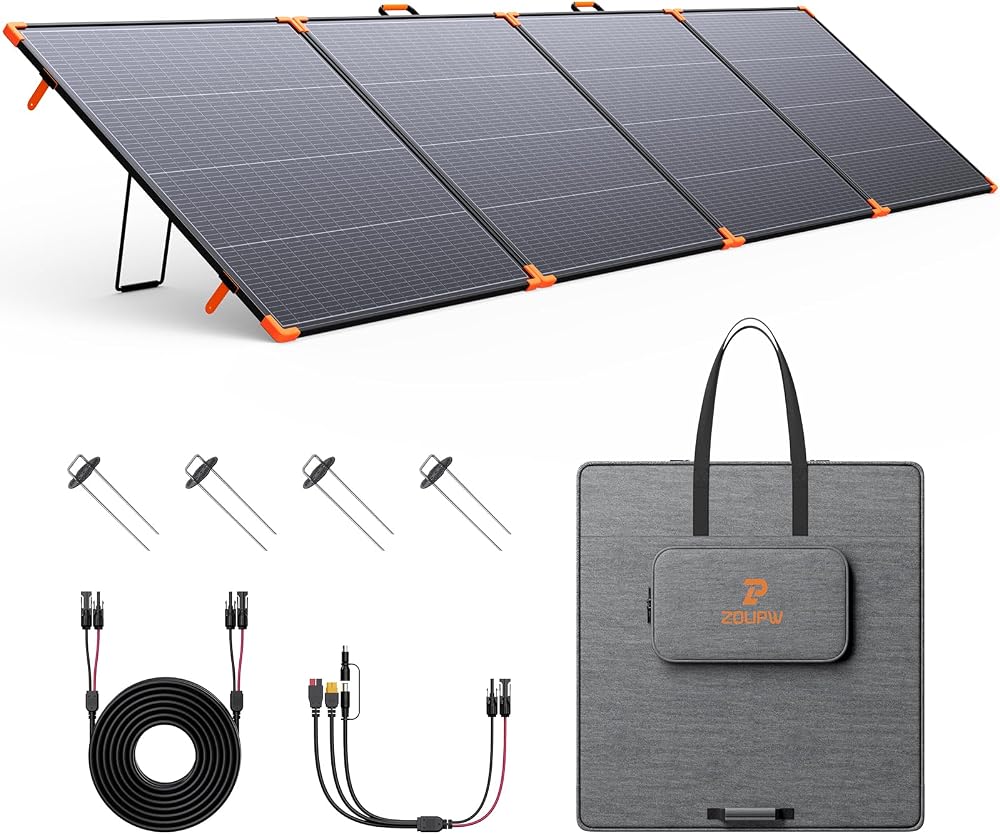
Our Winner: ZOUPW 450W PRO Bifacial Portable Solar Panel N-Type 16BB
The listing claims 25.6% cell efficiency, a 20.9 lb composite build, and a 4-zone parallel circuit that limits shade losses. It also lists wind and snow load ratings and a 36-month warranty with a 30-day money-back guarantee. Its 46.0V open-circuit voltage suits power stations that accept 40 to 60V input.
How We Compared These Models
This comparison relies on listing specifications and patterns in Amazon buyer ratings, not hands-on testing. Four criteria matter most: front-side wattage, claimed efficiency, weight and fold size, and warranty length. Rear-gain claims are weighted lightly because they depend on the ground surface, not the panel.
| Product | Key Specs | Our Choice | Action |
|---|---|---|---|
| ZOUPW 450W PRO | 450W, 25.6% claimed efficiency, 20.9 lbs, 36-month warranty | Editor’s Choice | |
| GEYOTO 200W Bifacial | 200W, up to 26% cell efficiency, reflective case, 2-year warranty | Best Rated Mid-Size | |
| ZOUPW 230W | 230W, 25% claimed efficiency, 12.6 lbs, tri-fold | Best for Portability | |
| ZOUPW 480W | 480W, 25% claimed efficiency, 22.5 lbs, 42.5V | Best Premium | |
| 110W Portable Bifacial | 110W, up to 25% efficiency, ETFE, about 6 kg, IP67 | Best Budget |
What Does a Bifacial Solar Panel Mean?
A bifacial solar panel generates electricity from both its front and rear surfaces. The front collects direct sunlight, while the rear collects light reflected from the ground or surroundings.
That is how bifacial solar panels work: rear output is added to front output, so the panel only benefits when light actually reaches the back. For a deeper primer, see this complete guide to dual-sided generation.
How Are Bifacial Solar Panels Rated?
Front-side nameplate wattage is normally stated under standard test conditions: 1,000 W/m² irradiance, 25°C cell temperature, and AM1.5 spectrum. That figure does not include rear gain.
Two other conditions appear on professional datasheets. BNPI adds 135 W/m² on the rear, and aBSI adds 300 W/m² or another manufacturer-specified rear value. Bifaciality factor is rear output divided by front output under comparable irradiance, so an 80% factor means the rear can produce 80% as much as the front.
None of these listings publishes a bifaciality factor, temperature coefficient, or BNPI/aBSI rating. The percentages they quote, such as “up to 30%,” are manufacturer claims for high-albedo surfaces like snow, not guaranteed output.
Do Bifacial Solar Panels Work on Roofs?
They can, but only when the rear sees light. A flush-mounted panel on a dark pitched roof receives almost no useful rear light, while an elevated panel over a white flat roof can gain materially. Practical guidance commonly recommends at least about 30 cm of rear clearance, with roughly 50 to 100 cm giving better access to reflected and diffuse light.
Pitched roofs usually fail the clearance test. Flat roofs with tilt-up racking pass more often. The portable panels reviewed here are designed for ground or temporary use. The ZOUPW 480W listing even advises against long-term fixed installation.
Roof Suitability Score
Score your site out of 100. Above 70, bifacial is likely worth a premium. From 40 to 69, the case is marginal. Below 40, buy monofacial.
| Factor | Max Points | Full Score | Zero Score |
|---|---|---|---|
| Rear clearance | 30 | 50 cm or more | Flush mount |
| Surface reflectivity | 25 | White membrane, snow, light sand | Dark shingle or asphalt |
| Panel tilt | 15 | Steep tilt with open rear | Near-flat against surface |
| Shading | 15 | No shade on rear | Rear shaded all day |
| Rear obstructions | 15 | Open racking | Solid backing or rails across cells |
Specification Comparison
The table shows what each listing actually publishes. “Not listed” means the product page did not state it, so ask the seller before relying on it.
| Model | Front Watts | Efficiency (claimed) | Bifaciality Factor | Temp Coefficient | Degradation | Warranty | Size / Weight | Intended Use |
|---|---|---|---|---|---|---|---|---|
| ZOUPW 450W PRO | 450W | 25.6% | Not listed | Not listed | Not listed | 36 months | 20.9 lbs | Large power stations |
| GEYOTO 200W | 200W | Up to 26% (cell) | Not listed | Not listed | Not listed | 2 years | Not listed | Camping, RV |
| ZOUPW 230W | 230W | 25% | Not listed | Not listed | Not listed | 36 months | 12.6 lbs | Mid-size RV, backup |
| ZOUPW 480W | 480W | 25% | Not listed | Not listed | Not listed | 36 months | 22.5 lbs | RV, home backup |
| 110W Portable | 110W | Up to 25% | Not listed | Not listed | Not listed | Not listed | 600x574x70mm folded, about 6 kg | Small stations, camping |
In-Depth Reviews

1. ZOUPW 450W PRO Bifacial Portable Solar Panel – Editor’s Choice
Our Verdict: The strongest balance of output, weight, and shade tolerance in this group, and it carries the highest buyer rating at 5.0/5 on Amazon.
The listing describes N-Type 16BB cells at 25.6% efficiency with a composite top layer weighing 20.9 lbs, which it compares to 29.5 lbs for standard 450W panels. The 4-zone parallel layout is meant to reduce loss from leaves, clouds, or tree shadows. It lists 2400Pa wind and 5400Pa snow load ratings, and IP68 sealing.
The manufacturer’s rear-gain figures are surface-specific: up to 30% on snow, 20% on sand, 15% on concrete, 10% on dirt, and 5% on asphalt. These are claims, so use them as a ranking of surfaces, not a forecast. The 46.0V Voc requires a power station that accepts 40 to 60V input.
Why We Like It
- Highest watts-per-pound among panels with a listed weight, at roughly 21.5 W/lb by calculation
- 4-in-1 cable with Anderson, XT60, DC7909, and DC8020 connectors
- 36-month warranty plus a 30-day money-back guarantee
Pros & Cons
Pros
- Anti-shading circuit layout
- Light for its output
- Ground stakes and extension cable included
Cons
- High voltage limits compatibility with smaller stations
- No bifaciality factor published

2. GEYOTO S200 200W Bifacial Portable Solar Panel – Best Rated Mid-Size
Our Verdict: A well-rated 200W option with a clever reflective carrying case, suited to people who want a simple camping or RV setup.
It holds a 4.8/5 rating on Amazon. The listing cites N-Type cells with up to 26% cell conversion efficiency and four-layer lamination. The carrying case has a built-in reflective layer meant to support rear-side collection, which is a practical idea for a portable panel.
The Y-shaped carbon-steel kickstand and integrated sundial help with setup. One caveat: the panel surface is IP68-rated, but the junction box is not waterproof, so keep it out of rain and standing water. The 2-year limited warranty is shorter than the 36 months on the ZOUPW models.
Why We Like It
- 10 ft MC4-to-XT60 cable lets the station stay in shade
- Reflective case doubles as a rear reflector
- Strong buyer rating
Pros & Cons
Pros
- Stable triangular kickstand
- Concealed connector design
Cons
- Junction box is not waterproof
- Weight and dimensions not listed

3. ZOUPW 230W Bifacial Portable Solar Panel – Best for Portability
Our Verdict: The lightest panel with a listed weight, best for travelers who carry gear by hand.
At 12.6 lbs and 18.3 W/lb, per the listing, it is far easier to move than the larger ZOUPW models. The tri-fold design and storage bag suit mid-size RVs and backup kits. The manufacturer claims over 1 kWh of daily output in peak sun, which depends heavily on location and season.
It uses N-Type 16BB cells at a claimed 25% efficiency, IP68 sealing, and a 5-in-1 adapter cable with a 10 ft length. Buyers rate it 4.4/5, a bit lower than the other ZOUPW panels.
Why We Like It
- 12.6 lb composite build
- 5-in-1 adapter cable for broad station compatibility
- 36-month warranty
Pros & Cons
Pros
- Easy to carry and store
- Complete package with cable and bag
Cons
- Lower power density than the 450W and 480W models
- Lower rating than the top picks

4. ZOUPW 480W Bifacial Portable Solar Panel – Best Premium
Our Verdict: The highest output here, aimed at large power stations and RV owners who want one panel instead of several.
The listing claims it replaces five 100W glass panels and weighs 22.5 lbs, or 21.3 W/lb. It runs at 42.5V with N-Type 16BB cells at a claimed 25% efficiency, and includes a 13 ft extension cable, 2 ft 4-in-1 cable, and four ground stakes. It is rated 4.7/5 on Amazon.
The safety notes matter: the manufacturer does not recommend long-term fixed installation, series or parallel connection of mismatched panels, or use in shade. That limits its use as a permanent home array.
Why We Like It
- Most watts per panel in this group
- IP68 rating with heat tolerance up to 140°F, per the listing
- 36-month warranty
Pros & Cons
Pros
- Fewer panels to set up
- Strong power density
Cons
- Highest price in this group
- Not intended for fixed or shaded use

5. 110W Portable Solar Panels Bifacial, Foldable – Best Budget
Our Verdict: The cheapest way into bifacial portable power, suited to small stations and occasional camping.
It lists 110W peak power, 25.9V open-circuit voltage, and 10.1A maximum power current. ETFE lamination, an IP67 rating, and a -10°C to +65°C operating range cover normal outdoor use. It folds four times to 600x574x70mm at about 6 kg (roughly 13 lbs).
That weight gives it the lowest power density here, near 8 W/lb. The adapter set is the broadest, covering MC4 to Anderson, XT60, DC7909, and DC5521. Its 4.2/5 rating is the lowest of the five, and the listing does not state a warranty length.
Why We Like It
- Lowest cost of entry
- Four adapter cables included
- Adjustable kickstand
Pros & Cons
Pros
- Affordable
- Wide connector support
Cons
- Heavy for its output
- Warranty not listed
How Much Extra Electricity Can Bifacial Panels Produce?
Reported real-world gains commonly range from roughly 5% to 10% over ordinary ground and about 15% to 20% over a bright surface. Clearance, reflectivity, tilt, shading, and rear obstruction change the result sharply.
Worked Example: 10 kW Monofacial vs 10 kW Bifacial
These numbers are an illustration, not measurements. They assume a baseline of 14,000 kWh per year for the monofacial array and an electricity value of $0.15 per kWh.
| Condition | Assumed Rear Gain | Monofacial 10 kW | Bifacial 10 kW | Extra Value per Year |
|---|---|---|---|---|
| Flush dark roof | 1% | 14,000 kWh | 14,140 kWh | About $21 |
| Elevated white flat roof | 15% | 14,000 kWh | 16,100 kWh | About $315 |
| Open ground mount | 7% | 14,000 kWh | 14,980 kWh | About $147 |
The flush dark roof barely repays any premium, while the white flat roof can. This is why a flush dark pitched roof and an elevated white flat roof should never be treated as equivalent. See this bifacial vs monofacial comparison for more context.
Are Bifacial Solar Panels Worth the Additional Cost?
They are worth it when the extra kWh per year, valued at your rate, exceeds the price premium over the lifetime of the panel. They are not when the rear is blocked, shaded, or sits over dark material.
Bifacial is also not automatically better. A high bifaciality factor does not offset weak front-side efficiency, a poor temperature coefficient, a short warranty, or a high installed price. Glass-glass modules in fixed arrays also need compatible racking. The installation and mounting guide covers rear access and racking in detail.
What Should Buyers Check Before Choosing a Bifacial Panel?
- Size the system on front-side STC wattage, then model rear gain separately. Do not treat the advertised bifacial percentage as guaranteed output.
- Confirm your power station’s input voltage range against the panel’s Voc and wattage limits.
- Ask for bifaciality factor, temperature coefficient, and BNPI or aBSI ratings. Most listings here omit them.
- Compare warranty length. These portable panels list 2 to 3 years, far shorter than typical rooftop module terms.
- Check weight and folded dimensions against how you will carry and store it.
- Place the panel over a light, open surface with clear space behind it.
Questions for sellers or installers: What rear irradiance does the stated power assume? What is the degradation guarantee? What clearance and tilt does the manufacturer recommend?
What Do Owners Say?
Owners like
- Good output where panels are elevated and the rear surface receives reflected light
- Useful performance on carports, open racks, ground mounts, and other installations with rear exposure
- Strong output from modern n-type bifacial modules in high-sun conditions
- Glass-glass designs are often viewed positively for durability and long-term outdoor exposure
- Some owners report years of reliable operation when panels are correctly mounted and ventilated
Common complaints
- Little or no noticeable bifacial benefit on flush-mounted or poorly ventilated roofs
- Rear-side gains are hard to verify because monitoring often reports total array output rather than front and rear separately
- Glass-glass modules can be heavier and may need more careful handling and compatible racking
- Inconsistent panel-to-panel performance in some lower-cost products
- Warranty or support problems are a recurring concern in some budget-panel reports, including failures within the first one to two years
Summarised from owner reviews and long-term user reports; individual experiences vary.
Frequently Asked Questions
Which bifacial solar panel is best?
Based on specifications and buyer ratings, the ZOUPW 450W PRO is the best overall in this group. For a lighter carry, the ZOUPW 230W is better, and for the lowest cost, the 110W panel fits.
How do bifacial solar panels work?
The front collects direct sunlight and the rear collects reflected and diffuse light. Total output is the sum of both, so the surface behind the panel decides the gain.
Do bifacial solar panels work?
Yes, they generate power from both sides, but the benefit varies. Light surfaces such as snow, sand, or white membranes help most, and dark asphalt helps least. The ZOUPW 450W PRO listing claims only 5% on asphalt versus up to 30% on snow.
Can bifacial solar panels be used on a roof?
They can on elevated flat-roof racking over a reflective surface. On a flush dark pitched roof the rear gain is minimal. The panels reviewed here are portable models, so they are not designed for permanent roof installation.
Why are bifacial solar panels better?
They capture more light from the same footprint when the rear is exposed. They are not better everywhere, so run the roof suitability score before paying a premium.
Conclusion
For most buyers, the ZOUPW 450W PRO offers the best mix of claimed efficiency, low weight, shade handling, and warranty. The GEYOTO 200W suits simpler camping setups, the ZOUPW 230W wins on portability, the ZOUPW 480W delivers the most power per panel, and the 110W model is the budget entry.
Whichever you choose, size by front-side watts, place the panel over a light surface with open space behind it, and treat rear gain as a bonus, not a promise. Some of the links on this page are affiliate links.
Sources
Affiliate Disclosure: As an Amazon Associate, we may earn commissions from qualifying purchases from Amazon.com. This comes at no extra cost to you and helps support our research.