
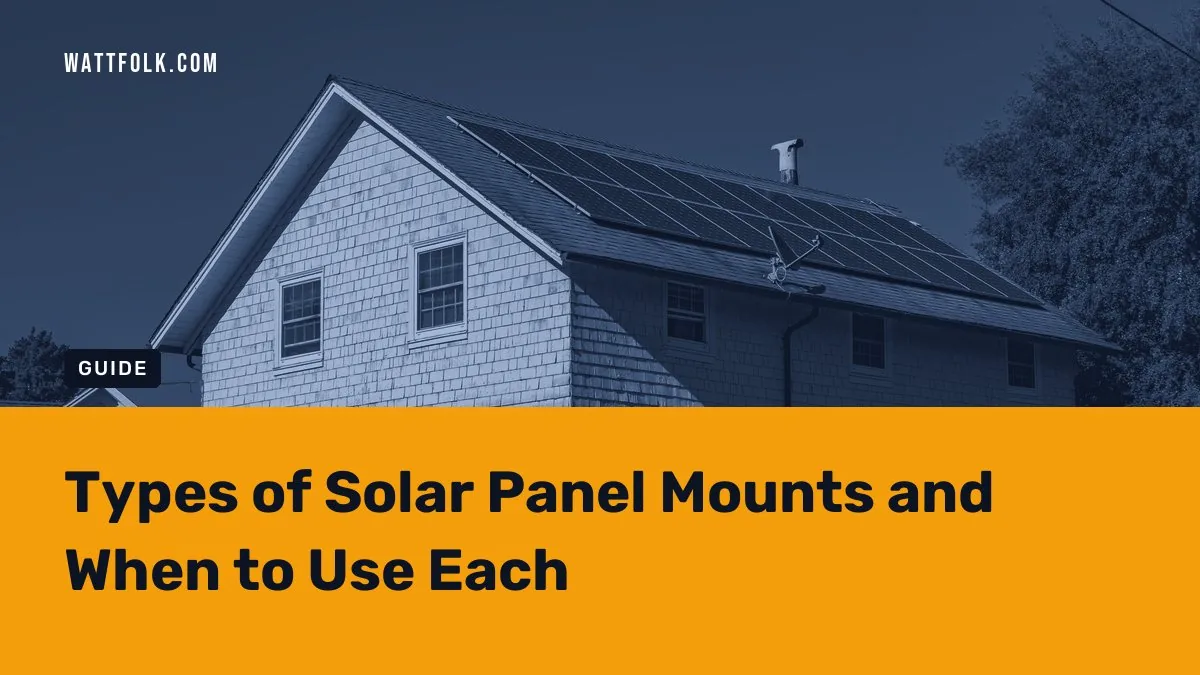
Solar panel mounts fall into seven main types: roof, ground, pole, carport, balcony or facade, floating, and tracking mounts. Roof mounts and fixed ground mounts suit most installations. The others solve specific problems, such as tight roof space, parking areas, or large sites. This guide sorts the options into clear groups so you can match a mount to your roof, land, and budget before you ask for quotes.
Quick answer
Most homes use a rail-based roof mount if the roof is sound, or a fixed-tilt ground mount if it is not. Pole mounts, carports, and trackers are for special cases. Always confirm the design with a structural check.
- Best for most homes: roof mount, lowest added footprint
- Best for weak or shaded roofs: ground mount
- Best for large open sites: single-axis tracker
- Four separate choices make up a mount: location, roof bracket design, foundation type, and tracking method.
- The roof covering decides the bracket. Shingle, tile, and metal each need different waterproofing.
- Flat roofs use ballasted (non-penetrating) or mechanically attached (penetrating) systems. Wind uplift and roof strength decide which.
- Trackers add energy but also moving parts, row spacing, and storm stow needs.
- Ask for project-specific structural design, not just a generic bracket rating.
- What Are the Different Types of Solar Panel Mounts?
- What Are the Different Types of Solar Panel Brackets for Pitched Roofs?
- Which Solar Mount Is Best for Each Roof Type?
- What Are Ballasted and Penetrating Flat-Roof Mounts?
- What Is the Difference Between a Roof Mount and a Ground Mount?
- Are Pole-Mounted Solar Panels Better Than Roof-Mounted Panels?
- What Solar Mounting Option Works for a Carport, Balcony, Facade, or Shed?
- When Should I Use Fixed Tilt, Adjustable Tilt, or a Solar Tracker?
- How Do Wind, Snow, Roof Condition, Shading, and Soil Affect Mount Selection?
- What Parts Make Up a Mounting System?
- Side-by-Side Comparison
- Decision Path: Which Mount Fits Your Project?
- Worked Example: Same Panels, Three Mounts
- What Should I Check Before Comparing Solar Mounting Quotes?
- Frequently Asked Questions
What Are the Different Types of Solar Panel Mounts?
Solar mounting systems can be installed on roofs, ground structures, facades, balconies, carports, and floating platforms, according to manufacturers such as Apex Solar Mount. Many guides jumble these into one long list. It is clearer to treat them as four separate decisions:
- Location: roof, ground, pole, carport, balcony, facade, or water.
- Roof bracket design: rail-based, rail-less, shared-rail, or tile hook.
- Foundation (ground only): driven piles, ground screws, or concrete.
- Tracking method: fixed tilt, adjustable tilt, single-axis, or dual-axis.
You pick one answer from each group that applies. A ground array, for example, might be a ground-screw foundation with a fixed tilt. A pitched roof array might be rail-based with tile hooks and no tracking at all.
What Are the Different Types of Solar Panel Brackets for Pitched Roofs?
Pitched roofs mainly use four bracket styles: rail-based, rail-less, shared-rail, and tile-hook systems. Each one links panels to the roof structure in a different way.
Rail-based mounts
Brackets (feet) bolt to the roof. Long aluminum rails run across them, and clamps hold the panels on the rails. This is the most common design. Rails make it easy to line up panels and handle uneven rafter spacing.
Rail-less mounts
Each panel attaches directly to its own bracket, with no long rails. This can cut parts and weight. It needs more careful layout, because each attachment point must land on solid structure.
Shared-rail mounts
Two rows of panels share one rail instead of each row having its own. This uses less material, but panel rows must line up with the rail layout.
Tile-hook brackets
These slide under or replace a roof tile and hook onto the rafter below. They keep the load on the structure rather than the tile. Tile type matters, so the hook must match your tile profile.

Which Solar Mount Is Best for an Asphalt-Shingle, Tile, Metal, or Flat Roof?
The best mount is the one made for your roof covering. Manufacturers design products for tile, asphalt shingle, standing-seam metal, trapezoidal metal, and flat commercial roofs.
| Roof type | Typical mount | What to watch |
|---|---|---|
| Asphalt shingle | Flashed feet with lag screws into rafters | Waterproof flashing; roof age |
| Tile | Tile hooks or replacement tile mounts | Tile profile; broken tiles during install |
| Standing-seam metal | Seam clamps, no roof holes | Seam profile and clamp match |
| Corrugated or trapezoidal metal | Fasteners with sealing washers or special brackets | Sealing at each fastener |
| Flat roof | Ballasted or mechanically attached racks | Wind uplift; roof strength |
Roof age matters as much as roof type. Panels often last decades. If the roof will need replacing sooner, it is usually cheaper to replace it first than to remove and reinstall the array later.
What Are Ballasted and Penetrating Flat-Roof Mounts?
Ballasted mounts sit on the roof and use weight to resist wind. Penetrating (mechanically attached) mounts are fastened into the roof structure. The right choice depends on roof construction, wind uplift, ballast weight, and structural capacity.
- Ballasted: no or few roof holes, so less risk to the membrane. The added weight must be supported by the roof. Protective pads are used under the racks.
- Mechanically attached: adds little weight and holds well against uplift. Each attachment must be sealed against leaks.
Flat-roof racks are often set at a low tilt, either facing south or in an east-west layout. Low tilt means less wind load and tighter spacing. East-west layouts fit more panels on a roof but spread output across the day. Both usually need engineering sign-off, because wind uplift at roof edges and corners can be much higher than in the middle.
What Is the Difference Between a Roof Mount and a Ground Mount?
A roof mount uses space you already have and keeps the yard clear. A ground mount sits on its own foundation, so it does not depend on your roof. Ground arrays are also easier to reach for cleaning and repair.
Ground foundations include driven piles, ground screws, concrete foundations, and other engineered bases, as described by suppliers such as Antaisolar.
- Driven piles: steel posts pushed into the soil. Fast, but rocky ground can stop them.
- Ground screws: screw-in steel anchors with little digging. Good for tricky or sensitive sites.
- Concrete: footings or ballast blocks. Suited to ground where piles will not hold, but slower and harder to undo.
The trade-offs are land use, trenching for cables, and possible permit needs for a freestanding structure.

Are Pole-Mounted Solar Panels Better Than Roof-Mounted Panels?
Not in general. Pole mounts are better only when the roof is shaded, weak, or too small. They lift panels on a pole set in the ground, which can help in places with snow or grazing animals, and they use little ground area.
- Single-pole: one post holds the whole array.
- Multi-pole: several posts carry a larger frame.
- Top-of-pole: panels sit on a frame at the top of the post.
- Side-of-pole: panels attach along the side of the post.
Pole mounts handle small to mid-sized arrays. Large poles need a proper foundation and wind-load design. For a typical home with a good south-facing roof, a roof mount is simpler and often cheaper.
What Solar Mounting Option Works for a Carport, Balcony, Facade, or Shed?
Each of these is its own mounting application, not just a roof or ground rack variant.
- Carports: a solar carport combines a parking structure with an array. It gives shade and power from land that is already paved, but needs a full structural design and foundations.
- Balconies: railing or wall brackets hold small panels. Renters should get landlord or building approval. Plug-in solar rules differ by state and change quickly, so confirm with your utility before connecting anything. Connect only as the product instructions say. Never use an extension cord, and never bypass a microinverter’s grid shut-off.
- Facades: panels fixed to a wall. Output is lower than from a well-angled roof, but it helps when roof space is limited. Fixings must suit the wall type.
- Sheds: roof mounts work if the roof frame can carry the load. Small outbuildings are often lightly built, so check the structure first.
- Floating solar: panels on floats on ponds or reservoirs. This is mostly for larger water sites, not typical homes.
A licensed electrician should handle any hardwired connection, no matter how simple the mount looks.
When Should I Use Fixed Tilt, Adjustable Tilt, or a Solar Tracker?
Use fixed tilt for most projects. Use adjustable tilt if you will change the angle by season and can reach the array. Use a tracker only for larger ground-mounted projects where extra output is worth extra cost.
- Fixed tilt: no moving parts, lowest upkeep.
- Adjustable tilt: angle changed by hand a few times a year. Cheap to add, but you must remember to do it.
- Single-axis tracker: moves panels along one axis to follow the sun across the day.
- Dual-axis tracker: adjusts in two directions to follow the sun more closely.
Ground arrays are commonly offered as fixed tilt or as single-axis and dual-axis trackers. Trackers are mainly associated with larger projects. Articles that praise their extra energy often skip the downsides:
- Motors and drives are moving parts that can fail.
- Rows need wider spacing to avoid shading each other, so they use more land.
- They need a storm stow position for high winds.
- Design and commissioning are more complex.
For a home, the added cost and upkeep rarely make sense compared with adding another panel or two.
How Do Wind, Snow, Roof Condition, Shading, and Soil Affect Mount Selection?
They decide which mounts are even possible. Mounting structures must resist environmental loads and long-term corrosion, so check manufacturer specifications and project-specific structural design rather than relying on a generic bracket rating.
- Wind: raises uplift, especially at roof edges and on tilted ground arrays. Higher wind areas need stronger attachment or more ballast.
- Snow: adds weight. Snow load is set locally, and the roof or frame must carry it.
- Roof condition: rotted decking, sagging rafters, or an old covering rule out a roof mount until fixed.
- Shading: trees and chimneys can cut output more than the mount type changes it. Ground and pole mounts can move panels out of shade.
- Soil: clay, sand, rock, and frost depth decide whether piles, screws, or concrete work best.
- Corrosion: coastal air and wet ground speed up rust, so ask about coatings and materials.
What Parts Make Up a Mounting System?
Most systems share a set of parts, whatever the mount type:
- Brackets or feet: connect to the roof or frame.
- Rails: carry the panels, except in rail-less designs.
- Clamps: hold panel edges to the rails.
- Flashing: seals roof penetrations.
- Anchors and bases: piles, screws, concrete, or ballast blocks.
- Grounding hardware: bonds metal parts for electrical safety. This work is for a licensed electrician.
- Cable management: clips and conduit that keep wiring off the roof surface and out of sun and water.
Side-by-Side Comparison
| Mount | Attachment | Tilt adjustable? | Land or roof impact | Maintenance | Best use |
|---|---|---|---|---|---|
| Pitched roof, rail-based | Feet into rafters | No (follows roof) | Roof holes; no land used | Low; check flashing | Most homes |
| Flat roof, ballasted | Weight on roof | Fixed low tilt | Adds roof load | Low; check pads and drains | Commercial and flat roofs |
| Flat roof, attached | Fastened to structure | Fixed | Sealed holes | Check seals | Weaker roofs with strong decks |
| Ground, fixed | Piles, screws, or concrete | Fixed | Uses land | Low; easy access | Bad roofs, larger arrays |
| Pole | Pole in foundation | Often yes | Small footprint | Low | Small arrays, limited roof |
| Carport | Structure on foundations | Fixed | Uses parking area | Low | Parking lots, driveways |
| Balcony or facade | Railing or wall brackets | Some | Wall or railing load | Low | Renters, small power |
| Tracker | Piles or screws plus drive | Moves automatically | Wide row spacing | Higher; moving parts | Large ground projects |
Decision Path: Which Mount Fits Your Project?
- Is the roof usable and structurally sound? Yes: choose a roof mount that matches the covering. Pitched roof: rail-based or tile hook. Flat roof: ballasted or attached.
- Roof too old, weak, or shaded? Compare a ground mount, pole mount, carport, balcony, or facade option.
- Small home or renter? Look at balcony or small pole kits, with building approval and utility confirmation.
- Large open site or commercial scale? Fixed-tilt ground first. Consider a single-axis tracker only if the budget, land, and upkeep plan support it.
- Want shade plus power over parking? Price a carport structure.
Worked Example: Same Panels, Three Mounts
Take 20 panels at 400 W each, or 8 kW of capacity. To estimate yearly output, assume 4.5 peak sun hours a day, 80% system efficiency after losses, and $0.17 per kWh.
Math: 8 kW × 4.5 hours × 0.80 = 28.8 kWh a day. Times 365 is about 10,512 kWh a year. At $0.17, that is about $1,787 a year. Swap in your own sun hours and rate. Real output also shifts with tilt, shading, and orientation, so the mount choice can move this number up or down.
| Factor | Pitched-roof rail | Ballasted flat roof | Ground-screw array |
|---|---|---|---|
| Access | Ladder or lift; fall safety needed | Roof access; edge protection | Walk-up, easiest |
| Foundation | Existing rafters | Roof structure carries ballast | Screws in soil |
| Waterproofing | Flashing at every foot | Membrane protection pads | None on a roof |
| Maintenance | Check flashing and roof | Check pads, drains, ballast | Trim plants; check frame |
| Main risk | Roof leaks | Overloading the roof | Poor soil, buried utilities |
Same panels, same rough energy, very different jobs and risks. Compare them on those points, not only on price.
What Should I Check Before Comparing Solar Mounting Quotes?
Ask every installer for the same details. Engineered suppliers such as SolarMountX publish project-specific design, which is what you should expect on larger jobs.
- Roof age and covering, and whether a re-roof is needed first.
- Structural inspection of rafters, decking, or the flat-roof deck.
- Wind and snow design loads used for your address.
- Shading study across the year.
- Soil conditions and frost depth, for ground mounts.
- Foundation method and why it was chosen.
- Corrosion protection and materials.
- Warranties on the mount and on roof penetrations.
- Grounding plan, done by a licensed electrician.
- Cable routing and conduit.
- Permits, and who handles them.
Frequently Asked Questions
What are the different types of solar panel mounts?
The main ones are roof mounts, ground mounts, pole mounts, carport mounts, balcony or facade mounts, floating mounts, and tracking mounts. Roof and fixed ground mounts cover most installs. Carports, balconies, and floating systems suit special sites, and trackers are mainly for larger ground projects.
What are the different types of solar panel brackets?
For pitched roofs, the main bracket styles are rail-based, rail-less, shared-rail, and tile-hook. For flat roofs, brackets are part of ballasted or mechanically attached racks. Match the bracket to your roof covering and check the flashing method.
What are the types of solar panel mounts for a home?
Most homes use a roof mount if the roof is sound and has good sun. If not, a ground mount or pole mount is the next option. Renters with balcony space may use small railing mounts, with building approval and a utility check. Have a licensed electrician handle any hardwired work.
Sources