
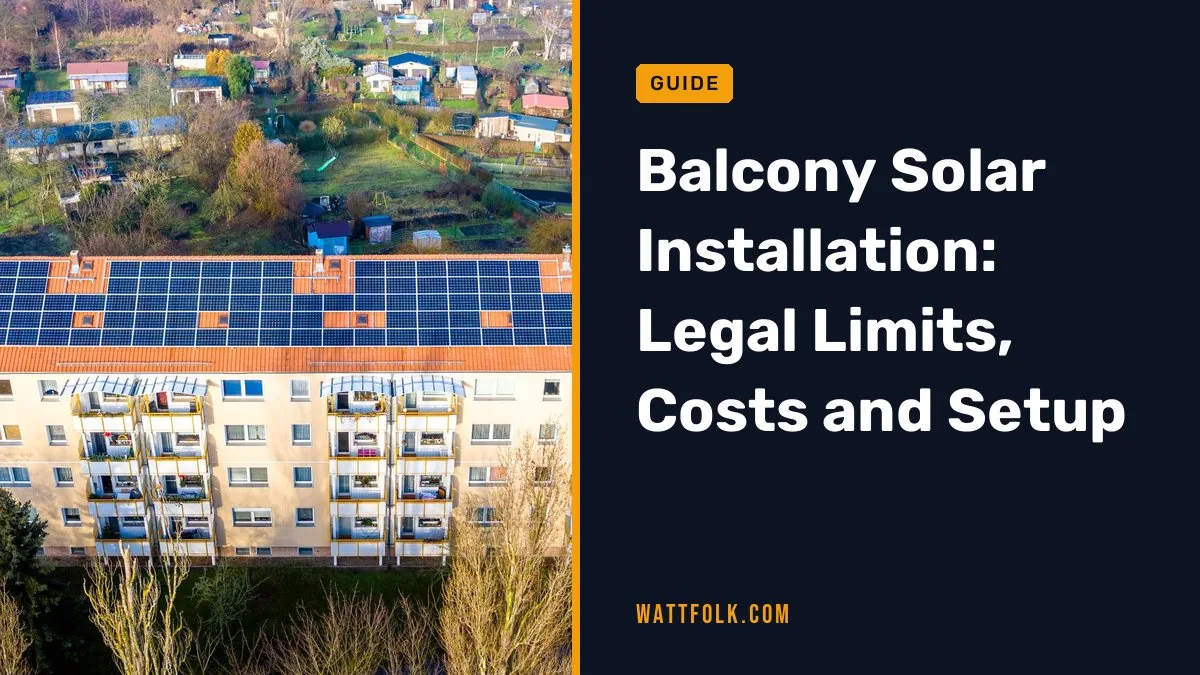
Renters, condo owners and small-home owners with a sunny balcony can cut their daytime electricity use with one or two panels and a small microinverter that plugs into a household outlet. Whether you are allowed to do it depends on where you live. Germany explicitly allows up to 800 VA of inverter output, Utah passed a small-system law in 2025, and California and the UK have no simple plug-in route yet.
Quick answer
Balcony solar feeds power into your home circuit and trims your bill, but only while the sun shines and only where local rules allow it. Check your utility and landlord first, then buy a certified kit.
- Best for renters: a clamp-on railing kit you can take with you
- Best for sunny, unshaded balconies: two panels facing south
- Skip it if: your balcony is shaded or faces north
- A kit is usually two panels plus a 600-800 W microinverter. Real output is well below the label most of the day.
- Germany has a national plug-in rule. The US and UK do not have an equivalent national rule.
- Savings come from self-consumption. Power you do not use in the moment is usually unpaid.
- Orientation, tilt and shade can change yearly output by 40% or more.
- Never use an extension cord, and never bypass the microinverter’s grid shut-off.
- What are balcony solar panels and how do they work?
- Do balcony solar panels work, and how much power do they make?
- Are balcony solar panels legal?
- Can I put solar panels on my balcony as a renter or in a condo?
- Can you put solar panels on a patio cover?
- How do I install a balcony solar system?
- Is plugging a solar inverter into a wall socket safe?
- Pre-install checklist
- What does a balcony solar kit cost?
- Are balcony solar panels worth it?
- Which setup fits you?
- Limits and alternatives
- What do owners say?
- Frequently Asked Questions
What are balcony solar panels and how do they work?
Balcony solar is a small plug-in system: one or two panels, a microinverter, a cable and mounting hardware. The panels make direct current (DC). The microinverter turns it into alternating current (AC) that matches your home’s wiring, and that power flows into the circuit it is plugged into.
A typical residential panel measures about 1.7 m x 1.1 m and is rated about 400-450 W. A balcony kit usually has two panels and a 600-800 W microinverter. Some kits add an optional battery, which raises cost and complexity.
How do balcony solar systems work with the rest of your home?
Your fridge, router and standby devices already draw power all day. When the panels produce, that power covers those loads first, so you buy less from the grid. This is called self-consumption.
If the panels make more than your home uses, the surplus flows out to the grid. Unregistered surplus is usually unpaid. That is why a steady base load matters more than the panel size.
Certified grid-tied microinverters also shut down on their own when grid power is lost. This is called anti-islanding. It protects line workers and is what makes plug-in designs acceptable. Look for UL 1741 in the US or VDE-AR-N 4105 in Germany.
Do balcony solar panels work, and how much power do they make?
Yes, they work, but the 800 W figure is a peak rating, not a typical output. A well-oriented 800 W system in central Europe typically makes roughly 600-850 kWh a year. Vertical or shaded railings make notably less, and sunnier US locations can make more.
You can redo the maths yourself: module watts x effective peak sun hours x 365 x system factor. The examples below assume 800 W of panels, 3.5 effective peak sun hours on a good south-facing balcony after shading, and a 0.75 system factor for heat, wiring and inverter losses. That gives about 765 kWh, which the table rounds to 750.
| Setup | Assumed share of best case | Illustrative yearly output |
|---|---|---|
| South-facing, tilted, no shade | 100% | about 750 kWh |
| East/west split, tilted | about 80% | about 600 kWh |
| Vertical on a railing | about 60% | about 450 kWh |
These are planning assumptions, not measurements. Your latitude, climate and nearby buildings will move them. Swap in your own peak sun hours to see your number.

Are balcony solar panels legal?
It depends on where you live, and rules are changing quickly. Germany has a clear national plug-in rule. The US and UK have no equivalent national rule. Most US and UK rules still treat grid-connected solar as needing utility approval.
| Region | Key limit | Registration | Check before you buy |
|---|---|---|---|
| Germany | Up to 800 VA inverter output and up to 2,000 W of modules (Solarpaket I, in force May 2024) | Simple entry in the Marktstammdatenregister | Certified inverter (VDE-AR-N 4105) and your meter type |
| Rest of EU | Varies by country | Varies | Your national grid operator’s rules |
| Utah | Small portable systems up to about 1,200 W (2025 law, HB 340) | No formal utility interconnection agreement | Confirm details with your utility |
| California | No simple plug-in route | Utility approval generally required | Ask your utility before buying |
| Other US states | Usually treated as grid-connected solar | Utility approval usually required | Ask your utility and local building office |
| UK | Small generators generally follow G98 | G98 notification | Plug-in kits are not an established route |
This table changes quickly. Confirm with your utility or grid operator before you buy.
Are balcony solar panels legal in California?
Not through a simple plug-in route. Grid-connected solar in California generally needs utility approval, so contact your utility before buying anything. Utah is the first US state to pass a small-system law, and other states may follow.
Are balcony solar panels legal in the UK?
There is no established plug-in route. Small generators generally follow the G98 notification process, and plug-in-to-socket kits are still under review. Do not assume a kit sold in Germany is acceptable on a UK socket.
Can I put solar panels on my balcony as a renter or in a condo?
Often yes, but you need permission, and the law has to allow the system first. Get your landlord’s consent in writing. Condo owners should read the HOA or board rules, because railings and exterior walls are often common property.
- Ask your insurer whether the panels are covered and who is liable if one falls.
- Mount without drilling using railing clamps or a freestanding stand that is weighted down. Confirm the railing can carry the load.
- Take it with you. A plug-in kit leaves with you when you move.
Can you put solar panels on a patio cover?
Sometimes. The cover must be rated to carry panel weight plus wind and snow load, and most light pergolas and aluminum covers are not. Ask the manufacturer or a structural pro before mounting anything on top.
Panels placed under a cover get little direct sun, so they will not help. A covered patio only works if the panels sit on the roof side, or on a separate stand in open sun. Tilt matters too, since a flat cover wastes some output.
How do I install a balcony solar system?
Install it in steps, starting with permission and ending with a plug-in check. Do the physical mounting carefully, because wind is the main hazard.
- Confirm legality and permission. Check your utility, landlord or HOA first.
- Pick the spot. Check shade at 9am, 12pm and 4pm.
- Choose the mount. Options are a railing mount, a wall mount, or a ground or patio stand.
- Secure the panels. Use at least two solid fixing points per panel and corrosion-resistant hardware.
- Route the cable. Keep it tied, away from sharp edges and out of puddles.
- Connect the microinverter. Plug the panel leads into it, then plug it into a suitable outlet.
Which direction and tilt work best?
In the northern hemisphere, face the panels south. East/west also works well and spreads output across the morning and evening. A tilt close to your latitude is a common starting point. Vertical railing panels make less overall but handle low winter sun better.

How much wind can a balcony take?
Each panel is about 1.9 square meters of sail, and gusts pull hard on it. Buyers often mention that railing mounts feel heavy and wind-exposed. Use rated hardware, check the railing, and secure the panel so it cannot swing free. On windy upper floors, ask the manufacturer about wind rating.
Is plugging a solar inverter into a wall socket safe?
It can be safe with a certified microinverter on a healthy circuit, but the risks are real. The main concerns are backfeed, circuit load, fire and wind.
- Backfeed: A certified microinverter stops feeding power when the grid drops. Never bypass that shut-off.
- Circuit load: An 800 W inverter pushes about 6.7 A at 120 V into the circuit. Your breaker cannot always see that, so wiring on a shared circuit can be loaded more than it appears. Put the system on a circuit with few other loads.
- Plug type: Using a standard socket plug is contested. Critics worry about exposed pins once a plug is pulled, which is part of why rules differ.
- Fire: Use only certified gear, and keep connectors dry and fully seated.
Pre-install checklist
- Permission from landlord, HOA or condo board, in writing
- Local rules checked with your utility, plus any registration or notification done
- Railing or wall rated to carry the load
- Wind exposure assessed for your floor level
- Shading checked at 9am, 12pm and 4pm
- Outlet circuit reviewed, with a licensed electrician if unsure
- Certified inverter (UL 1741 or VDE-AR-N 4105)
- Insurance question answered
What does a balcony solar kit cost?
German kit prices have fallen to roughly €300-800, which usually covers panels, a microinverter, cables and basic mounts. US pricing varies and legal options are still limited. Batteries cost extra and often lengthen payback.
Are balcony solar panels worth it?
Often yes in high-power-price areas with a sunny balcony, and less so where power is cheap. German kits often pay back in about 4-8 years at German electricity prices. Payback in cheaper-power regions is longer.
The table below uses assumptions you can change: a kit that costs $600, 85% of output used at home, and the yields from earlier. Savings are yearly kWh used x price per kWh.
| Setup | Used kWh/yr | Payback at 12 c/kWh | Payback at 18 c/kWh | Payback at 33 c/kWh |
|---|---|---|---|---|
| South-facing | about 640 | about 7.8 years | about 5.2 years | about 2.8 years |
| East/west | about 510 | about 9.8 years | about 6.5 years | about 3.6 years |
| Vertical railing | about 380 | about 13.2 years | about 8.8 years | about 4.8 years |
For example, a south-facing system uses about 640 kWh. At 18 c/kWh, that saves about $115 a year, so $600 pays back in about 5.2 years. If your base load is low, the used share falls and payback gets longer.
Which setup fits you?
If you rent and the balcony gets 4+ sun hours: use a clamp-on railing kit, with written consent and utility approval.
If you own a condo: check the HOA first, then follow the balcony route.
If you own a house with a covered patio: mount on the cover only if it is rated, or use a ground stand in open sun.
If you own a yard with open sun: a ground mount often beats a balcony for output.
If the space is shaded or north-facing, or the rules forbid it: it is a no-go.
Limits and alternatives
Balcony solar will not replace a rooftop system. It covers a small slice of daytime use and nothing at night. A battery can store surplus, but it adds cost and, in some places, extra rules.
If your balcony is unsuitable, look at a rooftop system, community solar, or a utility green power plan. Cutting your own base load, such as with efficient appliances, also helps.
What do owners say?
Owners like
- Easy to set up in an afternoon with no electrician, where it is allowed
- A visible drop in daytime baseload use and a satisfying app showing live generation
- Works for renters, who can take it with them when they move
- Low upfront cost compared with a rooftop system
Common complaints
- Output is lower than expected because of shade, a wrong angle or a north-facing balcony
- Landlord, HOA or condo board pushback and unclear rules
- Railing mounts feel heavy or wind-exposed, with concern over fixings
- Surplus power is wasted, with no payment for export
- Confusion over registration and the outlet or plug type
Summarised from owner reviews and long-term user reports; individual experiences vary.
Frequently Asked Questions
How do balcony solar panels work?
The panels turn sunlight into DC power. A microinverter converts it to AC and feeds it into your home circuit, so appliances use it before grid power. If the grid fails, a certified inverter shuts down automatically.
Can I put solar panels on my balcony?
Maybe. You need local legal clearance, permission from your landlord or HOA, and a railing or wall that can carry the load. Confirm with your utility first.
Do balcony solar panels work?
Yes, but output is modest and depends on sun, tilt and shade. A south-facing 800 W system might make roughly 600-850 kWh a year in central Europe. Vertical or shaded setups make less.
Can you put solar panels on a patio cover?
Only if the cover is structurally rated for panel weight, wind and snow. Panels under the cover get little sun, so they need to sit on top or on a separate stand.
Are balcony solar panels worth it?
They can be, especially with high power prices and a sunny south-facing spot. In the example above, payback ranged from about 2.8 years to over 13 years depending on price and orientation.
Are balcony solar panels legal in California?
There is no simple plug-in route. Grid-connected solar there generally needs utility approval, so ask your utility before you buy.
Are balcony solar panels legal in the UK?
Not through an established plug-in route. Small generators generally follow G98 notification, and plug-in kits are still under review. Check with your network operator.