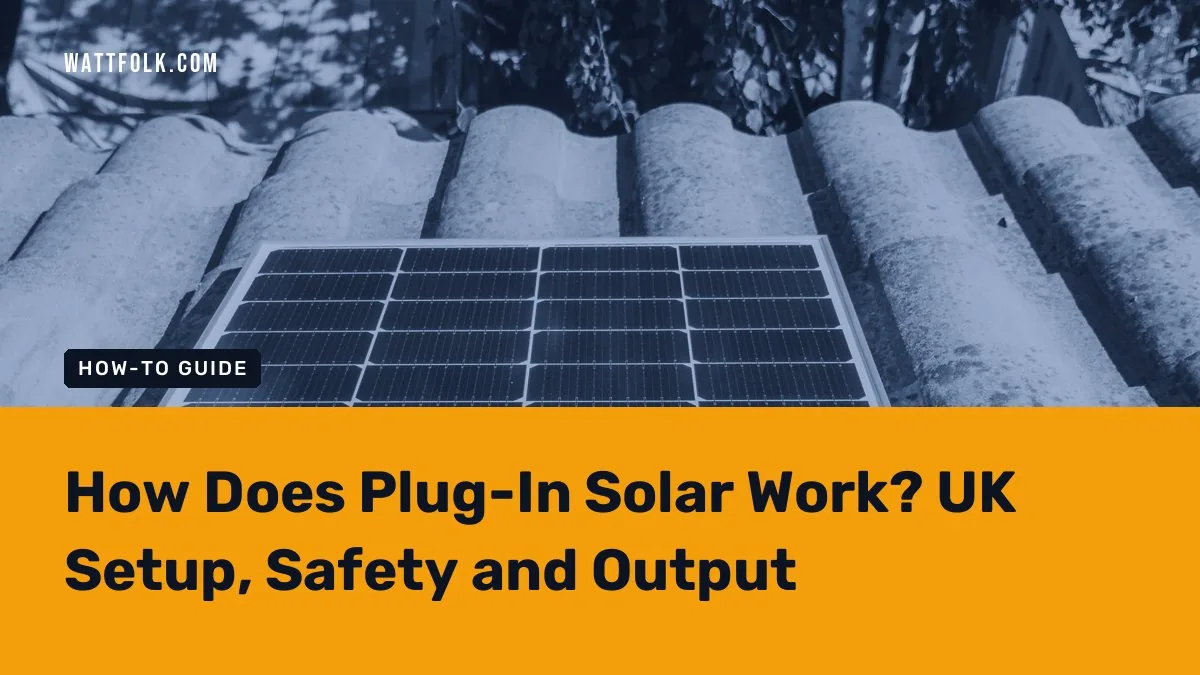
Rooftop solar needs an installer, a permit, and a large upfront bill. Plug-in solar is the small alternative: one or two panels feed a microinverter that turns DC power into AC power and pushes it into your home’s wiring through an outlet. Your appliances use that solar power first, and the grid covers whatever is left.
Quick answer
Panels make DC electricity. A microinverter converts it to 120-volt AC and matches the grid’s timing. Your home uses it before it pulls from the grid. It is grid-tied, so it shuts off in a blackout.
- Best for renters: a balcony kit you can unplug and move
- Best for backup power: a battery or portable power station
- Plug-in solar is a small grid-tied system: panel, microinverter, cable, and a household outlet circuit.
- Savings depend on self-consumption. Power you use while the sun shines saves the most money.
- It does not work in a power outage. The microinverter must shut off when the grid goes down.
- Never use extension cords. Use a proper outdoor outlet, and check your state and utility rules first.
- Typical output for a 800 W panel setup is roughly 2 to 3 kWh on a good day, based on the assumptions below.
- How does plug solar work?
- The energy path, step by step
- Can plug-in solar panels be connected to a normal outlet?
- Do plug-in solar panels power appliances directly or send electricity to the grid?
- What happens when the panels make more power than the home uses?
- What happens at night or during a power outage?
- How many watts can a plug-in solar system produce?
- Worked example: what a sunny day saves
- Is plug-in solar safe for an existing home electrical system?
- Do I need to tell my utility or hire an electrician?
- Plug-in solar vs. roof solar vs. batteries
- Installation checklist
- Frequently Asked Questions
How does plug solar work?
Plug-in solar works by turning sunlight into DC power, converting that DC to household AC with a microinverter, and feeding it into a home circuit. The home then uses that power before it draws from the grid. There is no battery in the basic setup.
Rooftop solar does the same job, but it is usually wired into the main electrical panel by a licensed installer. A plug-in kit is smaller and connects at an outlet. That is why people call it balcony solar: a railing, a patio, or a wall can hold the panels.
The energy path, step by step
Power moves in one direction through five parts. Each part has a clear job.
1. Sunlight hits the panel
↓
2. Solar panel makes DC electricity
↓
3. Microinverter converts DC to 120 V AC and syncs with the grid
↓
4. Outlet and home circuit carry the AC power into your wiring
↓
5. Appliances use it first. Any shortfall comes from the grid.
The microinverter is the key part. Panels make DC, but homes run on AC. The microinverter also watches the grid. It matches the voltage and timing of the utility’s power. If the grid drops out, it stops. That feature is called anti-islanding, and inverters sold in the US are typically tested to the UL 1741 standard for it.
Can plug-in solar panels be connected to a normal outlet?
Many plug-in kits are designed to connect to a standard 120-volt outlet, but whether that is allowed depends on your state and utility. A kit that is not approved for your area should not go into a wall outlet.
The NEC (National Electrical Code) was written with fixed, inspected installations in mind. Plug-in solar sits in a gray area in many places. Some states are changing their laws, so check current rules before you buy.
Do plug-in solar panels power appliances directly or send electricity to the grid?
Both, in a way. The microinverter puts power onto your home circuit, and electricity takes the shortest path to whatever is running nearby. Your fridge, router, and laptop charger use it first. The grid supplies any remaining demand.
This is called self-consumption. Your meter then records less grid use, so the bill drops. You do not need to switch anything on or off.
What happens when the panels make more power than the home uses?
The extra power flows back toward the grid. Whether you get paid for it depends on your utility’s net metering or export rules. Many plug-in owners should assume little or no credit.
Some meters also spin backward or register oddly with exported power. Ask your utility how your meter handles it. This is one reason to tell the utility about your system.
What happens at night or during a power outage?
At night, panels make nothing, so the grid runs your home as usual. During a blackout, plug-in solar shuts off, even in bright sun. The microinverter must stop so it does not energize lines that utility crews may be working on.
If you want power in an outage, you need a battery system or a portable power station, which are different products. Basic plug-in solar is not backup power.
How many watts can a plug-in solar system produce?
Most balcony kits are sized from about 400 W to 800 W of panel capacity. The real output is lower than the label, because of heat, wiring, inverter losses, angle, and shade.
A standard 15-amp, 120-volt circuit is rated for about 1,800 W, and continuous loads are normally kept to 80 percent of that, about 1,440 W. That limit is why small systems stay small. The wiring was built to carry power from the grid toward your outlets, not extra power from the other direction.
| Assumption | Value used |
|---|---|
| Panel capacity | 800 W |
| Peak sun hours | 4 per day (typical annual average in much of the US; the Southwest gets more, the Northeast and Pacific Northwest less) |
| System losses | 25% (so 75% of rated output reaches the outlet) |
| Electricity price | 17 cents per kWh (near the US average; state averages run from roughly 12 to 40 cents per the U.S. EIA) |
Daily output: 800 W × 4 hours × 0.75 = 2,400 Wh, or 2.4 kWh. Yearly: 2.4 × 365 = about 876 kWh. A very sunny day with 5 peak sun hours gives about 3 kWh.
Worked example: what a sunny day saves
Say your 800 W setup makes 3 kWh on a sunny day, and you pay 17 cents per kWh. What you save depends on how much power the house uses while the panels are producing.
| Scenario | Home use during sun | Solar used on site | Exported | Daily savings |
|---|---|---|---|---|
| Busy daytime home | 2 kWh | 2 kWh | 1 kWh | 2 × $0.17 = $0.34 |
| Empty daytime home | 0.5 kWh | 0.5 kWh | 2.5 kWh | 0.5 × $0.17 = $0.085 |
This example assumes exported power earns no credit, which is the cautious choice. The same panels save four times more in the first home. The difference comes from daytime demand, not from the hardware.
Now take a full year. Using 876 kWh a year with 60 percent used on site, you offset about 526 kWh. At 12 cents that is about $63, at 17 cents about $89, and at 40 cents about $210. Shade and a poor panel angle push these numbers down.
Is plug-in solar safe for an existing home electrical system?
It can be safe when the equipment is certified, the circuit is in good shape, and the install follows the maker’s instructions. It is a risk when the wiring is old, the outlet is worn, or someone uses a cord or adapter.
Older homes need extra care. Check for loose outlets, ungrounded wiring, and overloaded circuits. A licensed electrician should assess any home with aluminum wiring, a very old panel, or signs of overheating. The CPSC and NFPA both publish general electrical fire safety guidance worth reading.
What to look for in a safe setup
- Listed equipment: look for UL certification on the microinverter, with anti-islanding.
- GFCI protection: the NEC requires it on outdoor outlets at dwellings. Confirm that your inverter works with your GFCI or circuit breaker type.
- Weatherproofing: outdoor connectors and the outlet cover should be rated for wet locations.
- A dedicated or lightly loaded circuit: a heater on the same circuit leaves less margin.
- Secure mounting: panels act like sails in wind. Use the mounts the maker specifies.
Do I need to tell my utility or hire an electrician?
Often yes to both, depending on where you live. Rules for plug-in solar vary by state and are changing fast, so call your electric utility before buying, and ask whether they require notice or an interconnection agreement.
Hire a licensed electrician if you need a new outdoor outlet, a circuit check, or a panel inspection. Landlords and HOAs may also have rules about balcony equipment, so ask them in writing.
If you rent and your utility and landlord allow it, a plug-in kit is the simplest option.
If you own your home and want the most power, ask installers about rooftop solar.
If you want power during outages, add a battery system or a power station.
If your wiring is old or unclear, call an electrician first.
Plug-in solar vs. roof solar vs. batteries
| Feature | Plug-in solar | Roof solar | Battery storage |
|---|---|---|---|
| Typical output | Small, a few hundred watts | Several kilowatts | Stores power; makes none |
| Installation | Simple, but needs a safe outlet | Professional install, permits | Professional install usually |
| Backup in a blackout | No | No, unless paired with a battery | Yes, if built for backup |
| Upfront cost | Lowest | Highest for solar | High |
| Good for renters | Yes, portable | Rarely | Sometimes, as a portable unit |
Installation checklist
- Call your utility and ask about notice, interconnection, and meter rules.
- Check state law, lease terms, and HOA rules.
- Buy certified equipment with a UL-listed microinverter.
- Have an electrician inspect the circuit, outlet, and GFCI protection.
- Use a weatherproof outdoor outlet. No extension cords, power strips, or adapters.
- Mount panels securely, facing south in most of the US, with minimal shade.
- Plug in as the maker instructs and confirm the inverter starts after its grid check.
- Track output for a few weeks and compare it to your estimate.
Frequently Asked Questions
How does plug solar work?
Solar panels turn sunlight into DC electricity. A microinverter converts it to 120-volt AC and feeds it into your home circuit through an outlet. Your appliances use it first, and the grid fills any gap.
How does plugin solar work?
It is a small grid-tied system with no battery. The microinverter syncs with the utility’s power and shuts off when the grid fails. Savings come from the electricity you use while the sun shines, priced at your rate per kWh.
How does plugin solar work in my state?
The technology is the same everywhere, but the rules are not. Some states are writing laws for plug-in kits, while others have no clear rule yet. Confirm with your electric utility, and use a licensed electrician for any outlet or circuit work.